Domestic dog breeds. Particular care, treatment and behavior презентация
Содержание
- 2. The domestic dog (Canis lupus familiaris) is a subspecies of the
- 3. Most breeds of dog are at most a few hundred years
- 5. Behaviour: Dingoes tend to be nocturnal in warmer regions, but less
- 7. Dictionary: 1. free-ranging - Свободный выгул 2. Conversely - Наоборот
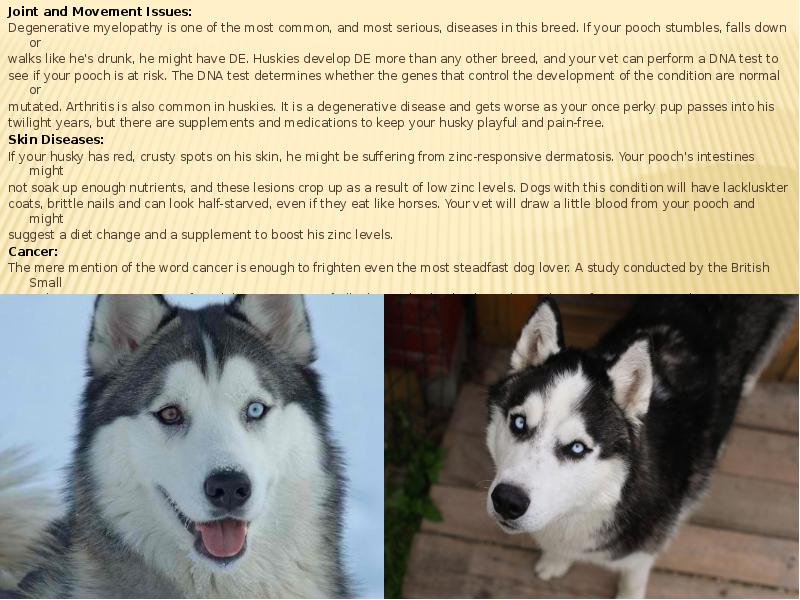
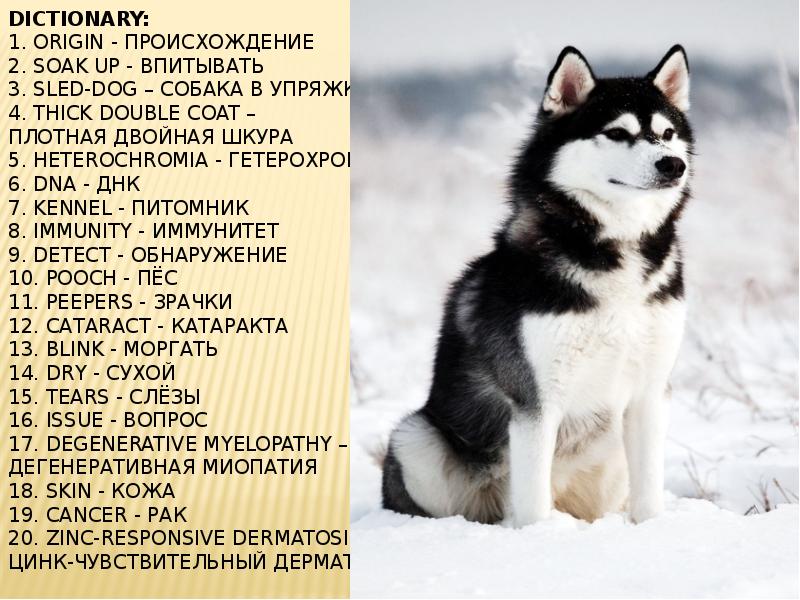
- 11. Dictionary: 1. Origin - Происхождение 2. Soak up - Впитывать 3.
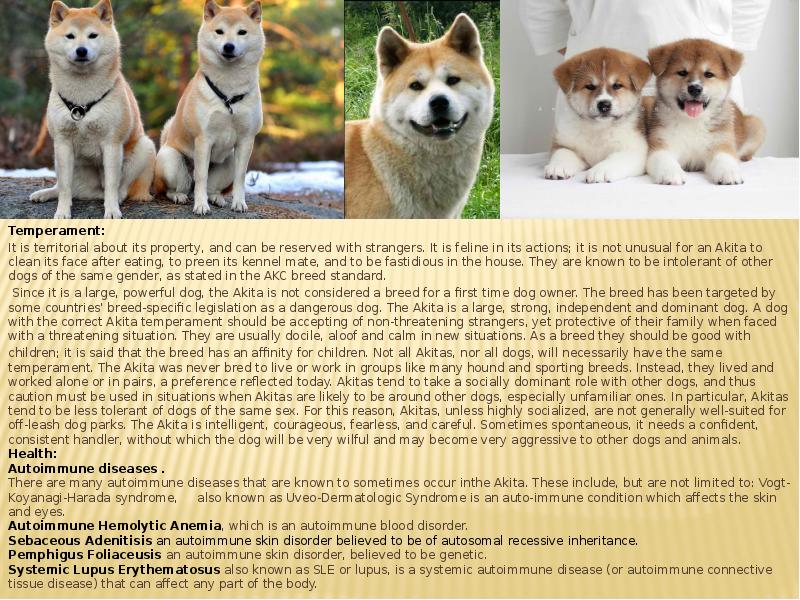
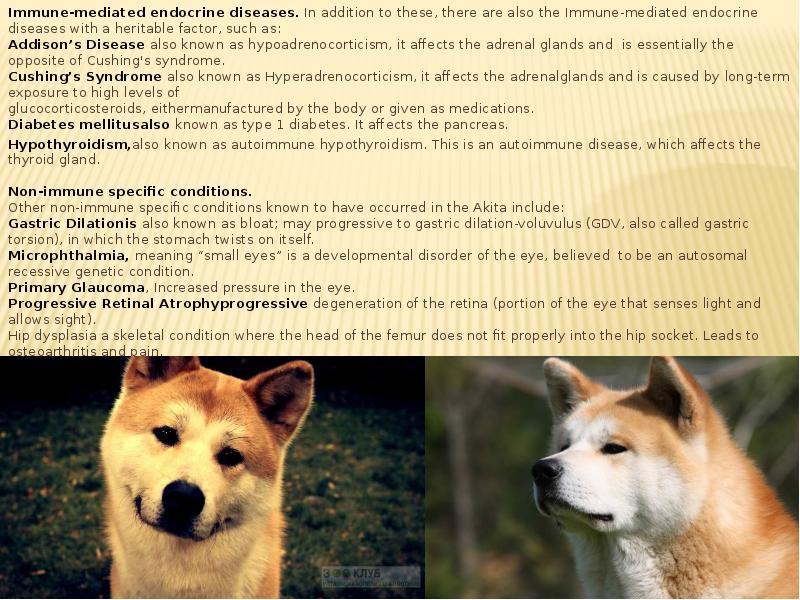
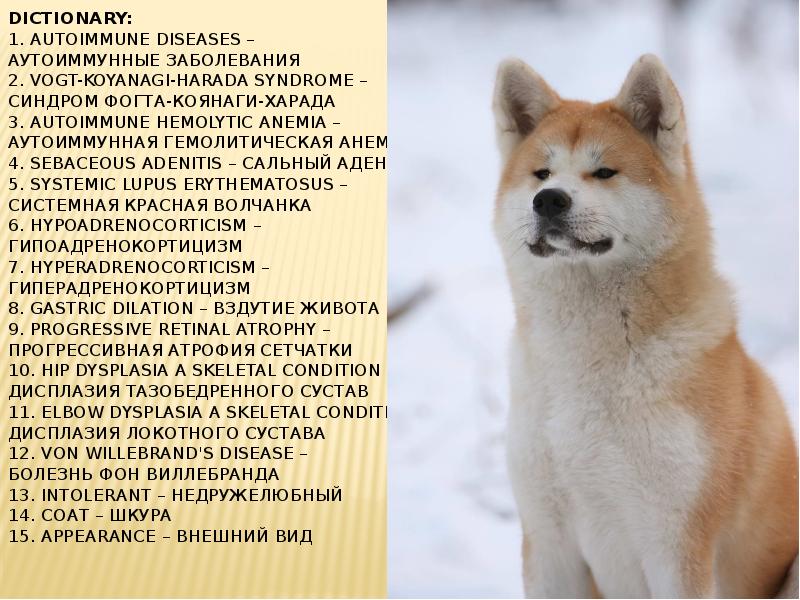
- 16. Dictionary: 1. Autoimmune diseases – Аутоиммунные заболевания 2. Vogt-Koyanagi-Harada syndrome –
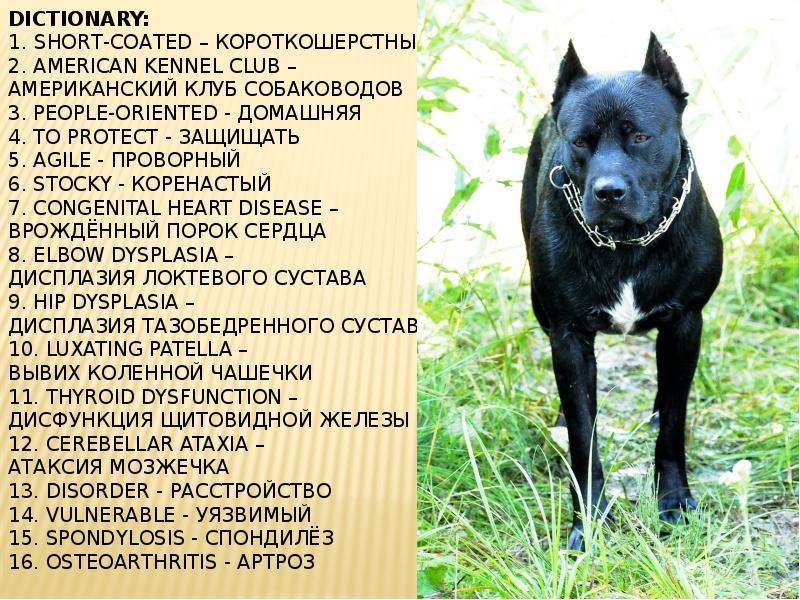
- 20. Dictionary: 1. Short-coated – Короткошерстный 2. American Kennel Club – Американский
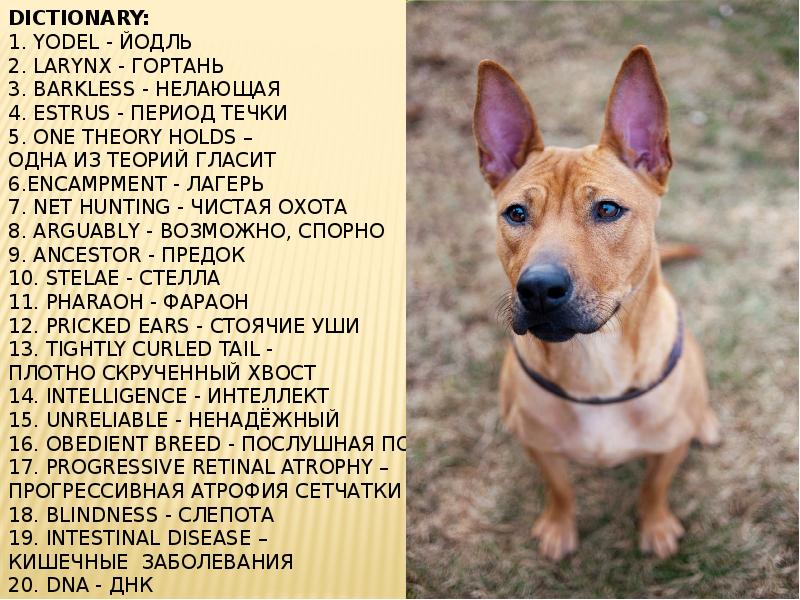
- 25. Dictionary: 1. Yodel - Йодль 2. Larynx - Гортань 3. Barkless
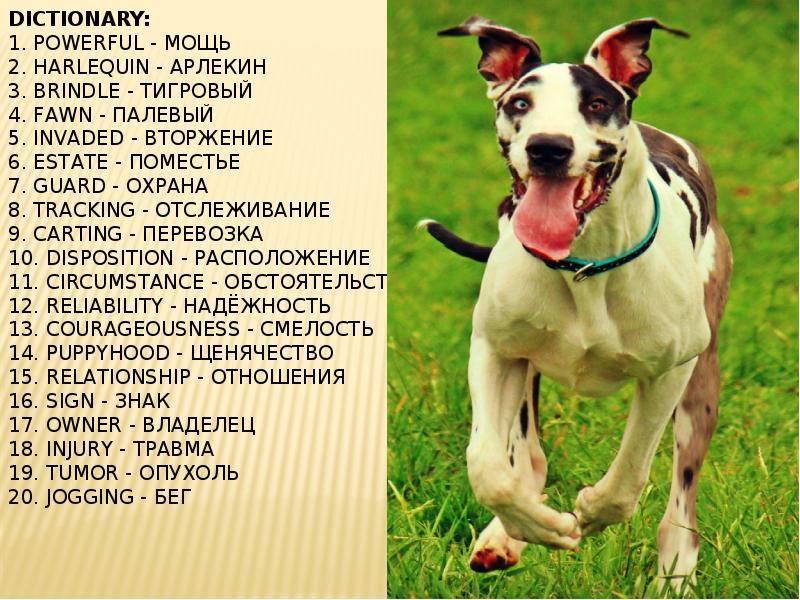
- 29. Dictionary: 1. Powerful - Мощь 2. Harlequin - Арлекин 3. Brindle
- 33. Dictionary: 1. Wedge-shaped - Клинообразная 2. Muzzle - Морда 3. Skull
- 39. Dictionary: 1. Inherited disorders – наследственные нарушения 2. Hereditary myopathy –
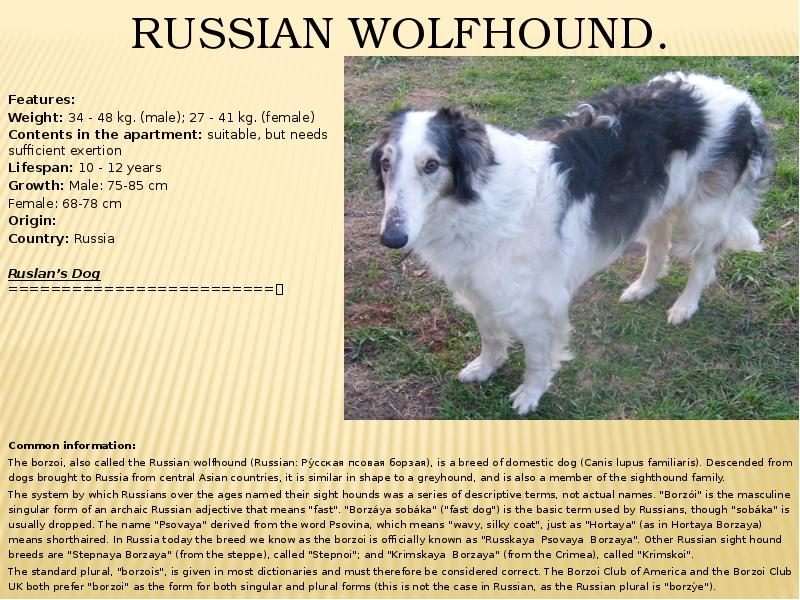
- 40. Russian Wolfhound. Features: Weight: 34 - 48 kg. (male); 27
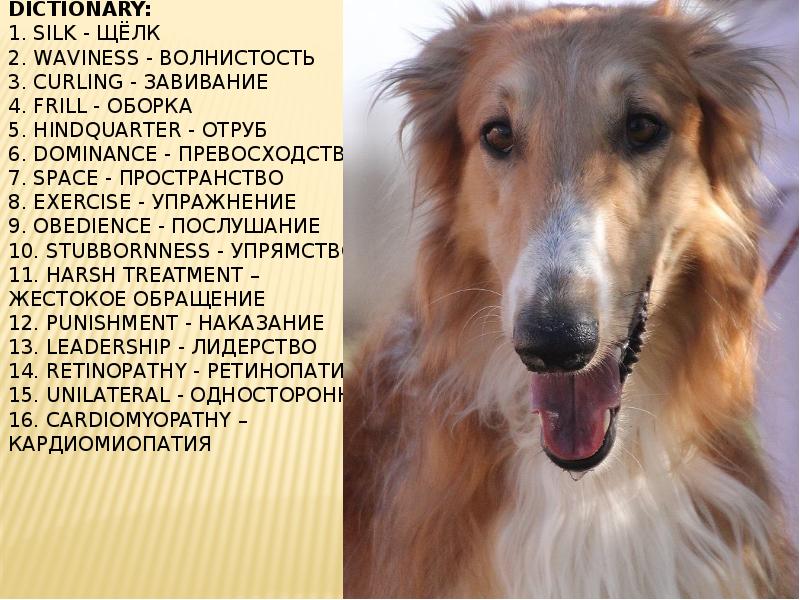
- 44. Dictionary: 1. Silk - Щёлк 2. Waviness - Волнистость 3. Curling
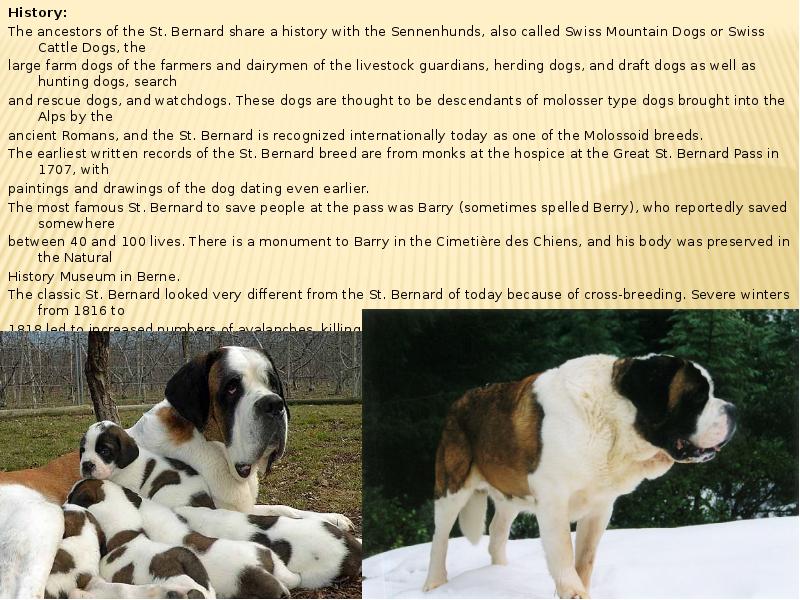
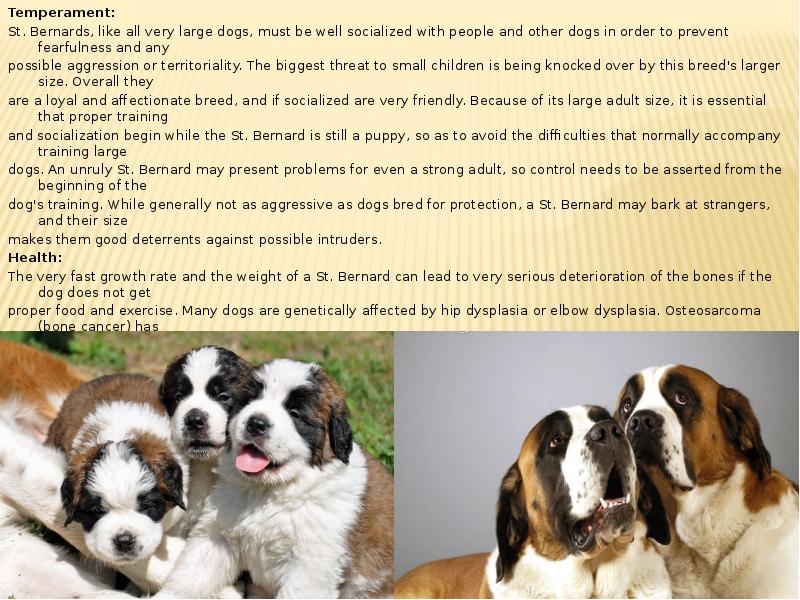
- 48. Dictionary: 1. alps - Альпы 2. Rescue - Спасение 3. Fame
- 49. Скачать презентацию









Слайды и текст этой презентации
Слайд 1
Описание слайда:
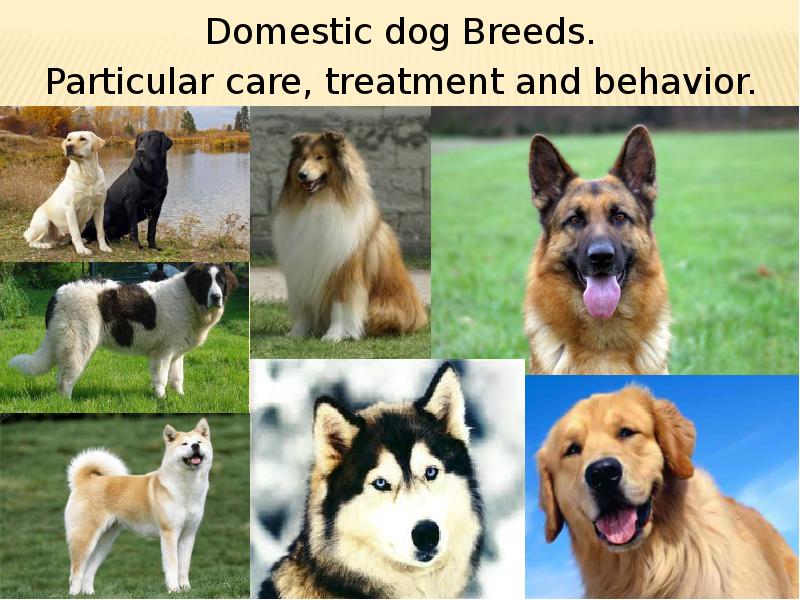
Domestic dog Breeds.
Particular care, treatment and behavior.
Слайд 2
Описание слайда:
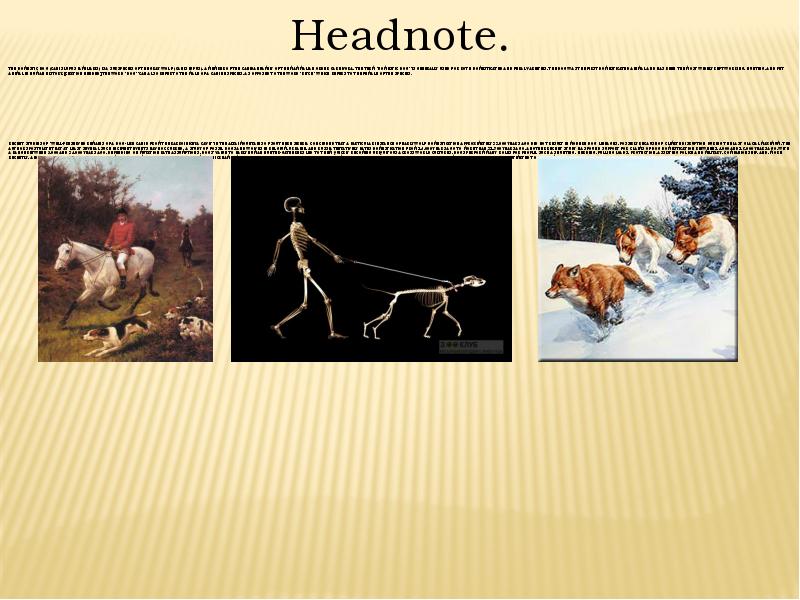
The domestic dog (Canis lupus familiaris) is a subspecies of the gray wolf (Canis lupus), a member of the Canidae family of the mammalian order Carnivora. The term "domestic dog" is generally used for both domesticated and feral varieties. The dog was the first domesticated animal and has been the most widely kept working, hunting, and pet animal in human history.[citation needed] The word "dog" can also refer to the male of a canine species, as opposed to the word "bitch" which refers to the female of the species.
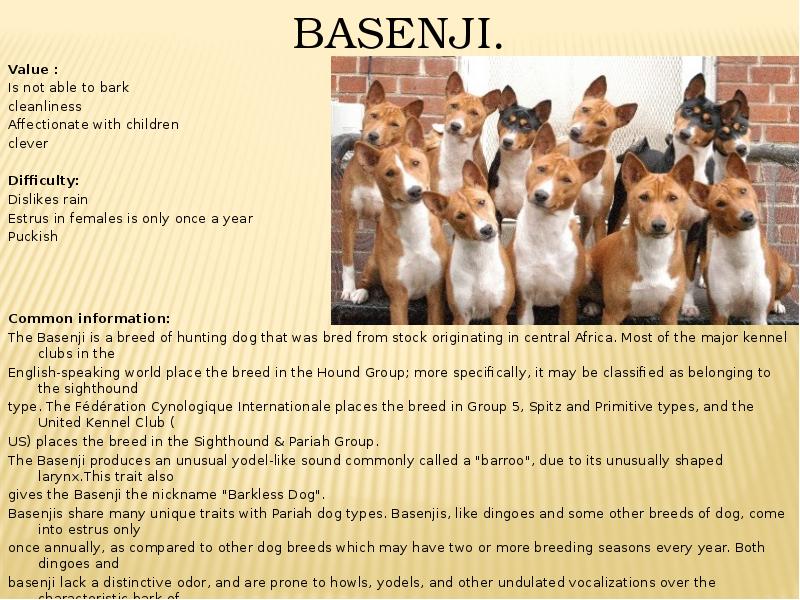
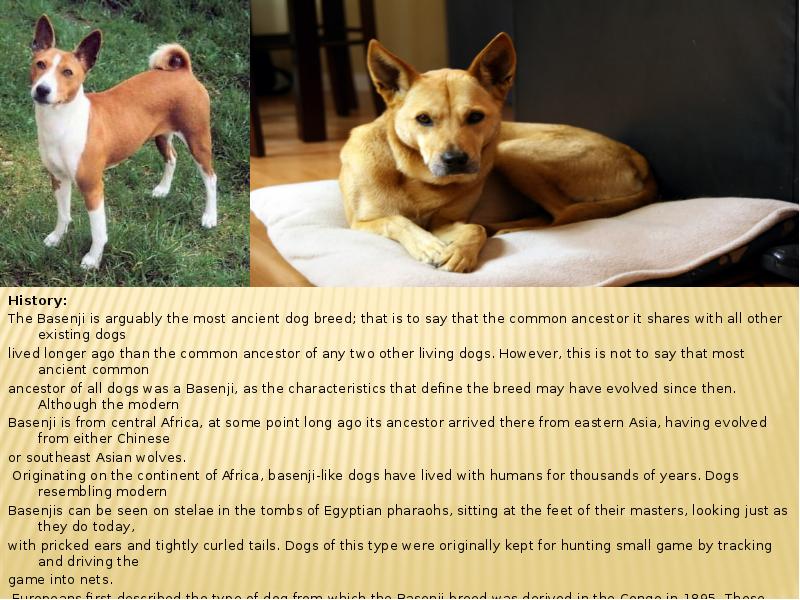
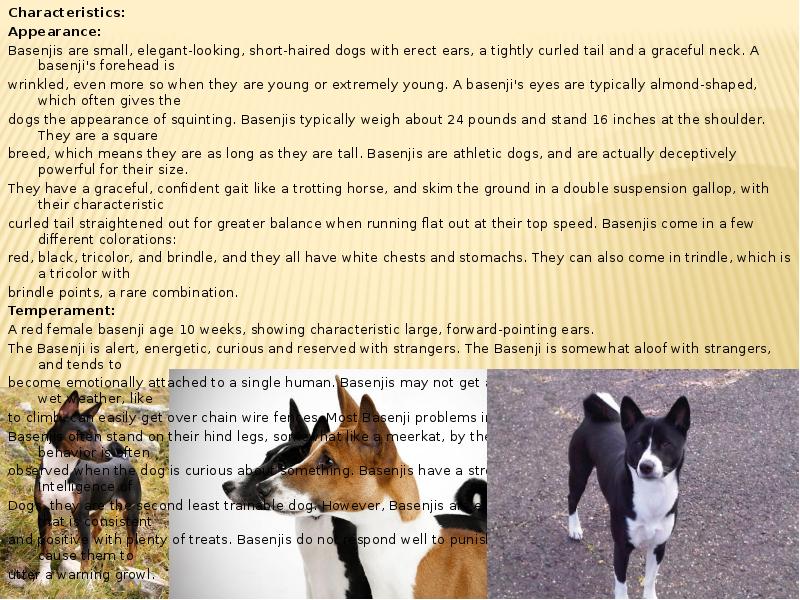
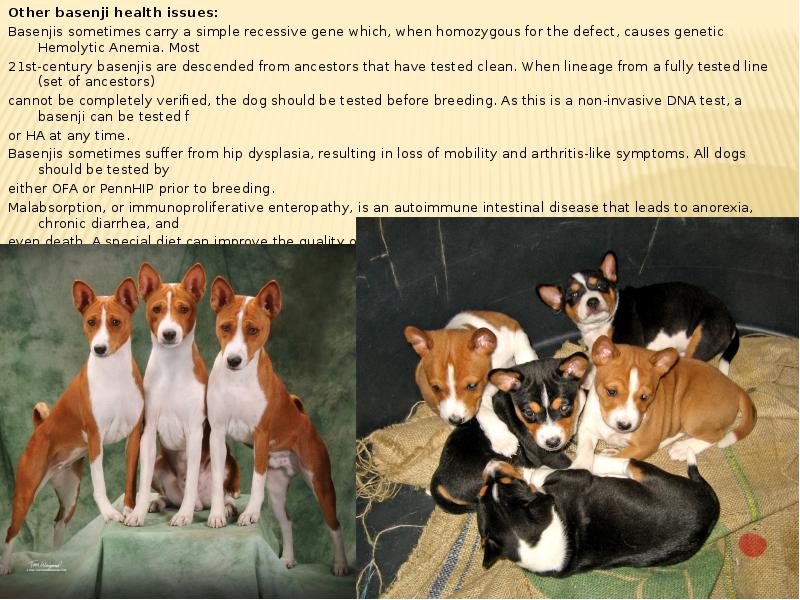
Recent studies of "well-preserved remains of a dog-like canid from the Razboinichya Cave" in the Altai Mountains of southern Siberia concluded that a particular instance of early wolf domestication approximately 33,000 years ago did not result in modern dog lineages, possibly because of climate disruption during the Last Glacial Maximum. The authors postulate that at least several such incipient events have occurred. A study of fossil dogs and wolves in Belgium, Ukraine, and Russia tentatively dates domestication from 14,000 years ago to more than 31,700 years ago. Another recent study has found support for claims of dog domestication between 14,000 and 16,000 years ago, with a range between 9,000 and 34,000 years ago, depending on mutation rate assumptions. Dogs' value to early human hunter-gatherers led to them quickly becoming ubiquitous across world cultures. Dogs perform many roles for people, such as hunting, herding, pulling loads, protection, assisting police and military, companionship, and, more recently, aiding handicapped individuals. This impact on human society has given them the nickname "man's best friend" in the Western world. In some cultures, however, dogs are also a source of meat. In 2001, there were estimated to be 400 million dogs in the world.
Headnote.
Слайд 3
Описание слайда:
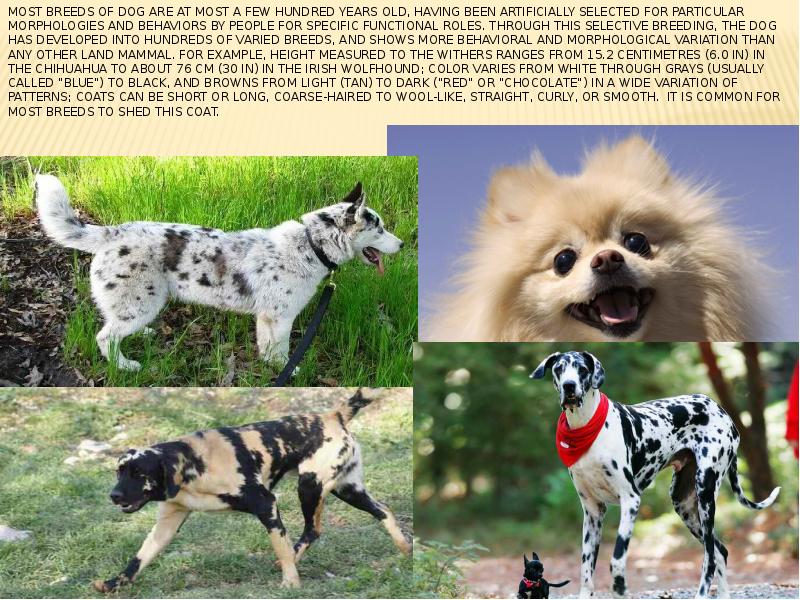
Most breeds of dog are at most a few hundred years old, having been artificially selected for particular morphologies and behaviors by people for specific functional roles. Through this selective breeding, the dog has developed into hundreds of varied breeds, and shows more behavioral and morphological variation than any other land mammal. For example, height measured to the withers ranges from 15.2 centimetres (6.0 in) in the Chihuahua to about 76 cm (30 in) in the Irish Wolfhound; color varies from white through grays (usually called "blue") to black, and browns from light (tan) to dark ("red" or "chocolate") in a wide variation of patterns; coats can be short or long, coarse-haired to wool-like, straight, curly, or smooth. It is common for most breeds to shed this coat.
Слайд 4
Описание слайда:
Слайд 5
Описание слайда:
Behaviour:
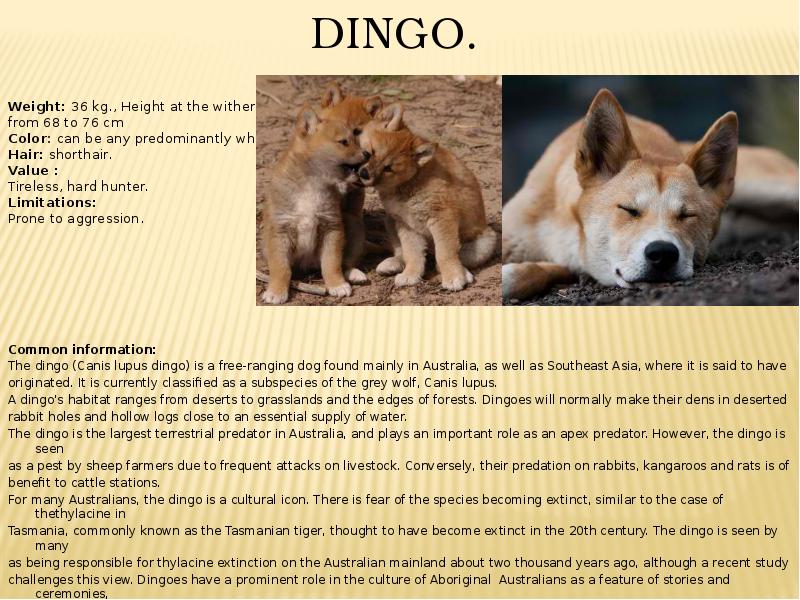
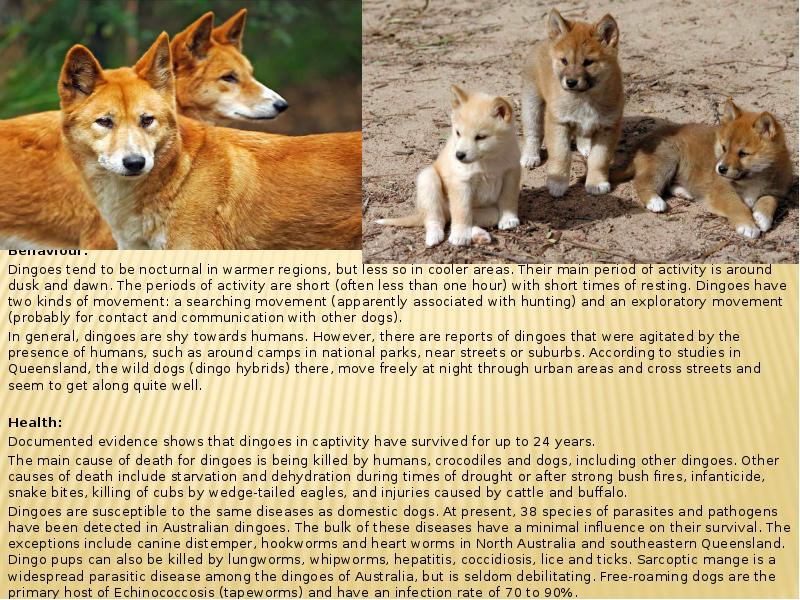
Dingoes tend to be nocturnal in warmer regions, but less so in cooler areas. Their main period of activity is around dusk and dawn. The periods of activity are short (often less than one hour) with short times of resting. Dingoes have two kinds of movement: a searching movement (apparently associated with hunting) and an exploratory movement (probably for contact and communication with other dogs).
In general, dingoes are shy towards humans. However, there are reports of dingoes that were agitated by the presence of humans, such as around camps in national parks, near streets or suburbs. According to studies in Queensland, the wild dogs (dingo hybrids) there, move freely at night through urban areas and cross streets and seem to get along quite well.
Health:
Documented evidence shows that dingoes in captivity have survived for up to 24 years.
The main cause of death for dingoes is being killed by humans, crocodiles and dogs, including other dingoes. Other causes of death include starvation and dehydration during times of drought or after strong bush fires, infanticide, snake bites, killing of cubs by wedge-tailed eagles, and injuries caused by cattle and buffalo.
Dingoes are susceptible to the same diseases as domestic dogs. At present, 38 species of parasites and pathogens have been detected in Australian dingoes. The bulk of these diseases have a minimal influence on their survival. The exceptions include canine distemper, hookworms and heart worms in North Australia and southeastern Queensland. Dingo pups can also be killed by lungworms, whipworms, hepatitis, coccidiosis, lice and ticks. Sarcoptic mange is a widespread parasitic disease among the dingoes of Australia, but is seldom debilitating. Free-roaming dogs are the primary host of Echinococcosis (tapeworms) and have an infection rate of 70 to 90%.
Слайд 6
Описание слайда:
Слайд 7
Описание слайда:
Dictionary:
1. free-ranging - Свободный выгул
2. Conversely - Наоборот
3. Livestock - Животноводство
4. Predator - Хищник
5. Shy - Застенчивый
6. Hybrid - Гибрид
7. Urban - Городской
8. Domestic - Домашний
9. Starvation - Голод
10. Dehydration - Обезвоживание
11. Infanticide - Детоубийство
12. Snakebite – Укус змеи
13. Hookworms - Анкилостомы
14. Heart worms–Сердечные черви
15. LungwormSticks –
Лёгочные палочки
16. Lice - Вши
17. Coccidiosis - Кокцидоз
18. Hepatitis - Гепатит
19. Whipworms -Власоглав
20. Native animal – Дикое животное
Слайд 8
Описание слайда:
Слайд 9
Описание слайда:
Слайд 10
Описание слайда:
Слайд 11
Описание слайда:
Dictionary:
1. Origin - Происхождение
2. Soak up - Впитывать
3. Sled-dog – Собака в упряжке
4. Thick double coat –
Плотная двойная шкура
5. Heterochromia - Гетерохромия
6. DNA - ДНК
7. Kennel - Питомник
8. Immunity - Иммунитет
9. Detect - Обнаружение
10. Pooch - Пёс
11. Peepers - Зрачки
12. Cataract - Катаракта
13. Blink - Моргать
14. Dry - Сухой
15. Tears - Слёзы
16. Issue - Вопрос
17. Degenerative myelopathy –
Дегенеративная Миопатия
18. Skin - Кожа
19. Cancer - Рак
20. Zinc-responsive dermatosis –
Цинк-чувствительный дерматоз
Слайд 12
Описание слайда:
Слайд 13
Описание слайда:
Слайд 14
Описание слайда:
Слайд 15
Описание слайда:
Слайд 16
Описание слайда:
Dictionary:
1. Autoimmune diseases –
Аутоиммунные заболевания
2. Vogt-Koyanagi-Harada syndrome –
Синдром Фогта-Коянаги-Харада
3. Autoimmune Hemolytic Anemia –
Аутоиммунная гемолитическая анемия
4. Sebaceous Adenitis – Сальный адентит
5. Systemic Lupus Erythematosus –
Системная красная волчанка
6. Hypoadrenocorticism –
Гипоадренокортицизм
7. Hyperadrenocorticism –
Гиперадренокортицизм
8. Gastric Dilation – Вздутие живота
9. Progressive Retinal Atrophy –
Прогрессивная атрофия сетчатки
10. Hip dysplasia a skeletal condition –
Дисплазия тазобедренного сустав
11. Elbow dysplasia a skeletal condition –
Дисплазия локотного сустава
12. Von Willebrand's Disease –
Болезнь фон Виллебранда
13. Intolerant – Недружелюбный
14. Coat – Шкура
15. Appearance – Внешний вид
Слайд 17
Описание слайда:
Слайд 18
Описание слайда:
Слайд 19
Описание слайда:
Слайд 20
Описание слайда:
Dictionary:
1. Short-coated – Короткошерстный
2. American Kennel Club –
Американский Клуб Собаководов
3. People-oriented - Домашняя
4. To protect - Защищать
5. Agile - Проворный
6. Stocky - Коренастый
7. Congenital heart disease –
Врождённый порок сердца
8. Elbow dysplasia –
Дисплазия локтевого сустава
9. Hip dysplasia –
Дисплазия тазобедренного сустава
10. Luxating patella –
Вывих коленной чашечки
11. Thyroid dysfunction –
Дисфункция щитовидной железы
12. Cerebellar ataxia –
Атаксия мозжечка
13. Disorder - Расстройство
14. Vulnerable - Уязвимый
15. Spondylosis - Спондилёз
16. Osteoarthritis - Артроз
Слайд 21
Описание слайда:
Слайд 22
Описание слайда:
Слайд 23
Описание слайда:
Слайд 24
Описание слайда:
Слайд 25
Описание слайда:
Dictionary:
1. Yodel - Йодль
2. Larynx - Гортань
3. Barkless - Нелающая
4. Estrus - Период течки
5. One theory holds –
Одна из теорий гласит
6.Encampment - Лагерь
7. Net hunting - Чистая охота
8. Arguably - Возможно, спорно
9. Ancestor - Предок
10. Stelae - Стелла
11. Pharaoh - Фараон
12. Pricked ears - Стоячие уши
13. Tightly curled tail -
Плотно скрученный хвост
14. Intelligence - Интеллект
15. Unreliable - Ненадёжный
16. Obedient breed - Послушная порода
17. Progressive retinal atrophy –
Прогрессивная атрофия сетчатки
18. Blindness - Слепота
19. intestinal disease –
кишечные Заболевания
20. DNA - ДНК
Слайд 26
Описание слайда:
Слайд 27
Описание слайда:
Слайд 28
Описание слайда:
Слайд 29
Описание слайда:
Dictionary:
1. Powerful - Мощь
2. Harlequin - Арлекин
3. Brindle - Тигровый
4. Fawn - Палевый
5. Invaded - Вторжение
6. Estate - Поместье
7. Guard - Охрана
8. Tracking - Отслеживание
9. Carting - Перевозка
10. Disposition - Расположение
11. Circumstance - Обстоятельство
12. Reliability - Надёжность
13. Courageousness - Смелость
14. Puppyhood - Щенячество
15. Relationship - Отношения
16. Sign - Знак
17. Owner - Владелец
18. Injury - Травма
19. Tumor - Опухоль
20. Jogging - Бег
Слайд 30
Описание слайда:
Слайд 31
Описание слайда:
Слайд 32
Описание слайда:
Слайд 33
Описание слайда:
Dictionary:
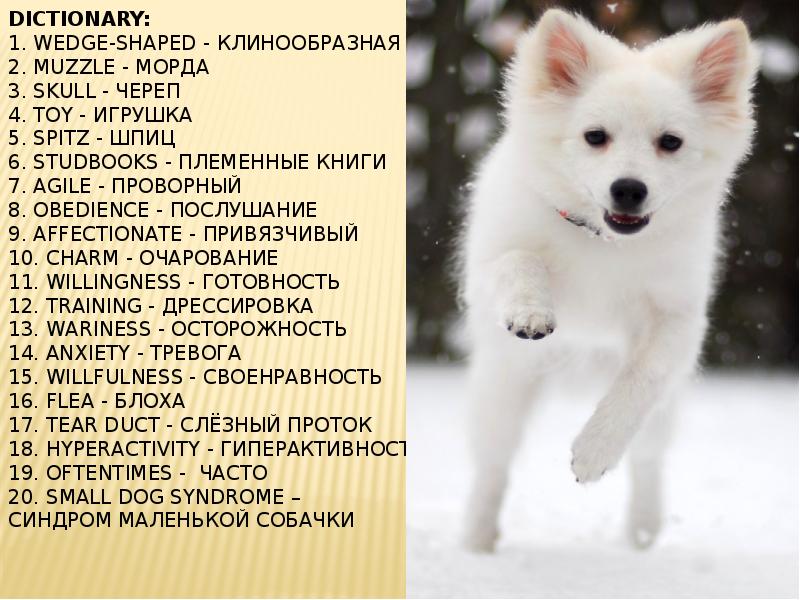
1. Wedge-shaped - Клинообразная
2. Muzzle - Морда
3. Skull - Череп
4. Toy - Игрушка
5. Spitz - Шпиц
6. Studbooks - Племенные книги
7. Agile - Проворный
8. Obedience - Послушание
9. Affectionate - Привязчивый
10. Charm - Очарование
11. Willingness - Готовность
12. Training - Дрессировка
13. Wariness - Осторожность
14. Anxiety - Тревога
15. Willfulness - Своенравность
16. Flea - Блоха
17. Tear duct - Слёзный проток
18. Hyperactivity - Гиперактивность
19. Oftentimes - Часто
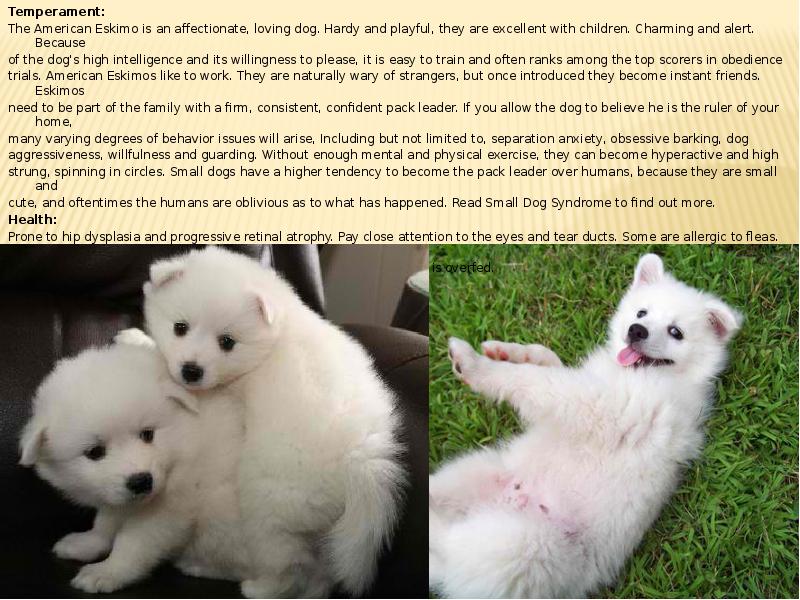
20. Small Dog Syndrome –
Синдром маленькой собачки
Слайд 34
Описание слайда:
Слайд 35
Описание слайда:
Слайд 36
Описание слайда:
Слайд 37
Описание слайда:
Слайд 38
Описание слайда:
Слайд 39
Описание слайда:
Dictionary:
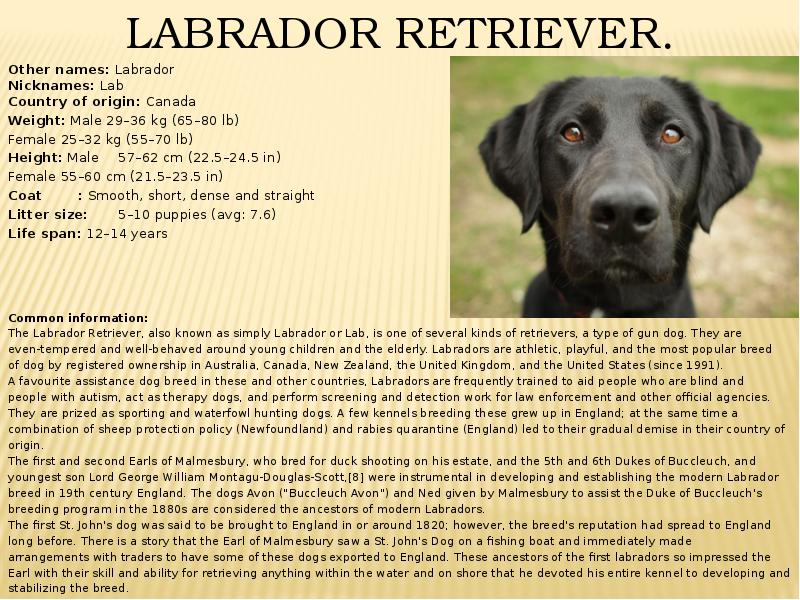
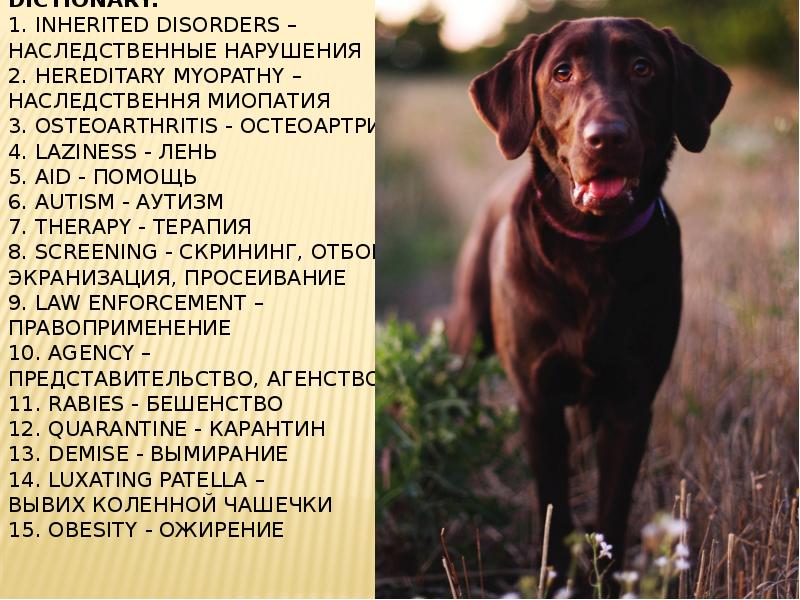
1. Inherited disorders –
наследственные нарушения
2. Hereditary myopathy –
наследствення миопатия
3. Osteoarthritis - остеоартрит
4. Laziness - лень
5. Aid - Помощь
6. Autism - Аутизм
7. Therapy - Терапия
8. Screening - Скрининг, отбор,
экранизация, просеивание
9. Law enforcement –
Правоприменение
10. Agency –
Представительство, агенство
11. Rabies - Бешенство
12. Quarantine - Карантин
13. Demise - Вымирание
14. Luxating patella –
Вывих коленной чашечки
15. Obesity - Ожирение
Слайд 40
Описание слайда:
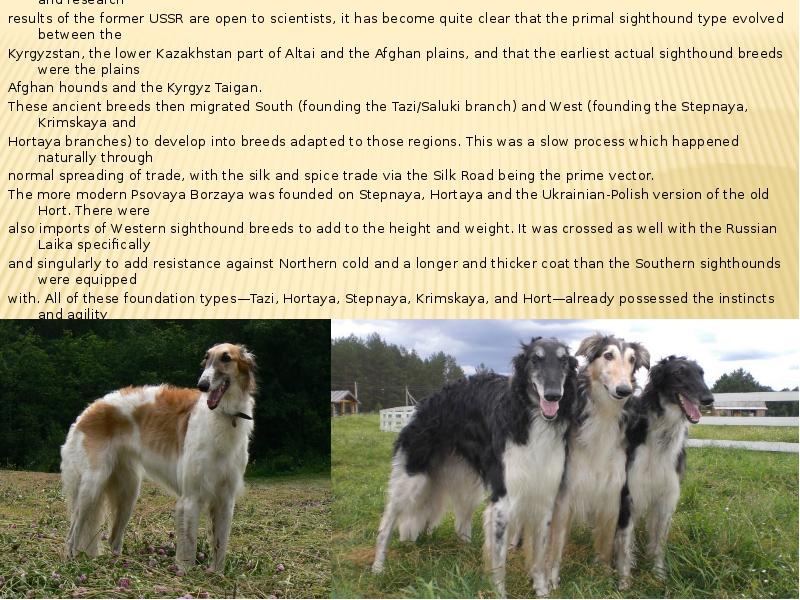
Russian Wolfhound.
Features:
Weight: 34 - 48 kg. (male); 27 - 41 kg. (female)
Contents in the apartment: suitable, but needs sufficient exertion
Lifespan: 10 - 12 years
Growth: Male: 75-85 cm
Female: 68-78 cm
Origin:
Country: Russia
Ruslan’s Dog =========================
Слайд 41
Описание слайда:
Слайд 42
Описание слайда:
Слайд 43
Описание слайда:
Слайд 44
Описание слайда:
Dictionary:
1. Silk - Щёлк
2. Waviness - Волнистость
3. Curling - Завивание
4. Frill - Оборка
5. Hindquarter - Отруб
6. Dominance - Превосходство
7. Space - Пространство
8. Exercise - Упражнение
9. Obedience - Послушание
10. Stubbornness - Упрямство
11. Harsh treatment –
Жестокое обращение
12. Punishment - Наказание
13. Leadership - Лидерство
14. Retinopathy - Ретинопатия
15. Unilateral - Односторонний
16. Cardiomyopathy –
Кардиомиопатия
Слайд 45
Описание слайда:
Слайд 46
Описание слайда:
Слайд 47
Описание слайда:
Слайд 48
Описание слайда:
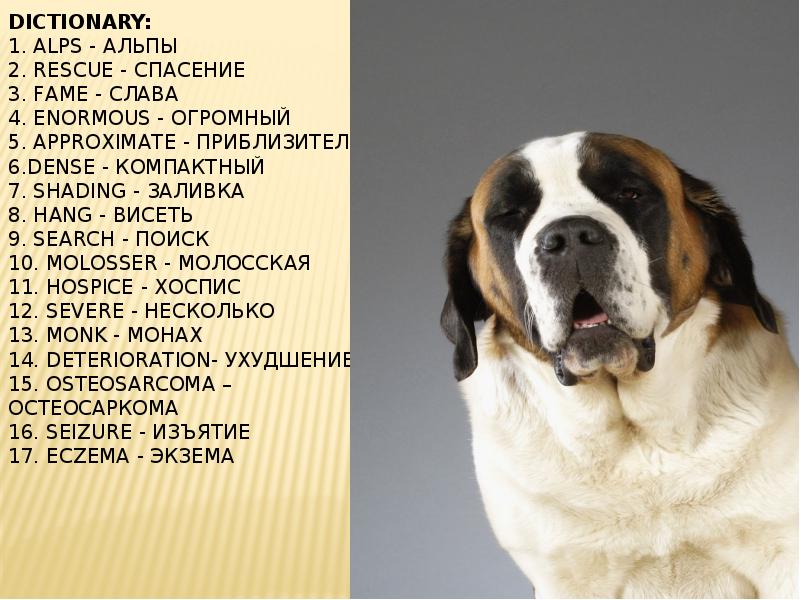
Dictionary:
1. alps - Альпы
2. Rescue - Спасение
3. Fame - Слава
4. Enormous - Огромный
5. Approximate - Приблизительно
6.Dense - Компактный
7. Shading - Заливка
8. Hang - Висеть
9. Search - Поиск
10. Molosser - Молосская
11. Hospice - Хоспис
12. Severe - Несколько
13. Monk - Монах
14. Deterioration- Ухудшение
15. Osteosarcoma –
Остеосаркома
16. Seizure - Изъятие
17. Eczema - Экзема
Скачать презентацию на тему Domestic dog breeds. Particular care, treatment and behavior можно ниже: