Middle English Dialects: Kentish, West Midland, Northern, South Western, презентация
Содержание
- 2. The dialectal position of Middle English is basically a continuation of
- 3. Kentish Kentish was originally spoken over the whole southeastern part of
- 4. West Midland In the West Midlands there is a gradation of dialect
- 5. Northern This dialect is the continuation of the Northumbrian variant of
- 6. South Western SOUTHERN West Saxon is the forerunner of this dialect
- 7. East Midland This is the dialect out of which the later
- 9. Скачать презентацию
Слайды и текст этой презентации
Слайд 1
Описание слайда:
Middle English Dialects: Kentish, West Midland, Northern, South Western, Scottish, London
Слайд 2
Описание слайда:
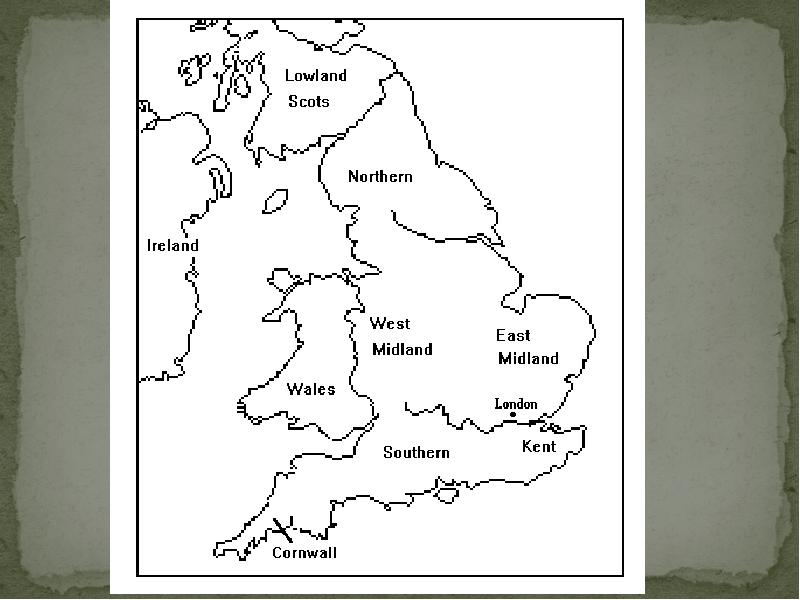
The dialectal position of Middle English is basically a continuation of that of Old English. The most important extralinguistic fact for the development of the Middle English dialects is that the capital of the country was moved from Winchester (in the Old English period) to London by William the Conqueror in his attempt to diminish the political influence of the native English.
The dialectal position of Middle English is basically a continuation of that of Old English. The most important extralinguistic fact for the development of the Middle English dialects is that the capital of the country was moved from Winchester (in the Old English period) to London by William the Conqueror in his attempt to diminish the political influence of the native English.
Слайд 3
Описание слайда:
Kentish
Kentish was originally spoken over the whole southeastern part of England, including London and Essex, but during the Middle English period its area was steadily diminished by the encroachment of the East Midland dialect, especially after London became an East Midland-speaking city; in late Middle English the Kentish dialect was confined to Kent and Sussex. In the Early Modern period, after the London dialect had begun to replace the dialects of neighboring areas, Kentish died out, leaving no descendants. Kentish is interesting to linguists because on the one hand its sound system shows distinctive innovations (already in the Old English period), but on the other its syntax and verb inflection are extremely conservative; as late as 1340, Kentish syntax is still virtually identical with Old English syntax.
Слайд 4
Описание слайда:
West Midland
In the West Midlands there is a gradation of dialect peculiarities from Northern to Southern as one moves from Lancashire to Cheshire and then down the Severn valley. This dialect has left modern descendants in the working- class country dialects of the area.
This is the most conservative of the dialect areas in the Middle English period and is fairly well-documented in literary works.
Слайд 5
Описание слайда:
Northern
This dialect is the continuation of the Northumbrian variant of Old English. Note that by Middle English times English had spread to (Lowland) Scotland and indeed led to a certain literary tradition developing there at the end of the Middle English period which has been continued up to the present time (with certain breaks, admittedly).
Слайд 6
Описание слайда:
South Western
SOUTHERN West Saxon is the forerunner of this dialect of Middle English. Note that the area covered in the Middle English period is greater than in the Old English period as inroads were made into Celtic-speaking Cornwall. This area becomes linguistically uninteresting in the Middle English period. It shares some features of both Kentish and West Midland dialects.
Слайд 7
Описание слайда:
East Midland
This is the dialect out of which the later standard developed. To be precise the standard arose out of the London dialect of the late Middle English period. Note that the London dialect naturally developed into what is called Cockney today while the standard became less and less characteristic of a certain area and finally (after the 19th century) became the sociolect which is termed Received Pronunciation.
Слайд 8
Описание слайда:
Скачать презентацию на тему Middle English Dialects: Kentish, West Midland, Northern, South Western, можно ниже: