Scottish, Irish, Welsh Englishes презентация
Содержание
- 2. Scottish English Scottish English is also know as Scottish Standard English.
- 3. The history In reality, Scottish English was born from a soft
- 4. The Particularities of Scottish English As we said before, there’s
- 5. Typically, Scots use “laddie” (lad + ie) to mean “young boy”
- 6. The term “how” is another one of Scottish English’s peculiarities. The
- 7. How to speak with scotish accent 1. Replace "o’s" with "ae"
- 8. How to speak with scotish accent 3. Play with the glottal
- 9. Irish English is the set of English dialects natively written and
- 10. How to speak with Irish accent Soften your vowels. Many people,
- 11. How to speak with Irish accent Harden your consonants. As a general
- 12. How to speak with Irish accent Drop your G's. English is full
- 13. Welsh Englishes the dialects are significantly influenced by Welsh grammar and
- 14. How to speak with welsh accent 1. Stretch out vowels and
- 15. How to speak with welsh accent 3. Slur certain letters. Some
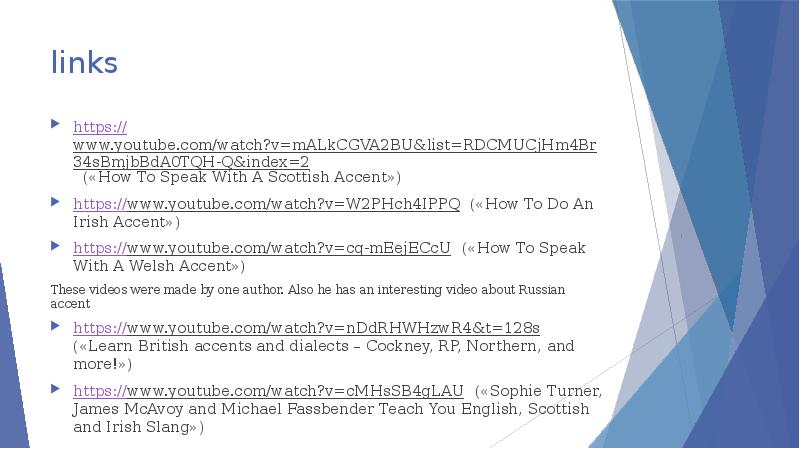
- 16. links https://www.youtube.com/watch?v=mALkCGVA2BU&list=RDCMUCjHm4Br34sBmjbBdA0TQH-Q&index=2 («How To Speak With A Scottish Accent») https://www.youtube.com/watch?v=W2PHch4IPPQ («How
- 17. Скачать презентацию
Слайды и текст этой презентации
Слайд 1
Описание слайда:
Scottish, Irish, Welsh Englishes
Stryapunina Vika
Слайд 2
Описание слайда:
Scottish English
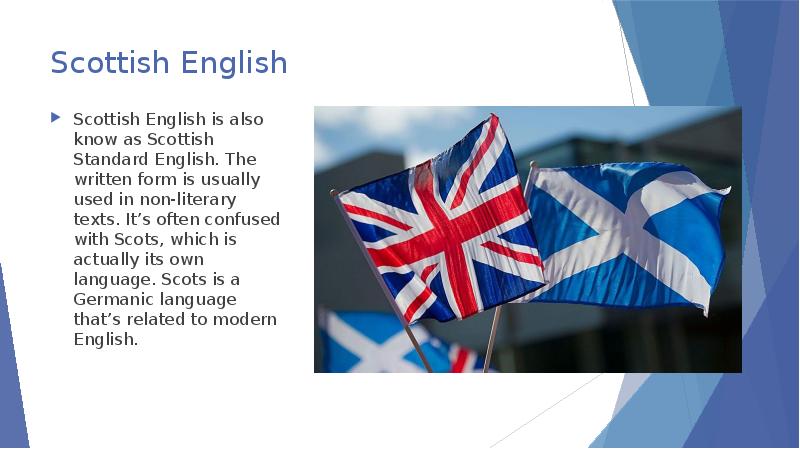
Scottish English is also know as Scottish Standard English. The written form is usually used in non-literary texts. It’s often confused with Scots, which is actually its own language. Scots is a Germanic language that’s related to modern English.
Слайд 3
Описание слайда:
The history
In reality, Scottish English was born from a soft mix between English and Scots. It came about during the 17th century when the language underwent a number of linguistic changes. After the union with England in 1707, Scottish transformed while remaining autonomous. This independence helped created the languages identity, which ties in with the culture.
Whether it’s the phonology, the semantics, punctuation, or even the grammar, this type of English has contributed to how the people of Scotland express themselves. However, there are different variants of Scottish English from region to region. There are different types of Scottish English in the Highlands, the Lowlands, Glasgow, Edinburgh, etc.
The population of Scotland has increased by 30,000 in twenty years. This is a good reason to learn more about the country and its language.
Слайд 4
Описание слайда:
The Particularities of Scottish English
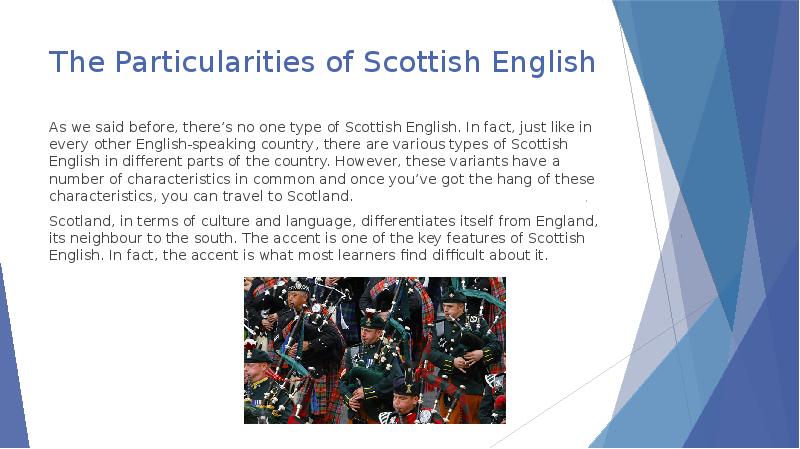
As we said before, there’s no one type of Scottish English. In fact, just like in every other English-speaking country, there are various types of Scottish English in different parts of the country. However, these variants have a number of characteristics in common and once you’ve got the hang of these characteristics, you can travel to Scotland.
Scotland, in terms of culture and language, differentiates itself from England, its neighbour to the south. The accent is one of the key features of Scottish English. In fact, the accent is what most learners find difficult about it.
Слайд 5
Описание слайда:
Typically, Scots use “laddie” (lad + ie) to mean “young boy” and “lassie” (lass + ie) to mean “young girl”. You’ll also notice that instead of saying “small”, Scots will use the word “wee”.
Typically, Scots use “laddie” (lad + ie) to mean “young boy” and “lassie” (lass + ie) to mean “young girl”. You’ll also notice that instead of saying “small”, Scots will use the word “wee”.
These are the kind of things that you probably won’t learn in English but you will learn by travelling to Scotland or learning with a private tutor. In terms of pronunciation, unlike other variants of British English, the terms “cot” and “caught” are pronounced the same in Scotland. In linguistics, this is known as the cot-caught merger and is more common in American English than in varieties of British English.
Unlike in England where the letter "r" isn't often pronounced after a vowel, speakers of Scottish English will pronounce the letter "r" wherever it's found in a word, even after a vowel. Additionally, just like the stereotype, the “r” in Scottish English is sometimes rolled. However, this isn't as common as you'd think as it's usually an alveolar tap with the tongue hitting the roof of the mouth once rather than an alveolar trill, which produces the common rolled sound.
Слайд 6
Описание слайда:
The term “how” is another one of Scottish English’s peculiarities. The term is often used as a replacement for “why” in Scotland, Ireland, and northern England. Even the queen of England would be a bit lost with some of these changes.
The term “how” is another one of Scottish English’s peculiarities. The term is often used as a replacement for “why” in Scotland, Ireland, and northern England. Even the queen of England would be a bit lost with some of these changes.
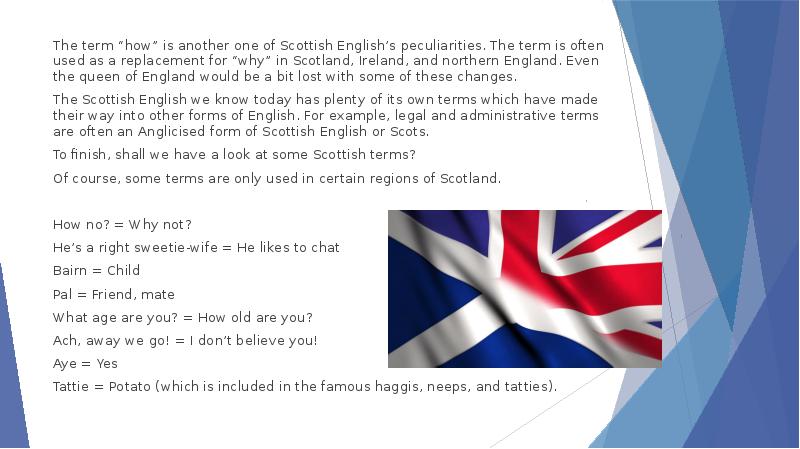
The Scottish English we know today has plenty of its own terms which have made their way into other forms of English. For example, legal and administrative terms are often an Anglicised form of Scottish English or Scots.
To finish, shall we have a look at some Scottish terms?
Of course, some terms are only used in certain regions of Scotland.
How no? = Why not?
He’s a right sweetie-wife = He likes to chat
Bairn = Child
Pal = Friend, mate
What age are you? = How old are you?
Ach, away we go! = I don’t believe you!
Aye = Yes
Tattie = Potato (which is included in the famous haggis, neeps, and tatties).
Слайд 7
Описание слайда:
How to speak with scotish accent
1. Replace "o’s" with "ae" sounds. The "ae" sound, officially known as the Near-Open Front Unrounded Vowel, is an "ah" sound with more emphasis on the "a" and less on the "h". You hear this sound when you pronounce words like "have" and "that" in American Standard English. Try making the "ah" sound in words like "Not" to become "nae." Words that end in "oo" sounds get more of the "ae" pronunciation as well."To" is pronounced as "tae". "Do" becomes "dae". Additionally, "no" gets a bit of an "aw" sound at the end making it sound like "naw" or "nae".
Another example of changing how you pronounce words is in the sentence "I am going to the shops over there." In a Scottish accent, it would be pronounced as "Am gan tae the shoaps oor air.“
2. Pronounce like words the same, join syllables in words, and drop "g" endings. Unlike in American English where "pull" has a slightly different pronunciation than "pool", in a Scottish accent, both words sound like "pool".When trying a Scottish accent, think of "u" sounds as "oo" sounds.
If there are two short words together, pronounce the two as one. "Did not" often becomes "didnae" or "dinnae." However, avoid speaking too fast.
Drop the 'g' sound from words ending in a 'g.' For example, say "evenin’" instead of "evening." "Sewing" becomes "sewin’".
Слайд 8
Описание слайда:
How to speak with scotish accent
3. Play with the glottal stop. The glottal stop is made when you close off airflow in your throat during a word to pronounce your "t’s". Think of it like an absence of sound. For example, if you were to say "glottal stop" with a Scottish accent, you would say "glo’al stop".
The glottal stop is not used for every "t" sound in a Scottish accent. If you have a "t" at the beginning of a word you would still pronounce the "t". For example, "that" would sound like "tha". And at the end of the word, you would constrict your throat to stop the airflow.
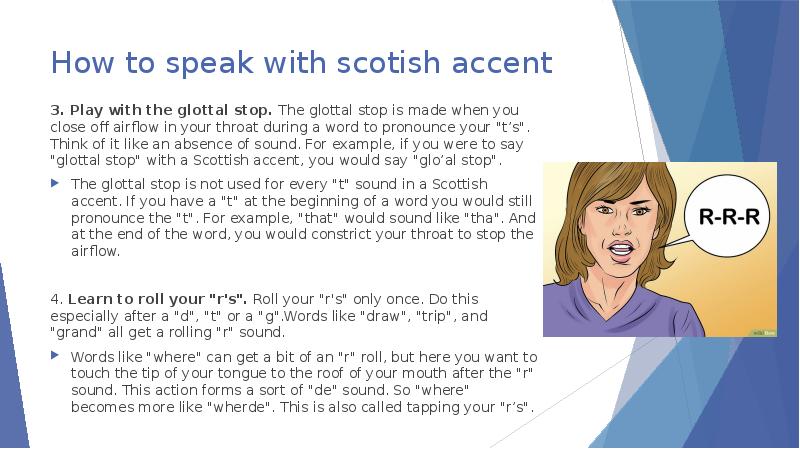
4. Learn to roll your "r's". Roll your "r's" only once. Do this especially after a "d", "t" or a "g".Words like "draw", "trip", and "grand" all get a rolling "r" sound.
Words like "where" can get a bit of an "r" roll, but here you want to touch the tip of your tongue to the roof of your mouth after the "r" sound. This action forms a sort of "de" sound. So "where" becomes more like "wherde". This is also called tapping your "r’s".
Слайд 9
Описание слайда:
Irish English
is the set of English dialects natively written and spoken within the island of Ireland (including both the Republic of Ireland and Northern Ireland).
English was brought to Ireland as a result of the Norman invasion of Ireland of the late 12th century. Initially, it was mainly spoken in an area known as the Pale around Dublin, with mostly Irish spoken throughout the rest of the country. By the Tudor period, Irish culture and language had regained most of the territory lost to the invaders: even in the Pale, "all the common folk… for the most part are of Irish birth, Irish habit, and of Irish language". Some small pockets remained predominantly English-speaking; because of their sheer isolation their dialects developed into later (now extinct) dialects known as Yola in Wexford and Fingallian in Fingal, Dublin. These were no longer mutually intelligible with other English varieties.
Слайд 10
Описание слайда:
How to speak with Irish accent
Soften your vowels. Many people, especially Americans, tend to harden their vowels. For example, Americans pronounce the letter A, "ay"; those with an Irish accent would pronounce it "ah" or "aw." Be very conscious of this in every word, but especially those vowels that come in the middle.
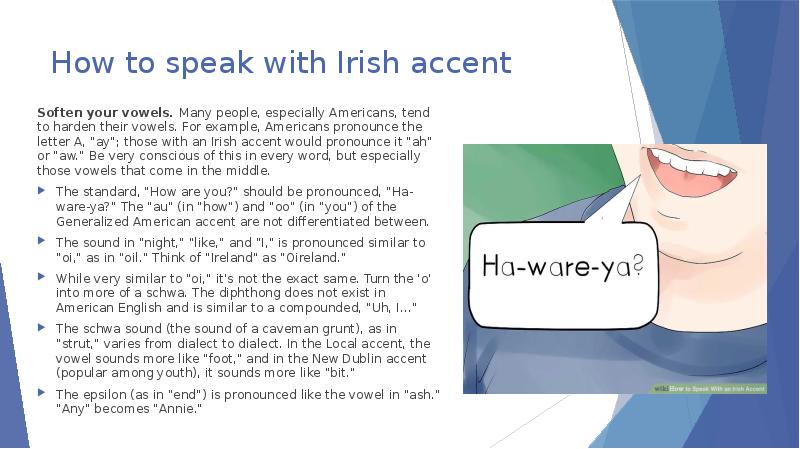
The standard, "How are you?" should be pronounced, "Ha-ware-ya?" The "au" (in "how") and "oo" (in "you") of the Generalized American accent are not differentiated between.
The sound in "night," "like," and "I," is pronounced similar to "oi," as in "oil." Think of "Ireland" as "Oireland."
While very similar to "oi," it's not the exact same. Turn the 'o' into more of a schwa. The diphthong does not exist in American English and is similar to a compounded, "Uh, I..."
The schwa sound (the sound of a caveman grunt), as in "strut," varies from dialect to dialect. In the Local accent, the vowel sounds more like "foot," and in the New Dublin accent (popular among youth), it sounds more like "bit."
The epsilon (as in "end") is pronounced like the vowel in "ash." "Any" becomes "Annie."
Слайд 11
Описание слайда:
How to speak with Irish accent
Harden your consonants. As a general rule, Americans have gotten lazy in their speech. "Ladder" and "latter" are pronounced the same in the US, but not to an Irishman. Give each consonant its due (with the exception of the next rule!). As a beginning sound, /d/ often sounds like /d͡ʒ/ or the sound that a J makes in most variants of English. That is, "due" will sound like "Jew." As its unvoiced partner, "t" becomes "ch." "Tube" sounds like "choob."
There is a distinction between words like "wine" and "whine." Words with "wh" begin with an initial "h" sound; try expelling a bit of breath before the word -- the result should be something akin to "hwine."
Some Irish accents turn "think" and "that" into "tink" and "dat," respectively. Try "trowing" it into your speech sporadically.
Слайд 12
Описание слайда:
How to speak with Irish accent
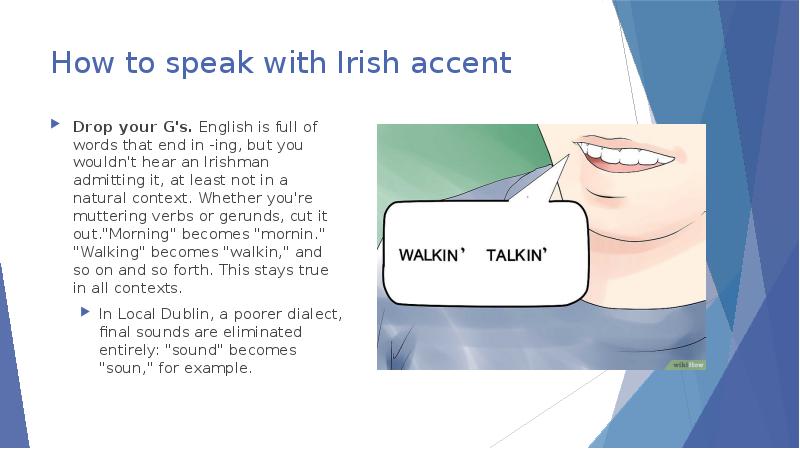
Drop your G's. English is full of words that end in -ing, but you wouldn't hear an Irishman admitting it, at least not in a natural context. Whether you're muttering verbs or gerunds, cut it out."Morning" becomes "mornin." "Walking" becomes "walkin," and so on and so forth. This stays true in all contexts.
In Local Dublin, a poorer dialect, final sounds are eliminated entirely: "sound" becomes "soun," for example.
Слайд 13
Описание слайда:
Welsh Englishes
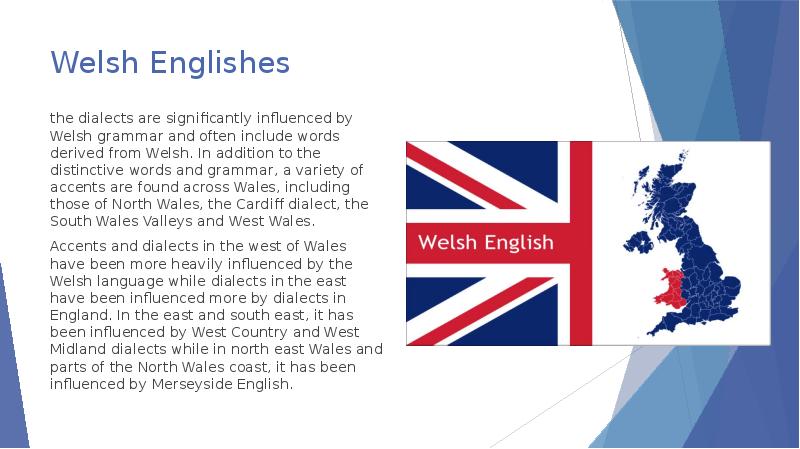
the dialects are significantly influenced by Welsh grammar and often include words derived from Welsh. In addition to the distinctive words and grammar, a variety of accents are found across Wales, including those of North Wales, the Cardiff dialect, the South Wales Valleys and West Wales.
Accents and dialects in the west of Wales have been more heavily influenced by the Welsh language while dialects in the east have been influenced more by dialects in England. In the east and south east, it has been influenced by West Country and West Midland dialects while in north east Wales and parts of the North Wales coast, it has been influenced by Merseyside English.
Слайд 14
Описание слайда:
How to speak with welsh accent
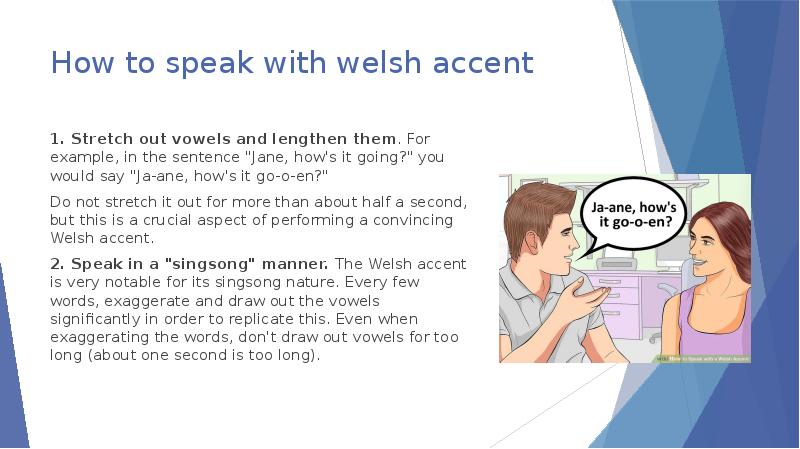
1. Stretch out vowels and lengthen them. For example, in the sentence "Jane, how's it going?" you would say "Ja-ane, how's it go-o-en?"
Do not stretch it out for more than about half a second, but this is a crucial aspect of performing a convincing Welsh accent.
2. Speak in a "singsong" manner. The Welsh accent is very notable for its singsong nature. Every few words, exaggerate and draw out the vowels significantly in order to replicate this. Even when exaggerating the words, don't draw out vowels for too long (about one second is too long).
Слайд 15
Описание слайда:
How to speak with welsh accent
3. Slur certain letters. Some letters are slurred; for example, "h" and "f" are often skipped or slurred where "have" becomes "ave" and "of" becomes "ov". This is not for all letters though so do this with only "h", "f" and other "soft" letters. Do not do this with vowels.
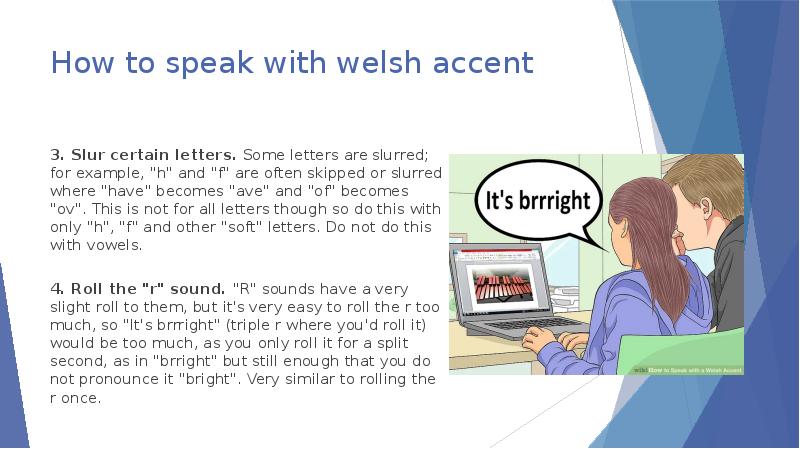
4. Roll the "r" sound. "R" sounds have a very slight roll to them, but it's very easy to roll the r too much, so "It's brrright" (triple r where you'd roll it) would be too much, as you only roll it for a split second, as in "brright" but still enough that you do not pronounce it "bright". Very similar to rolling the r once.
Слайд 16
Описание слайда:
links
https://www.youtube.com/watch?v=mALkCGVA2BU&list=RDCMUCjHm4Br34sBmjbBdA0TQH-Q&index=2 («How To Speak With A Scottish Accent»)
https://www.youtube.com/watch?v=W2PHch4IPPQ («How To Do An Irish Accent»)
https://www.youtube.com/watch?v=cq-mEejECcU («How To Speak With A Welsh Accent»)
These videos were made by one author. Also he has an interesting video about Russian accent
https://www.youtube.com/watch?v=nDdRHWHzwR4&t=128s («Learn British accents and dialects – Cockney, RP, Northern, and more!»)
https://www.youtube.com/watch?v=cMHsSB4gLAU («Sophie Turner, James McAvoy and Michael Fassbender Teach You English, Scottish and Irish Slang»)
Скачать презентацию на тему Scottish, Irish, Welsh Englishes можно ниже: