Scottish english презентация
Содержание
- 2. What is Scottish English? Scottish English refers to the varieties of
- 3. History During Reformation (16th century) religious texts printed in English were
- 4. History 1603 - King James VI of Scotland became James
- 5. Phonology: vowels Scottish English lacks about 5 (!) English vowels Scottish
- 6. Phonology: consonants Scottish English is a rhotic accent, meaning /r/ is
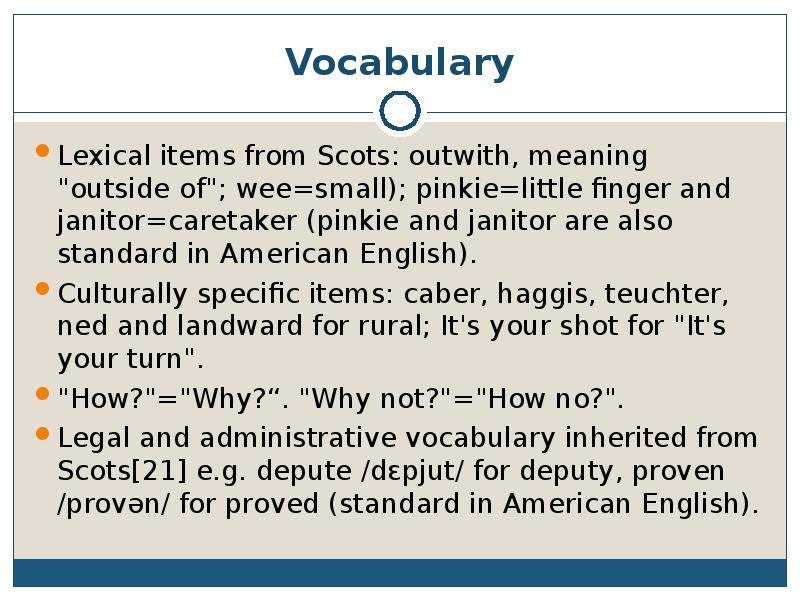
- 7. Vocabulary Lexical items from Scots: outwith, meaning "outside of"; wee=small); pinkie=little
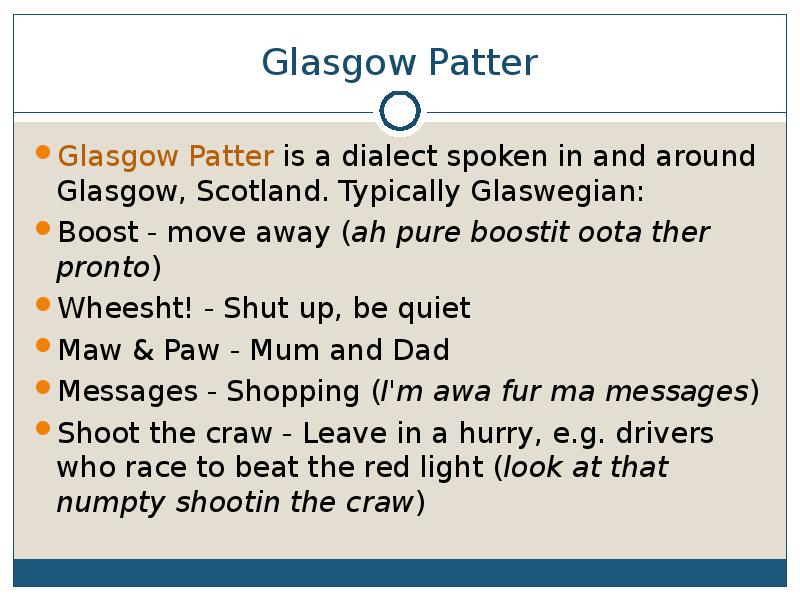
- 8. Glasgow Patter Glasgow Patter is a dialect spoken in and around
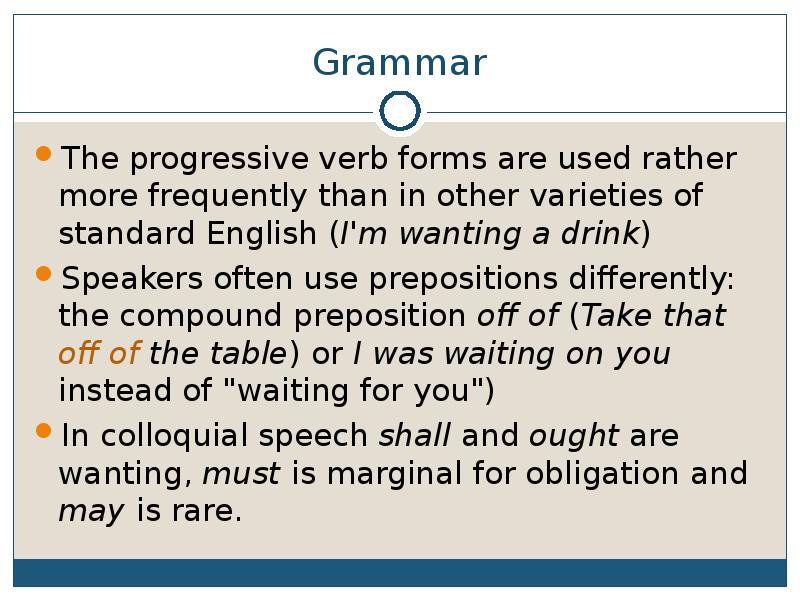
- 9. Grammar The progressive verb forms are used rather more frequently than
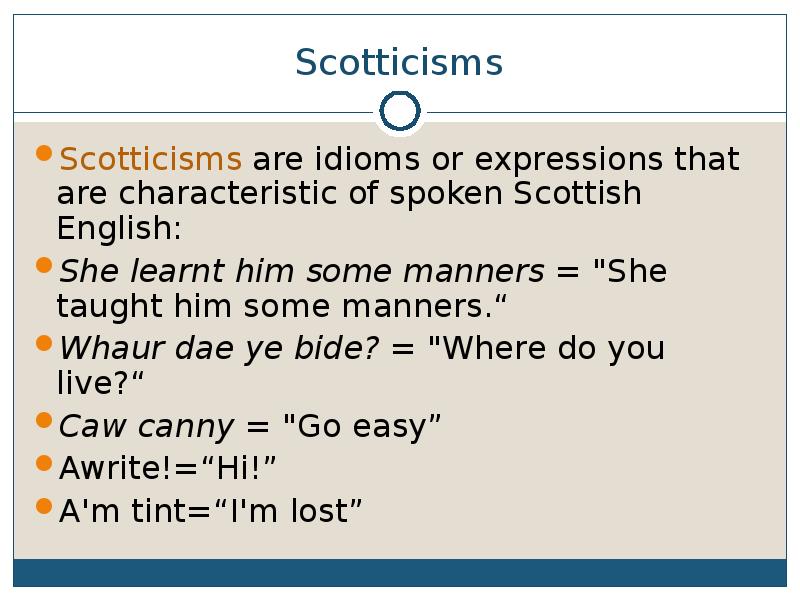
- 10. Scotticisms Scotticisms are idioms or expressions that are characteristic of spoken
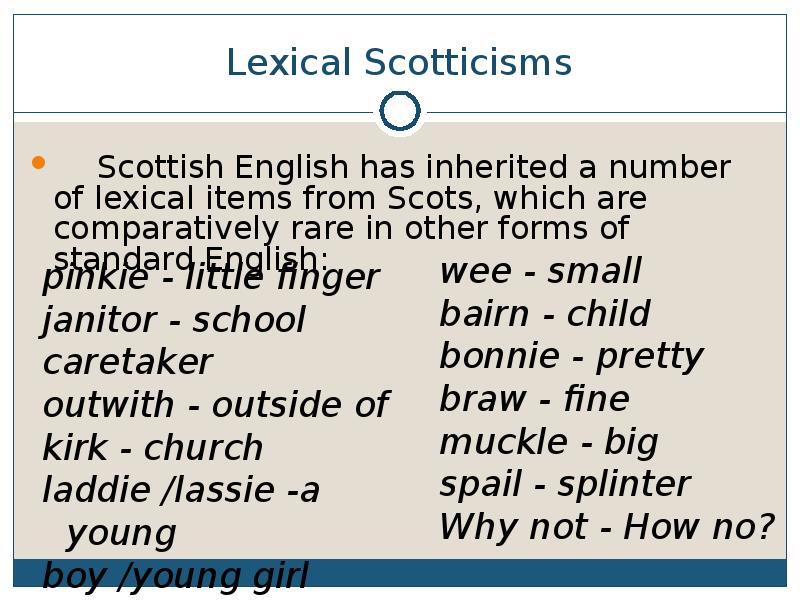
- 11. Lexical Scotticisms Scottish English has inherited a number of lexical
- 12. Grammatical Scotticisms What age are you? for "How old are you?" My
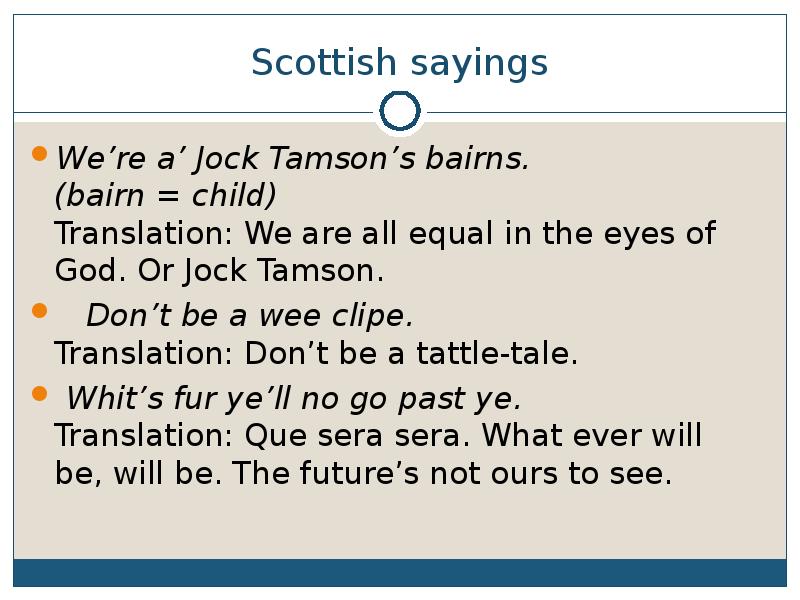
- 13. Scottish sayings We’re a’ Jock Tamson’s bairns. (bairn = child) Translation:
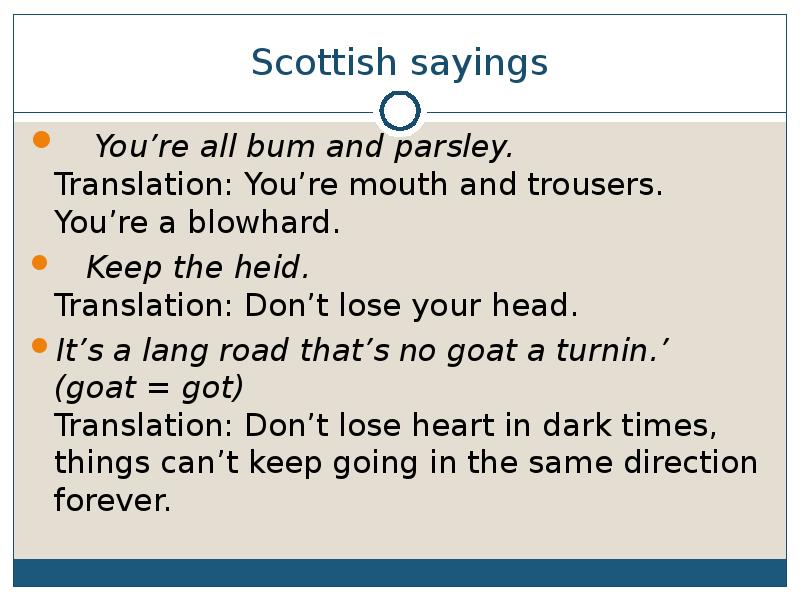
- 14. Scottish sayings You’re all bum and parsley. Translation: You’re mouth
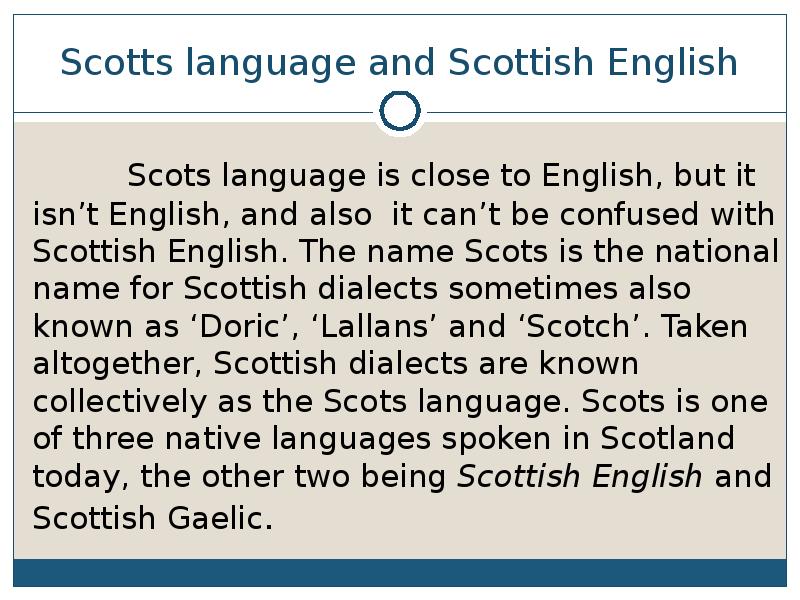
- 15. Scotts language and Scottish English Scots language is
- 16. Listen to the Scottish accent
- 17. Listen to the Scottish accent
- 18. Скачать презентацию


Слайды и текст этой презентации
Слайд 1
Описание слайда:
Scottish English
Слайд 2
Описание слайда:
What is Scottish English?
Scottish English refers to the varieties of English spoken in Scotland.
The formal variety is called Standard Scottish English, SSE.
It has distinctive vocabulary, particularly pertaining to Scottish institutions such as the Church of Scotland, local government and the education and legal systems.
Слайд 3
Описание слайда:
History
During Reformation (16th century) religious texts printed in English were widely distributed in Scotland in order to spread Protestant doctrine.
Scottish English results from language contact between Scots and the Standard English of England after the 17th century.
Слайд 4
Описание слайда:
History
1603 - King James VI of Scotland became James I of England and moved his court to London.
The poets of the court therefore moved south and “began adapting the language and style of their verse to the tastes of the English market”
Слайд 5
Описание слайда:
Phonology: vowels
Scottish English lacks about 5 (!) English vowels
Scottish speakers don't use a schwa sound: the sound in 'the' is the same as the sound in 'bit'.
'bird' and 'heard' are not homophones (the vowel in 'heard' is the same as the vowel in 'bet‘ and the vowel in 'bird' can be the same as the vowel in 'but' or 'bit' depending on the accent and gender of the speaker.
No difference between front and back 'a' sounds.
Слайд 6
Описание слайда:
Phonology: consonants
Scottish English is a rhotic accent, meaning /r/ is pronounced in the syllable coda.
There is a distinction between /w/ and /wh/ in word pairs such as witch and which.
The phoneme /x/ is common in names => Some Scottish speakers use it in words of Greek origin as well, such as technical, patriarch.
Слайд 7
Описание слайда:
Vocabulary
Lexical items from Scots: outwith, meaning "outside of"; wee=small); pinkie=little finger and janitor=caretaker (pinkie and janitor are also standard in American English).
Culturally specific items: caber, haggis, teuchter, ned and landward for rural; It's your shot for "It's your turn".
"How?"="Why?“. "Why not?"="How no?".
Legal and administrative vocabulary inherited from Scots[21] e.g. depute /dɛpjut/ for deputy, proven /provən/ for proved (standard in American English).
Слайд 8
Описание слайда:
Glasgow Patter
Glasgow Patter is a dialect spoken in and around Glasgow, Scotland. Typically Glaswegian:
Boost - move away (ah pure boostit oota ther pronto)
Wheesht! - Shut up, be quiet
Maw & Paw - Mum and Dad
Messages - Shopping (I'm awa fur ma messages)
Shoot the craw - Leave in a hurry, e.g. drivers who race to beat the red light (look at that numpty shootin the craw)
Слайд 9
Описание слайда:
Grammar
The progressive verb forms are used rather more frequently than in other varieties of standard English (I'm wanting a drink)
Speakers often use prepositions differently: the compound preposition off of (Take that off of the table) or I was waiting on you instead of "waiting for you")
In colloquial speech shall and ought are wanting, must is marginal for obligation and may is rare.
Слайд 10
Описание слайда:
Scotticisms
Scotticisms are idioms or expressions that are characteristic of spoken Scottish English:
She learnt him some manners = "She taught him some manners.“
Whaur dae ye bide? = "Where do you live?“
Caw canny = "Go easy”
Awrite!=“Hi!”
A'm tint=“I'm lost”
Слайд 11
Описание слайда:
Lexical Scotticisms
Scottish English has inherited a number of lexical items from Scots, which are comparatively rare in other forms of standard English:
Слайд 12
Описание слайда:
Grammatical
Scotticisms
What age are you? for "How old are you?"
My hair is needing washed or My hair needs washed for "My hair needs washing" or "My hair needs to be washed".
I'm just after telling you for "I've just told you".
Amn't I invited? for Am I not invited?
He's at the school. for He’s at school.
I'm wanting a drink. for I want some drink.
Слайд 13
Описание слайда:
Scottish sayings
We’re a’ Jock Tamson’s bairns.
(bairn = child)
Translation: We are all equal in the eyes of God. Or Jock Tamson.
Don’t be a wee clipe.
Translation: Don’t be a tattle-tale.
Whit’s fur ye’ll no go past ye.
Translation: Que sera sera. What ever will be, will be. The future’s not ours to see.
Слайд 14
Описание слайда:
Scottish sayings
You’re all bum and parsley.
Translation: You’re mouth and trousers. You’re a blowhard.
Keep the heid.
Translation: Don’t lose your head.
It’s a lang road that’s no goat a turnin.’
(goat = got)
Translation: Don’t lose heart in dark times, things can’t keep going in the same direction forever.
Слайд 15
Описание слайда:
Scotts language and Scottish English
Scots language is close to English, but it isn’t English, and also it can’t be confused with Scottish English. The name Scots is the national name for Scottish dialects sometimes also known as ‘Doric’, ‘Lallans’ and ‘Scotch’. Taken altogether, Scottish dialects are known collectively as the Scots language. Scots is one of three native languages spoken in Scotland today, the other two being Scottish English and Scottish Gaelic.
Слайд 16
Описание слайда:
Listen to the Scottish accent
Слайд 17
Описание слайда:
Listen to the Scottish accent
Скачать презентацию на тему Scottish english можно ниже: