Actual Division of the Sentence презентация
Содержание
- 2. The Notion of Actual Division of the Sentence. The notional parts
- 3. The Theme. The Rheme. The theme expresses the starting point of
- 4. The theme of the actual division of the sentence may or
- 5. Linguistic Expression of the Theme and the Rheme Certain syntactic constructions
- 6. Among the formal means of expressing the distinction between the theme
- 7. Sentences for analysis: The first to receive her diploma should be
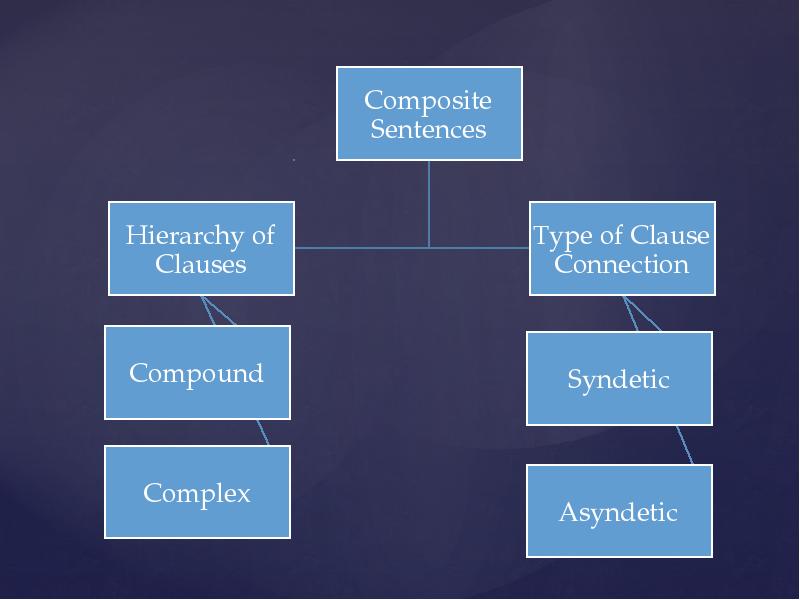
- 8. The Composite Sentence The definition of the composite sentence. Compound
- 9. Definition of the Composite Sentence A composite sentence is a structural
- 11. Compound Sentences The process of coordination involves the linking of structures
- 12. Coordinate connectors can be grouped in the following way: Copulative: and;
- 13. Complex Sentences Complex sentences are structures of subordination with two or
- 14. Analyze the Type of Italicized Clauses: Suddenly she felt so relieved
- 15. I went to the party, though I did not feel like
- 16. Asyndetic Sentences In traditional grammar asyndetic sentences, just as syndetic ones,
- 17. According to Prof. Ilyish, in some types of asyndetic composite sentences,
- 18. Transitive-Type Sentences The following syntactical phenomena can be considered transitional cases:
- 19. b) sentences containing an adjective or adverb, which may be preceded
- 20. Complex-Compound Sentences Though Lois was very jauntily attired in an expensively
- 21. Скачать презентацию
Слайды и текст этой презентации
Слайд 1
Описание слайда:
Actual Division of the Sentence
1. The Notion of Actual Division of the Sentence. The Theme and the Rheme.
2. Linguistic Expression of Actual
Division in a Sentence.
Слайд 2
Описание слайда:
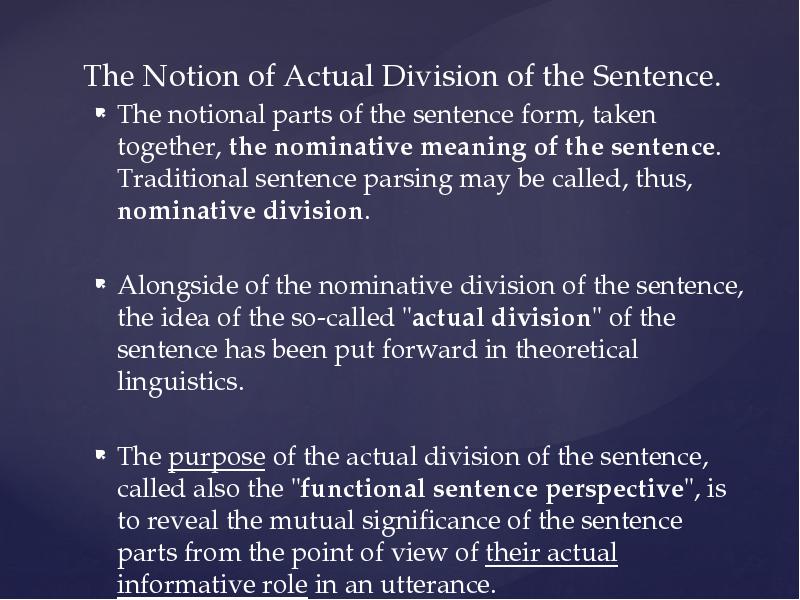
The Notion of Actual Division of the Sentence.
The notional parts of the sentence form, taken together, the nominative meaning of the sentence. Traditional sentence parsing may be called, thus, nominative division.
Alongside of the nominative division of the sentence, the idea of the so-called "actual division" of the sentence has been put forward in theoretical linguistics.
The purpose of the actual division of the sentence, called also the "functional sentence perspective", is to reveal the mutual significance of the sentence parts from the point of view of their actual informative role in an utterance.
Слайд 3
Описание слайда:
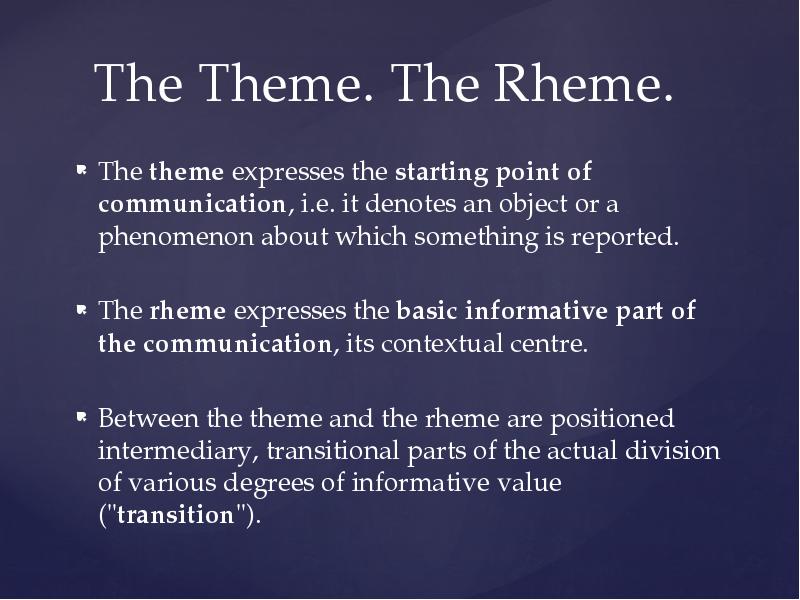
The Theme. The Rheme.
The theme expresses the starting point of communication, i.e. it denotes an object or a phenomenon about which something is reported.
The rheme expresses the basic informative part of the communication, its contextual centre.
Between the theme and the rheme are positioned intermediary, transitional parts of the actual division of various degrees of informative value ("transition").
Слайд 4
Описание слайда:
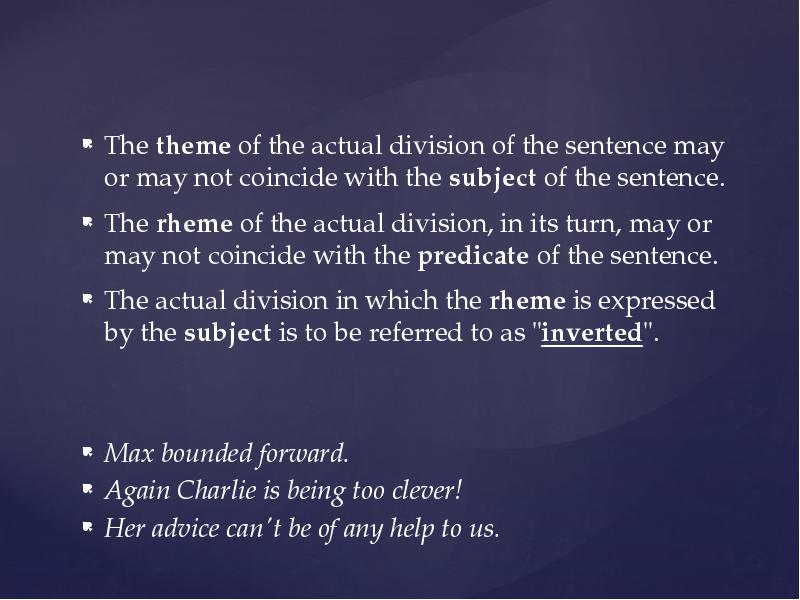
The theme of the actual division of the sentence may or may not coincide with the subject of the sentence.
The rheme of the actual division, in its turn, may or may not coincide with the predicate of the sentence.
The actual division in which the rheme is expressed by the subject is to be referred to as "inverted".
Max bounded forward.
Again Charlie is being too clever!
Her advice can't be of any help to us.
Слайд 5
Описание слайда:
Linguistic Expression
of the Theme and the Rheme
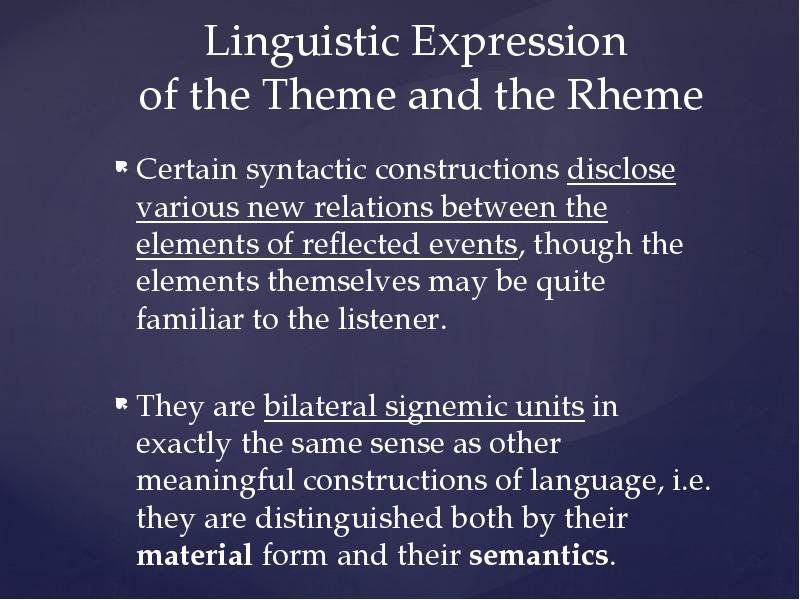
Certain syntactic constructions disclose various new relations between the elements of reflected events, though the elements themselves may be quite familiar to the listener.
They are bilateral signemic units in exactly the same sense as other meaningful constructions of language, i.e. they are distinguished both by their material form and their semantics.
Слайд 6
Описание слайда:
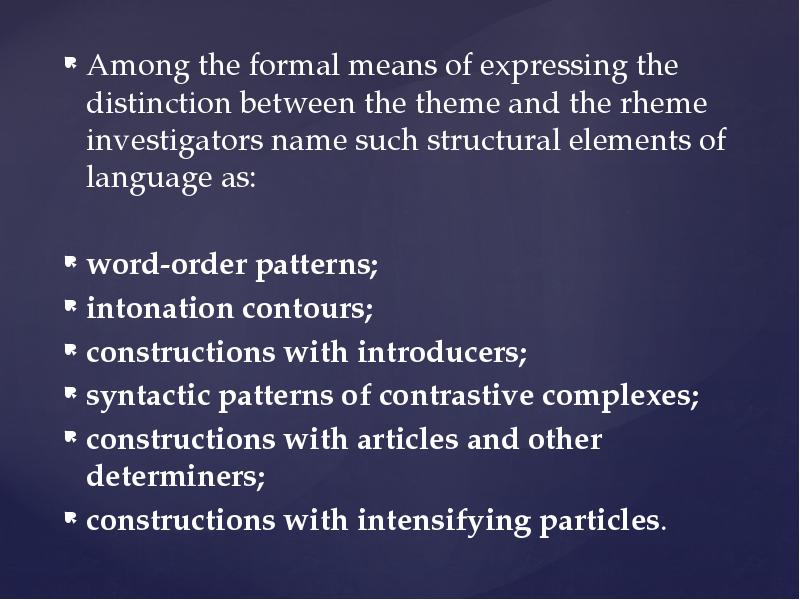
Among the formal means of expressing the distinction between the theme and the rheme investigators name such structural elements of language as:
word-order patterns;
intonation contours;
constructions with introducers;
syntactic patterns of contrastive complexes;
constructions with articles and other determiners;
constructions with intensifying particles.
Слайд 7
Описание слайда:
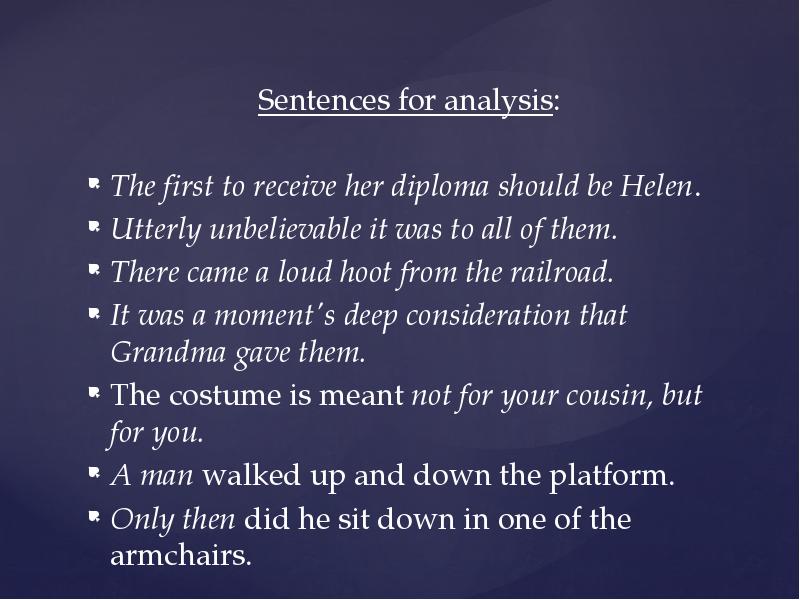
Sentences for analysis:
The first to receive her diploma should be Helen.
Utterly unbelievable it was to all of them.
There came a loud hoot from the railroad.
It was a moment's deep consideration that Grandma gave them.
The costume is meant not for your cousin, but for you.
A man walked up and down the platform.
Only then did he sit down in one of the armchairs.
Слайд 8
Описание слайда:
The Composite Sentence
The definition of the composite sentence.
Compound sentences.
Complex sentences.
Asyndetic sentences.
Transitional sentences.
Слайд 9
Описание слайда:
Definition of the Composite Sentence
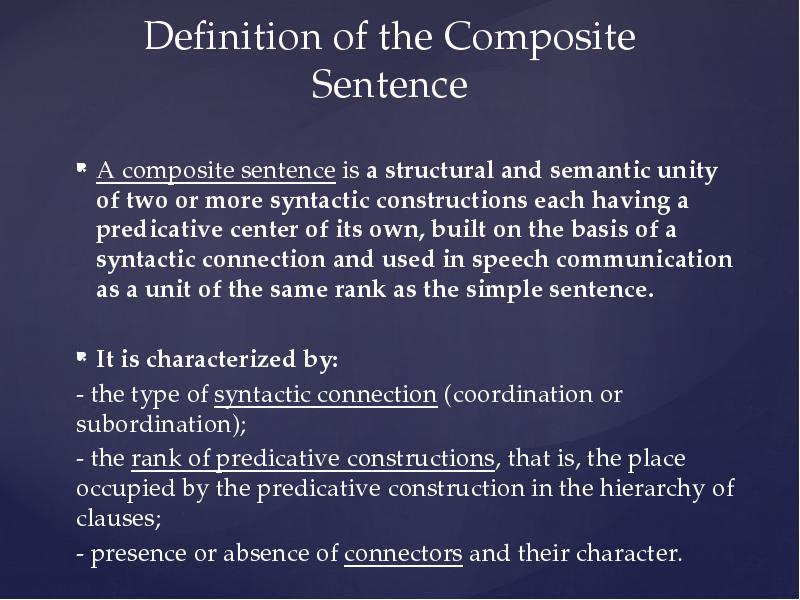
A composite sentence is a structural and semantic unity of two or more syntactic constructions each having a predicative center of its own, built on the basis of a syntactic connection and used in speech communication as a unit of the same rank as the simple sentence.
It is characterized by:
- the type of syntactic connection (coordination or subordination);
- the rank of predicative constructions, that is, the place occupied by the predicative construction in the hierarchy of clauses;
- presence or absence of connectors and their character.
Слайд 10
Описание слайда:
Слайд 11
Описание слайда:
Compound Sentences
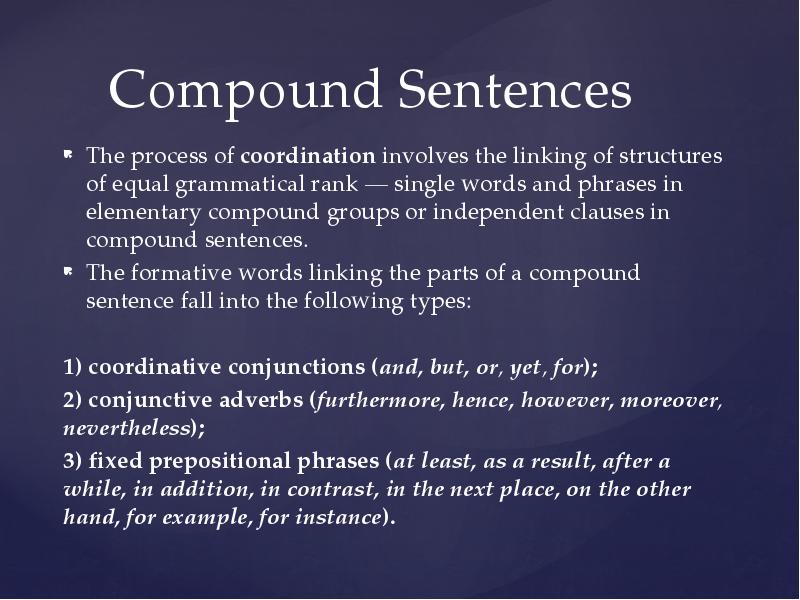
The process of coordination involves the linking of structures of equal grammatical rank — single words and phrases in elementary compound groups or independent clauses in compound sentences.
The formative words linking the parts of a compound sentence fall into the following types:
1) coordinative conjunctions (and, but, or, yet, for);
2) conjunctive adverbs (furthermore, hence, however, moreover, nevertheless);
3) fixed prepositional phrases (at least, as a result, after a while, in addition, in contrast, in the next place, on the other hand, for example, for instance).
Слайд 12
Описание слайда:
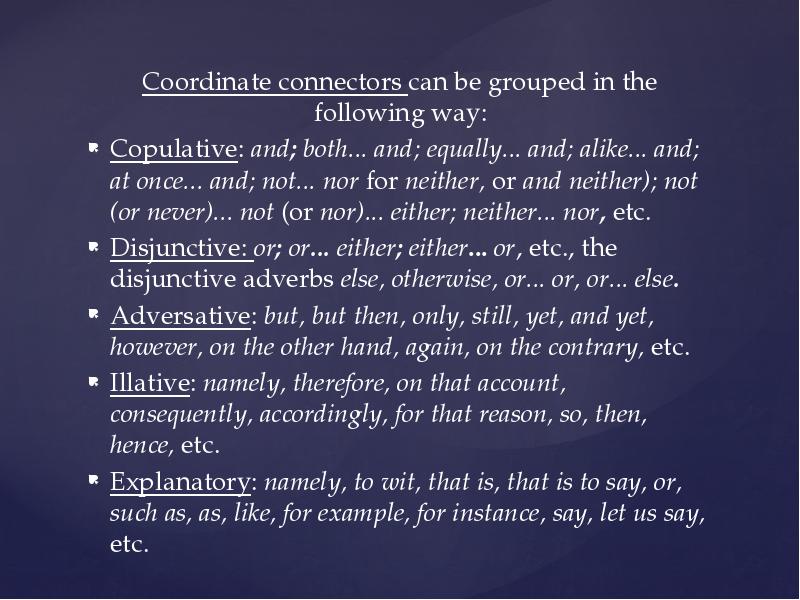
Coordinate connectors can be grouped in the following way:
Copulative: and; both... and; equally... and; alike... and; at once... and; not... nor for neither, or and neither); not (or never)... not (or nor)... either; neither... nor, etc.
Disjunctive: or; or... either; either... or, etc., the disjunctive adverbs else, otherwise, or... or, or... else.
Adversative: but, but then, only, still, yet, and yet, however, on the other hand, again, on the contrary, etc.
Illative: namely, therefore, on that account, consequently, accordingly, for that reason, so, then, hence, etc.
Explanatory: namely, to wit, that is, that is to say, or, such as, as, like, for example, for instance, say, let us say, etc.
Слайд 13
Описание слайда:
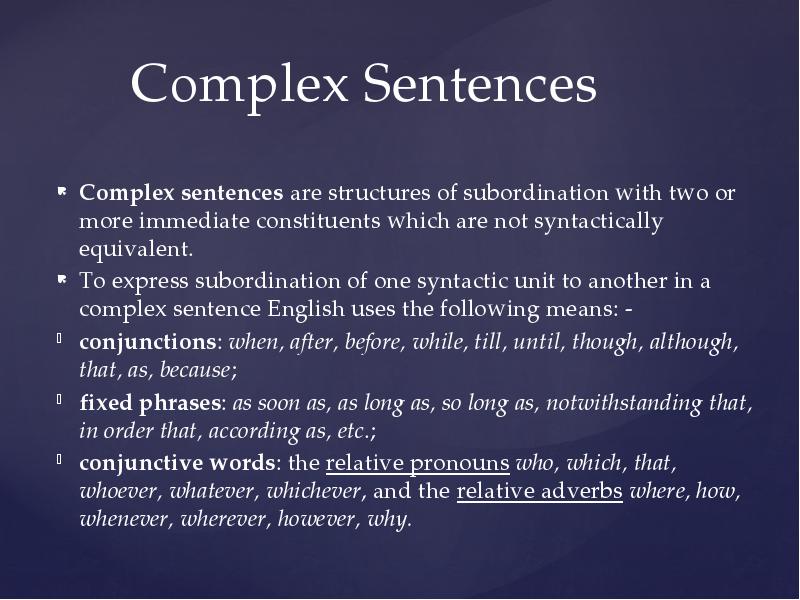
Complex Sentences
Complex sentences are structures of subordination with two or more immediate constituents which are not syntactically equivalent.
To express subordination of one syntactic unit to another in a complex sentence English uses the following means: -
conjunctions: when, after, before, while, till, until, though, although, that, as, because;
fixed phrases: as soon as, as long as, so long as, notwithstanding that, in order that, according as, etc.;
conjunctive words: the relative pronouns who, which, that, whoever, whatever, whichever, and the relative adverbs where, how, whenever, wherever, however, why.
Слайд 14
Описание слайда:
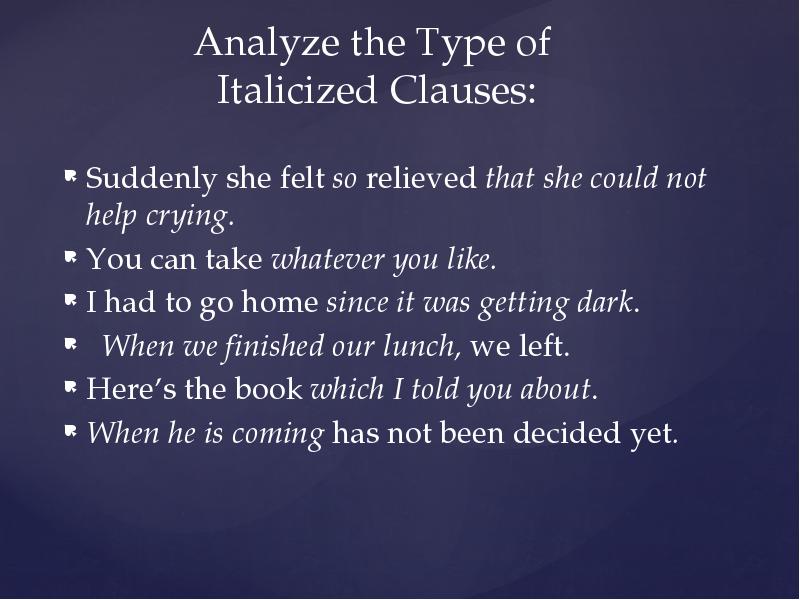
Analyze the Type of
Italicized Clauses:
Suddenly she felt so relieved that she could not help crying.
You can take whatever you like.
I had to go home since it was getting dark.
When we finished our lunch, we left.
Here’s the book which I told you about.
When he is coming has not been decided yet.
Слайд 15
Описание слайда:
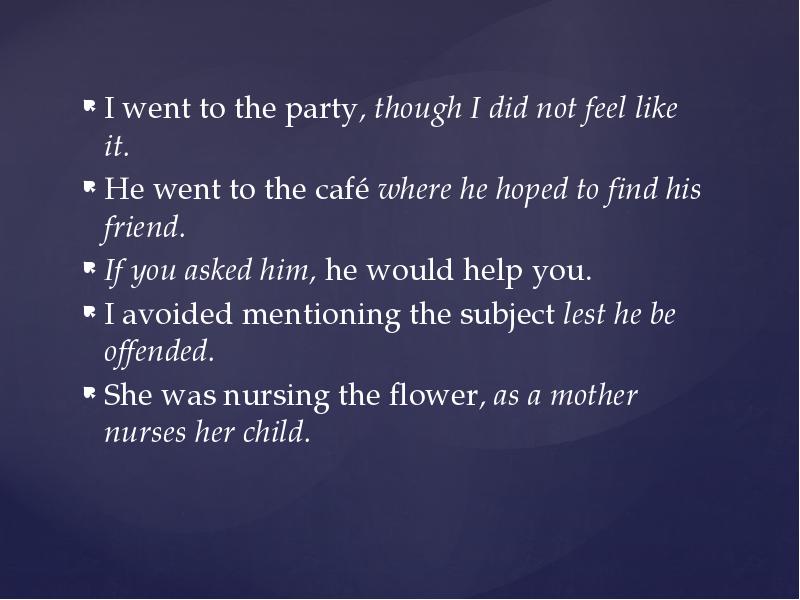
I went to the party, though I did not feel like it.
He went to the café where he hoped to find his friend.
If you asked him, he would help you.
I avoided mentioning the subject lest he be offended.
She was nursing the flower, as a mother nurses her child.
Слайд 16
Описание слайда:
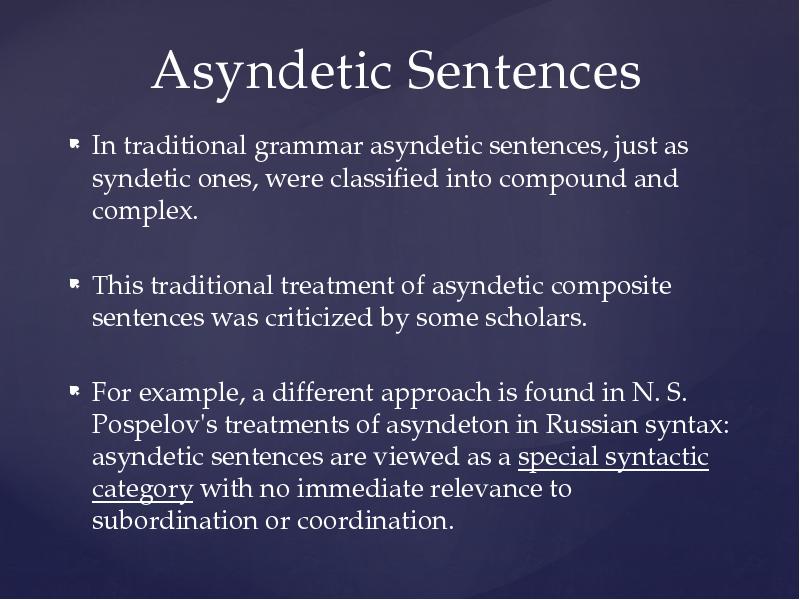
Asyndetic Sentences
In traditional grammar asyndetic sentences, just as syndetic ones, were classified into compound and complex.
This traditional treatment of asyndetic composite sentences was criticized by some scholars.
For example, a different approach is found in N. S. Pospelov's treatments of asyndeton in Russian syntax: asyndetic sentences are viewed as a special syntactic category with no immediate relevance to subordination or coordination.
Слайд 17
Описание слайда:
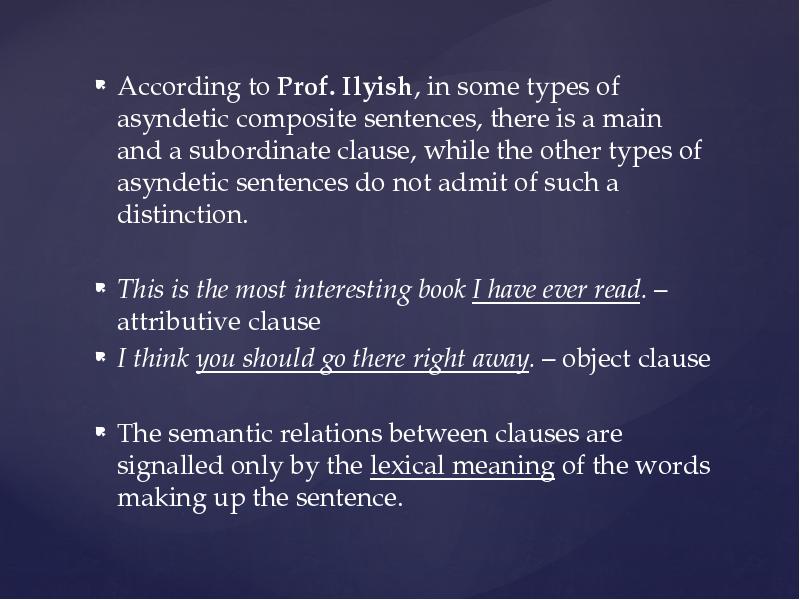
According to Prof. Ilyish, in some types of asyndetic composite sentences, there is a main and a subordinate clause, while the other types of asyndetic sentences do not admit of such a distinction.
This is the most interesting book I have ever read. – attributive clause
I think you should go there right away. – object clause
The semantic relations between clauses are signalled only by the lexical meaning of the words making up the sentence.
Слайд 18
Описание слайда:
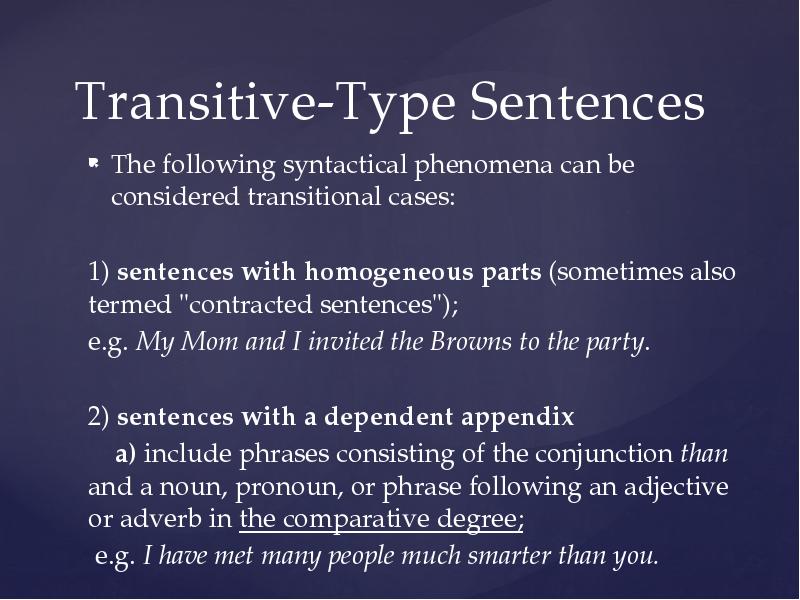
Transitive-Type Sentences
The following syntactical phenomena can be considered transitional cases:
1) sentences with homogeneous parts (sometimes also termed "contracted sentences");
e.g. My Mom and I invited the Browns to the party.
2) sentences with a dependent appendix
a) include phrases consisting of the conjunction than and a noun, pronoun, or phrase following an adjective or adverb in the comparative degree;
e.g. I have met many people much smarter than you.
Слайд 19
Описание слайда:
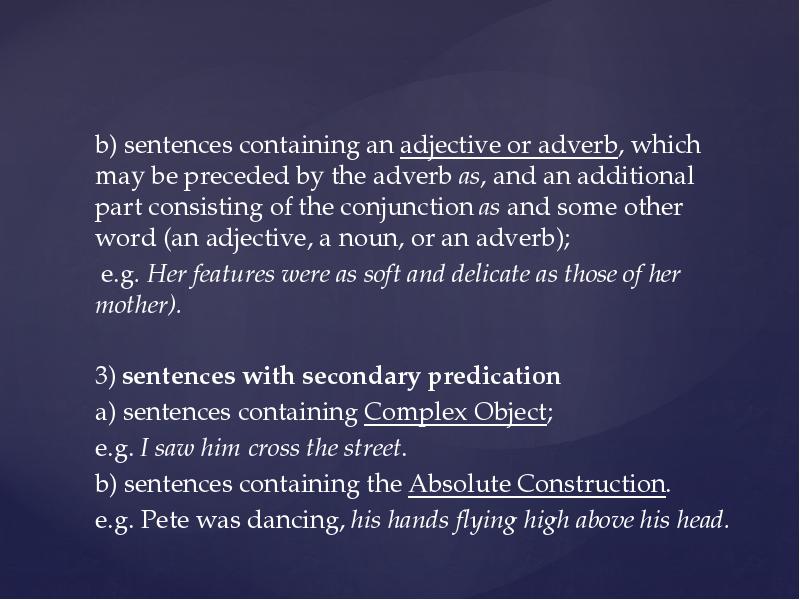
b) sentences containing an adjective or adverb, which may be preceded by the adverb as, and an additional part consisting of the conjunction as and some other word (an adjective, a noun, or an adverb);
e.g. Her features were as soft and delicate as those of her mother).
3) sentences with secondary predication
a) sentences containing Complex Object;
e.g. I saw him cross the street.
b) sentences containing the Absolute Construction.
e.g. Pete was dancing, his hands flying high above his head.
Слайд 20
Описание слайда:
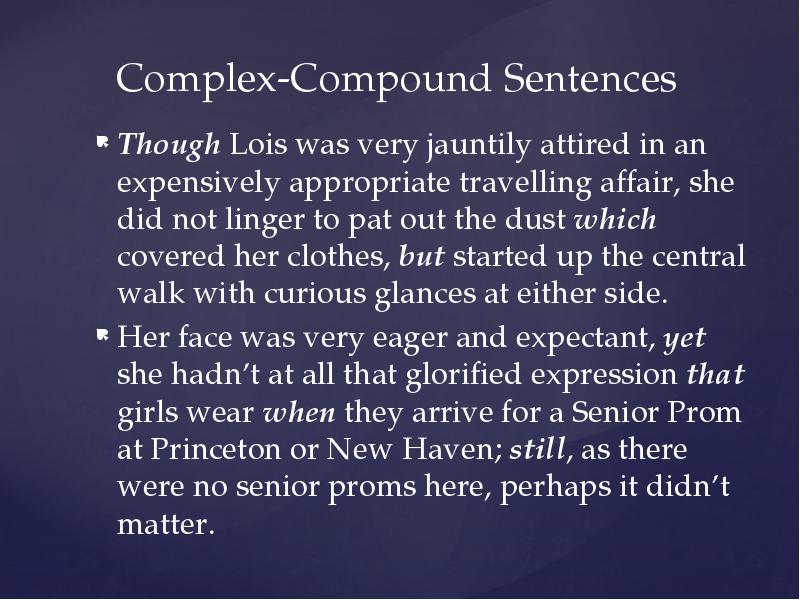
Complex-Compound Sentences
Though Lois was very jauntily attired in an expensively appropriate travelling affair, she did not linger to pat out the dust which covered her clothes, but started up the central walk with curious glances at either side.
Her face was very eager and expectant, yet she hadn’t at all that glorified expression that girls wear when they arrive for a Senior Prom at Princeton or New Haven; still, as there were no senior proms here, perhaps it didn’t matter.
Скачать презентацию на тему Actual Division of the Sentence можно ниже: