Australian Senate презентация
Содержание
- 2. The Senate is the upper house of the bicameral Parliament of
- 3. Origins The Commonwealth of Australia Constitution Act (Imp.) of 1900 established
- 4. Structure Under Section 24 of the Constitution, the number of members
- 5. Electoral system The system for electing senators has changed several times
- 6. Membership (Parties) The Coalition Australian Labor Party Australian Greens Pauline Hanson's
- 7. The Coalition The Liberal–National Coalition, commonly known simply as The Coalition,
- 8. Australian Labor Party The Australian Labor Party (ALP), also simply known
- 9. Australian Greens The Australian Greens, commonly known as The Greens, is
- 10. Pauline Hanson's One Nation Pauline Hanson's One Nation was founded in
- 11. Centre Alliance Centre Alliance, formerly known as the Nick Xenophon Team
- 12. Jacqui Lambie Network The Jacqui Lambie Network (abbreviated JLN) is an
- 13. Скачать презентацию
Слайды и текст этой презентации
Слайд 1
Описание слайда:
Australian Senate
Слайд 2
Описание слайда:
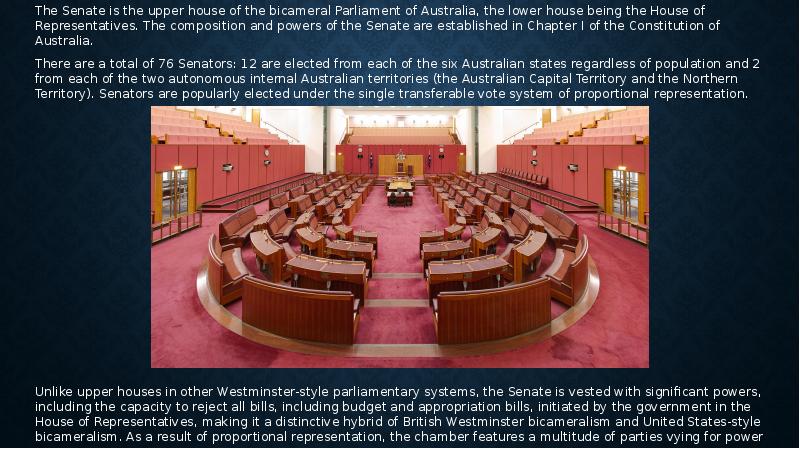
The Senate is the upper house of the bicameral Parliament of Australia, the lower house being the House of Representatives. The composition and powers of the Senate are established in Chapter I of the Constitution of Australia.
The Senate is the upper house of the bicameral Parliament of Australia, the lower house being the House of Representatives. The composition and powers of the Senate are established in Chapter I of the Constitution of Australia.
There are a total of 76 Senators: 12 are elected from each of the six Australian states regardless of population and 2 from each of the two autonomous internal Australian territories (the Australian Capital Territory and the Northern Territory). Senators are popularly elected under the single transferable vote system of proportional representation.
Unlike upper houses in other Westminster-style parliamentary systems, the Senate is vested with significant powers, including the capacity to reject all bills, including budget and appropriation bills, initiated by the government in the House of Representatives, making it a distinctive hybrid of British Westminster bicameralism and United States-style bicameralism. As a result of proportional representation, the chamber features a multitude of parties vying for power
Слайд 3
Описание слайда:
Origins
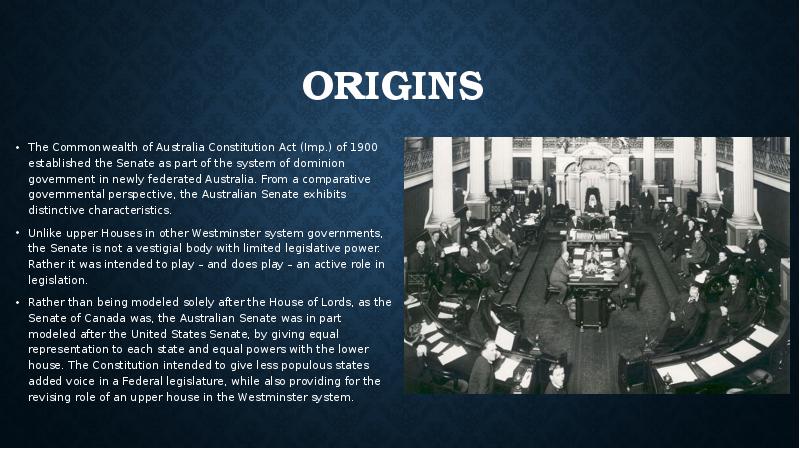
The Commonwealth of Australia Constitution Act (Imp.) of 1900 established the Senate as part of the system of dominion government in newly federated Australia. From a comparative governmental perspective, the Australian Senate exhibits distinctive characteristics.
Unlike upper Houses in other Westminster system governments, the Senate is not a vestigial body with limited legislative power. Rather it was intended to play – and does play – an active role in legislation.
Rather than being modeled solely after the House of Lords, as the Senate of Canada was, the Australian Senate was in part modeled after the United States Senate, by giving equal representation to each state and equal powers with the lower house. The Constitution intended to give less populous states added voice in a Federal legislature, while also providing for the revising role of an upper house in the Westminster system.
Слайд 4
Описание слайда:
Structure
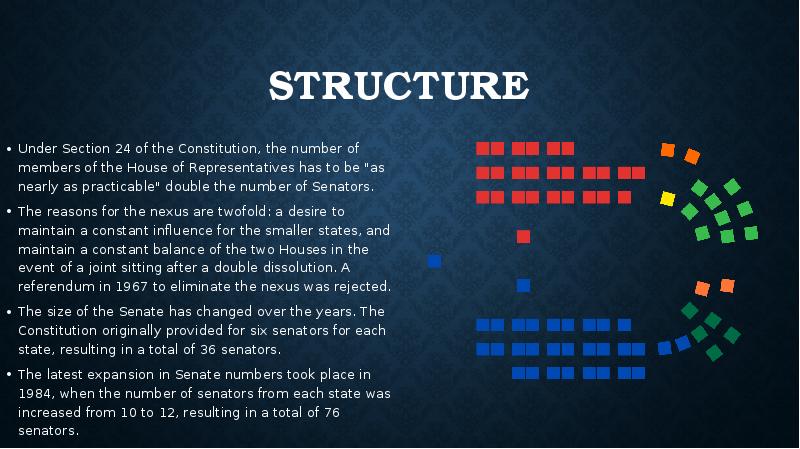
Under Section 24 of the Constitution, the number of members of the House of Representatives has to be "as nearly as practicable" double the number of Senators.
The reasons for the nexus are twofold: a desire to maintain a constant influence for the smaller states, and maintain a constant balance of the two Houses in the event of a joint sitting after a double dissolution. A referendum in 1967 to eliminate the nexus was rejected.
The size of the Senate has changed over the years. The Constitution originally provided for six senators for each state, resulting in a total of 36 senators.
The latest expansion in Senate numbers took place in 1984, when the number of senators from each state was increased from 10 to 12, resulting in a total of 76 senators.
Слайд 5
Описание слайда:
Electoral system
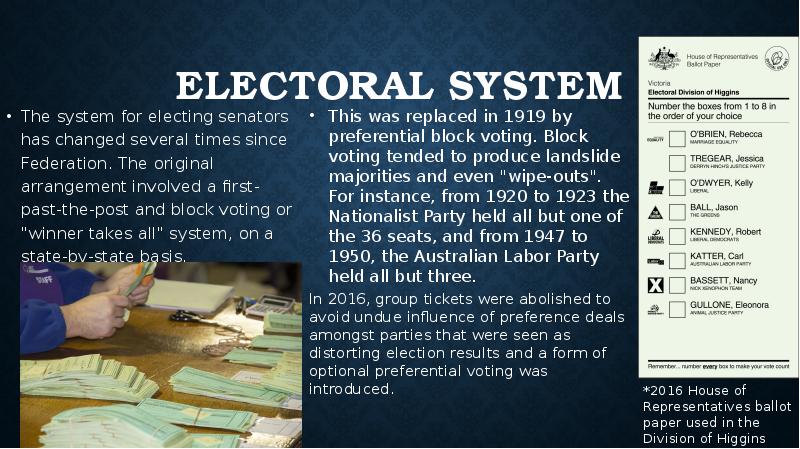
The system for electing senators has changed several times since Federation. The original arrangement involved a first-past-the-post and block voting or "winner takes all" system, on a state-by-state basis.
Слайд 6
Описание слайда:
Membership (Parties)
The Coalition
Australian Labor Party
Australian Greens
Pauline Hanson's One Nation
Centre Alliance
Jacqui Lambie Network
Слайд 7
Описание слайда:
The Coalition
The Liberal–National Coalition, commonly known simply as The Coalition, is an alliance of center-right political parties that forms one of the two major groupings in Australian federal politics. Its main opponent is the Australian Labor Party; the two forces are often regarded as operating in a two-party system.
The Coalition has been in government since the 2013 federal election, most recently being re-elected in the 2019 Australian federal election. The group is led by Scott Morrison as Prime Minister of Australia since August 2018.
Слайд 8
Описание слайда:
Australian Labor Party
The Australian Labor Party (ALP), also simply known as Labor and historically spelt Labour, is a major centre-left political party in Australia. The party has been in opposition at the federal level since the 2013 federal election. The party is a federal party with branches in each state and territory. Labor is in government in the states of Victoria, Queensland, Western Australia, and in both the Australian Capital Territory and Northern Territory. Labor's constitution has long stated: "The Australian Labor Party is a democratic socialist party and has the objective of the democratic socialisation of industry, production, distribution and exchange, to the extent necessary to eliminate exploitation and other anti-social features in these fields".
This "socialist objective" was introduced in 1921, but was later qualified by two further objectives: "maintenance of and support for a competitive non-monopolistic private sector" and "the right to own private property".
Labor governments have not attempted the "democratic socialisation" of any industry since the 1940s, when the Chifley Government failed to nationalise the private banks, and in fact have privatised several industries such as aviation and banking.
Слайд 9
Описание слайда:
Australian Greens
The Australian Greens, commonly known as The Greens, is a federation of Green state political parties in Australia. As of the 2019 federal election, the Greens are currently the third largest political party in Australia by vote. The leader of the party is Adam Bandt, and the party's co-deputy leaders are Larissa Waters and Nick McKim.
The party was formed in 1992 and is a confederation of eight state and territorial parties. The party cites four core values: ecological sustainability, social justice, grassroots democracy and peace and non-violence.
Слайд 10
Описание слайда:
Pauline Hanson's One Nation
Pauline Hanson's One Nation was founded in 1997, by member of parliament Pauline Hanson and her advisors David Ettridge and David Oldfield after Hanson was disendorsed as a federal candidate for the Liberal Party of Australia. The disendorsement came before the 1996 federal election because of comments she made about Indigenous Australians. Hanson sat as an independent for one year before forming Pauline Hanson's One Nation.
Federally, no One Nation candidate has ever been elected to the House of Representatives (Hanson was already a member of the House when One Nation was formed).
However, one candidate from the party was elected to the Senate in the 1998 federal election, and four One Nation senators were elected in the 2016 federal election.
Слайд 11
Описание слайда:
Centre Alliance
Centre Alliance, formerly known as the Nick Xenophon Team (NXT), is a centrist political party in Australia based in the state of South Australia. It presently holds two seats in the Australian Senate and one seat in the House of Representatives of Australia.
Since its founding in July 2013, the party has twice changed names. At the time of the 2016 Australian federal election, it was known as the Nick Xenophon Team (NXT). After the creation of SA-BEST, an affiliated state-based party created by Nick Xenophon, NXT sought to change its name to SA-BEST (Federal), but prior to Australian Electoral Commission approval Nick Xenophon departed from politics, and so the party withdrew its application and changed its name to Centre Alliance. In 2018, Centre Alliance senator Stirling Griff stated that SA-BEST is "a separate entity, a separate association, a separate party" from Centre Alliance.
The party's ideological focus is a combination of centrism, social liberalism and populism, drawing from the positions of Xenophon. Its present members have variously declared support for same-sex marriage, reform of the Australian Intelligence Community, action on climate change, support for military veterans, affordable tax cuts, Australian-made manufacturing, including defence-industry spending and legalising euthanasia.
Слайд 12
Описание слайда:
Jacqui Lambie Network
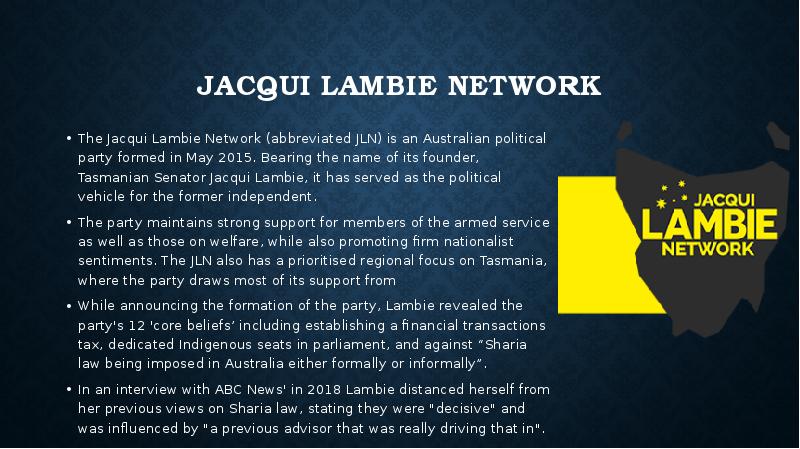
The Jacqui Lambie Network (abbreviated JLN) is an Australian political party formed in May 2015. Bearing the name of its founder, Tasmanian Senator Jacqui Lambie, it has served as the political vehicle for the former independent.
The party maintains strong support for members of the armed service as well as those on welfare, while also promoting firm nationalist sentiments. The JLN also has a prioritised regional focus on Tasmania, where the party draws most of its support from
While announcing the formation of the party, Lambie revealed the party's 12 'core beliefs’ including establishing a financial transactions tax, dedicated Indigenous seats in parliament, and against “Sharia law being imposed in Australia either formally or informally”.
In an interview with ABC News' in 2018 Lambie distanced herself from her previous views on Sharia law, stating they were "decisive" and was influenced by "a previous advisor that was really driving that in".
Скачать презентацию на тему Australian Senate можно ниже: