C RAFTING A STRATEGY: THE THIRD DIRECTION-SETTING TASK презентация
Содержание
- 2. Strategy is answer for “How” questions Organizations need strategies to guide
- 3. An organization's strategy evolves over time The future is too unknowable
- 4. The Strategy-Making Pyramid ( A Diversified Company)
- 5. The Strategy-Making Pyramid ( A Diversified Company) In diversified enterprises,
- 6. The Strategy-Making Pyramid ( A Single Business Company) In single-business
- 7. Corporate Strategy Corporate strategy is the overall managerial game plan for
- 8. Core elements that identify a diversified company's corporate strategy
- 9. Four initiatives in corporate strategy (1): Crafting corporate strategy for
- 10. Four initiatives in corporate strategy (2): Crafting corporate strategy for a
- 11. Four initiatives in corporate strategy (3): Crafting corporate strategy for
- 12. Four initiatives in corporate strategy (4): Crafting corporate strategy for a
- 13. Who crafts Corporate strategy Corporate strategy is crafted at the highest
- 14. Business Strategy The term business strategy refers to the managerial game
- 15. What is Business Strategy The central thrust of business strategy is
- 16. Functional Strategy The term functional strategy refers to the managerial game
- 17. What kinds of functional strategies should be A company needs a
- 18. Roles of functional strategies The primary role of a functional strategy
- 19. Operating Strategy Operating strategies concern the even narrower strategic initiatives and
- 20. Who crafts Operating strategy Lead responsibility for operating strategies is usually
- 21. Скачать презентацию
Слайды и текст этой презентации
Слайд 1
Описание слайда:
CRAFTING A STRATEGY:
THE THIRD
DIRECTION-SETTING TASK
Слайд 2
Описание слайда:
Strategy is answer for “How” questions
Organizations need strategies to guide how to achieve objectives and how to pursue the organization's business mission and strategic vision. Strategy making is all about how—how to achieve performance targets, how to outcompete rivals, how to achieve sustainable competitive advantage, how to strengthen the enterprise's long-term business position, how to make management's strategic vision for the company a reality. A strategy is needed for the company as a whole, for each business the company is in, and for each functional piece of each business—R&D, purchasing, production, sales and marketing, finance, customer service, information systems, and so on.
Слайд 3
Описание слайда:
An organization's strategy evolves over time
The future is too unknowable for management to plan a company's strategy in advance and encounter no reason for changing one piece or another as time passes. Reacting and responding to unpredictable happenings in the surrounding environment is a normal and necessary part of the strategy-making process, there is always something new to react to and some new strategic window opening up—whether from new competitive developments, budding trends in buyer needs and expectations, unexpected increases or decreases in costs, mergers and acquisitions among major industry players, new regulations, the raising or lowering of trade barriers, or countless other events that make it desirable to alter first one then another aspect of the present strategy.
This is why the task of crafting strategy is never ending.
Слайд 4
Описание слайда:
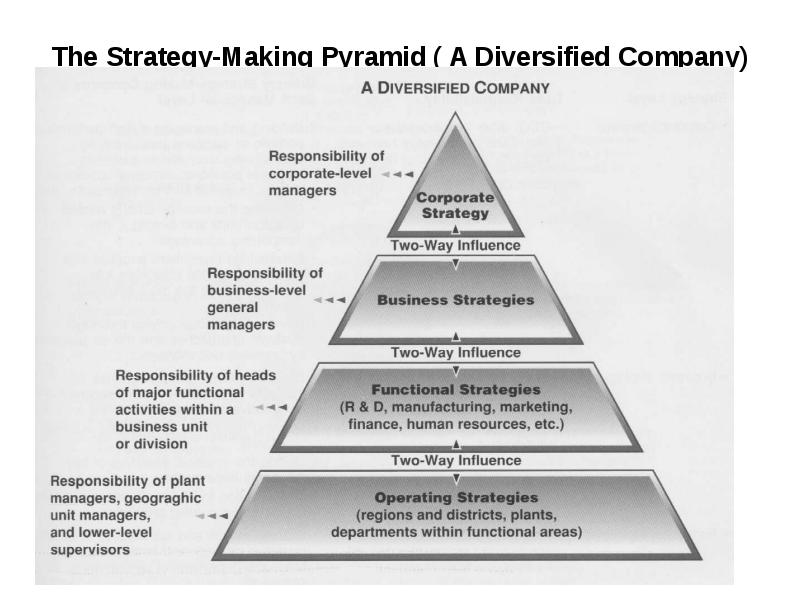
The Strategy-Making Pyramid ( A Diversified Company)
Слайд 5
Описание слайда:
The Strategy-Making Pyramid ( A Diversified Company)
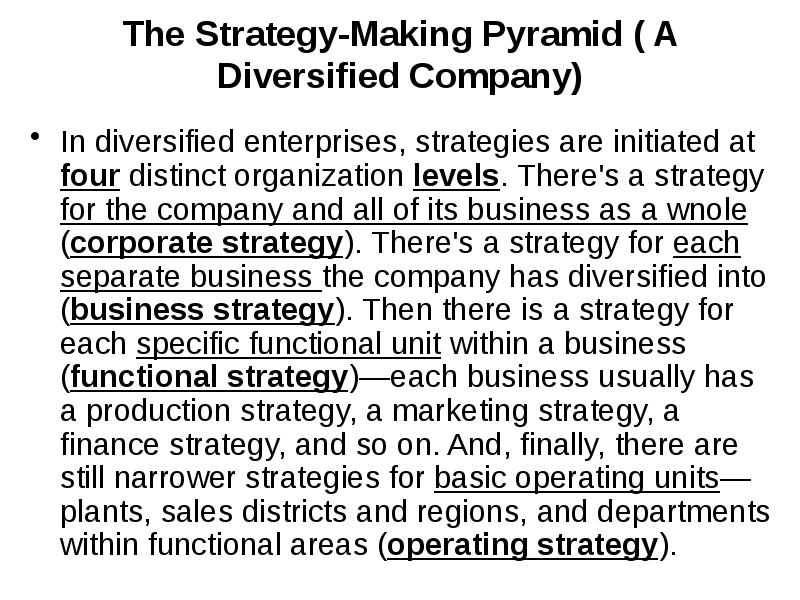
In diversified enterprises, strategies are initiated at four distinct organization levels. There's a strategy for the company and all of its business as a wnole (corporate strategy). There's a strategy for each separate business the company has diversified into (business strategy). Then there is a strategy for each specific functional unit within a business (functional strategy)—each business usually has a production strategy, a marketing strategy, a finance strategy, and so on. And, finally, there are still narrower strategies for basic operating units—plants, sales districts and regions, and departments within functional areas (operating strategy).
Слайд 6
Описание слайда:
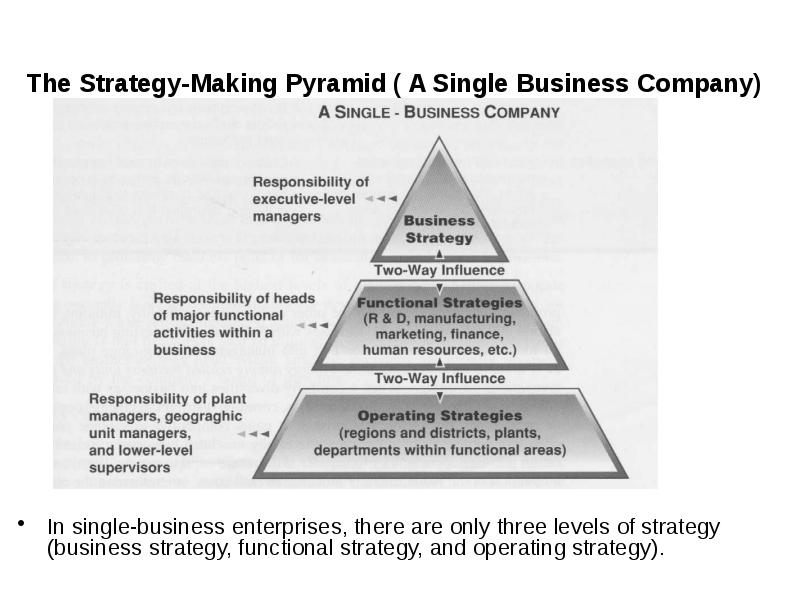
The Strategy-Making Pyramid ( A Single Business Company)
In single-business enterprises, there are only three levels of strategy (business strategy, functional strategy, and operating strategy).
Слайд 7
Описание слайда:
Corporate Strategy
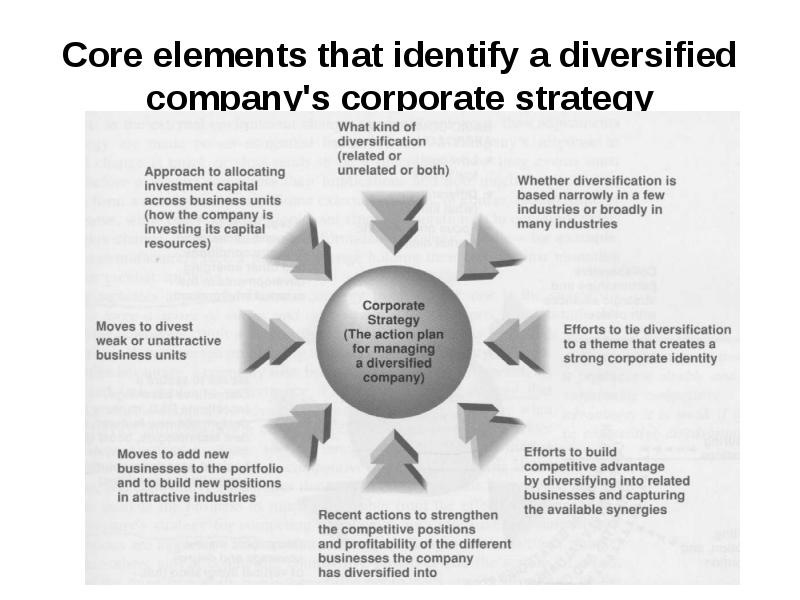
Corporate strategy is the overall managerial game plan for a diversified company. Corporate strategy extends companywide—an umbrella over all a diversified company's businesses. It consists of the moves made to establish business positions in different industries and the approaches used to manage the company's group of businesses.
Слайд 8
Описание слайда:
Core elements that identify a diversified company's corporate strategy
Слайд 9
Описание слайда:
Four initiatives in corporate strategy (1):
Crafting corporate strategy for a diversified company involves four kinds of initiatives:
1. Making the moves to establish positions in different businesses and achieve diversification. In a diversified company, a key piece of corporate strategy is how many and what kinds of businesses the company should be in - specifically, what industries should the company participate in and whether to enter the industries by starting a new business or acquiring another company (an established leader, an up-and-coming company, or a troubled company with turnaround potential). This piece of corporate strategy establishes whether diversification is based narrowly in a few industries or broadly in many industries and whether the different businesses will be related or unrelated.
Слайд 10
Описание слайда:
Four initiatives in corporate strategy (2):
Crafting corporate strategy for a diversified company involves four kinds of initiatives:
2. Initiating actions to boost the combined performance of the businesses the firm has diversified into. As positions are created in the chosen industries, corporate strategy making concentrates on ways to strengthen the long-term competitive positions and profitabilities of the businesses the firm has invested in. Corporate parents can help their business subsidiaries be more successful by financing additional capacity and efficiency improvements, by supplying missing skills and managerial know-how, by acquiring another company in the same industry and merging the two operations into a stronger business, and/or by acquiring new businesses that strongly complement existing businesses. Management's overall strategy for improving companywide performance usually involves pursuing rapid-growth strategies in the most
promising businesses, keeping the other core businesses healthy, initiating turnaround efforts in weak-performing businesses with potential, and divesting businesses that are no longer attractive or that don't fit into management's long-range plans.
Слайд 11
Описание слайда:
Four initiatives in corporate strategy (3):
Crafting corporate strategy for a diversified company involves four kinds of initiatives:
3. Pursuing ways to capture the synergy among related business units and turn it into competitive advantage. When a company diversifies into businesses with related technologies, similar operating characteristics, common distribution channels or customers, or some other synergistic relationship, it gains competitive advantage potential not open to a company that diversifies into totally unrelated businesses. Related diversification presents opportunities to transfer skills, share expertise or facilities, and leverage a common brand name, thereby reducing overall costs, strengthening the competitiveness of some of the company's products, or enhancing the capabilities of particular business units—any of which can represent a significant source of competitive advantage and provide a basis for greater overall corporate profitability.
Слайд 12
Описание слайда:
Four initiatives in corporate strategy (4):
Crafting corporate strategy for a diversified company involves four kinds of initiatives:
4. Establishing investment priorities and steering corporate resources into the most attractive business units. A diversified company's different businesses are usually not equally attractive from the standpoint of investing additional funds. This facet of corporate strategy making involves channeling resources into areas where earnings potentials are higher and away from areas where they are lower. Corporate strategy may include divesting business units that are chronically poor performers or those in an increasingly unattractive industry. Divestiture frees up unproductive investments for redeployment to promising business units or for financing attractive new acquisitions.
Слайд 13
Описание слайда:
Who crafts Corporate strategy
Corporate strategy is crafted at the highest levels of management. Senior corporate executives normally have lead responsibility for devising corporate strategy and for choosing among whatever recommended actions bubble up from lower-level managers. Key business-unit heads may also be influential, especially in strategic decisions affecting the businesses they head. Major strategic decisions are usually reviewed and approved by the company's board of directors.
Слайд 14
Описание слайда:
Business Strategy
The term business strategy refers to the managerial game plan for a single business. It is mirrored in the pattern of approaches and moves crafted by management to produce successful performance in one specific line of business. For a single-business company, corporate strategy and business strategy are one and the same since there is only one business to form a strategy for. The distinction between corporate strategy and business strategy is relevant only for diversified firms.
Слайд 15
Описание слайда:
What is Business Strategy
The central thrust of business strategy is how to build and strengthen the company's long-term competitive position in the marketplace. Business strategy is concerned principally with
(1) forming responses to changes under way in the industry, the economy at large, the regulatory and political arena, and other relevant areas,
(2) crafting competitive moves and market approaches that can lead to sustainable competitive advantage,
(3) building competitively valuable competencies and capabilities,
(4) uniting the strategic initiatives of functional departments,
(5) addressing specific strategic issues facing the company's business.
Слайд 16
Описание слайда:
Functional Strategy
The term functional strategy refers to the managerial game plan for a particular functional activity, business process, or key department within a business.
A company's marketing strategy, for example, represents the managerial game plan for running the marketing part of the business. A company's new product development strategy represents the managerial game plan for keeping the company's product lineup fresh and in tune with what buyers are looking for.
Слайд 17
Описание слайда:
What kinds of functional strategies should be
A company needs a functional strategy for every competitively relevant business activity and organizational unit—for R&D, production, marketing, customer service, distribution, finance, human resources, information technology, and so on. Functional strategies, while narrower in scope than business strategies, add relevant detail to the overall business game plan by setting forth the actions, approaches, and practices to be employed in managing a particular functional department or business process or key activity.
Слайд 18
Описание слайда:
Roles of functional strategies
The primary role of a functional strategy is to support the company's overall business strategy and competitive approach. Well-executed functional strategies give the enterprise competitively valuable competencies, capabilities, and resource strengths. A related role is to create a managerial roadmap for achieving the functional area's objectives and mission.
Thus, functional strategy in the production/manufacturing area represents the game plan for how manufacturing activities will be managed to support business strategy and achieve the manufacturing department's objectives and mission. Functional strategy in the finance area consists of how financial activities will be managed in supporting business strategy and achieving the finance department's objectives and mission.
Слайд 19
Описание слайда:
Operating Strategy
Operating strategies concern the even narrower strategic initiatives and approaches for managing key operating units (plants, sales districts, distribution centers) and for handling daily operating tasks with strategic significance (advertising campaigns, materials purchasing, inventory control, maintenance, shipping). Operating strategies, while of limited scope, add further detail and completeness to functional strategies and to the overall business plan.
Слайд 20
Описание слайда:
Who crafts Operating strategy
Lead responsibility for operating strategies is usually delegated to frontline managers, subject to review and approval by higher-ranking managers. Even though operating strategy is at the bottom of the strategy-making pyramid, its importance should not be downplayed.
Скачать презентацию на тему C RAFTING A STRATEGY: THE THIRD DIRECTION-SETTING TASK можно ниже: