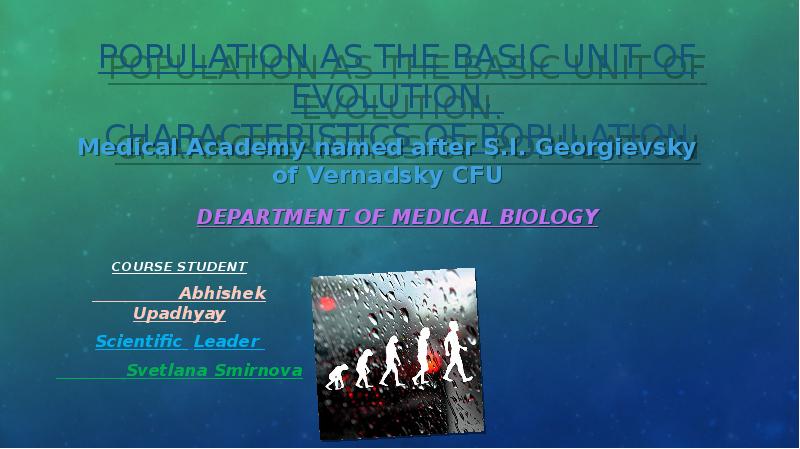
COURSE STUDENT Abhishek Upadhyay Scientific Leader Svetlana Smirnova POPULATION презентация
Содержание
- 2. population population is a group of organisms of the same species that
- 3. evolution evolution is the change in the characteristics of a species over
- 4. Different characteristics tend to exist within any given population as a
- 5. POPULATION AS THE BASIC UNIT OF EVOLUTION. A population is the smallest unit of
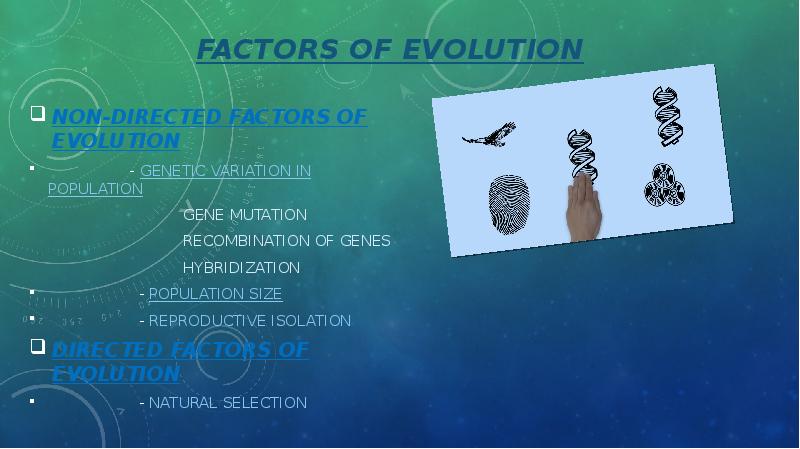
- 6. FACTORS OF EVOLUTION NON-DIRECTED FACTORS OF EVOLUTION
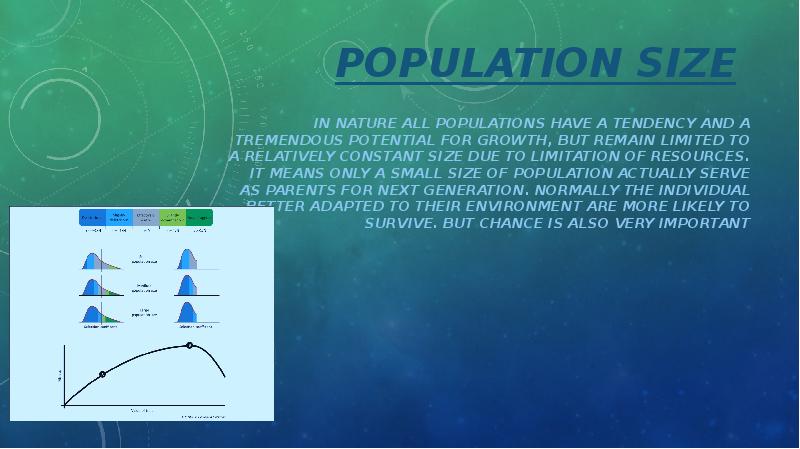
- 7. POPULATION SIZE In nature all populations have a tendency and a
- 8. genetic characteristics of population Heterogeneity of population Genetical unity of
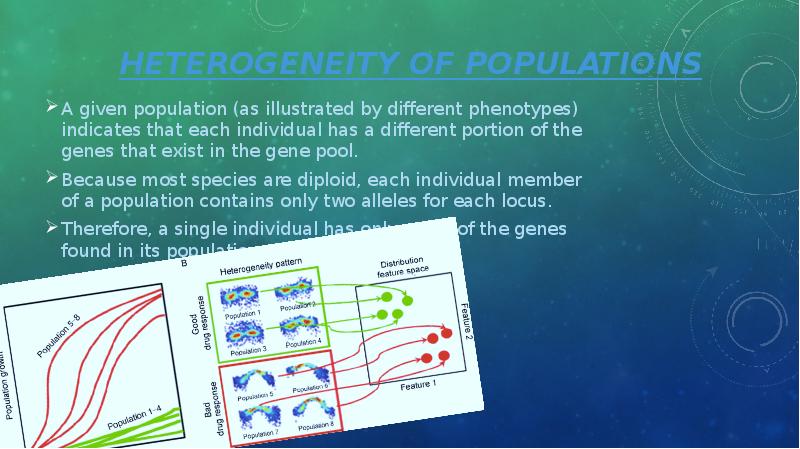
- 9. Heterogeneity of populations A given population (as illustrated by different phenotypes)
- 10. Genetical unity of populations. Each population possesses an iso- lated gene
- 11. The Hardy-Weinberg law shows that in large populations, the process of
- 12. Most populations have a large reservoir of variability Heterozygote advantage
- 13. EVOLUTION RESISTANCE
- 14. for better understanding https://www.youtube.com/watch?v=GhHOjC4oxh8 https://www.youtube.com/watch?v=SRWXEMlI0_U https://www.youtube.com/watch?v=hOfRN0KihOU
- 16. Скачать презентацию

Слайды и текст этой презентации
Слайд 1
Описание слайда:
Слайд 2
Описание слайда:
population
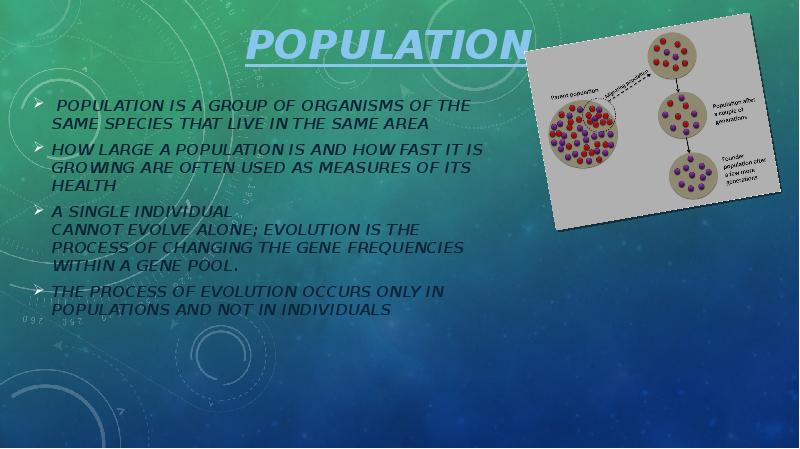
population is a group of organisms of the same species that live in the same area
How large a population is and how fast it is growing are often used as measures of its health
A single individual cannot evolve alone; evolution is the process of changing the gene frequencies within a gene pool.
The process of evolution occurs only in populations and not in individuals
Слайд 3
Описание слайда:
evolution
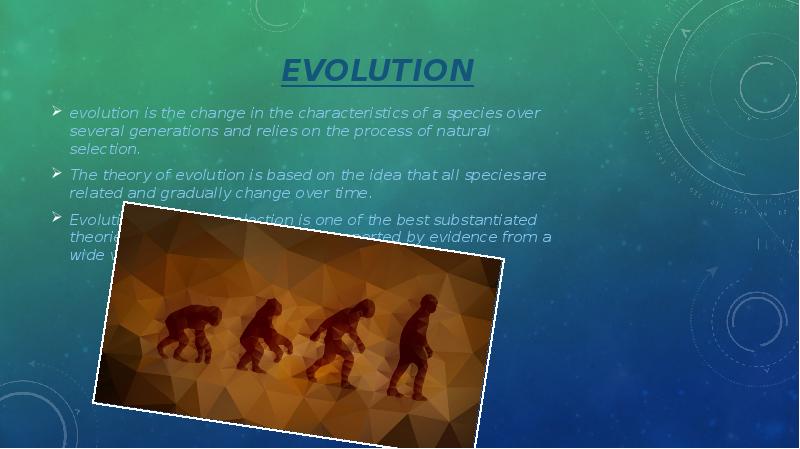
evolution is the change in the characteristics of a species over several generations and relies on the process of natural selection.
The theory of evolution is based on the idea that all species are related and gradually change over time.
Evolution by natural selection is one of the best substantiated theories in the history of science, supported by evidence from a wide variety of scientific disciplines
Слайд 4
Описание слайда:
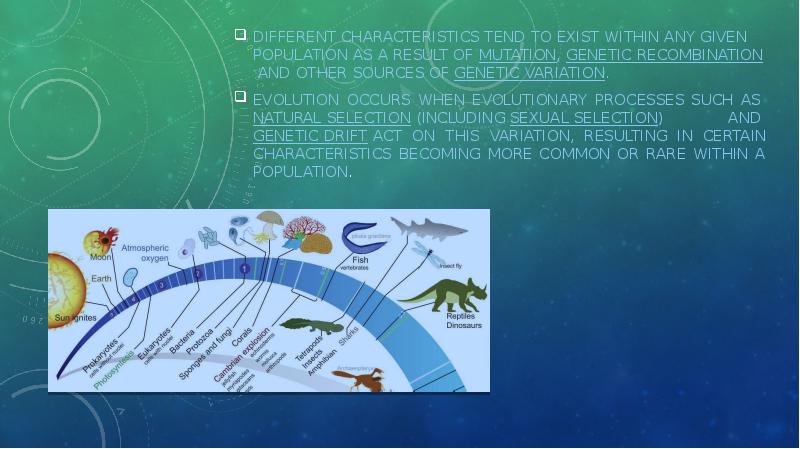
Different characteristics tend to exist within any given population as a result of mutation, genetic recombination and other sources of genetic variation.
Evolution occurs when evolutionary processes such as natural selection (including sexual selection) and genetic drift act on this variation, resulting in certain characteristics becoming more common or rare within a population.
Слайд 5
Описание слайда:
POPULATION AS THE BASIC UNIT OF EVOLUTION.
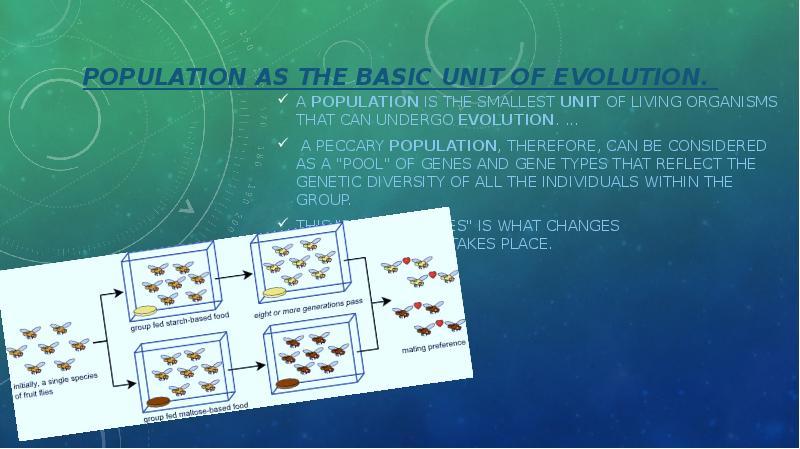
A population is the smallest unit of living organisms that can undergo evolution. ...
A peccary population, therefore, can be considered as a "pool" of genes and gene types that reflect the genetic diversity of all the individuals within the group.
This "pool-of-genes" is what changes when evolution takes place.
Слайд 6
Описание слайда:
FACTORS OF EVOLUTION
NON-DIRECTED FACTORS OF EVOLUTION
- GENETIC VARIATION IN POPULATION
GENE MUTATION
RECOMBINATION OF GENES
HYBRIDIZATION
- POPULATION SIZE
- REPRODUCTIVE ISOLATION
DIRECTED FACTORS OF EVOLUTION
- NATURAL SELECTION
Слайд 7
Описание слайда:
POPULATION SIZE
In nature all populations have a tendency and a tremendous potential for growth, but remain limited to a relatively constant size due to limitation of resources. It means only a small size of population actually serve as parents for next generation. Normally the individual better adapted to their environment are more likely to survive. But chance is also very important
Слайд 8
Описание слайда:
genetic characteristics of population
Heterogeneity of population
Genetical unity of population
If a population is not evolving, the frequencies of each allele remain constant from one generation to the next generation
Слайд 9
Описание слайда:
Heterogeneity of populations
A given population (as illustrated by different phenotypes) indicates that each individual has a different portion of the genes that exist in the gene pool.
Because most species are diploid, each individual member of a population contains only two alleles for each locus.
Therefore, a single individual has only some of the genes found in its population gene pool.
Слайд 10
Описание слайда:
Genetical unity of populations.
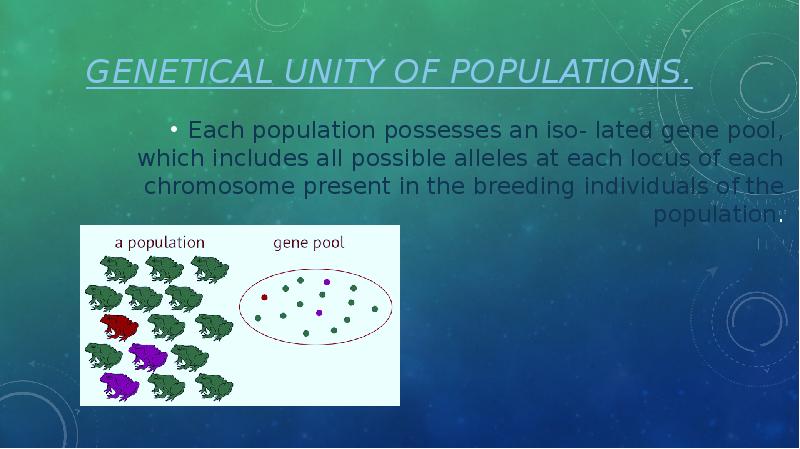
Each population possesses an iso- lated gene pool, which includes all possible alleles at each locus of each chromosome present in the breeding individuals of the population.
Слайд 11
Описание слайда:
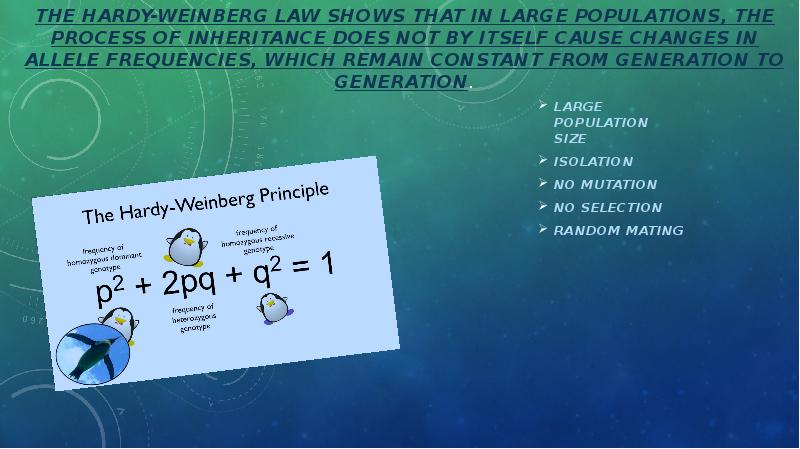
The Hardy-Weinberg law shows that in large populations, the process of inheritance does not by itself cause changes in allele frequencies, which remain constant from generation to generation.
LARGE POPULATION SIZE
ISOLATION
NO MUTATION
NO SELECTION
RANDOM MATING
Слайд 12
Описание слайда:
Most populations have a large reservoir of variability
Heterozygote advantage occurs when the heterozygote has a higher degree of fitness than either homozygote. Both alleles are maintained in the population.
In frequency-dependent selection, a genotype’s selective value varies with its frequency of occurrence.
Variation that confers no detectable selective advantage is called neutral variation.
The neutralist-selectionist controversy is a debate among biologists over the relative importance of selection versus genetic drift in maintaining genetic variability.
Слайд 13
Описание слайда:
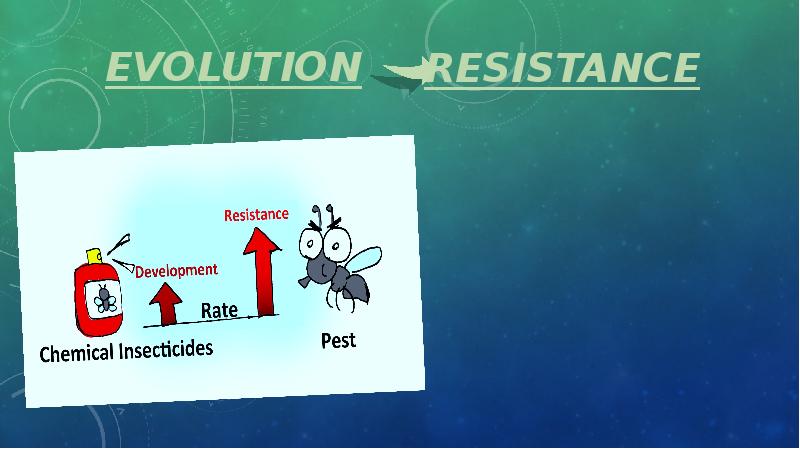
EVOLUTION
RESISTANCE
Слайд 14
Описание слайда:
for better understanding
https://www.youtube.com/watch?v=GhHOjC4oxh8
https://www.youtube.com/watch?v=SRWXEMlI0_U
https://www.youtube.com/watch?v=hOfRN0KihOU
Слайд 15
Описание слайда:
Скачать презентацию на тему COURSE STUDENT
Abhishek Upadhyay
Scientific Leader
Svetlana Smirnova
POPULATION можно ниже: