DIPLOMATIC LAW презентация
Содержание
- 2. CONTENTS The notion of diplomatic law; The sources of diplomatic law;
- 3. Terms Features Diplomatic law
- 4. II. Sources of diplomatic law (DL) (1) Sources of public international
- 5. II. Sources of DL (2): Sources of DL in Art. 38
- 6. Sources of DL (3): Sources of DL in Art. 38 of
- 7. Sources of DL (4): Sources of DL, listed in Art. 38
- 8. Sources of DL (5): Sources of DL, listed in Art. 38
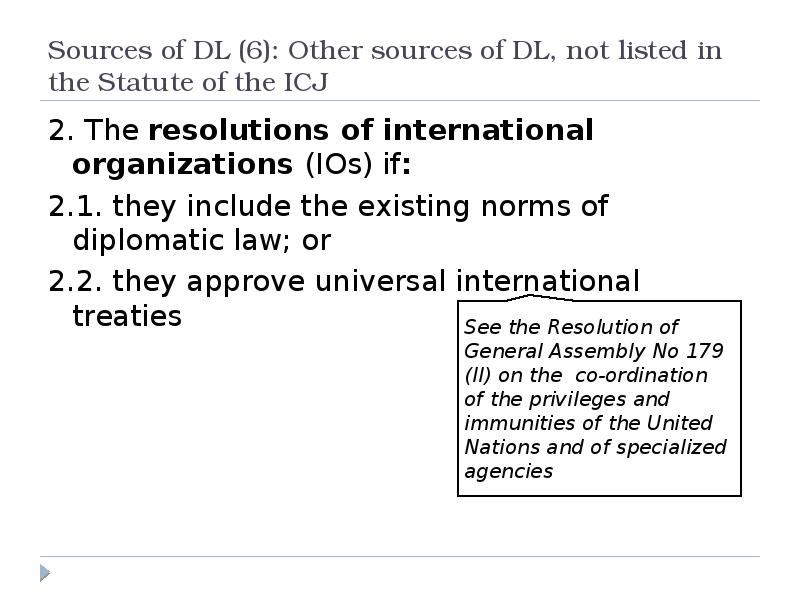
- 9. Sources of DL (6): Other sources of DL, not listed in
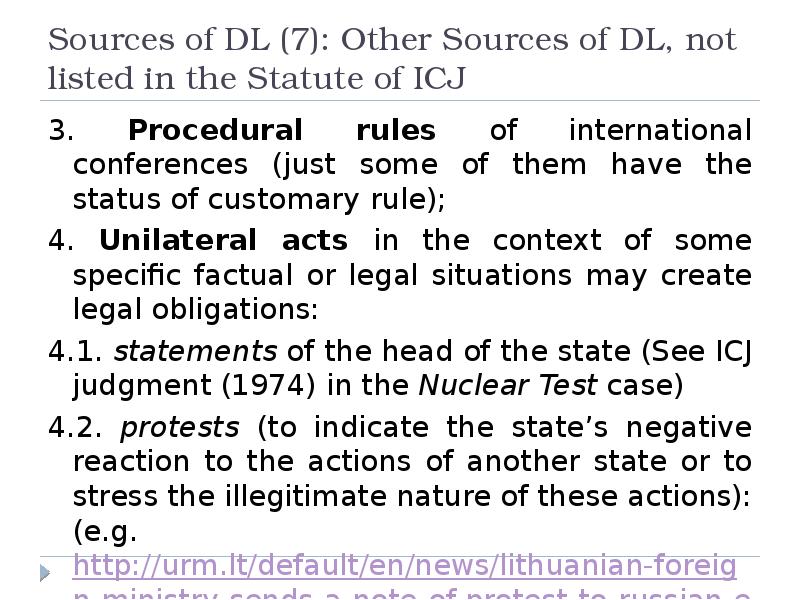
- 10. Sources of DL (7): Other Sources of DL, not listed in
- 11. Sources of DL (9): Other Sources of DL, not listed in
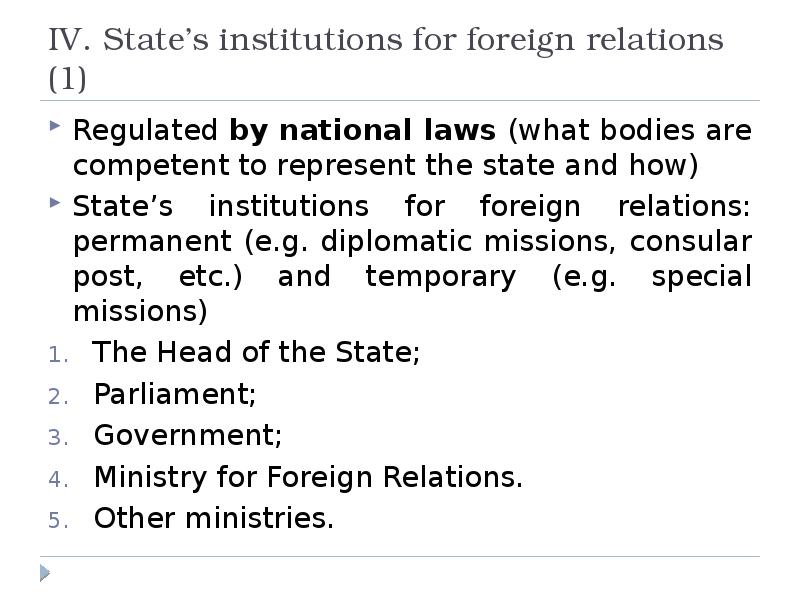
- 12. IV. State’s institutions for foreign relations (1) Regulated by national laws
- 13. IV. State’s institutions for foreign relations (3) The Head of the
- 14. IV. State’s institutions for foreign relations (4) Parliaments: Decide on war/peace
- 15. IV. State’s institutions for foreign relations (5) Governments: In practice, initiate
- 16. Скачать презентацию
Слайды и текст этой презентации
Слайд 1
Описание слайда:
DIPLOMATIC LAW
26 September 2018
Слайд 2
Описание слайда:
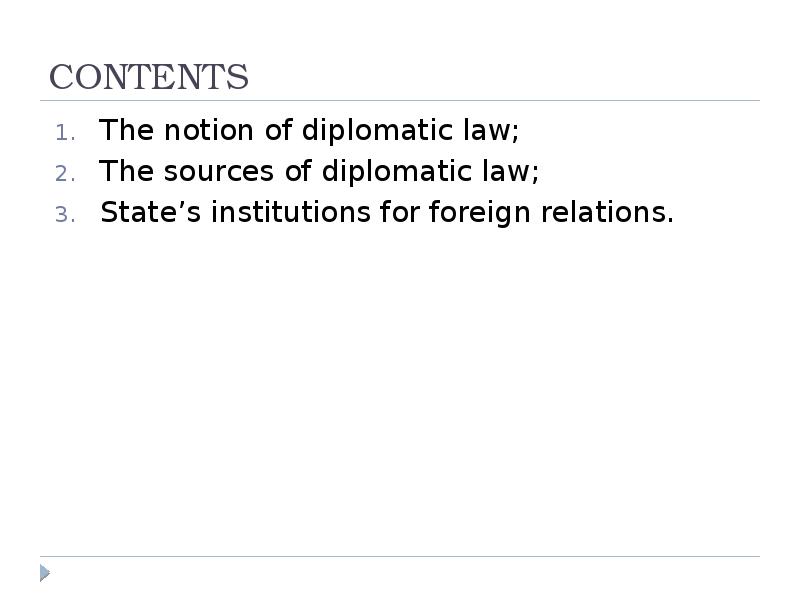
CONTENTS
The notion of diplomatic law;
The sources of diplomatic law;
State’s institutions for foreign relations.
Слайд 3
Описание слайда:
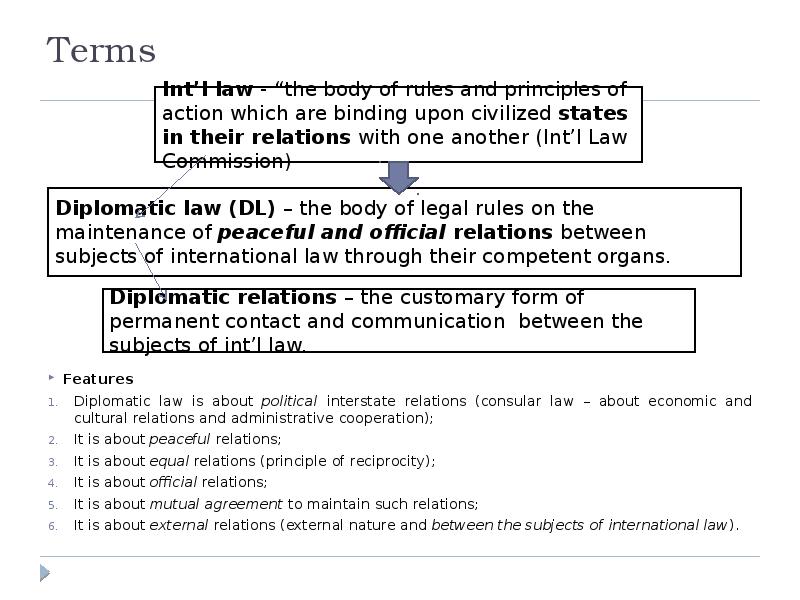
Terms
Features
Diplomatic law is about political interstate relations (consular law – about economic and cultural relations and administrative cooperation);
It is about peaceful relations;
It is about equal relations (principle of reciprocity);
It is about official relations;
It is about mutual agreement to maintain such relations;
It is about external relations (external nature and between the subjects of international law).
Слайд 4
Описание слайда:
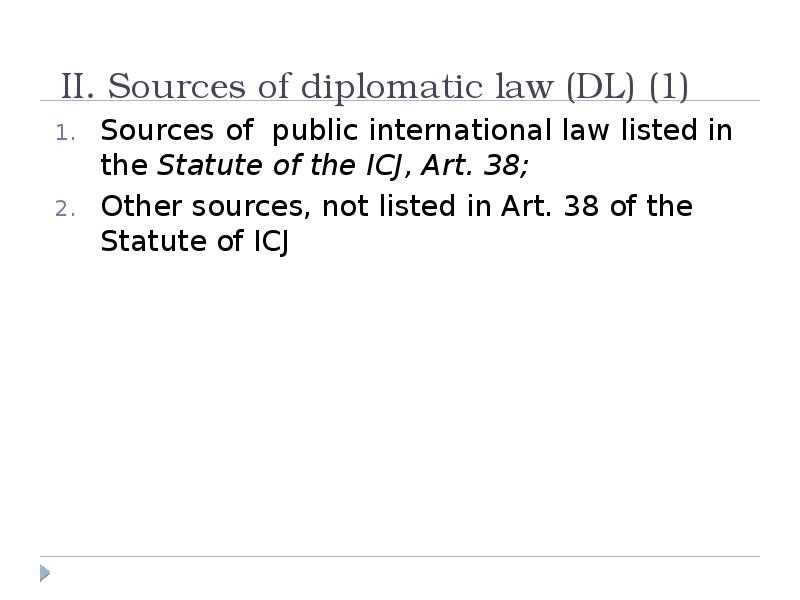
II. Sources of diplomatic law (DL) (1)
Sources of public international law listed in the Statute of the ICJ, Art. 38;
Other sources, not listed in Art. 38 of the Statute of ICJ
Слайд 5
Описание слайда:
II. Sources of DL (2): Sources of DL in Art. 38 of the Statute of the ICJ
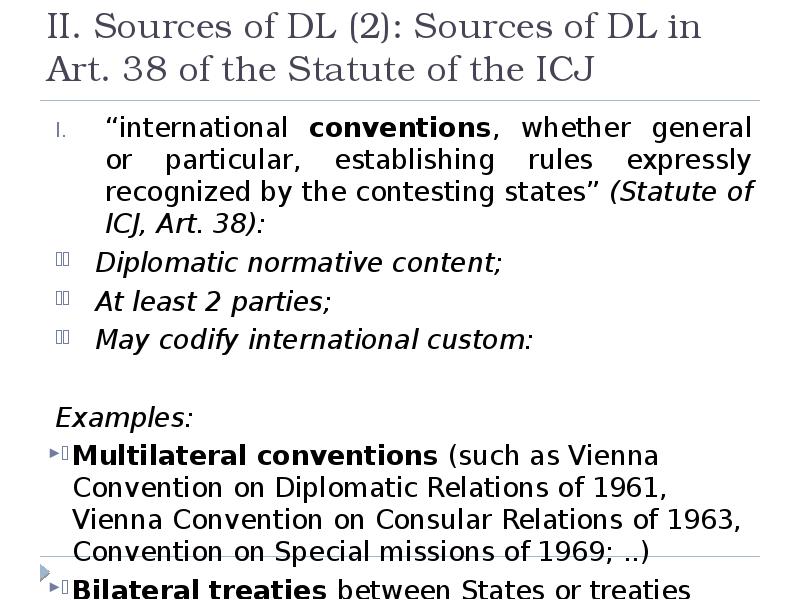
“international conventions, whether general or particular, establishing rules expressly recognized by the contesting states” (Statute of ICJ, Art. 38):
Diplomatic normative content;
At least 2 parties;
May codify international custom:
Examples:
Multilateral conventions (such as Vienna Convention on Diplomatic Relations of 1961, Vienna Convention on Consular Relations of 1963, Convention on Special missions of 1969; ..)
Bilateral treaties between States or treaties with IO’s on the questions of DL.
Слайд 6
Описание слайда:
Sources of DL (3): Sources of DL in Art. 38 of the Statute of the ICJ
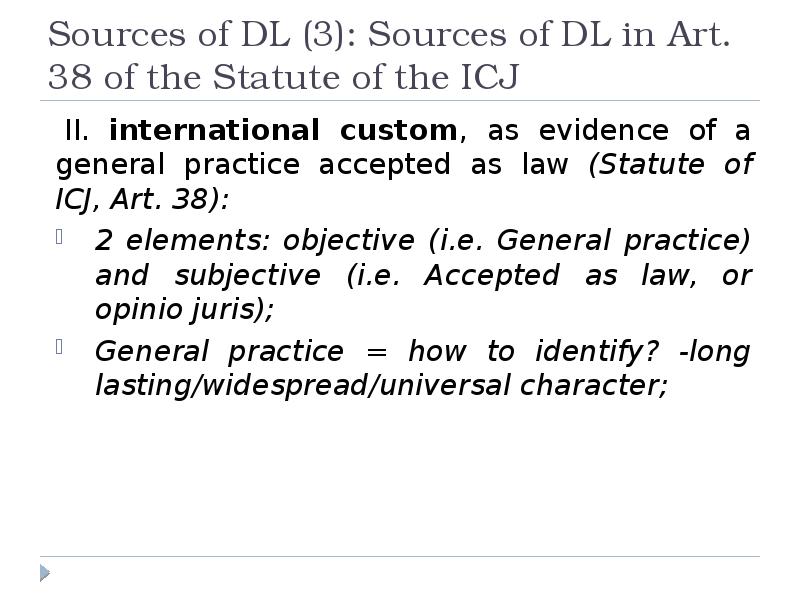
II. international custom, as evidence of a general practice accepted as law (Statute of ICJ, Art. 38):
2 elements: objective (i.e. General practice) and subjective (i.e. Accepted as law, or opinio juris);
General practice = how to identify? -long lasting/widespread/universal character;
Слайд 7
Описание слайда:
Sources of DL (4): Sources of DL, listed in Art. 38 of the Statute of the ICJ
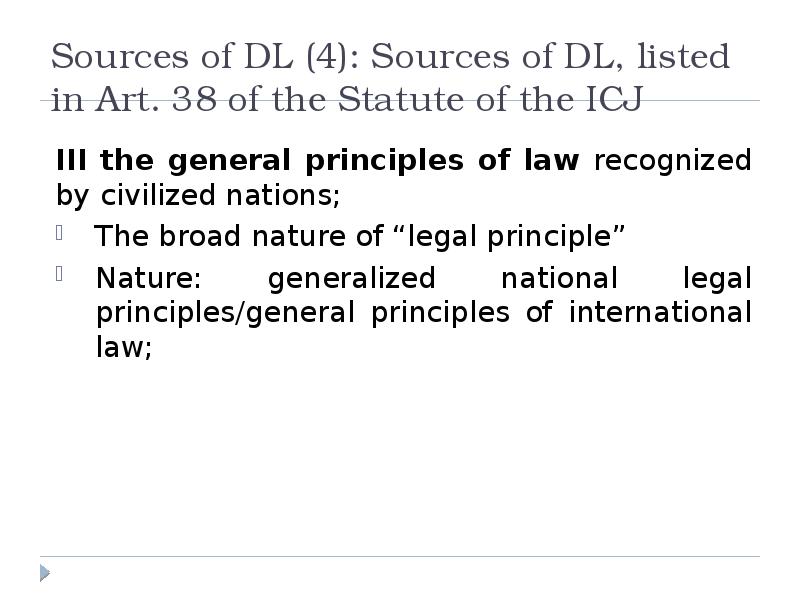
III the general principles of law recognized by civilized nations;
The broad nature of “legal principle”
Nature: generalized national legal principles/general principles of international law;
Слайд 8
Описание слайда:
Sources of DL (5): Sources of DL, listed in Art. 38 of the Statute of the ICJ
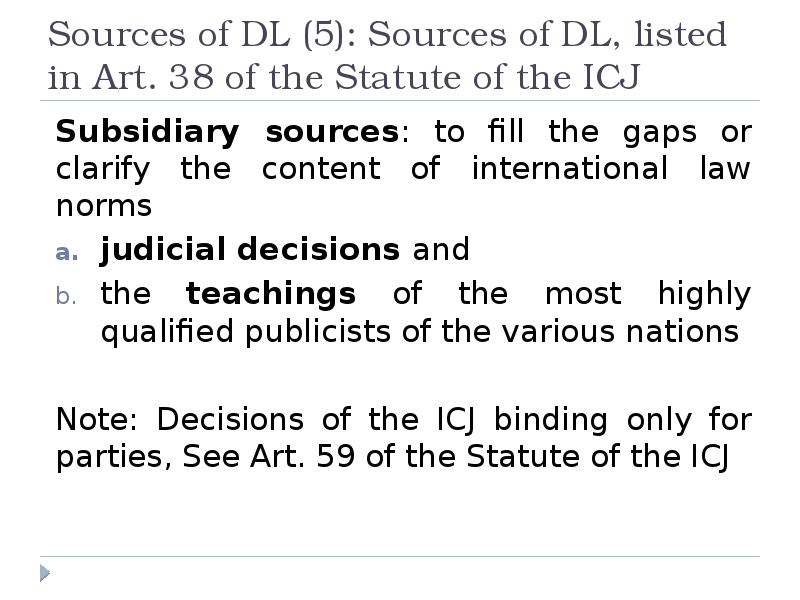
Subsidiary sources: to fill the gaps or clarify the content of international law norms
judicial decisions and
the teachings of the most highly qualified publicists of the various nations
Note: Decisions of the ICJ binding only for parties, See Art. 59 of the Statute of the ICJ
Слайд 9
Описание слайда:
Sources of DL (6): Other sources of DL, not listed in the Statute of the ICJ
2. The resolutions of international organizations (IOs) if:
2.1. they include the existing norms of diplomatic law; or
2.2. they approve universal international treaties
Слайд 10
Описание слайда:
Sources of DL (7): Other Sources of DL, not listed in the Statute of ICJ
3. Procedural rules of international conferences (just some of them have the status of customary rule);
4. Unilateral acts in the context of some specific factual or legal situations may create legal obligations:
4.1. statements of the head of the state (See ICJ judgment (1974) in the Nuclear Test case)
4.2. protests (to indicate the state’s negative reaction to the actions of another state or to stress the illegitimate nature of these actions): (e.g. http://urm.lt/default/en/news/lithuanian-foreign-ministry-sends-a-note-of-protest-to-russian-embassy-over-illegal-actions-in-detaining-lithuanias-fishing-vessel-)
Слайд 11
Описание слайда:
Sources of DL (9): Other Sources of DL, not listed in the Statute of ICJ
In the widest sense (because they cannot create, change or repeal DL norms, just serve for the purpose of implementation or interpretation) also:
National laws (usually on the status of the state’s or IO’s missions or the functioning of the diplomatic service)
The doctrine of diplomatic law;
Слайд 12
Описание слайда:
IV. State’s institutions for foreign relations (1)
Regulated by national laws (what bodies are competent to represent the state and how)
State’s institutions for foreign relations: permanent (e.g. diplomatic missions, consular post, etc.) and temporary (e.g. special missions)
The Head of the State;
Parliament;
Government;
Ministry for Foreign Relations.
Other ministries.
Слайд 13
Описание слайда:
IV. State’s institutions for foreign relations (3)
The Head of the State:
Has the power to represent the State ex officio, so the actions of the Head of the State are equal to the actions of the State;
Usually accepts the credentials, appoints the representatives, negotiates with the heads and other officials of other States, concludes the treaties (the concrete powers of the Head of the State depend on the political regime)
Слайд 14
Описание слайда:
IV. State’s institutions for foreign relations (4)
Parliaments:
Decide on war/peace issues, territorial questions, ratifies the int’l treaties, assigns the budget, pass the memoranda or resolutions...
Usually have permanent commissions for foreign relations; send delegations, develop inter-parliamentary diplomacy..
Слайд 15
Описание слайда:
IV. State’s institutions for foreign relations (5)
Governments:
In practice, initiate most important decisions on the questions of foreign relations;
Ministry of Foreign Affairs:
Maintain diplomatic and consular relations with foreign countries and supervise the activity of the diplomatic missions and consular post;
Other bodies:
The heads and other officials of different institutions participate at int’l delegations, special attaches work at the diplomatic mission)
Скачать презентацию на тему DIPLOMATIC LAW можно ниже: