Global Economic Environment презентация
Содержание
- 2. The World Economy (an overview) a. Which historical event marks the
- 3. answers a. World War II b. before 10% , now 50%
- 4. In the last 20 years the global market has change shaping
- 5. answers a. Cereal farming b. Leaders and policy makers focus on
- 6. Economic systems Traditional approach: Based on resource allocation (market vs command)
- 7. Modern approach: Modern approach: Based on a more descriptive criteria. Type
- 8. Advanced Industry State Advanced Industry State Emerging Economy Type of Economy Transition
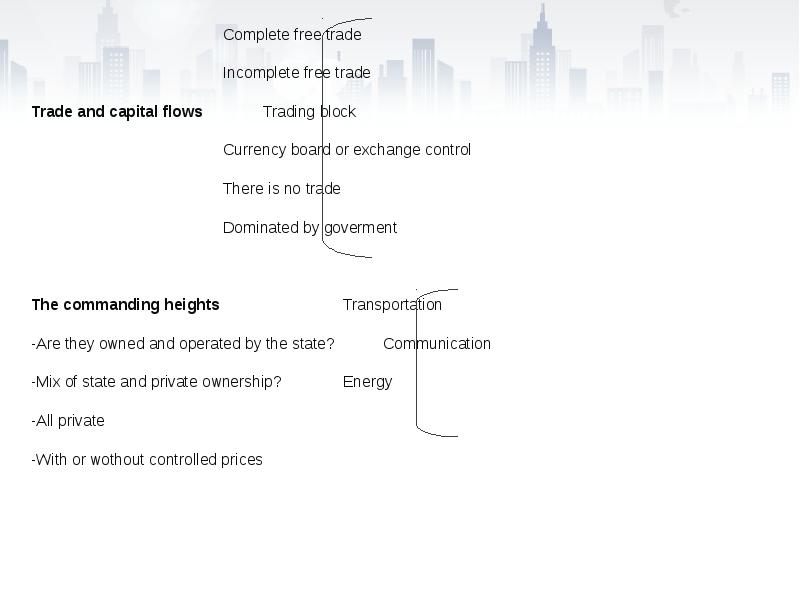
- 9. Complete free trade Complete free trade Incomplete free trade Trade and
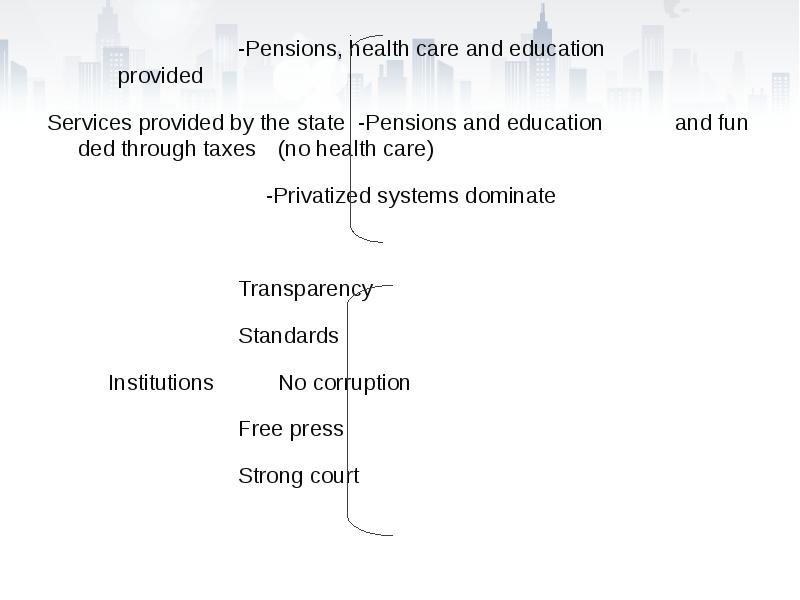
- 10. -Pensions, health care and education provided -Pensions, health care and education
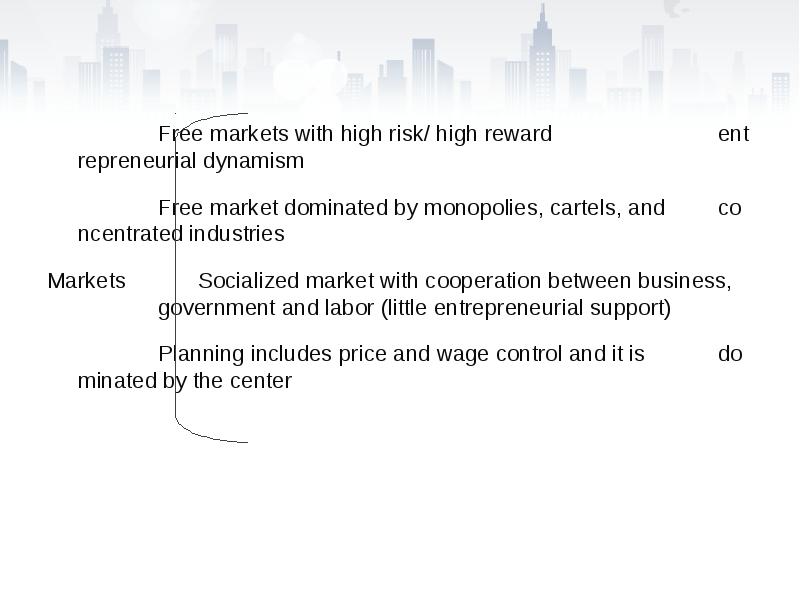
- 11. Free markets with high risk/ high reward entrepreneurial dynamism Free markets
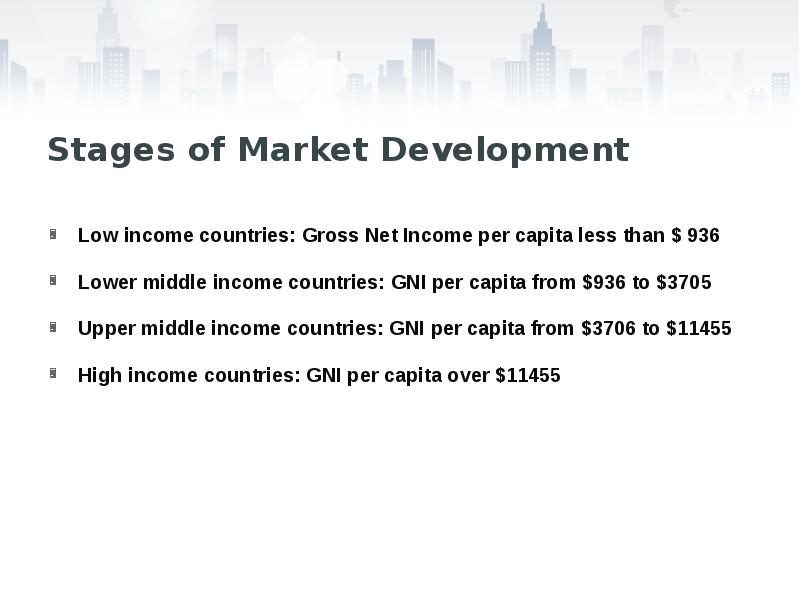
- 12. Stages of Market Development Low income countries: Gross Net Income per
- 13. Stages of Market Development Low income countries: less than $ 936
- 14. anwers: a. There are low wages Industry is promoted by the
- 15. c. Infosys c. Infosys Mahindra and Mahindra Tata Wipro d. Huge
- 16. Lower middle income countries: GNI per capita from $936 to $3705
- 17. answers a. Mature, standirized labor intense industries such as toy makers
- 18. Upper middle income countries: GNI per capita from $3706 to $11455
- 19. Exercise: Exercise: a. Name some advantageous characteristics of Brazil? b. Which
- 20. Answers Answers a. is the largest in South America in terms
- 21. Balance of Payments Record of all economic transsactions between residents of
- 22. A country accumulates reserves when the net of current and capital
- 23. Overview of International Finance - spot market vs forward market -central
- 25. Скачать презентацию

Слайды и текст этой презентации
Слайд 1
Описание слайда:
Global Economic Environment
-THE WORLD ECONOMY (AN OVERVIEW)
-ECONOMIC SYSTEMS
-STAGES OF MARKET DEVELOPMENT
-BALANCE OF PAYMENTS
-OVERVIEW OF INTERNATIONAL FINANCE
Слайд 2
Описание слайда:
The World Economy (an overview)
a. Which historical event marks the emergence of global markets?
b. What was the percentage of economic integration at the beginning of the 20th century and what is the precentage now?
c. Which product can be use as an example to show such market integration?
Слайд 3
Описание слайда:
answers
a. World War II
b. before 10% , now 50%
c. cars
Слайд 4
Описание слайда:
In the last 20 years the global market has change shaping a number of new realites to be taken into acount:
In the last 20 years the global market has change shaping a number of new realites to be taken into acount:
Capital movements replace trade as the driving force of economy
Production is uncoupled from employment
a. which economic activity in USA is a clear example of this disparity?
Countrys' economies are subordinate to global economy
b. What is the secret of the succes of Japanese and German companies?
Pure socialism prove to be inefficient as economic system
c. How socialist countries adapted to new global market conditions?
e-commerce has diminished the importance of national barriers
d. which two inventions made possible the informatic era?
Слайд 5
Описание слайда:
answers
a. Cereal farming
b. Leaders and policy makers focus on world market and the competition in each country
c. by mix approach with capitalism
d. PC's and the Internet
Слайд 6
Описание слайда:
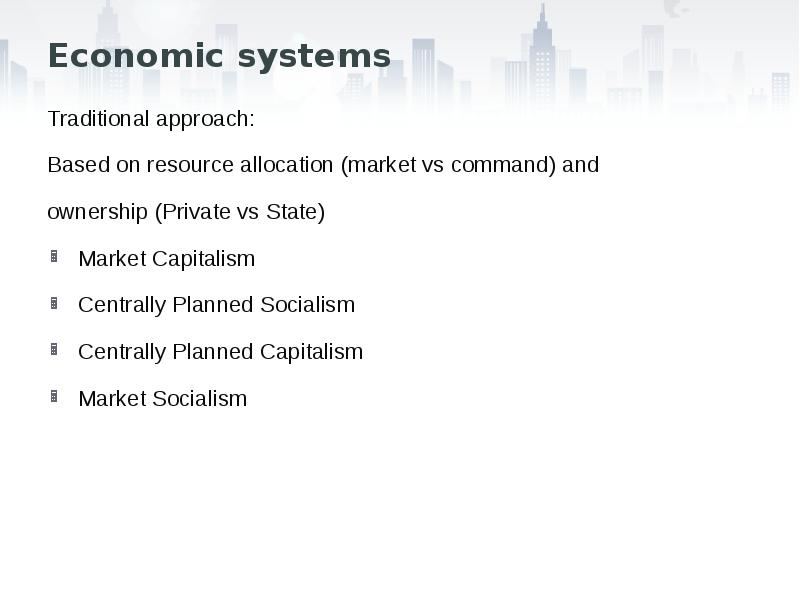
Economic systems
Traditional approach:
Based on resource allocation (market vs command) and
ownership (Private vs State)
Market Capitalism
Centrally Planned Socialism
Centrally Planned Capitalism
Market Socialism
Слайд 7
Описание слайда:
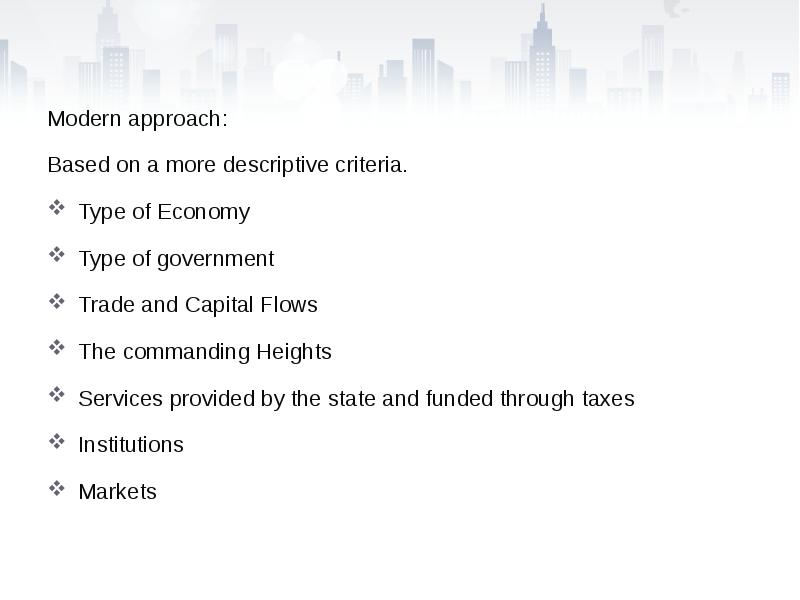
Modern approach:
Modern approach:
Based on a more descriptive criteria.
Type of Economy
Type of government
Trade and Capital Flows
The commanding Heights
Services provided by the state and funded through taxes
Institutions
Markets
Слайд 8
Описание слайда:
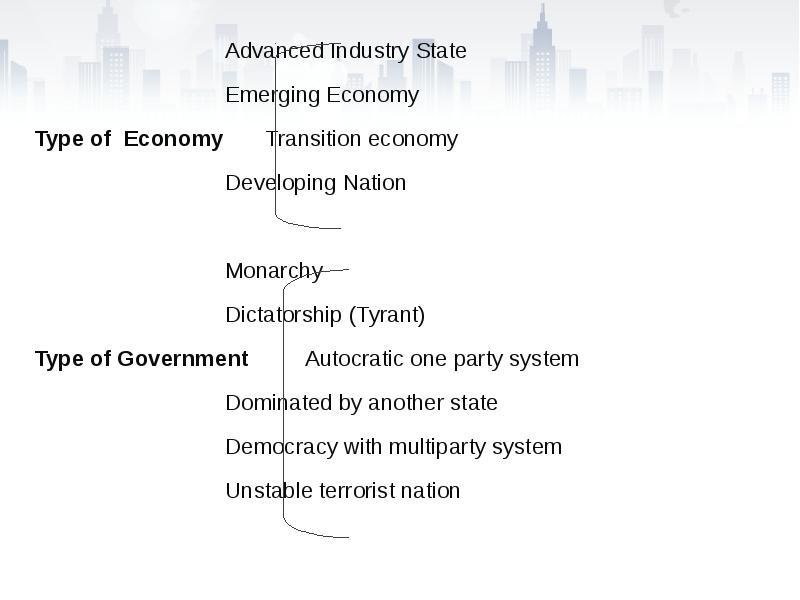
Advanced Industry State
Advanced Industry State
Emerging Economy
Type of Economy Transition economy
Developing Nation
Monarchy
Dictatorship (Tyrant)
Type of Government Autocratic one party system
Dominated by another state
Democracy with multiparty system
Unstable terrorist nation
Слайд 9
Описание слайда:
Complete free trade
Complete free trade
Incomplete free trade
Trade and capital flows Trading block
Currency board or exchange control
There is no trade
Dominated by goverment
The commanding heights Transportation
-Are they owned and operated by the state? Communication
-Mix of state and private ownership? Energy
-All private
-With or wothout controlled prices
Слайд 10
Описание слайда:
-Pensions, health care and education provided
-Pensions, health care and education provided
Services provided by the state -Pensions and education and funded through taxes (no health care)
-Privatized systems dominate
Transparency
Standards
Institutions No corruption
Free press
Strong court
Слайд 11
Описание слайда:
Free markets with high risk/ high reward entrepreneurial dynamism
Free markets with high risk/ high reward entrepreneurial dynamism
Free market dominated by monopolies, cartels, and concentrated industries
Markets Socialized market with cooperation between business, government and labor (little entrepreneurial support)
Planning includes price and wage control and it is dominated by the center
Слайд 12
Описание слайда:
Stages of Market Development
Low income countries: Gross Net Income per capita less than $ 936
Lower middle income countries: GNI per capita from $936 to $3705
Upper middle income countries: GNI per capita from $3706 to $11455
High income countries: GNI per capita over $11455
Слайд 13
Описание слайда:
Stages of Market Development
Low income countries: less than $ 936
-Little industrialization, high agriculture (peasants farming)
-Low literacy rates
-Reliance on foreign aid
-Political inestability / unrest
Exercise:
a. Why is Bangladesh genuine market opportunity?
b. Which measures were taken by india to promote market development?
c. Which are some of indias world class companies?
d. Which characteristic makes India a good place to sell products and services?
Слайд 14
Описание слайда:
anwers:
a. There are low wages
Industry is promoted by the goverment
It is favored by a trade agreement (MFA) -Mul-Fiber Arrangement-
It sells in places others can't (like USA where chinese products are restricted)
b. Eliminating import license requirements
Reducing tariffs
Easing restrictions on Foreign Investment
Liberalizing the rupee
Слайд 15
Описание слайда:
c. Infosys
c. Infosys
Mahindra and Mahindra
Tata
Wipro
d. Huge population
Слайд 16
Описание слайда:
Lower middle income countries: GNI per capita from $936 to $3705
Lower middle income countries: GNI per capita from $936 to $3705
-Rapid expansion
-Labor forces target foreign markets
(Russia, China)
Exercise:
a. What is their competitive advantage?
b. Why is the Chinese market attrative for other countries?
c. How is China supporting its export led economic transformation?
Слайд 17
Описание слайда:
answers
a. Mature, standirized labor intense industries such as toy makers and textiles.
b. becouse of its vast size and market potential.
c. Infrastructure projects (airports, cargo ports, railroads, etc)
Слайд 18
Описание слайда:
Upper middle income countries: GNI per capita from $3706 to $11455
Upper middle income countries: GNI per capita from $3706 to $11455
AKA industrialized or developing countries.
-Low percentage of people involved in agriculture
- Increased degree of urbanization
- High literacy rates
- Wages growth
(Russia, Brazil)
Слайд 19
Описание слайда:
Exercise:
Exercise:
a. Name some advantageous characteristics of Brazil?
b. Which kind of contrasting situations can be found in Brazilian economy?
c. Are there any similar contrasts in China?
Слайд 20
Описание слайда:
Answers
Answers
a. is the largest in South America in terms of economy, population, territory, and natural resources
b. while distribution services are computarized, horse drawn carts are a common way to deliver goods.
c. your opinion
Слайд 21
Описание слайда:
Balance of Payments
Record of all economic transsactions between residents of a country and the rest of the world.
It can be measured by analysing the Current accounts, and the Capital Accounts
The current account: is a broad measure that includes:
-merchandise trade -Service trade and
-Some financial transfers (humanitarian aid)
A country with negative current account balance has trade deficit when the flow of money exceeds the inflow of money for sales exports. (it is buying more than it sells). On the other hand, positive current account balance translates in trade surplus.
Capital account: is a record of all long term direct ivestment, portafolio investment, and other short and long term capital flows.
Слайд 22
Описание слайда:
A country accumulates reserves when the net of current and capital account transactions show surplus. In contrast, it gives up reserves when the net shows a deficit.
A country accumulates reserves when the net of current and capital account transactions show surplus. In contrast, it gives up reserves when the net shows a deficit.
Exercise:
a. Why USA shows a growing trade deficit?
-increased imports from china
-insatiable demand for imported products
-the cost of military operations in middle east
(USA balances the situation with a continuos and growing surplus on services)
Слайд 23
Описание слайда:
Overview of International Finance
- spot market vs forward market
-central bank role: buys and sells currency to influence exchange rates
-currency speculators
-currency conversion issue for companies
Purchasing power parity
Economic exposure
Managing exchange rate exposure
Слайд 24
Описание слайда:
Скачать презентацию на тему Global Economic Environment можно ниже: