Importing, Exporting, and Sourcing Chapter 8 презентация
Содержание
- 2. Learning Objectives Compare and contrast export selling and export marketing. Identify
- 3. Export Selling vs. Export Marketing Export selling involves selling the
- 4. Requirements for Export Marketing An understanding of the target market environment
- 5. Organizational Export Activities The firm is unwilling to export; it will
- 6. Organizational Export Activities (Cont.) The firm is an experienced exporter to
- 7. Potential Export Problems
- 8. Top 10 Clothing Exporters 2011 ($ billions)
- 9. National Policies Governing Exports and Imports Most nations encourage exports and
- 10. Government Programs that Support Exports Governments concerned about trade deficits or
- 11. Government Programs that Support Exports Tax incentives Subsidies Governmental assistance Free
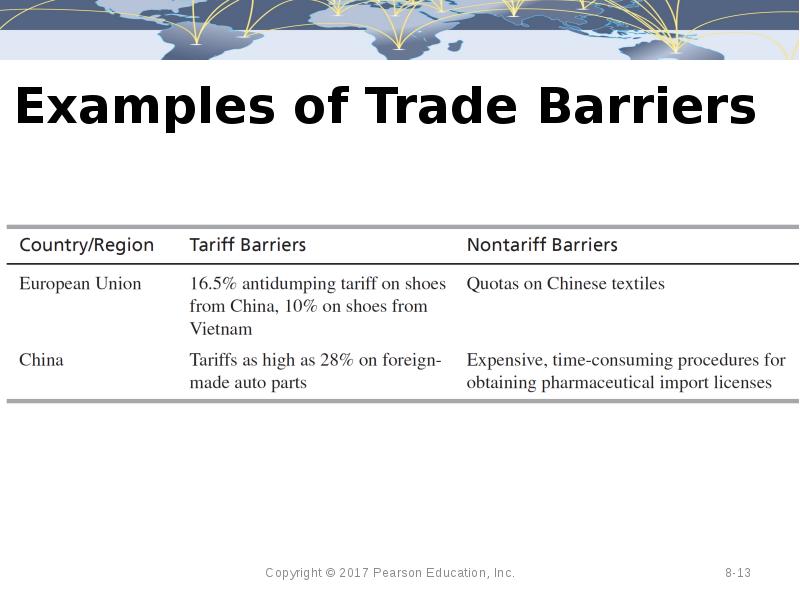
- 12. Governmental Actions to Discourage Imports and Block Market Access Tariffs: 3
- 13. Examples of Trade Barriers
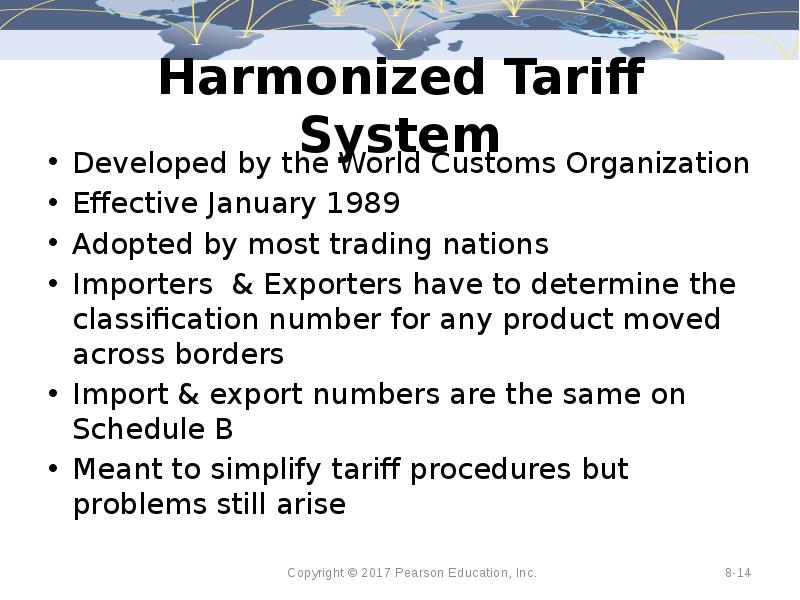
- 14. Harmonized Tariff System Developed by the World Customs Organization Effective January
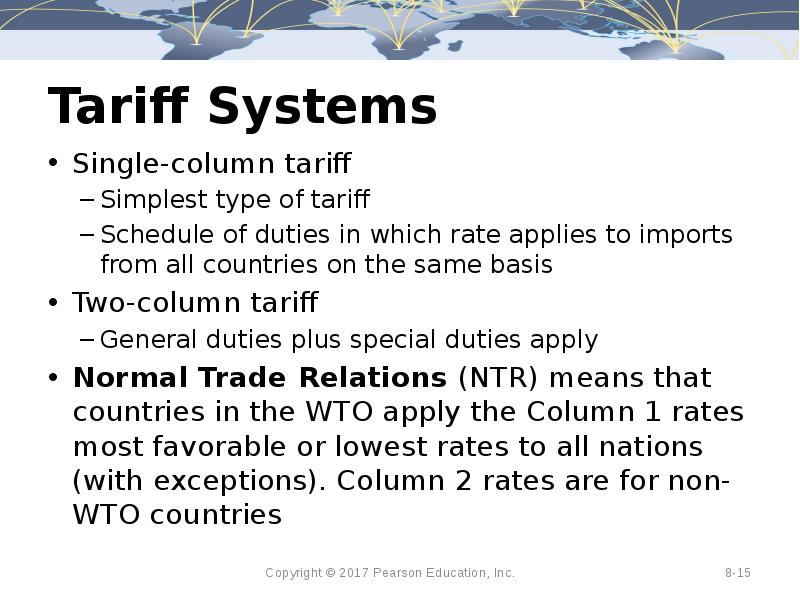
- 15. Tariff Systems Single-column tariff Simplest type of tariff Schedule of
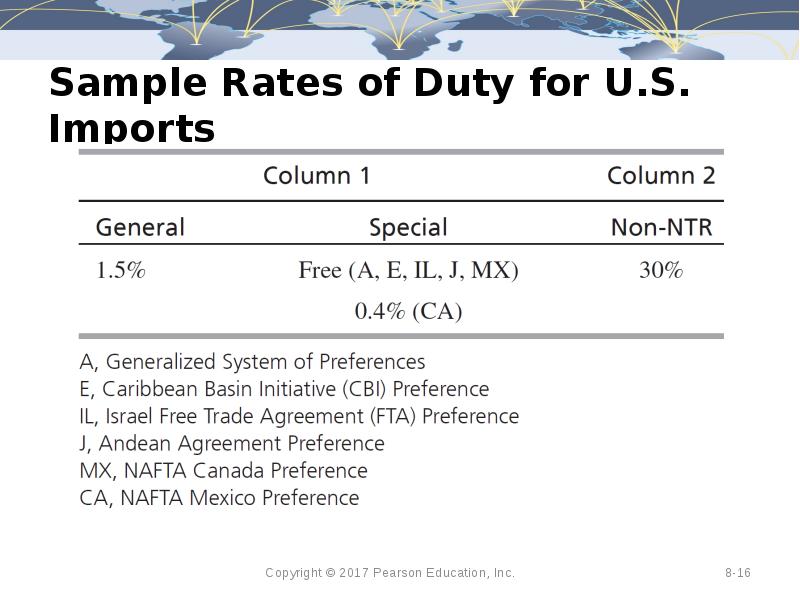
- 16. Sample Rates of Duty for U.S. Imports
- 17. Preferential Tariff Reduced tariff rate applied to imports from certain countries
- 18. Customs Duties Ad valorem duty Expressed as percentage of value of
- 19. Other Duties and Import Charges Anti-dumping Duties Dumping is the sale
- 20. Key Export Participants Foreign purchasing agents Export brokers Export merchants
- 21. Organizing for Exporting in the Manufacturer’s Country Exports can be handled
- 22. Organizing for Exporting in the Market Country Direct market representation Advantages:
- 23. Trade Financing and Methods of Payment Documentary credits (letter of credit)
- 24. Documentary Credit-Letter of Credit
- 25. Documentary Credit (Con’t)
- 26. Methods of Payment Documentary Collections (Sight or Time Drafts) use a
- 27. Methods of Payment Cash in Advance
- 28. Customs Trade Partnership Against Terrorism The U.S. Customs and Border Patrol
- 29. Duty Drawback Refunds of duties paid on imports that are processed
- 30. Sourcing
- 31. Factors that Affect Sourcing Management vision Factor costs and conditions Customer
- 32. Other Export/Import Issues
- 33. Other Export/Import Issues Customer Needs Needs can trump low cost; Dell
- 34. Other Export/Import Issues Political Factors Political risk is higher in less
- 35. Looking Ahead to Chapter 9 Global Market-Entry Strategies: Licensing, Investment, and
- 36. Скачать презентацию

Слайды и текст этой презентации
Слайд 1
Описание слайда:
Слайд 2
Описание слайда:
Learning Objectives
Compare and contrast export selling and export marketing.
Identify the stages a company goes through, and the problems it encounters, as it gains experience as an exporter.
Describe the various national policies that pertain to imports and exports.
Explain the structure of the Harmonized Tariff System.
Describe the various organizations that participate in the export process.
Identify home-country export organization considerations.
Identify market-country export organization considerations.
Discuss the various payment methods that are typically used in trade financing.
Identify the factors that global marketers consider when making sourcing decisions.
Слайд 3
Описание слайда:
Export Selling vs. Export Marketing
Export selling involves selling the same product, at the same price, with the same promotional tools in a different place
Export marketing tailors the marketing mix to international customers
Слайд 4
Описание слайда:
Requirements for Export Marketing
An understanding of the target market environment
The use of market research and identification of market potential
Decisions concerning product design, pricing, distribution and channels, advertising, and communications
Слайд 5
Описание слайда:
Organizational Export Activities
The firm is unwilling to export; it will not even fill an unsolicited export order.
The firm fills unsolicited export orders but does not pursue unsolicited orders. Such a firm is an export seller.
The firm explores the feasibility of exporting (this stage may bypass Stage 2).
The firm exports to one or more markets on a trial basis.
Слайд 6
Описание слайда:
Organizational Export Activities (Cont.)
The firm is an experienced exporter to one or more markets.
The firm pursues country- or region-focused marketing based on certain criteria
The firm evaluates global market potential for the “best” target markets.
Слайд 7
Описание слайда:
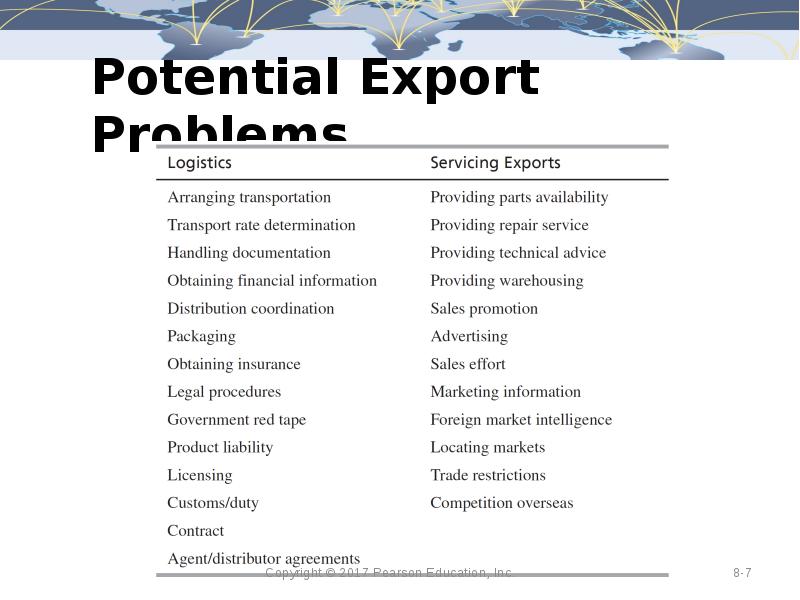
Potential Export Problems
Слайд 8
Описание слайда:
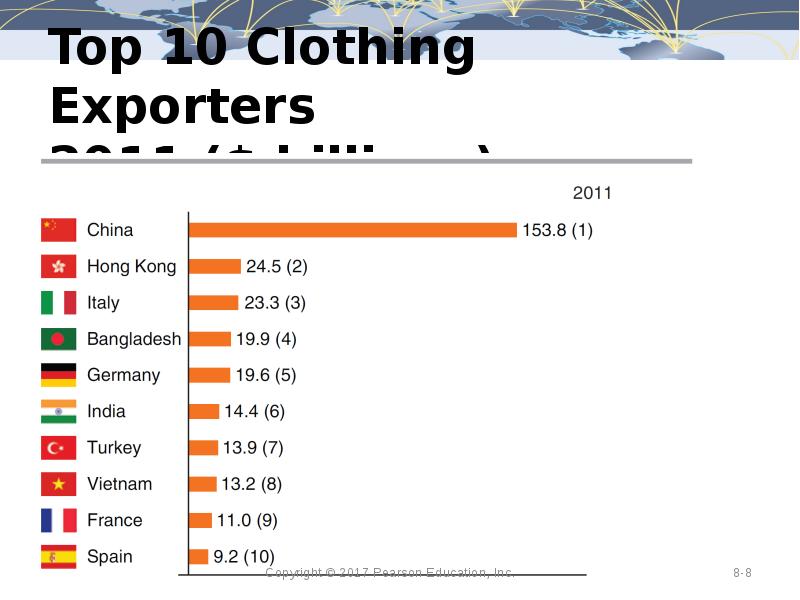
Top 10 Clothing Exporters
2011 ($ billions)
Слайд 9
Описание слайда:
National Policies Governing
Exports and Imports
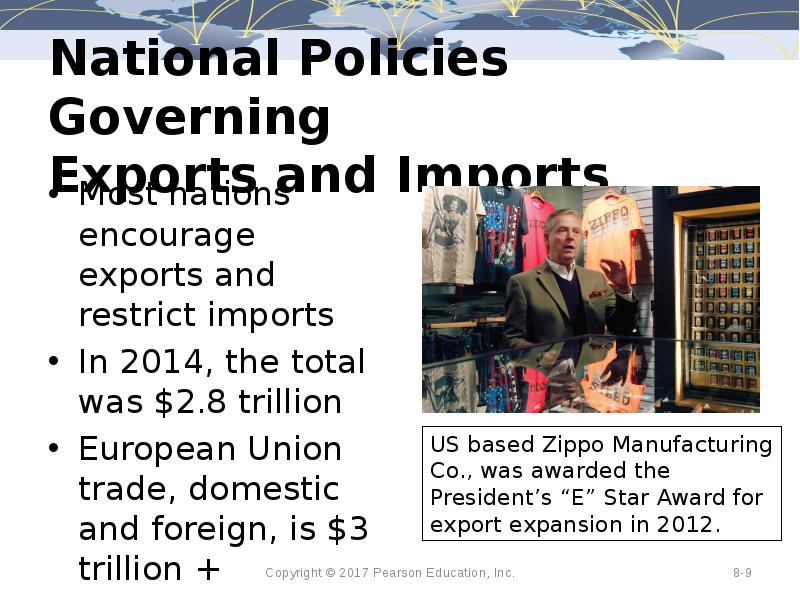
Most nations encourage exports and restrict imports
In 2014, the total was $2.8 trillion
European Union trade, domestic and foreign, is $3 trillion +
Слайд 10
Описание слайда:
Government Programs that
Support Exports
Governments concerned about trade deficits or economic development should educate firms about possible gains from exporting
Done at the national, regional & local levels
After WWII, Japan’s trade ministry developed export strategies
The China triangle (People’s Republic, Taiwan, & Hong Kong), & the four tigers--Singapore, South Korea, Taiwan, & Hong Kong) learned from Japan and built strong export-based economies
Слайд 11
Описание слайда:
Government Programs that
Support Exports
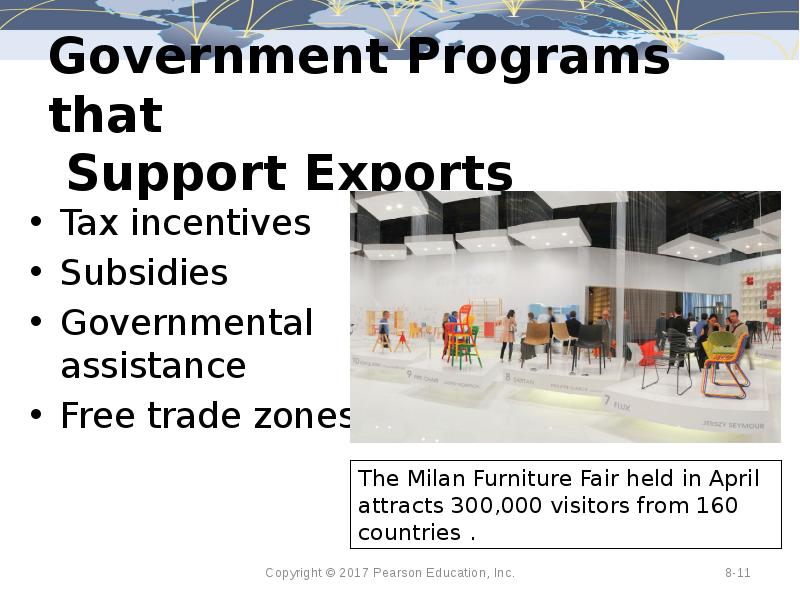
Tax incentives
Subsidies
Governmental assistance
Free trade zones
Слайд 12
Описание слайда:
Governmental Actions to Discourage Imports and Block Market Access
Tariffs: 3 Rs—rules, rate schedules, & regulations
Import controls
Nontariff barriers (hidden)
Quotas
Discriminatory procurement policies
Restrictive customs procedures
Arbitrary monetary policies
Restrictive administrative & technical regulations
Слайд 13
Описание слайда:
Examples of Trade Barriers
Слайд 14
Описание слайда:
Harmonized Tariff System
Developed by the World Customs Organization
Effective January 1989
Adopted by most trading nations
Importers & Exporters have to determine the classification number for any product moved across borders
Import & export numbers are the same on Schedule B
Meant to simplify tariff procedures but problems still arise
Слайд 15
Описание слайда:
Tariff Systems
Single-column tariff
Simplest type of tariff
Schedule of duties in which rate applies to imports from all countries on the same basis
Two-column tariff
General duties plus special duties apply
Normal Trade Relations (NTR) means that countries in the WTO apply the Column 1 rates most favorable or lowest rates to all nations (with exceptions). Column 2 rates are for non-WTO countries
Слайд 16
Описание слайда:
Sample Rates of Duty for U.S. Imports
Слайд 17
Описание слайда:
Preferential Tariff
Reduced tariff rate applied to imports from certain countries
GATT prohibits the use, with three exceptions:
Historical preference arrangements already existed
Preference is part of formal economic integration treaty
Industrial countries are permitted to grant preferential market access to LDCs
Слайд 18
Описание слайда:
Customs Duties
Ad valorem duty
Expressed as percentage of value of goods
Specific duty
Expressed as specific amount of currency per unit of weight, volume, length, or other unit of measurement
Compound or mixed duties
Apply
Слайд 19
Описание слайда:
Other Duties and Import Charges
Anti-dumping Duties
Dumping is the sale of merchandise in export markets at unfair prices
Special import charges equal to the dumping margin
Countervailing Duties offset subsidies of the exporting country
Variable Import Levies apply to agriculture
Temporary Surcharges protect local industries and are used to adjust balance of payment deficits
Слайд 20
Описание слайда:
Key Export Participants
Foreign purchasing agents
Export brokers
Export merchants
Export management companies
Слайд 21
Описание слайда:
Organizing for Exporting in the Manufacturer’s Country
Exports can be handled
As a part-time activity performed by domestic employees
Through an export partner
Through an export department
Through an export department within an international division
For multi-divisional companies; each possibility exists for each division
Слайд 22
Описание слайда:
Organizing for Exporting
in the Market Country
Direct market representation
Advantages: control and communications
Representation by independent intermediaries
Advantages: best for situations with small sales volume
Слайд 23
Описание слайда:
Trade Financing and
Methods of Payment
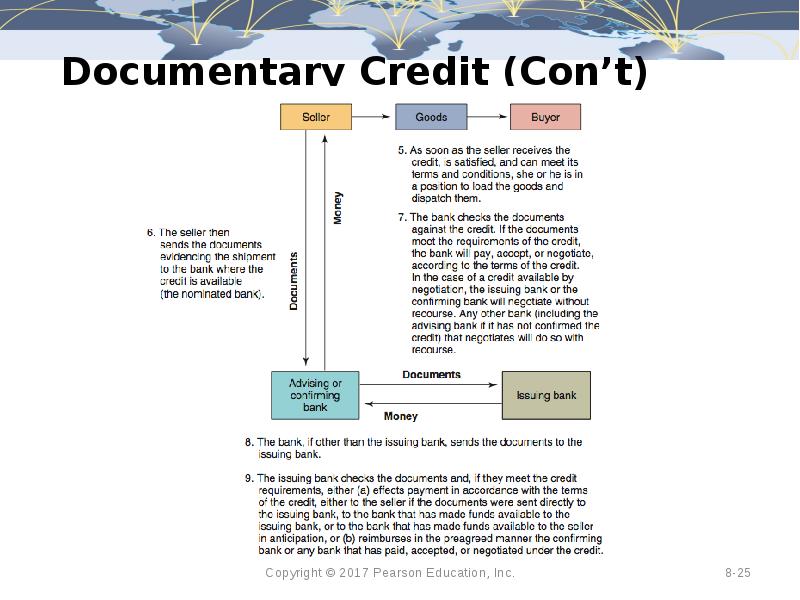
Documentary credits (letter of credit)
Documentary collections (bill of exchange)
Cash in advance
Sales on open account
Sales on consignment basis
Слайд 24
Описание слайда:
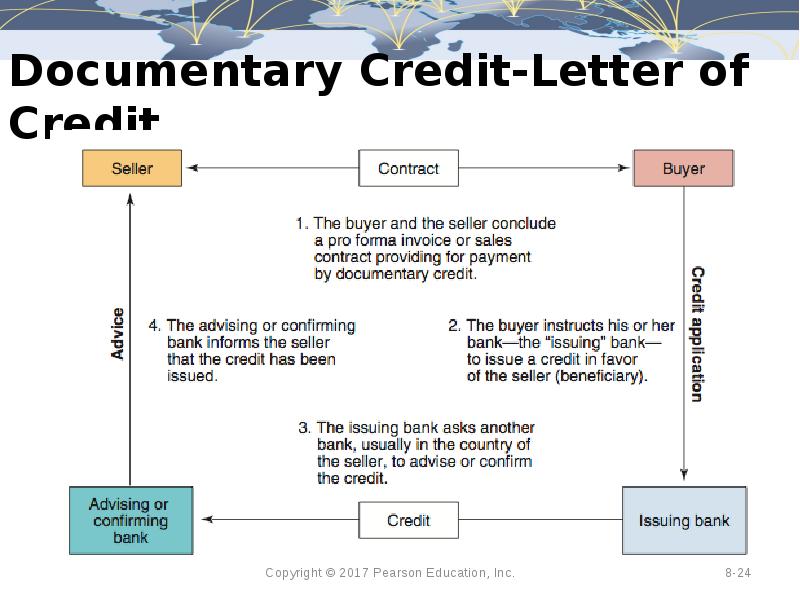
Documentary Credit-Letter of Credit
Слайд 25
Описание слайда:
Documentary Credit (Con’t)
Слайд 26
Описание слайда:
Methods of Payment
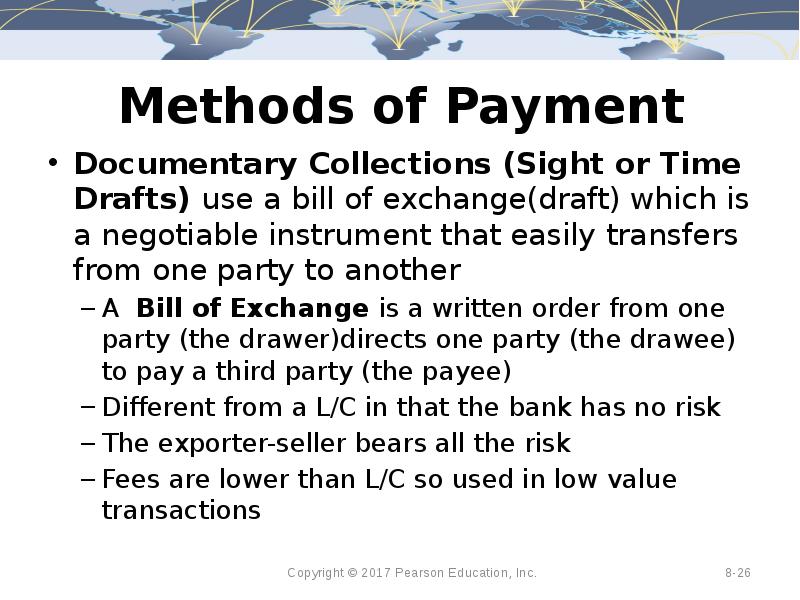
Documentary Collections (Sight or Time Drafts) use a bill of exchange(draft) which is a negotiable instrument that easily transfers from one party to another
A Bill of Exchange is a written order from one party (the drawer)directs one party (the drawee) to pay a third party (the payee)
Different from a L/C in that the bank has no risk
The exporter-seller bears all the risk
Fees are lower than L/C so used in low value transactions
Слайд 27
Описание слайда:
Methods of Payment
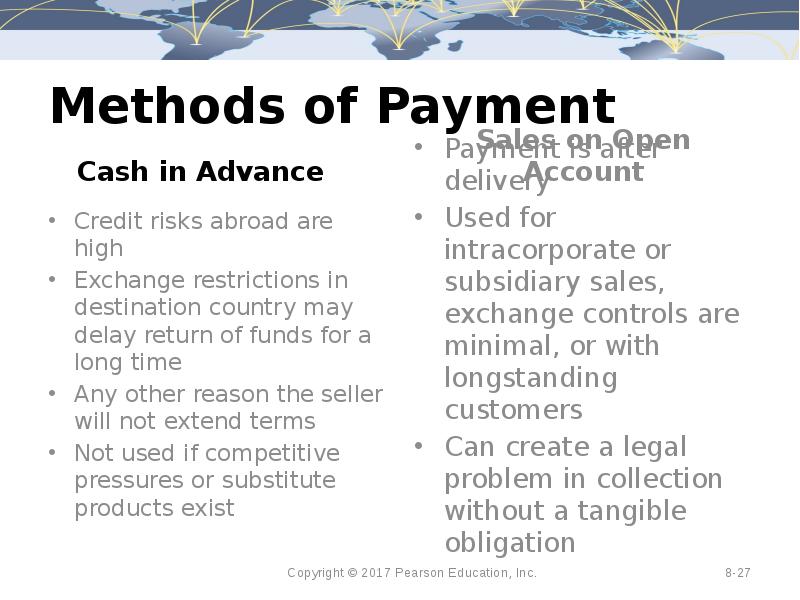
Cash in Advance
Слайд 28
Описание слайда:
Customs Trade Partnership
Against Terrorism
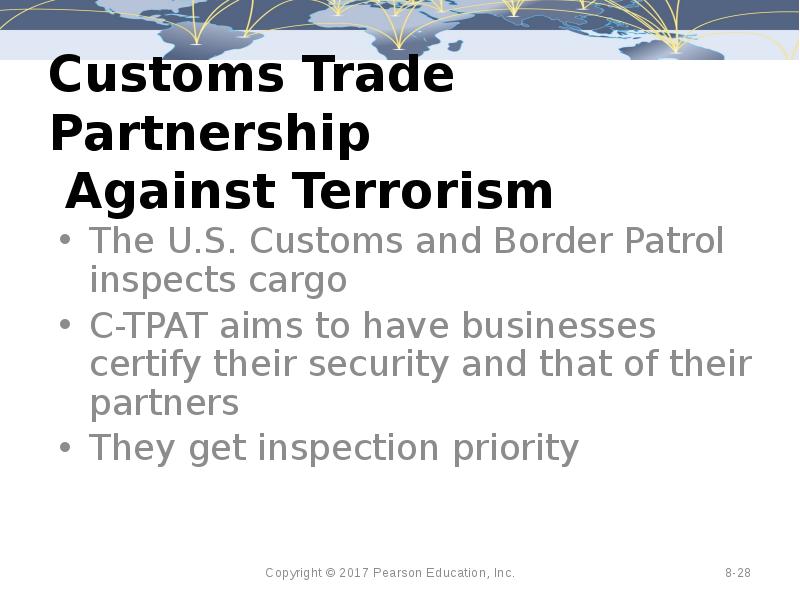
The U.S. Customs and Border Patrol inspects cargo
C-TPAT aims to have businesses certify their security and that of their partners
They get inspection priority
Слайд 29
Описание слайда:
Duty Drawback
Refunds of duties paid on imports that are processed or incorporated into other goods AND re-exported
Reduce the price of imported production inputs
Used in the U.S. to encourage exports
After NAFTA, U.S. reduced drawbacks on exports to Canada and Mexico
China had to reduce drawbacks in order to join the WTO
Слайд 30
Описание слайда:
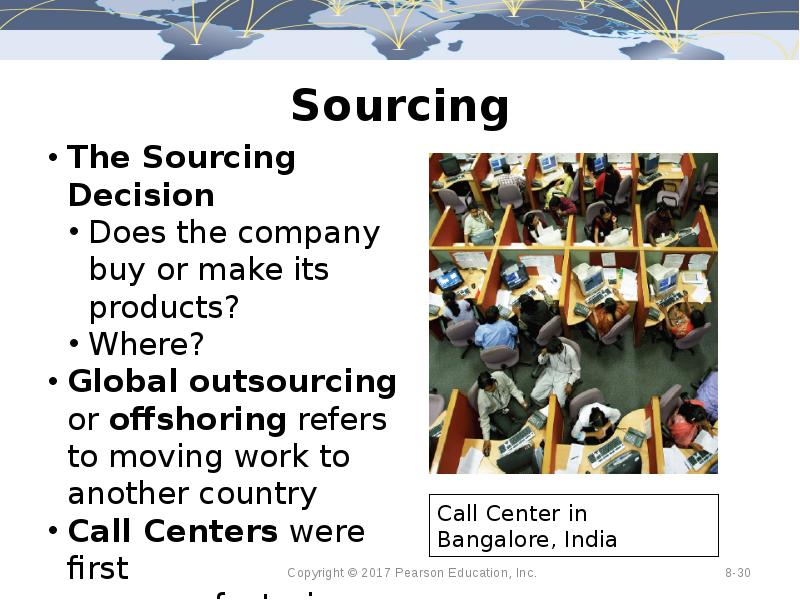
Sourcing
Слайд 31
Описание слайда:
Factors that Affect Sourcing
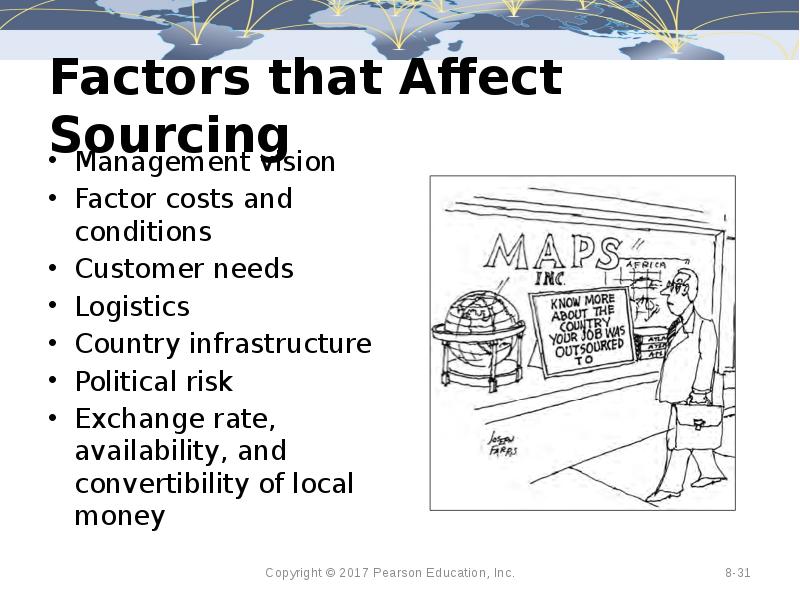
Management vision
Factor costs and conditions
Customer needs
Logistics
Country infrastructure
Political risk
Exchange rate, availability, and convertibility of local money
Слайд 32
Описание слайда:
Other Export/Import Issues
Слайд 33
Описание слайда:
Other Export/Import Issues
Customer Needs
Needs can trump low cost; Dell moved call centers back to U.S. when customers complained about problems with Indian tech support
Logistics
Improved transportation systems & intermodal services cut time & lower costs
Country Infrastructure
Power, transportation, roads, communications, service & component suppliers, a labor pool, civil order, effective government
Слайд 34
Описание слайда:
Other Export/Import Issues
Political Factors
Political risk is higher in less developed countries in Africa, South America or Asia than in the Triad
Protectionism at the state and federal level
Senate passed an amendment that would prohibit certain agencies from hiring companies that used offshore call centers
Foreign Exchange Rates
Companies try to use global sourcing to limit risk of volatile exchange rates or price levels of commodities
Слайд 35
Описание слайда:
Looking Ahead to Chapter 9
Global Market-Entry Strategies: Licensing, Investment, and Strategic Alliances
Скачать презентацию на тему Importing, Exporting, and Sourcing
Chapter 8 можно ниже: