Lecture 12 the Pronoun презентация
Содержание
- 2. 1. The Problem of Singling out the Pronoun as a Separate
- 3. Morphological Composition Simple pronouns (the stem): I, you; this, that; all,
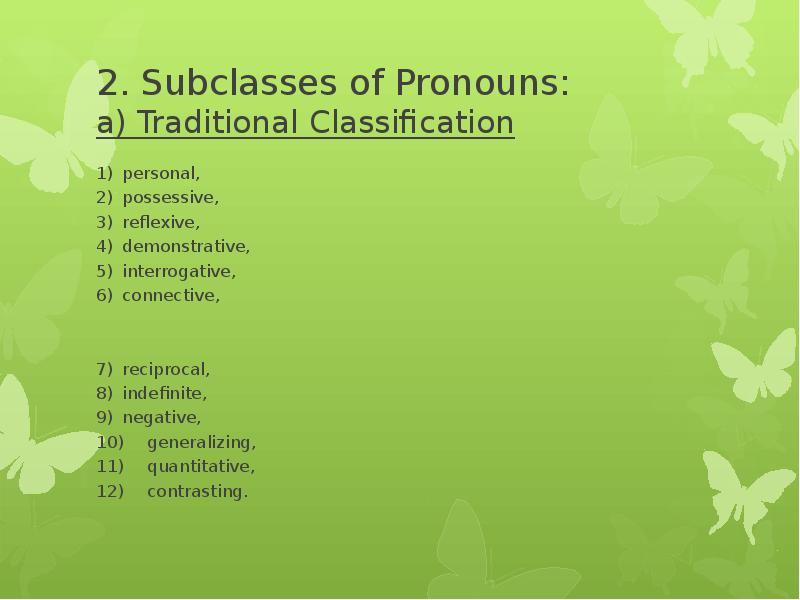
- 4. 2. Subclasses of Pronouns: a) Traditional Classification 1) personal, 2) possessive, 3) reflexive, 4) demonstrative,
- 5. Personal Pronouns Nucleus of the class I (me), thou (thee), he
- 6. Possessive Pronouns Possessive pronouns are usually treated as adjective pronouns, whereas
- 7. Reflexive Pronouns They are compound noun pronouns whose second 'element -self
- 8. Demonstrative Pronouns The pronouns this (these), that (those), such and (the)
- 9. Interrogative Pronouns The meaning that unites the interrogative pronouns:"an inquiry" about
- 10. Connective Pronouns The pronouns who, what, which, whose, that, where, when,
- 11. Reciprocal Pronouns These are the group-pronouns — each other and one
- 12. Indefinite Pronouns This class includes some, any, every, no (and their
- 13. Negative Pronouns The negative pronouns are no, nobody, nobody's, none, nothing,
- 14. Like the other pronouns in -body, -one, and -thing the negative
- 15. Generalizing pronouns Such pronouns as all, both, each, either, every and
- 16. Quantitative Pronouns Here belong much, many, (a) few, (a) little, several,
- 17. Contrasting Pronouns Here belonged/- (others, other's, others'), another (another's) and otherwise.
- 18. When the pro-noun other denotes inanimate things, it has only a
- 19. One At least three-variants of this pronoun: 1) an indefinite pronoun,
- 20. b) Functional Classification All classes of pronouns are not united by
- 22. 3. Morphological Features of the Pronoun Case B.A.Ilyish: Nomin. I
- 23. M.Y.Blokh: Personal pronominal system of cases has completely disintegrated, and in
- 24. Number this/ these that / those other / others (if not
- 25. 4. Syntactic Characteristics of the Pronoun Personal Pronouns The nominative form:
- 26. The objective form: object (with or without a preposition); occasionally
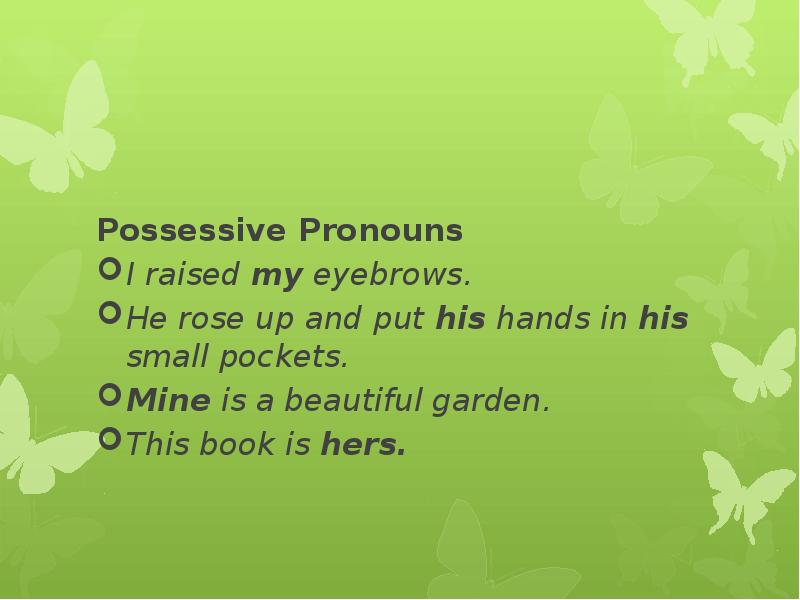
- 27. Possessive Pronouns I raised my eyebrows. He rose up and put
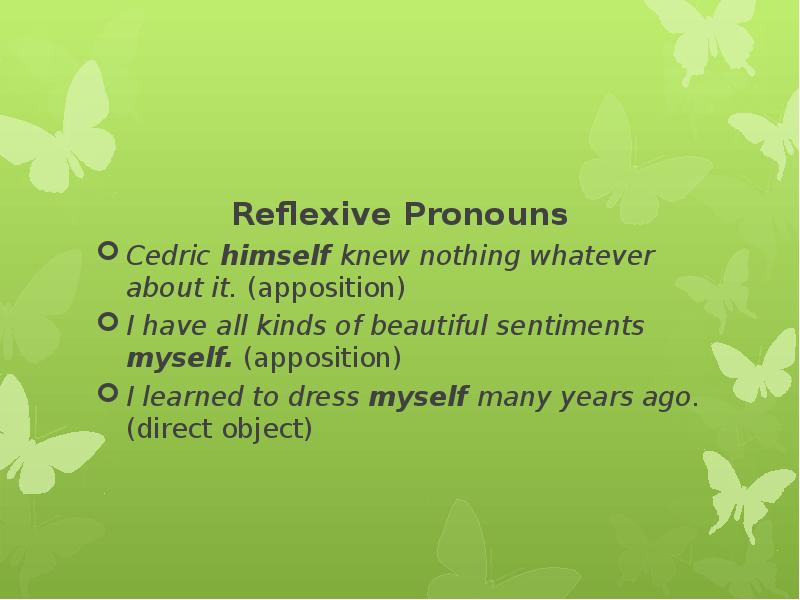
- 28. Reflexive Pronouns Cedric himself knew nothing whatever about it. (apposition)
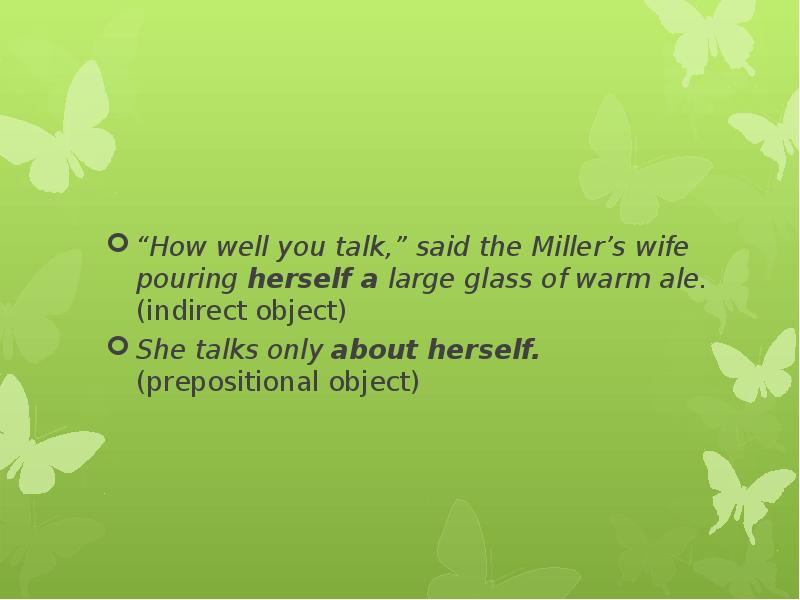
- 29. “How well you talk,” said the Miller’s wife pouring herself a
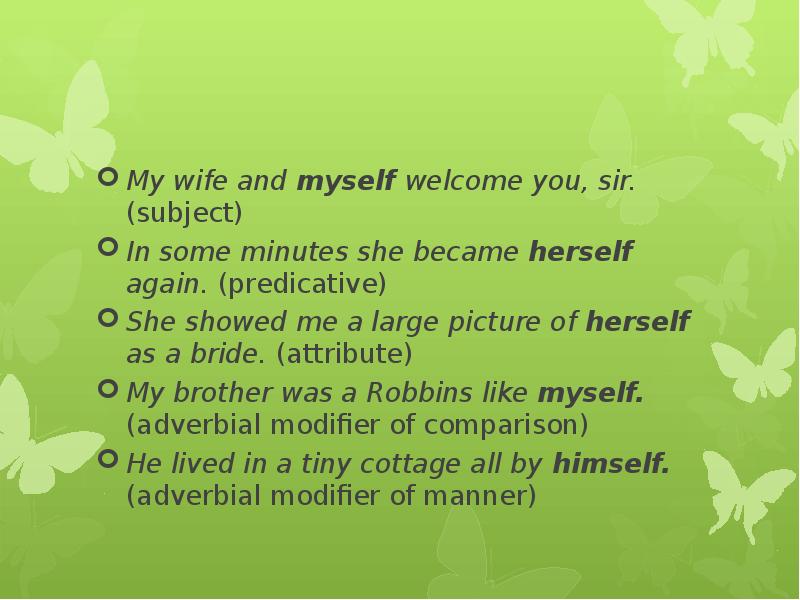
- 30. My wife and myself welcome you, sir. (subject) In some minutes
- 31. Reciprocal Pronouns Reciprocal pronouns in their common form function as objects:
- 32. Demonstrative Pronouns Syntactically the pronouns this and that can be subject,
- 33. Indefinite Pronouns Function as noun-pronouns Something unexpected always happened to him.
- 34. Negative Pronouns I told him nothing. None were present at the
- 35. Contrasting Pronouns One of the girls was pretty, while the other
- 36. Universal Pronouns Function as noun-pronouns All were present. All night long
- 37. Interrogative Pronouns Function as noun-pronouns and adjective-pronouns What has happened? What
- 38. Conjunctive Pronouns Who did it will repent. (who opens the subject
- 39. Relative Pronouns Who he was is still a mystery (conjunctive pronoun).
- 40. 5. Words of Broad Meaning and Their Pronominal Features. Notional
- 41. The lexical paradigm of nomination receives a complete substitutive representation.
- 42. Скачать презентацию






Слайды и текст этой презентации
Слайд 1
Описание слайда:
Lecture 12
the Pronoun
1. The Problem of Singling out the Pronoun as a Separate Part of Speech.
2. Subclasses of Pronouns:
a) Traditional Classification Based on Meaning;
b)Functional Classification.
3. Morphological Features of the Pronoun.
4. Syntactic Characteristics of the Pronoun.
5. Words of Broad Meaning and Their Pronominal Features.
Слайд 2
Описание слайда:
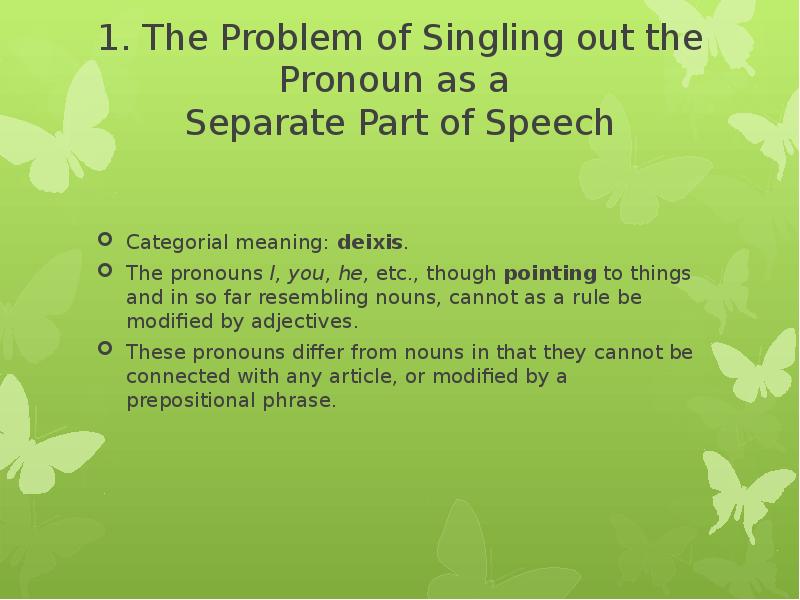
1. The Problem of Singling out the Pronoun as a
Separate Part of Speech
Categorial meaning: deixis.
The pronouns I, you, he, etc., though pointing to things and in so far resembling nouns, cannot as a rule be modified by adjectives.
These pronouns differ from nouns in that they cannot be connected with any article, or modified by a prepositional phrase.
Слайд 3
Описание слайда:
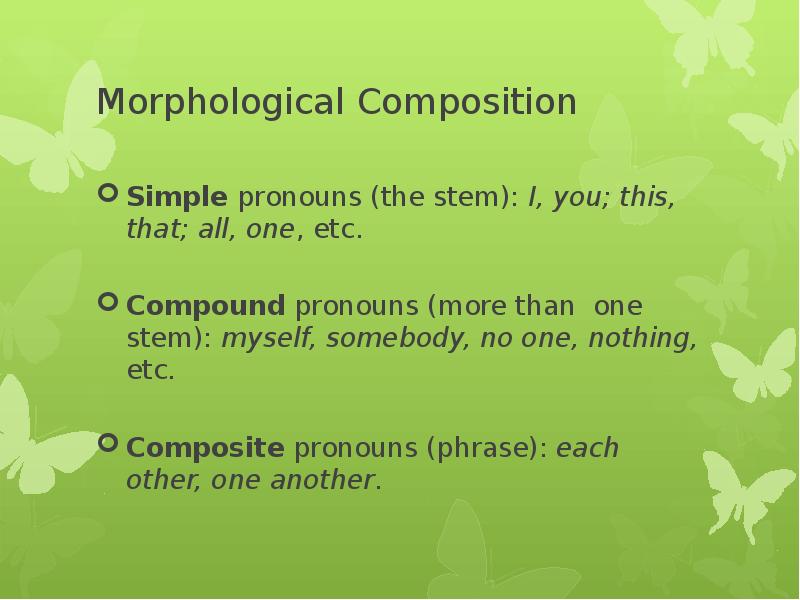
Morphological Composition
Simple pronouns (the stem): I, you; this, that; all, one, etc.
Compound pronouns (more than one stem): myself, somebody, no one, nothing, etc.
Composite pronouns (phrase): each other, one another.
Слайд 4
Описание слайда:
2. Subclasses of Pronouns:
a) Traditional Classification
1) personal,
2) possessive,
3) reflexive,
4) demonstrative,
5) interrogative,
6) connective,
7) reciprocal,
8) indefinite,
9) negative,
10) generalizing,
11) quantitative,
12) contrasting.
Слайд 5
Описание слайда:
Personal Pronouns
Nucleus of the class
I (me), thou (thee), he (him), she (her), it, we (us), you, they (them).
The personal pronouns serve to indicate all persons and things from the point of view of the speaker
All the personal pronouns are said to be noun pronouns or pro-nouns
Слайд 6
Описание слайда:
Possessive Pronouns
Possessive pronouns are usually treated as adjective pronouns, whereas they are in reality noun pronouns or pro-nouns
Possessive pronouns are possessive case opposites of the personal pronouns
Two sets of possessive pronouns — the conjoint possessive pronouns my, thy, her, our, your, their and the absolute possessive pronouns mine, thine, ours, yours, theirs.
The pairs my — mine, thy — thine, our — ours, your — yours, etc. can be regarded as opposemes of a grammatical category. It resembles the category of case.
Слайд 7
Описание слайда:
Reflexive Pronouns
They are compound noun pronouns whose second 'element -self expresses the anaphorical relation of the first element, i. e. it shows that the first element refers to the person mentioned previously in the sentence.
I ... myself, thou .. thyself, he (or John) ... himself, she (or Mary) ... herself, it (or bird) . itself, we .. ourselves, you ... yourself (yourselves), they (or the chidren) ... themselves, one ... oneself.
The reflexive pronouns distinguish the lexico-grammatical meanings of person, number and gender.
Some linguists are of the opinion that in myself — ourselves, yourself— yourselves number is expressed grammatically.
These pronouns are used to form the so-called reflexive voice.
Слайд 8
Описание слайда:
Demonstrative Pronouns
The pronouns this (these), that (those), such and (the) same are regarded as demonstrative. But this small group is not homogeneous.
The pronouns this — that (these — those) are correlative.
The pronouns such and (the) same have no correlative pronouns.
Слайд 9
Описание слайда:
Interrogative Pronouns
The meaning that unites the interrogative pronouns:"an inquiry" about some object (what, who), its properties (whose, which, what), place of some event (where), its time (when), cause (why), manner of existence (how).
This group embraces pro-nouns (what, who, which, whose), pro-adjectives (what, which) and pro-adverbs (where, when, why, how).
Who and what are regularly used to distinguish "persons" and "non-persons".
The pronoun who is the only interrogative pronoun which has a case opposite, whom, as in Whom did you meet?
But! There is a distinct tendency to substitute the nominative case (who) for the objective (whom), which may eventually bring about the obliteration of case distinctions in the interrogative pronouns.
Слайд 10
Описание слайда:
Connective Pronouns
The pronouns who, what, which, whose, that, where, when, why, how are called 'connective' when they serve to connect clauses in complex sentences.
At the same time they retain their meanings and functions of pro-nouns, pro-adjectives or pro-adverbs.
This combination of functions is a typical feature of the connective pronouns.
In accordance with their meaning and the types of clauses they introduce they fall into two groups: conjunctive pronouns and relative pronouns.
Слайд 11
Описание слайда:
Reciprocal Pronouns
These are the group-pronouns — each other and one another.
They serve to express mutuality.
It is traditionally maintained that each other implies only two and one another more than two, but this rule is often ignored, one another and each other becoming interchangeable.
The reciprocal pronouns share the noun case system.
Common case Possessive case
each other — each other's
one another — one another's
Слайд 12
Описание слайда:
Indefinite Pronouns
This class includes some, any, every, no (and their compounds), all, each, either, much, many, few, little, etc., words of different lexical and grammatical nature.
V. N. Zhigadlo, P. Ivanova and L. L. lofik suppose that only the pronouns some, any and their compounds really indicate things, properties, etc. in an indefinite way.
They can be used as pro-nouns (some, somebody), pro-adjectives (some, each), as pro-adverbs (some)
Слайд 13
Описание слайда:
Negative Pronouns
The negative pronouns are no, nobody, nobody's, none, nothing, neither, nowhere.
They can be used as pro-nouns (nobody, nobody's, none, neither, nothing), pro-adjectives (no, neither), as a pro-adverb (nowhere) and a pro numeral (none).
E. g. How many have you caught? — Nine as yet.
The negative pronouns serve to build up negative sentences.
Слайд 14
Описание слайда:
Like the other pronouns in -body, -one, and -thing the negative pronouns distinguish 'person' and 'non-person'
Neither refers both to animate and inanimate objects (two of them).
In neither case can I agree. Both smil°d but neither spoke (Heyer).
Nobody — nobody's is a case opposeme of the noun type.
Слайд 15
Описание слайда:
Generalizing pronouns
Such pronouns as all, both, each, either, every and its compounds (everyone, everybody, everything, everywhere) which give a generalizing indication of persons, things, properties and circumstances.
This group includes pro-nouns (all, both, each, either, everybody, everyone, everything); pro-adjectives and pro-numerals (every, each, all, both, either); pro-adverb (everywhere) .
All, everybody, everything, everywhere, both may be said to have an inclusive, uniting meaning as opposed to every, each, either conveying a separating meaning '.
Слайд 16
Описание слайда:
Quantitative Pronouns
Here belong much, many, (a) few, (a) little, several, enough
They may function as pro-nouns (much, many, (a) few, several, (a) little, enough); pro-adjectives (much, (a) little, enough); pro-numerals (many, several, (a) few); and pro-adverbs (much, (a) little, enough).
Most quantitative pronouns form opposemes of comparison:
many – more, the most
few – fewer, the fewest
little – less, the least
Слайд 17
Описание слайда:
Contrasting Pronouns
Here belonged/- (others, other's, others'), another (another's) and otherwise.
They are united by the meaning "not the (object, property, circumstance) indicated" and contrast therefore with the demonstrative pronouns:
This, that (book) — another (book)
these, those (books) — other (books)
these, those — others
thus, so — otherwise.
Other, others, other's, another, another's are used as pronouns, other and another as pro-adjectives, and otherwise as a pro-adverb.
Слайд 18
Описание слайда:
When the pro-noun other denotes inanimate things, it has only a number opposite, others, like nouns of the book type. When it denotes persons, it has also a case opposite, other's, like nouns of the boy type.
Another peculiarity of other is its combinability. Like a noun it may be used with the definite article or a demonstrative pronoun.
Слайд 19
Описание слайда:
One
At least three-variants of this pronoun: 1) an indefinite pronoun, 2) an indefinite personal or generalizing personal pronoun, 3) a prop-word.
As an indefinite pronoun it is usually a pro-adjective with the meaning "a certain" and refers to both living beings and inanimate things.
As an indefinite or generalizhig personal pronoun one indicates only a person. It is a pro-noun. It has a case opposite one's and is correlated with the reflexive pronoun oneself.
Sometimes one serves to disguise the speaker, as in О п e just can't throw о п e' s self-respect to the dogs because of this sandy-haired boy. (Williamson).
Слайд 20
Описание слайда:
b) Functional Classification
All classes of pronouns are not united by common morphological or syntactical characteristics.
They constitute a separate class of words with peculiar meanings and references to the world of reality.
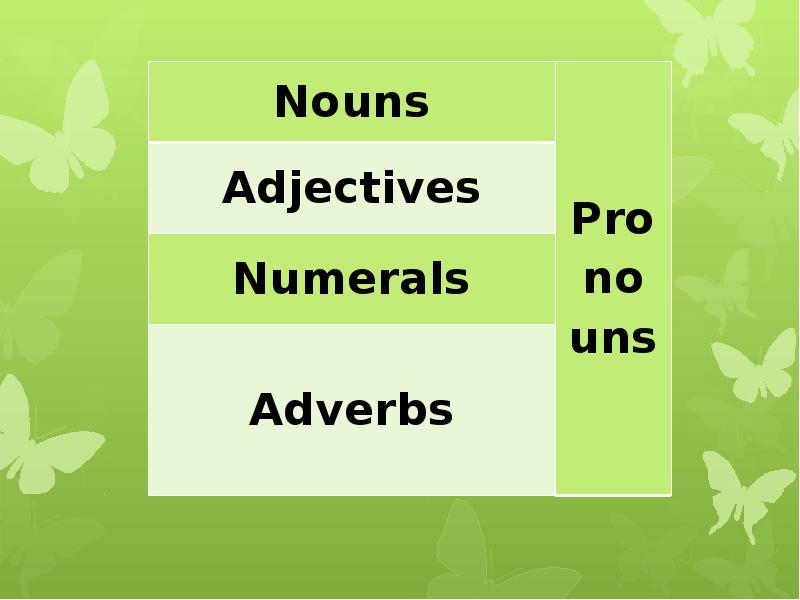
All of them are of double nature, as they combine their peculiar meanings with certain properties of definite parts of speech.
Слайд 21
Описание слайда:
Слайд 22
Описание слайда:
3. Morphological Features
of the Pronoun
Case
B.A.Ilyish:
Nomin. I he she (it) we (you) they who
Obj. me him her (it) us (you) them whom
Genitive somebody’s, anybody’s, one’s, another’s
Слайд 23
Описание слайда:
M.Y.Blokh:
Personal pronominal system of cases has completely disintegrated, and in its place the four individual word-types of pronouns have appeared:
the nominative form
the objective form
the possessive form (conjoint and absolute).
Слайд 24
Описание слайда:
Number
this/ these
that / those
other / others (if not used before a noun)
The pronouns I / we; he, she, it / they have no grammatical category of number.
Слайд 25
Описание слайда:
4. Syntactic Characteristics
of the Pronoun
Personal Pronouns
The nominative form:
subject of the sentence
predicative in the compound nominal predicate in sentences like: It was I who did it.
Both the nominative and the objective case forms are used after the conjunctions as and than in comparative constructions: She is taller than I / me.
Слайд 26
Описание слайда:
The objective form:
object (with or without a preposition);
occasionally as an attribute in prepositional phrases: Give me your hand; Were you speaking about me?; The better half of me protested.
Слайд 27
Описание слайда:
Possessive Pronouns
I raised my eyebrows.
He rose up and put his hands in his small pockets.
Mine is a beautiful garden.
This book is hers.
Слайд 28
Описание слайда:
Reflexive Pronouns
Cedric himself knew nothing whatever about it. (apposition)
I have all kinds of beautiful sentiments myself. (apposition)
I learned to dress myself many years ago. (direct object)
Слайд 29
Описание слайда:
“How well you talk,” said the Miller’s wife pouring herself a large glass of warm ale. (indirect object)
She talks only about herself. (prepositional object)
Слайд 30
Описание слайда:
My wife and myself welcome you, sir. (subject)
In some minutes she became herself again. (predicative)
She showed me a large picture of herself as a bride. (attribute)
My brother was a Robbins like myself. (adverbial modifier of comparison)
He lived in a tiny cottage all by himself. (adverbial modifier of manner)
Слайд 31
Описание слайда:
Reciprocal Pronouns
Reciprocal pronouns in their common form function as objects:
Now they hate each other. They often quarrelled with one another.
The possessive forms are used as attributes:
They stood silent, in each other’s arms.
Слайд 32
Описание слайда:
Demonstrative Pronouns
Syntactically the pronouns this and that can be subject, predicative, object, or attribute.
This was my old dear car again.
His story was like that.
Do you remember this?
The woods are so beautiful at this time of year.
Слайд 33
Описание слайда:
Indefinite Pronouns
Function as noun-pronouns
Something unexpected always happened to him.
Let somebody bring me a glass of water.
Did somebody call me up?
One is used as subject and attribute (in the genitive case)
One never knows what may happen.
One’s thoughts should be kept to oneself.
Слайд 34
Описание слайда:
Negative Pronouns
I told him nothing.
None were present at the meeting.
I remember none of the stories.
It looked like nobody’s home.
Слайд 35
Описание слайда:
Contrasting Pronouns
One of the girls was pretty, while the other was terribly plain.
He gulped one cup, then another.
I live on the other side.
Слайд 36
Описание слайда:
Universal Pronouns
Function as noun-pronouns
All were present.
All night long she sat by the window.
Everything looks so beautiful in spring.
I haven’t read all the book.
Слайд 37
Описание слайда:
Interrogative Pronouns
Function as noun-pronouns and adjective-pronouns
What has happened?
What is his name?
What did you say?
What are you looking at?
What book are you reading?
Слайд 38
Описание слайда:
Conjunctive Pronouns
Who did it will repent. (who opens the subject clause)
I know who did it. (who opens the object clause)
They were what you call model girls. (what opens the predicative clause)
Whatever you may do you can’t save the situation. (whatever opens the adverbial concessive clause)
Слайд 39
Описание слайда:
Relative Pronouns
Who he was is still a mystery (conjunctive pronoun).
I don’t know which of the books is better (conjunctive pronoun).
That is the man who has saved your child (relative pronoun).
Here is the book which the lecturer recommended (relative pronoun).
Relative pronouns may function in the subordinate attributive clause as subject, object, attribute, and adverbial modifier (with prepositions).
Слайд 40
Описание слайда:
5. Words of Broad Meaning and Their Pronominal Features.
Notional words of broad meaning are identified as forming an intermediary layer between the pronouns and notional words proper.
I wish at her age she'd learn to sit quiet and not do things.
Flora's suggestion is making sense.
I will therefore briefly set down the circumstances which led to my being connected with the affair.
Слайд 41
Описание слайда:
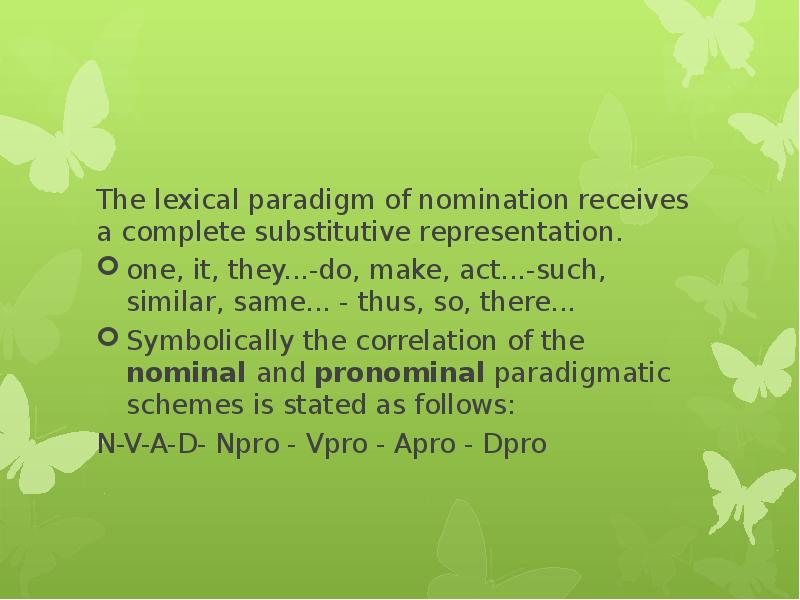
The lexical paradigm of nomination receives a complete substitutive representation.
one, it, they...-do, make, act...-such, similar, same... - thus, so, there...
Symbolically the correlation of the nominal and pronominal paradigmatic schemes is stated as follows:
N-V-A-D- Npro - Vpro - Apro - Dpro
Скачать презентацию на тему Lecture 12 the Pronoun можно ниже: