Peter the Great’s Reforms презентация
Содержание
- 2. A break with tradition Peter I (the Great) reigned 1682-1725. A
- 3. A military state 1698 – brutal suppression of the Streltsy revolt.
- 4. The Founding of St Petersburg 1703: “Here shall be a town.”
- 5. Westernisation 1700: imposition of Western dress on Russian gentry – shaving
- 6. The Table of Ranks Peter systematised the principle of gentry service
- 7. Cultural revolution Subordination of Church to State: creation of the Holy
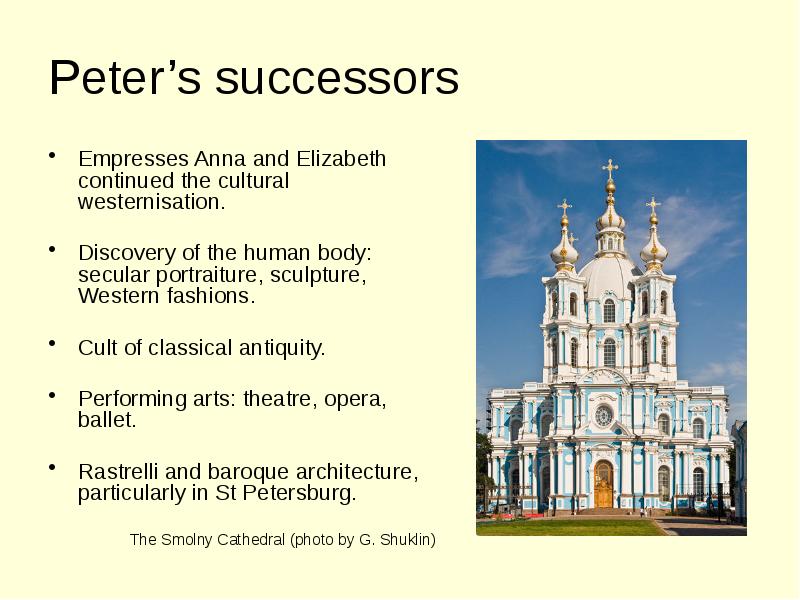
- 8. Peter’s successors Empresses Anna and Elizabeth continued the cultural westernisation. Discovery
- 9. Peter the Great: A focus for ongoing debate Controversial means
- 10. Openness to isolation and back again This pattern was common to
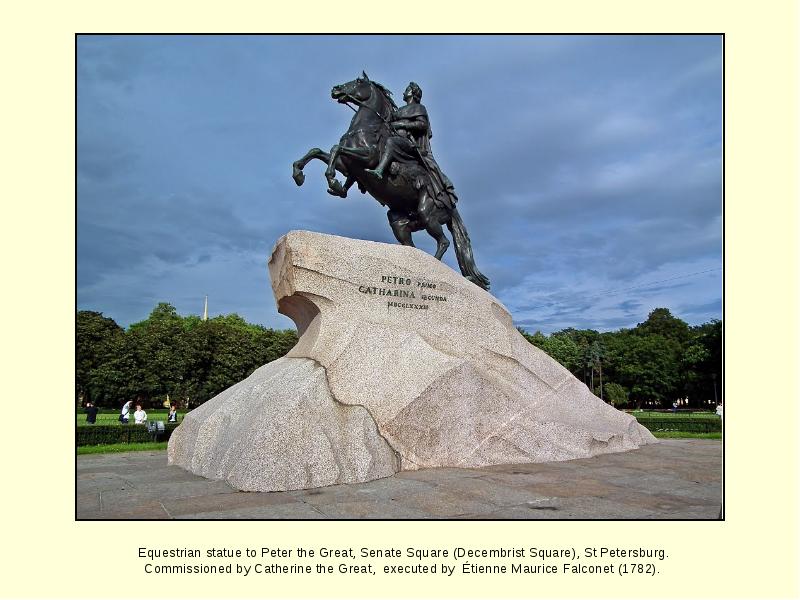
- 11. Equestrian statue to Peter the Great, Senate Square (Decembrist Square), St
- 12. Скачать презентацию
Слайды и текст этой презентации
Слайд 1
Описание слайда:
Peter the Great’s Reforms
Слайд 2
Описание слайда:
A break with tradition
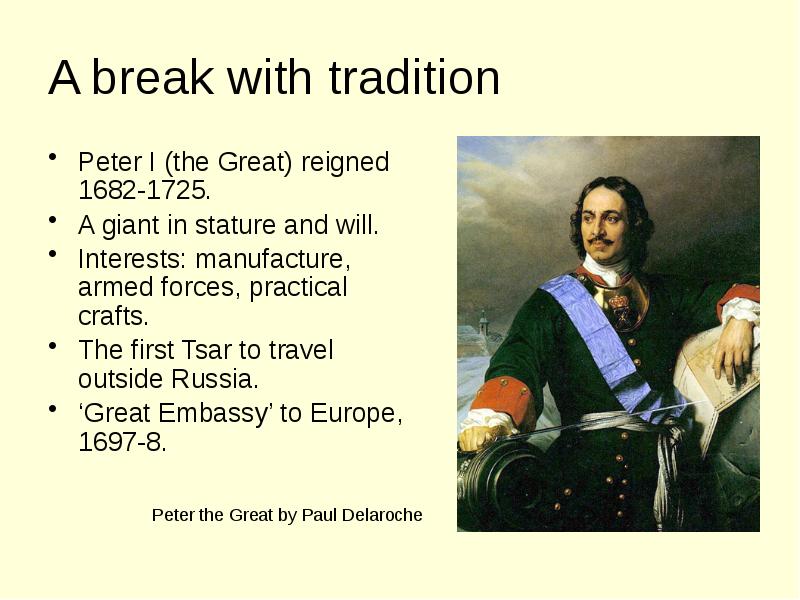
Peter I (the Great) reigned 1682-1725.
A giant in stature and will.
Interests: manufacture, armed forces, practical crafts.
The first Tsar to travel outside Russia.
‘Great Embassy’ to Europe, 1697-8.
Peter the Great by Paul Delaroche
Слайд 3
Описание слайда:
A military state
1698 – brutal suppression of the Streltsy revolt.
Wars with Sweden, Turkey and campaigns in the Middle East.
Creation of a Russian navy.
Many reforms driven by the need to power the military machine.
Слайд 4
Описание слайда:
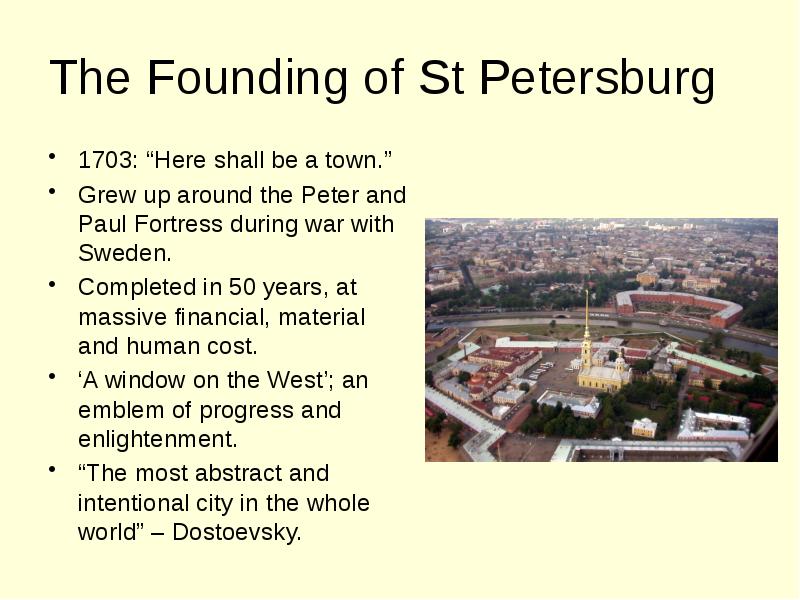
The Founding of St Petersburg
1703: “Here shall be a town.”
Grew up around the Peter and Paul Fortress during war with Sweden.
Completed in 50 years, at massive financial, material and human cost.
‘A window on the West’; an emblem of progress and enlightenment.
“The most abstract and intentional city in the whole world” – Dostoevsky.
Слайд 5
Описание слайда:
Westernisation
1700: imposition of Western dress on Russian gentry – shaving of beards, frock coats instead of kaftans.
A symbol of Peter’s will and of the tone of his reforms.
Stark division between gentry and peasantry.
Resistance: Peter was called ‘the Antichrist’ by some (‘Old Believers’).
Peter adopts title of imperator (Emperor), 1721.
Слайд 6
Описание слайда:
The Table of Ranks
Peter systematised the principle of gentry service to the State.
Compulsory education (often abroad), followed by army, navy or civil service.
Table of Ranks instituted in 1722. 14 ranks, equivalent across the army, navy and civil service
This stimulated a great preoccupation with social rank and promotion (which is depicted – often satirised - in works of Russian literature)
Слайд 7
Описание слайда:
Cultural revolution
Subordination of Church to State: creation of the Holy Synod, 1721. Subordination of Russian Orthodox Church: in this respect Peter has been compared to Bolsheviks after 1917
Development of the education system.
Founding of the Russian Academy of Sciences.
Adoption of the Julian calendar in 1700.
Simplification of the Cyrillic alphabet.
Publication of the first newspaper, Vedomosti (News) and secular books.
Women encouraged to ‘come out’ into society.
Слайд 8
Описание слайда:
Peter’s successors
Empresses Anna and Elizabeth continued the cultural westernisation.
Discovery of the human body: secular portraiture, sculpture, Western fashions.
Cult of classical antiquity.
Performing arts: theatre, opera, ballet.
Rastrelli and baroque architecture, particularly in St Petersburg.
The Smolny Cathedral (photo by G. Shuklin)
Слайд 9
Описание слайда:
Peter the Great: A focus for ongoing debate
Controversial means to achieve desirable
ends.
The Slavophiles of the 19th century didn’t
even view these ends as desirable or
good for Russia. They idealised pre-Petrine
Russia.
Слайд 10
Описание слайда:
Openness to isolation and back again
This pattern was common to Russia and
Japan:
Extraordinary openness and eagerness to
imitate foreign ways
Under Nicholas I (19th c.) and Stalin (20th c.):
Isolation and fearfulness of ‘the foreigner’,
who might ‘infect’ and ‘contaminate’ the
population with ‘foreign’ ideas and lifestyles.
Слайд 11
Описание слайда:
Equestrian statue to Peter the Great, Senate Square (Decembrist Square), St Petersburg. Commissioned by Catherine the Great, executed by Étienne Maurice Falconet (1782).
Скачать презентацию на тему Peter the Great’s Reforms можно ниже: