Purposes and results: In order to, so as to and etc презентация
Содержание
- 2. In order/so as + to-infinitive To talk about the purpose of
- 3. We usually use so as not to/in order not to instead
- 4. In order that and so that To talk about a purpose;
- 5. We often use modal verbs after ‘in order that/so that’; We
- 6. Such that and in such a way/as to; such …. that
- 7. We can also use ‘such + noun phrase + that’ to
- 8. Скачать презентацию
Слайды и текст этой презентации
Слайд 1
Описание слайда:
Слайд 2
Описание слайда:
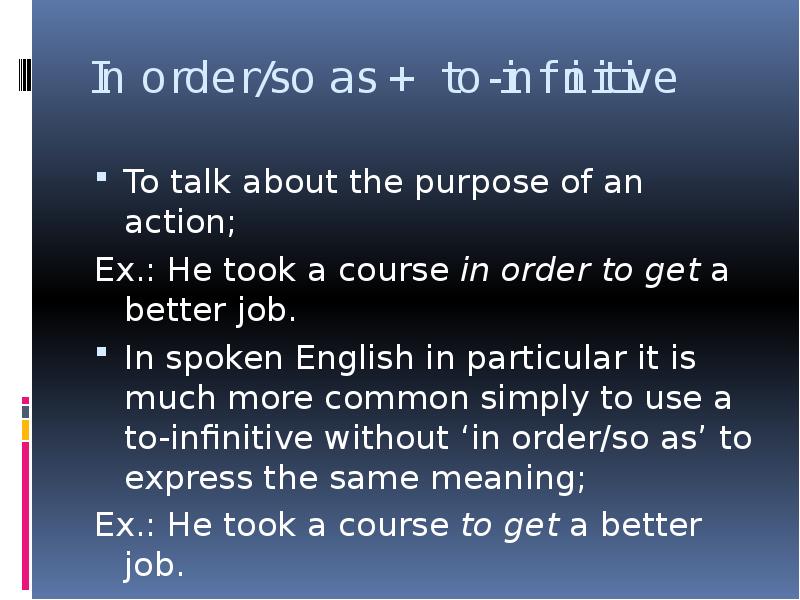
In order/so as + to-infinitive
To talk about the purpose of an action;
Ex.: He took a course in order to get a better job.
In spoken English in particular it is much more common simply to use a to-infinitive without ‘in order/so as’ to express the same meaning;
Ex.: He took a course to get a better job.
Слайд 3
Описание слайда:
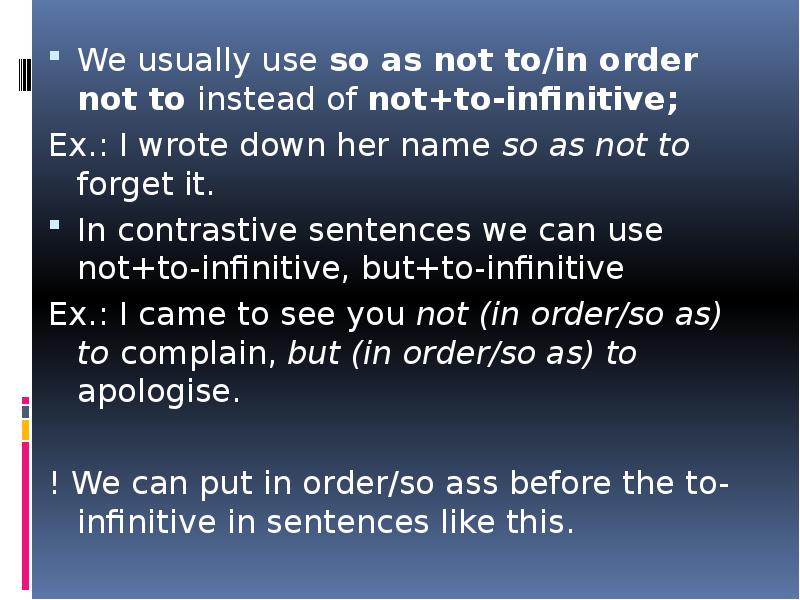
We usually use so as not to/in order not to instead of not+to-infinitive;
We usually use so as not to/in order not to instead of not+to-infinitive;
Ex.: I wrote down her name so as not to forget it.
In contrastive sentences we can use not+to-infinitive, but+to-infinitive
Ex.: I came to see you not (in order/so as) to complain, but (in order/so as) to apologise.
! We can put in order/so ass before the to-infinitive in sentences like this.
Слайд 4
Описание слайда:
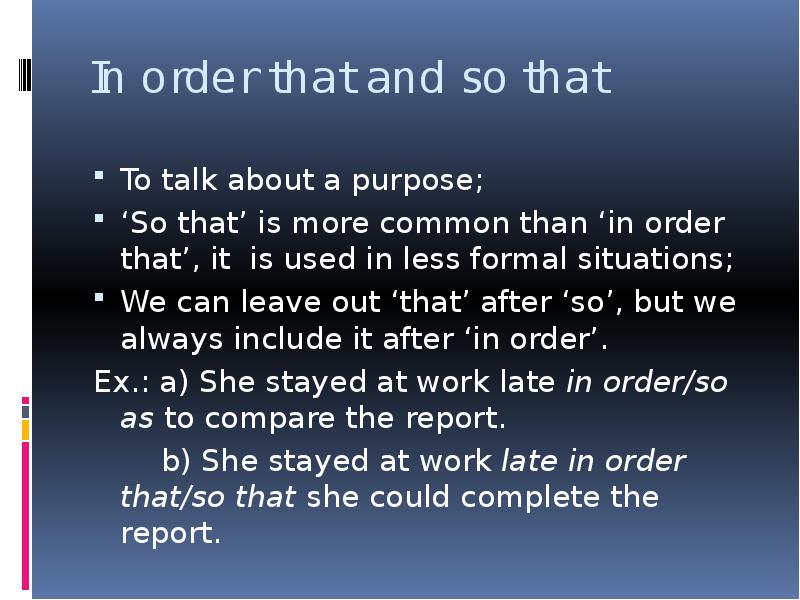
In order that and so that
To talk about a purpose;
‘So that’ is more common than ‘in order that’, it is used in less formal situations;
We can leave out ‘that’ after ‘so’, but we always include it after ‘in order’.
Ex.: a) She stayed at work late in order/so as to compare the report.
b) She stayed at work late in order that/so that she could complete the report.
Слайд 5
Описание слайда:
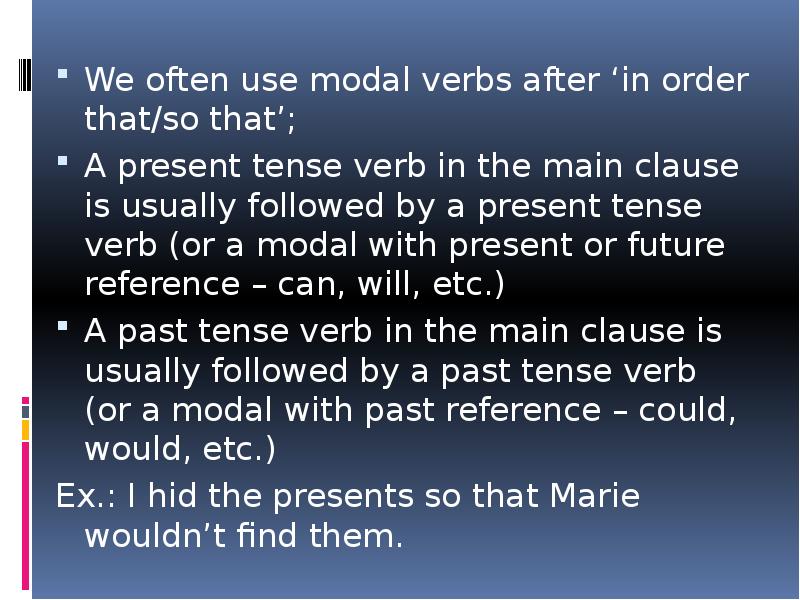
We often use modal verbs after ‘in order that/so that’;
We often use modal verbs after ‘in order that/so that’;
A present tense verb in the main clause is usually followed by a present tense verb (or a modal with present or future reference – can, will, etc.)
A past tense verb in the main clause is usually followed by a past tense verb (or a modal with past reference – could, would, etc.)
Ex.: I hid the presents so that Marie wouldn’t find them.
Слайд 6
Описание слайда:
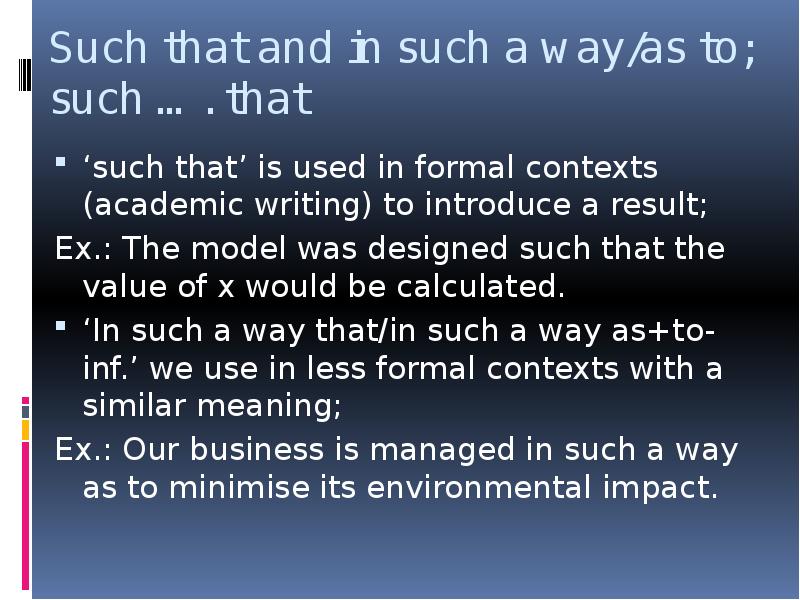
Such that and in such a way/as to;
such …. that
‘such that’ is used in formal contexts (academic writing) to introduce a result;
Ex.: The model was designed such that the value of x would be calculated.
‘In such a way that/in such a way as+to-inf.’ we use in less formal contexts with a similar meaning;
Ex.: Our business is managed in such a way as to minimise its environmental impact.
Слайд 7
Описание слайда:
We can also use ‘such + noun phrase + that’ to introduce a result:
We can also use ‘such + noun phrase + that’ to introduce a result:
Ex.: It is such a popular play that all the performances were sold out after the first day.
Скачать презентацию на тему Purposes and results:
In order to, so as to and etc можно ниже: