SPECIATION презентация
Содержание
- 2. SUB TOPICS FORMATION OF SPECIES RESULT OF MICROEVOLUTION SPECIATION IS THE
- 3. FORMATION OF SPECIES Speciation is the evolutionary process by which populations evolve to become
- 4. FORMATION OF SPECIES Rapid sympatric speciation can take place through polyploidy, such
- 5. TYPE OF SPECIATION ALLOPATRIC SPECIATION SYMPATRIC SPECIATION PERIPATRIC SPECIATION PARAPATRIC SPECIATION
- 7. ALLOPATRIC SPECIATION During allopatric (from the ancient Greek allos, "other" + patrā, "fatherland")
- 8. SYMPATRIC SPECIATION Sympatric speciation is the evolution of a new species from
- 9. PERIPATRIC SPECIATION In peripatric speciation, a subform of allopatric speciation, new
- 10. PARAPATRIC SPECIATION n parapatric speciation, there is only partial separation of
- 11. RESULT OF MICROEVOLUTION Microevolution is the change in allele frequencies that occurs over time
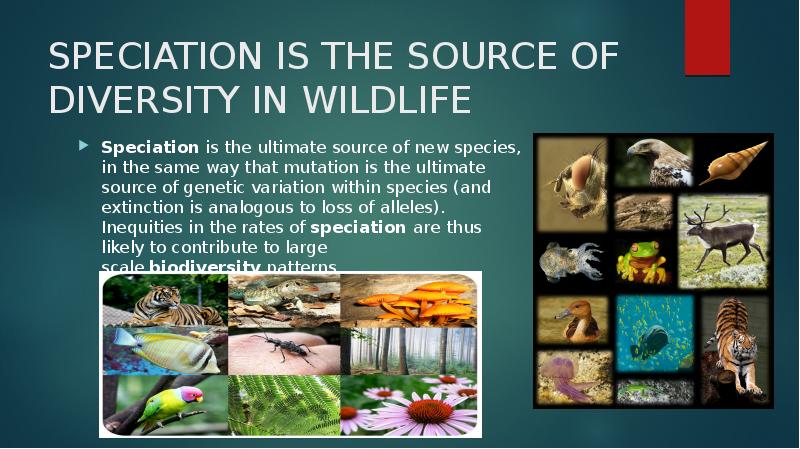
- 12. SPECIATION IS THE SOURCE OF DIVERSITY IN WILDLIFE Speciation is the
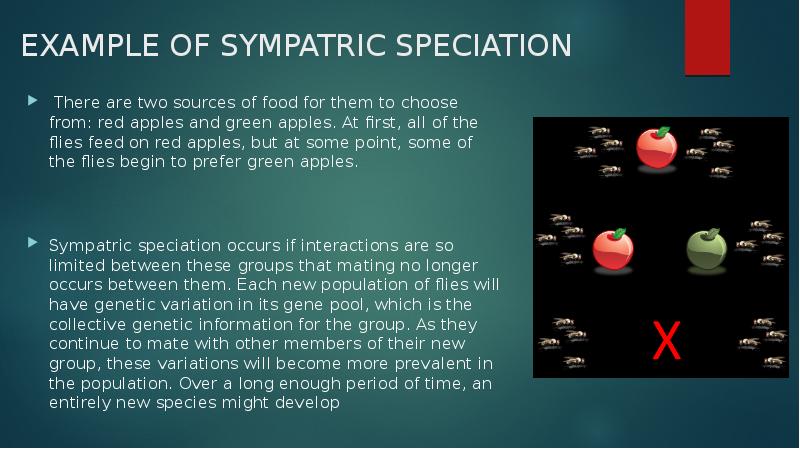
- 13. EXAMPLE OF SYMPATRIC SPECIATION There are two sources of food for
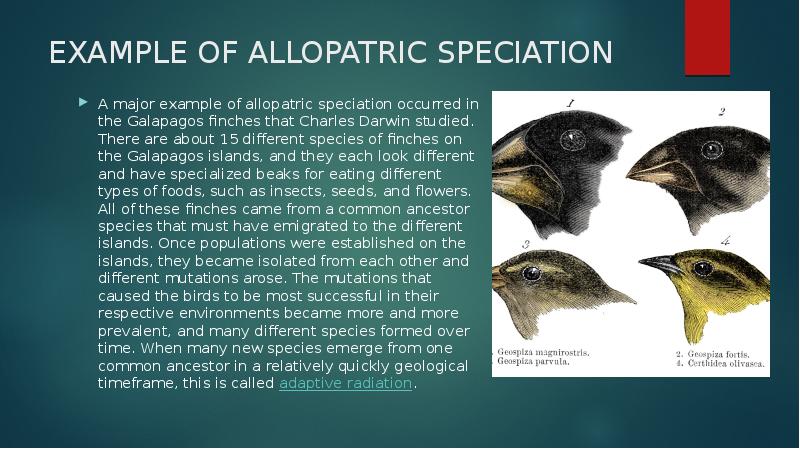
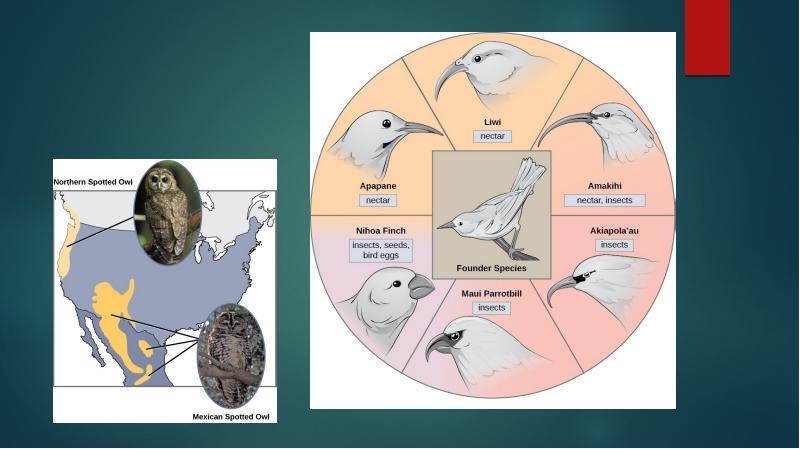
- 14. EXAMPLE OF ALLOPATRIC SPECIATION A major example of allopatric speciation occurred
- 16. EXAMPLE OF PERIPATRIC SPECIATION The figwart plant species Scrophularia lowei is thought to have arisen
- 17. EXAMPLE OF PARAPATRIC SPECIATION The best-known example of incipient parapatric speciation occurs in populations of
- 19. MAIN WAY AND MEAN OF SPECIATION Speciation occurs along two main
- 21. Скачать презентацию

Слайды и текст этой презентации
Слайд 1
Описание слайда:
SPECIATION
BY :MOHAN KUMAR AMARNATH
GROUP NO: 191 B
TEACHER: SVETLANA SMIRNOVA
Слайд 2
Описание слайда:
SUB TOPICS
FORMATION OF SPECIES
RESULT OF MICROEVOLUTION
SPECIATION IS THE SOURCE OF DIVERSITY IN WILDLIFE
EXAMPLE OF SPECIATION
MAIN WAY AND MEANS OF SPECIATION
Слайд 3
Описание слайда:
FORMATION OF SPECIES
Speciation is the evolutionary process by which populations evolve to become distinct species. The biologist Orator F. Cook coined the term in 1906 for cladogenesis, the splitting of lineages, as opposed to anagenesis, phyletic evolution within lineages . Charles Darwin was the first to describe the role of natural selection in speciation in his 1859 book On the Origin of Species. He also identified sexual selection as a likely mechanism, but found it problematic.
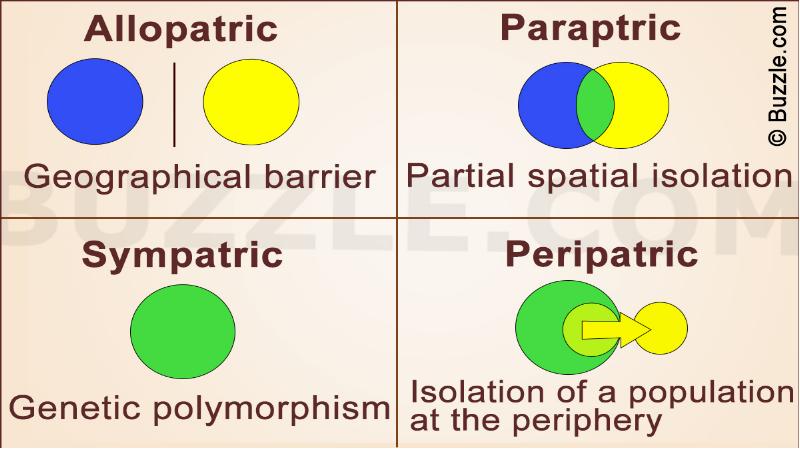
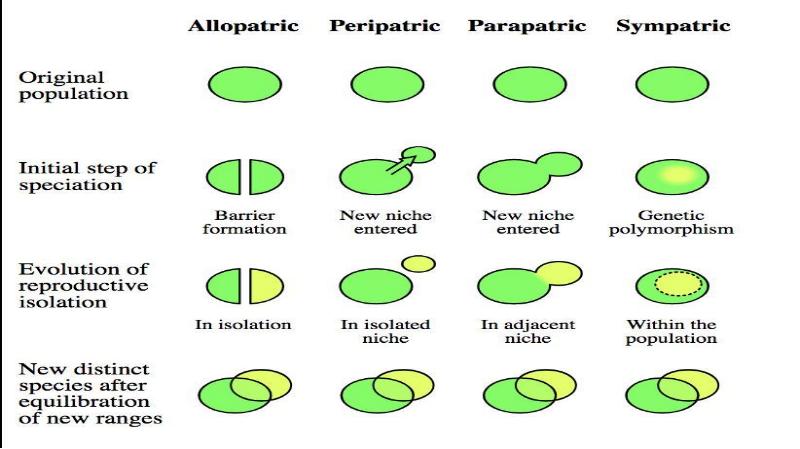
There are four geographic modes of speciation in nature, based on the extent to which speciating populations are isolated from one another: allopatric, peripatric, parapatric, and sympatric. Speciation may also be induced artificially, through animal husbandry, agriculture, or laboratory experiments. Whether genetic drift is a minor or major contributor to speciation is the subject matter of much ongoing discussion.
Слайд 4
Описание слайда:
FORMATION OF SPECIES
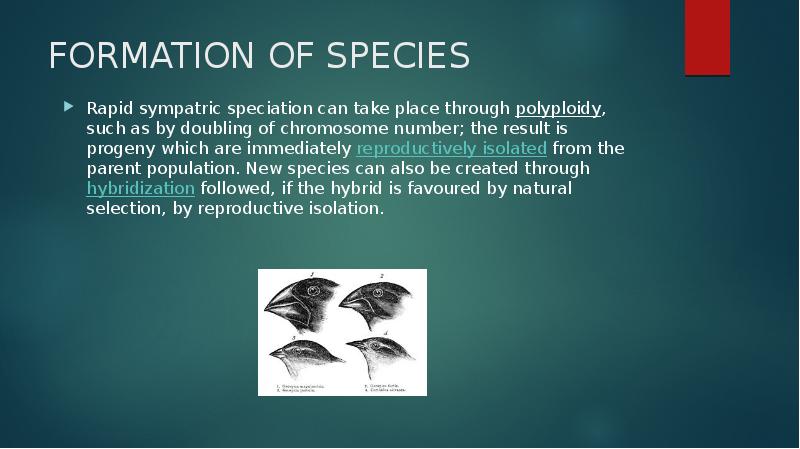
Rapid sympatric speciation can take place through polyploidy, such as by doubling of chromosome number; the result is progeny which are immediately reproductively isolated from the parent population. New species can also be created through hybridization followed, if the hybrid is favoured by natural selection, by reproductive isolation.
Слайд 5
Описание слайда:
TYPE OF SPECIATION
ALLOPATRIC SPECIATION
SYMPATRIC SPECIATION
PERIPATRIC SPECIATION
PARAPATRIC SPECIATION
Слайд 6
Описание слайда:
Слайд 7
Описание слайда:
ALLOPATRIC SPECIATION
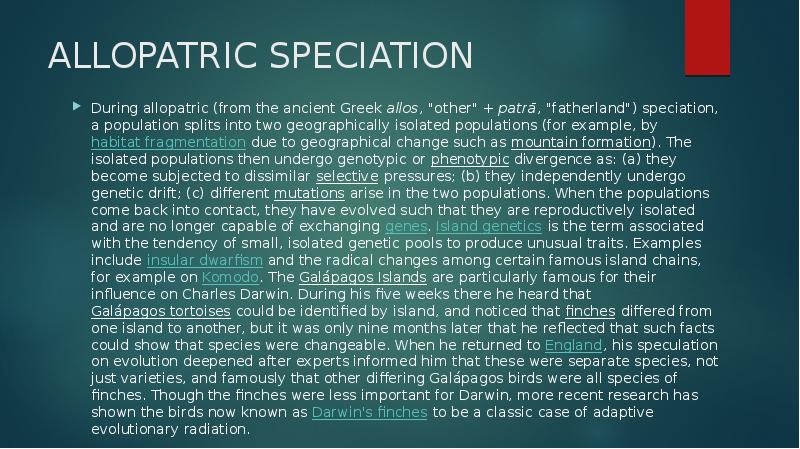
During allopatric (from the ancient Greek allos, "other" + patrā, "fatherland") speciation, a population splits into two geographically isolated populations (for example, by habitat fragmentation due to geographical change such as mountain formation). The isolated populations then undergo genotypic or phenotypic divergence as: (a) they become subjected to dissimilar selective pressures; (b) they independently undergo genetic drift; (c) different mutations arise in the two populations. When the populations come back into contact, they have evolved such that they are reproductively isolated and are no longer capable of exchanging genes. Island genetics is the term associated with the tendency of small, isolated genetic pools to produce unusual traits. Examples include insular dwarfism and the radical changes among certain famous island chains, for example on Komodo. The Galápagos Islands are particularly famous for their influence on Charles Darwin. During his five weeks there he heard that Galápagos tortoises could be identified by island, and noticed that finches differed from one island to another, but it was only nine months later that he reflected that such facts could show that species were changeable. When he returned to England, his speculation on evolution deepened after experts informed him that these were separate species, not just varieties, and famously that other differing Galápagos birds were all species of finches. Though the finches were less important for Darwin, more recent research has shown the birds now known as Darwin's finches to be a classic case of adaptive evolutionary radiation.
Слайд 8
Описание слайда:
SYMPATRIC SPECIATION
Sympatric speciation is the evolution of a new species from a surviving ancestral species while both continue to inhabit the same geographic region. In evolutionary biology and biogeography, sympatric and sympatry are terms referring to organisms whose ranges overlap so that they occur together at least in some places. If these organisms are closely related (e.g. sister species), such a distribution may be the result of sympatric speciation. Etymologically, sympatry is derived from the Greek roots συν ("together") and πατρίς ("homeland").[1] The term was coined by Edward Bagnall Poulton in 1904, who explains the derivation.
Sympatric speciation is one of three traditional geographic modes of speciation. Allopatric speciation is the evolution of species caused by the geographic isolation of two or more populations of a species. In this case, divergence is facilitated by the absence of gene flow. Parapatric speciation is the evolution of geographically adjacent populations into distinct species. In this case, divergence occurs despite limited interbreeding where the two diverging groups come into contact. In sympatric speciation, there is no geographic constraint to interbreeding. These categories are special cases of a continuum from zero (sympatric) to complete (allopatric) spatial segregation of diverging groups.
Слайд 9
Описание слайда:
PERIPATRIC SPECIATION
In peripatric speciation, a subform of allopatric speciation, new species are formed in isolated, smaller peripheral populations that are prevented from exchanging genes with the main population. It is related to the concept of a founder effect, since small populations often undergo bottlenecks. Genetic drift is often proposed to play a significant role in peripatric speciation.
Case studies include Mayr's investigation of bird fauna; the Australian bird Petroica multicolor; and reproductive isolation in populations of Drosophila subject to population bottlenecking.
Слайд 10
Описание слайда:
PARAPATRIC SPECIATION
n parapatric speciation, there is only partial separation of the zones of two diverging populations afforded by geography; individuals of each species may come in contact or cross habitats from time to time, but reduced fitness of the heterozygote leads to selection for behaviour or mechanisms that prevent their interbreeding. Parapatric speciation is modelled on continuous variation within a "single," connected habitat acting as a source of natural selection rather than the effects of isolation of habitats produced in peripatric and allopatric speciation.
Parapatric speciation may be associated with differential landscape-dependent selection. Even if there is a gene flow between two populations, strong differential selection may impede assimilation and different species may eventually develop. Habitat differences may be more important in the development of reproductive isolation than the isolation time. Caucasian rock lizards Darevskia rudis, D. valentini and D. portschinskii all hybridize with each other in their hybrid zone; however, hybridization is stronger between D. portschinskii and D. rudis, which separated earlier but live in similar habitats than between D. valentini and two other species, which separated later but live in climatically different habitats.
Слайд 11
Описание слайда:
RESULT OF MICROEVOLUTION
Microevolution is the change in allele frequencies that occurs over time within a population. This change is due to four different processes: mutation, selection (natural and artificial), gene flow and genetic drift. This change happens over a relatively short (in evolutionary terms) amount of time compared to the changes termed macroevolution.
Population genetics is the branch of biology that provides the mathematical structure for the study of the process of microevolution. Ecological genetics concerns itself with observing microevolution in the wild. Typically, observable instances of evolution are examples of microevolution; for example, bacterial strains that have antibiotic resistance.
Microevolution may lead to speciation, which provides the raw material for macroevolution.
Слайд 12
Описание слайда:
SPECIATION IS THE SOURCE OF DIVERSITY IN WILDLIFE
Speciation is the ultimate source of new species, in the same way that mutation is the ultimate source of genetic variation within species (and extinction is analogous to loss of alleles). Inequities in the rates of speciation are thus likely to contribute to large scale biodiversity patterns
Слайд 13
Описание слайда:
EXAMPLE OF SYMPATRIC SPECIATION
There are two sources of food for them to choose from: red apples and green apples. At first, all of the flies feed on red apples, but at some point, some of the flies begin to prefer green apples.
Sympatric speciation occurs if interactions are so limited between these groups that mating no longer occurs between them. Each new population of flies will have genetic variation in its gene pool, which is the collective genetic information for the group. As they continue to mate with other members of their new group, these variations will become more prevalent in the population. Over a long enough period of time, an entirely new species might develop
Слайд 14
Описание слайда:
EXAMPLE OF ALLOPATRIC SPECIATION
A major example of allopatric speciation occurred in the Galapagos finches that Charles Darwin studied. There are about 15 different species of finches on the Galapagos islands, and they each look different and have specialized beaks for eating different types of foods, such as insects, seeds, and flowers. All of these finches came from a common ancestor species that must have emigrated to the different islands. Once populations were established on the islands, they became isolated from each other and different mutations arose. The mutations that caused the birds to be most successful in their respective environments became more and more prevalent, and many different species formed over time. When many new species emerge from one common ancestor in a relatively quickly geological timeframe, this is called adaptive radiation.
Слайд 15
Описание слайда:
Слайд 16
Описание слайда:
EXAMPLE OF PERIPATRIC SPECIATION
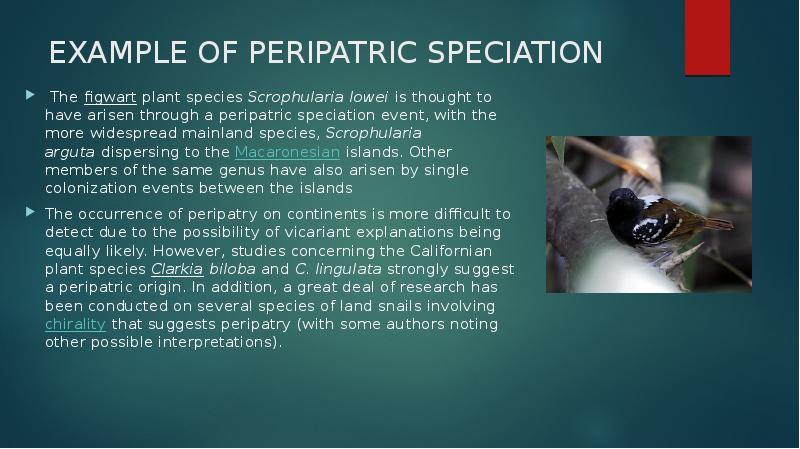
The figwart plant species Scrophularia lowei is thought to have arisen through a peripatric speciation event, with the more widespread mainland species, Scrophularia arguta dispersing to the Macaronesian islands. Other members of the same genus have also arisen by single colonization events between the islands
The occurrence of peripatry on continents is more difficult to detect due to the possibility of vicariant explanations being equally likely. However, studies concerning the Californian plant species Clarkia biloba and C. lingulata strongly suggest a peripatric origin. In addition, a great deal of research has been conducted on several species of land snails involving chirality that suggests peripatry (with some authors noting other possible interpretations).
Слайд 17
Описание слайда:
EXAMPLE OF PARAPATRIC SPECIATION
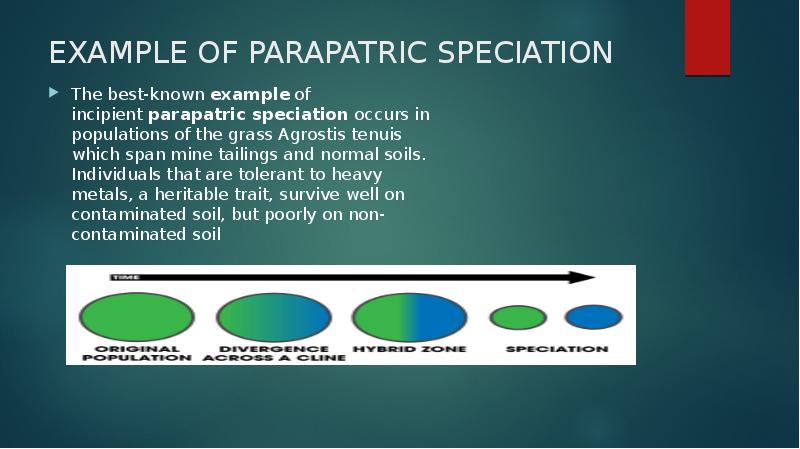
The best-known example of incipient parapatric speciation occurs in populations of the grass Agrostis tenuis which span mine tailings and normal soils. Individuals that are tolerant to heavy metals, a heritable trait, survive well on contaminated soil, but poorly on non-contaminated soil
Слайд 18
Описание слайда:
Слайд 19
Описание слайда:
MAIN WAY AND MEAN OF SPECIATION
Speciation occurs along two main pathways: geographic separation (allopatric speciation) and through mechanisms that occur within a shared habitat (sympatric speciation). Both pathways force reproductive isolation between populations. Sympatric speciation can occur through errors in meiosis that form gametes with extra chromosomes, called polyploidy. Autopolyploidy occurs within a single species, whereas allopolyploidy occurs because of a mating between closely related species. Once the populations are isolated, evolutionary divergence can take place leading to the evolution of reproductive isolating traits that prevent interbreeding should the two populations come together again. The reduced viability of hybrid offspring after a period of isolation is expected to select for stronger inherent isolating mechanisms.
Слайд 20
Описание слайда:
Скачать презентацию на тему SPECIATION можно ниже: