Shortest paths and spanning trees in graphs 1 презентация
Содержание
- 2. Shortest paths and spanning trees in graphs Lyzhin Ivan, 2015
- 3. Shortest path problem The problem of finding a path between two
- 4. Dijkstra algorithm There are two sets of vertices – visited and
- 5. Trivial implementation
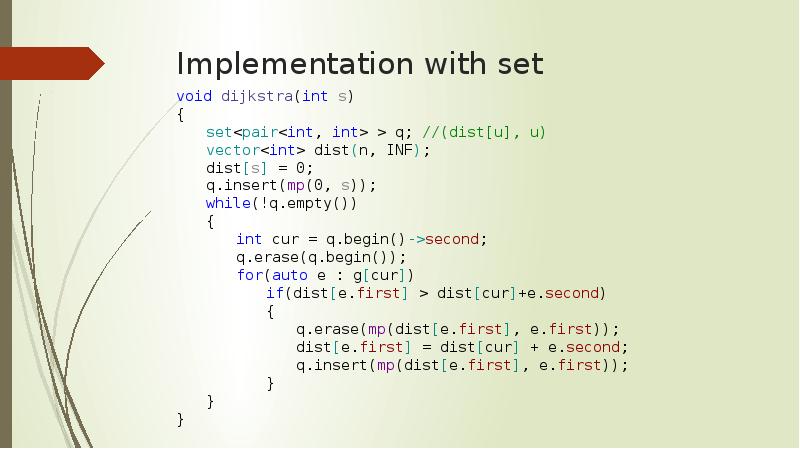
- 6. Implementation with set
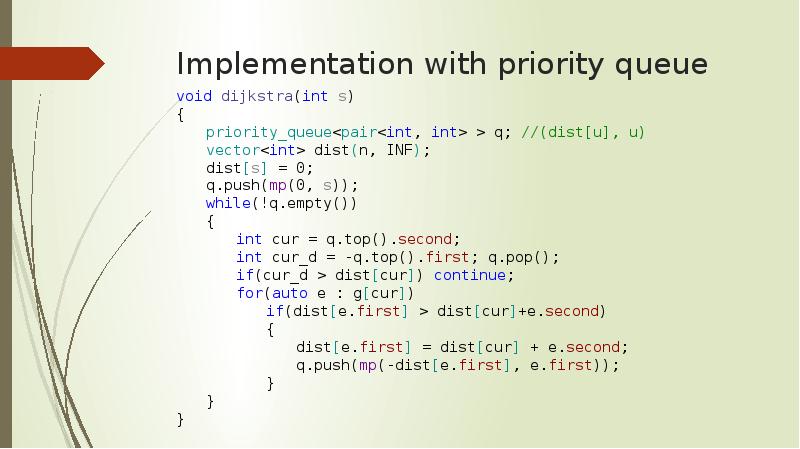
- 7. Implementation with priority queue
- 8. Floyd–Warshall algorithm Initially, dist[u][u]=0 and for each edge (u, v): dist[u][v]=weight(u,
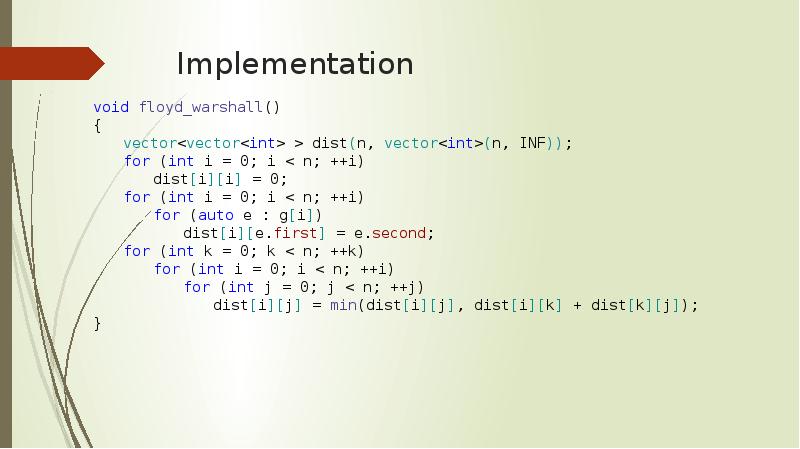
- 9. Implementation
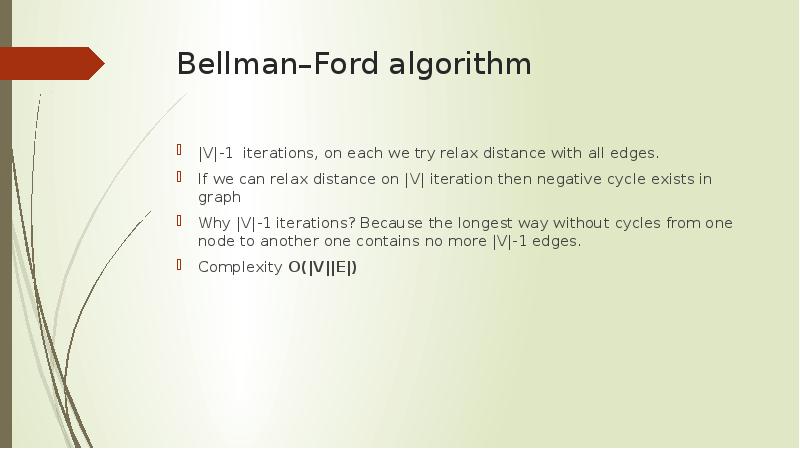
- 10. Bellman–Ford algorithm |V|-1 iterations, on each we try relax distance with
- 11. Implementation
- 12. Minimal spanning tree A spanning tree T of an undirected graph
- 13. Prim’s algorithm Initialize a tree with a single vertex, chosen arbitrarily
- 14. Implementation
- 15. Kruskal’s algorithm Create a forest F (a set of trees), where
- 16. Trivial implementation
- 17. Implementation with DSU
- 18. Disjoint-set-union (DSU) Two main operations: Find(U) – return root of set,
- 19. Implementation
- 20. Path compression When we go up, we can remember root of
- 21. Union by size
- 22. Links https://en.wikipedia.org/wiki/Dijkstra%27s_algorithm https://en.wikipedia.org/wiki/Floyd–Warshall_algorithm https://en.wikipedia.org/wiki/Bellman–Ford_algorithm https://en.wikipedia.org/wiki/Kruskal%27s_algorithm https://en.wikipedia.org/wiki/Prim%27s_algorithm https://en.wikipedia.org/wiki/Disjoint-set_data_structure http://e-maxx.ru/algo/topological_sort
- 23. Home task http://ipc.susu.ac.ru/210-2.html?problem=1903 http://ipc.susu.ac.ru/210-2.html?problem=186 http://acm.timus.ru/problem.aspx?space=1&num=1982 http://acm.timus.ru/problem.aspx?space=1&num=1119 http://acm.timus.ru/problem.aspx?space=1&num=1210 http://acm.timus.ru/problem.aspx?space=1&num=1272
- 24. Скачать презентацию


![Floyd–Warshall algorithm
Initially, dist[u][u]=0 and for each edge (u, v): dist[u][v]=weight(u,](/documents_7/18c580b776fb3605ab47687b9d0a35e3/img7.jpg "Floyd–Warshall algorithm
Initially, dist[u][u]=0 and for each edge (u, v): dist[u][v]=weight(u,")
Слайды и текст этой презентации
Слайд 1
Описание слайда:
Слайд 2
Описание слайда:
Shortest paths and spanning trees in graphs
Lyzhin Ivan, 2015
Слайд 3
Описание слайда:
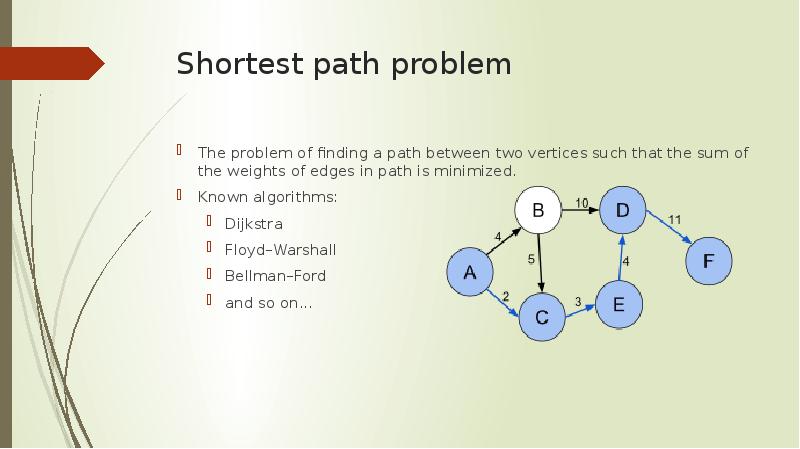
Shortest path problem
The problem of finding a path between two vertices such that the sum of the weights of edges in path is minimized.
Known algorithms:
Dijkstra
Floyd–Warshall
Bellman–Ford
and so on...
Слайд 4
Описание слайда:
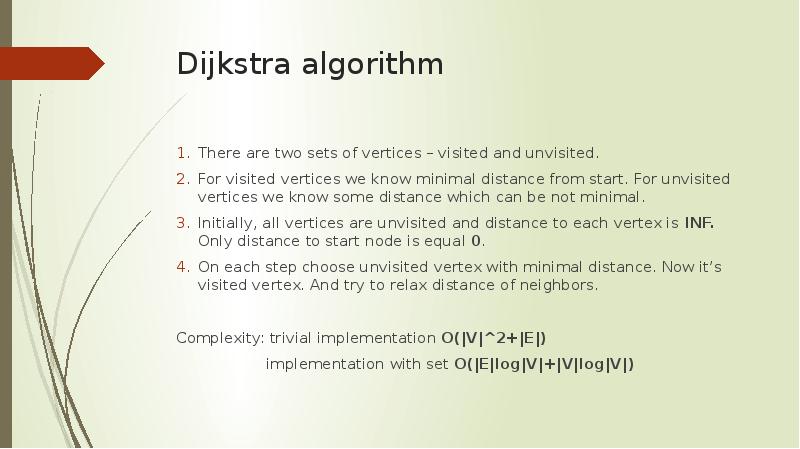
Dijkstra algorithm
There are two sets of vertices – visited and unvisited.
For visited vertices we know minimal distance from start. For unvisited vertices we know some distance which can be not minimal.
Initially, all vertices are unvisited and distance to each vertex is INF. Only distance to start node is equal 0.
On each step choose unvisited vertex with minimal distance. Now it’s visited vertex. And try to relax distance of neighbors.
Complexity: trivial implementation O(|V|^2+|E|)
implementation with set O(|E|log|V|+|V|log|V|)
Слайд 5
Описание слайда:
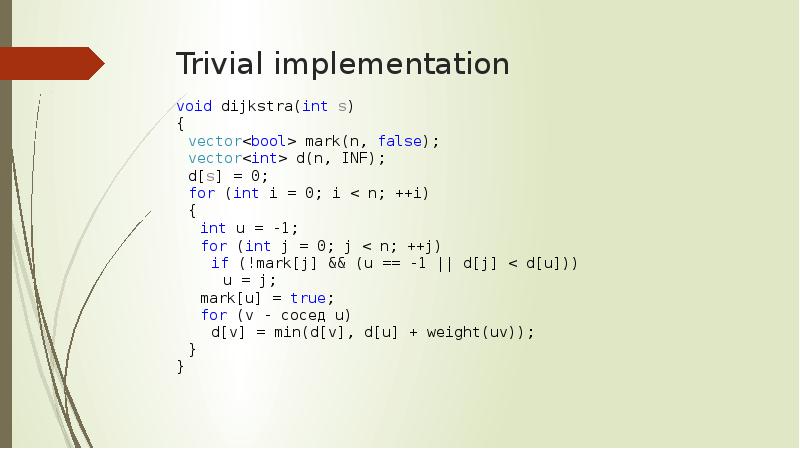
Trivial implementation
Слайд 6
Описание слайда:
Implementation with set
Слайд 7
Описание слайда:
Implementation with priority queue
Слайд 8
Описание слайда:
Floyd–Warshall algorithm
Initially, dist[u][u]=0 and for each edge (u, v): dist[u][v]=weight(u, v)
On iteration k we let use vertex k as intermediate vertex and for each pair of vertices we try to relax distance.
dist[u][v] = min(dist[u][v], dist[u][k]+dist[k][v])
Complexity: O(|V|^3)
Слайд 9
Описание слайда:
Implementation
Слайд 10
Описание слайда:
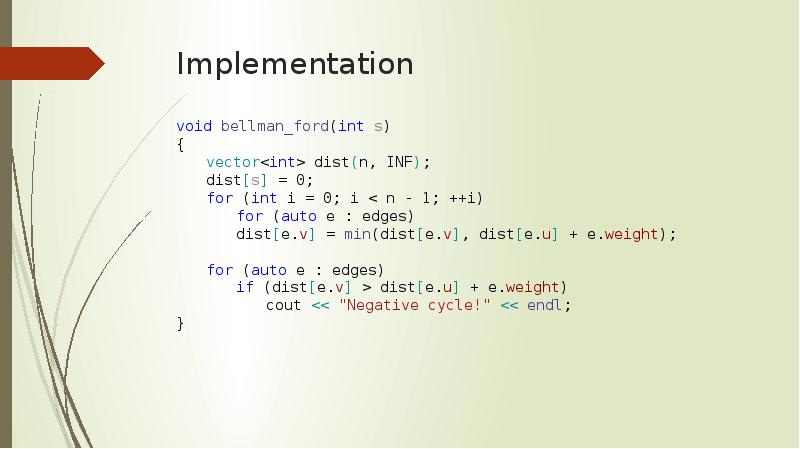
Bellman–Ford algorithm
|V|-1 iterations, on each we try relax distance with all edges.
If we can relax distance on |V| iteration then negative cycle exists in graph
Why |V|-1 iterations? Because the longest way without cycles from one node to another one contains no more |V|-1 edges.
Complexity O(|V||E|)
Слайд 11
Описание слайда:
Implementation
Слайд 12
Описание слайда:
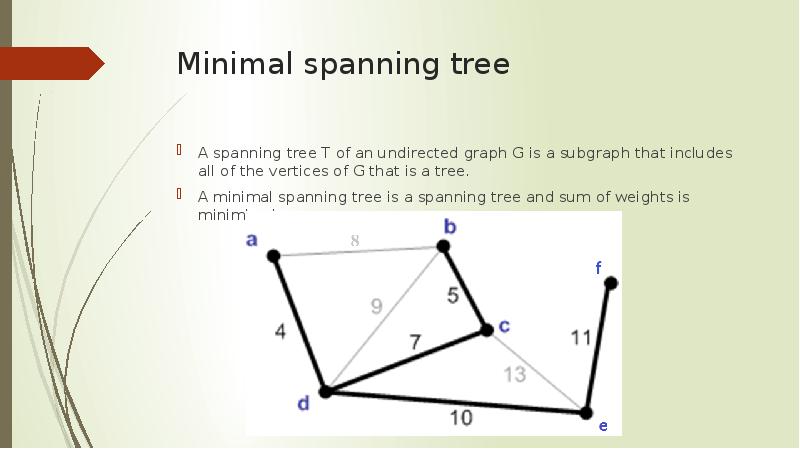
Minimal spanning tree
A spanning tree T of an undirected graph G is a subgraph that includes all of the vertices of G that is a tree.
A minimal spanning tree is a spanning tree and sum of weights is minimized.
Слайд 13
Описание слайда:
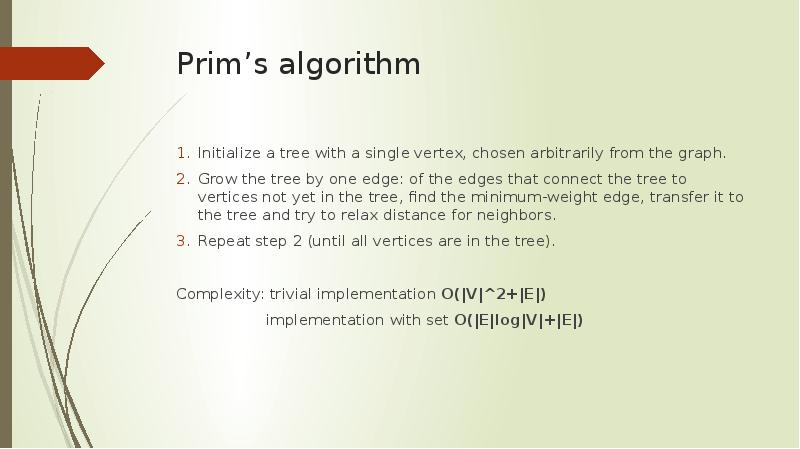
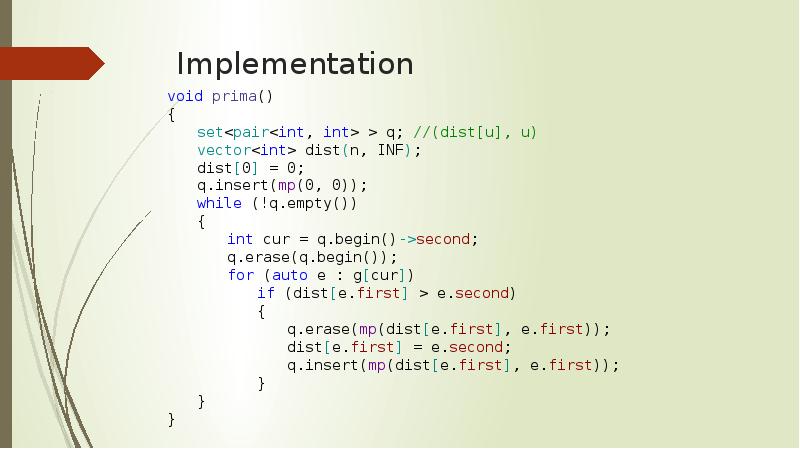
Prim’s algorithm
Initialize a tree with a single vertex, chosen arbitrarily from the graph.
Grow the tree by one edge: of the edges that connect the tree to vertices not yet in the tree, find the minimum-weight edge, transfer it to the tree and try to relax distance for neighbors.
Repeat step 2 (until all vertices are in the tree).
Complexity: trivial implementation O(|V|^2+|E|)
implementation with set O(|E|log|V|+|E|)
Слайд 14
Описание слайда:
Implementation
Слайд 15
Описание слайда:
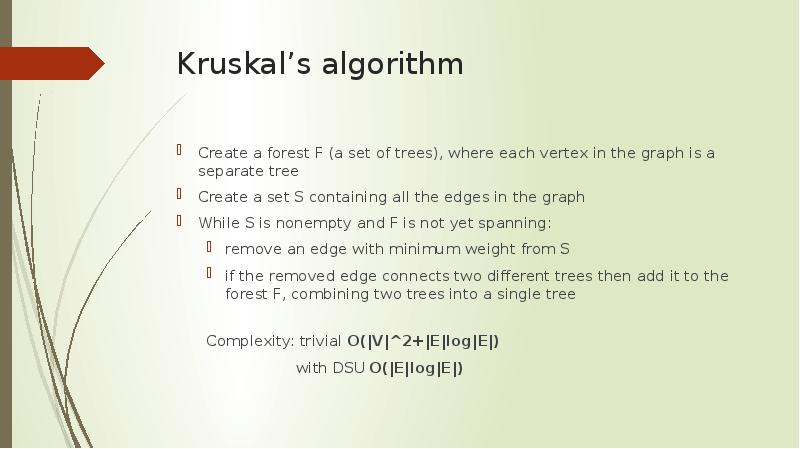
Kruskal’s algorithm
Create a forest F (a set of trees), where each vertex in the graph is a separate tree
Create a set S containing all the edges in the graph
While S is nonempty and F is not yet spanning:
remove an edge with minimum weight from S
if the removed edge connects two different trees then add it to the forest F, combining two trees into a single tree
Complexity: trivial O(|V|^2+|E|log|E|)
with DSU O(|E|log|E|)
Слайд 16
Описание слайда:
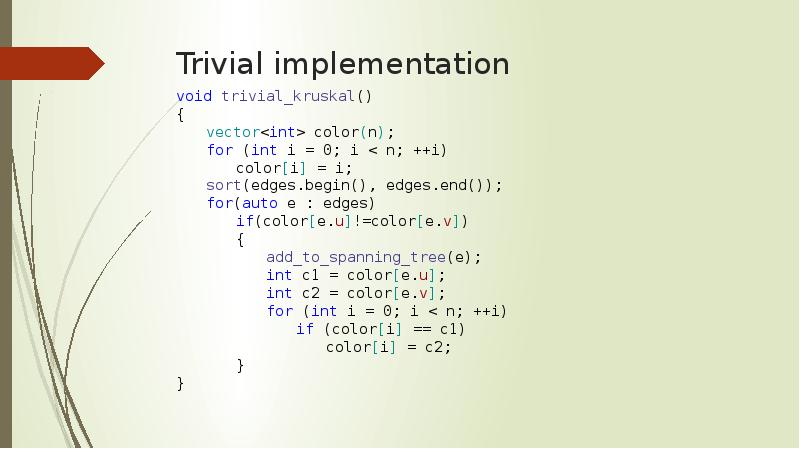
Trivial implementation
Слайд 17
Описание слайда:
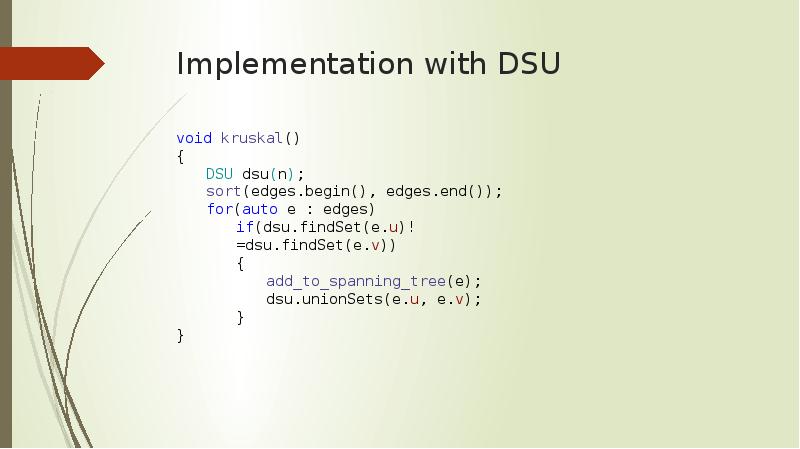
Implementation with DSU
Слайд 18
Описание слайда:
Disjoint-set-union (DSU)
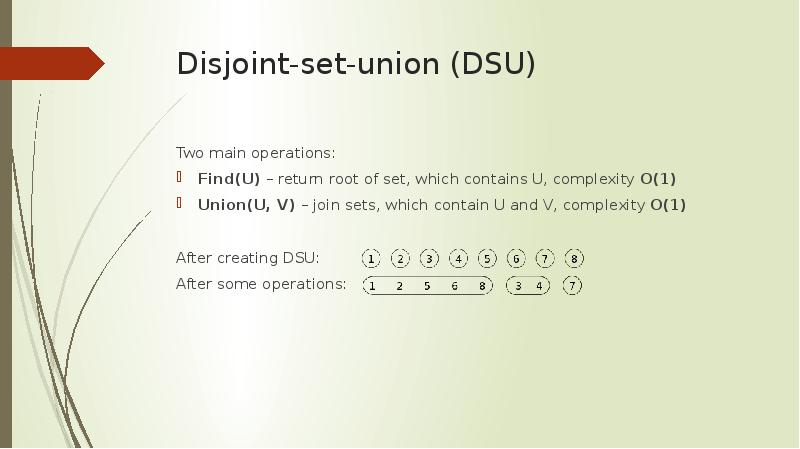
Two main operations:
Find(U) – return root of set, which contains U, complexity O(1)
Union(U, V) – join sets, which contain U and V, complexity O(1)
After creating DSU:
After some operations:
Слайд 19
Описание слайда:
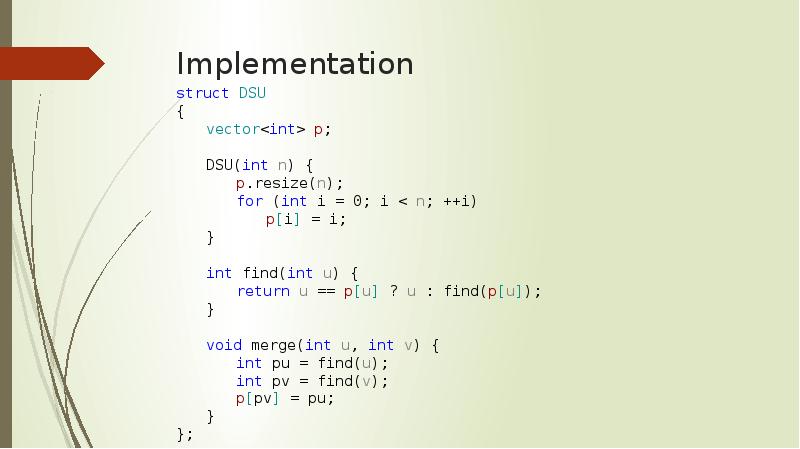
Implementation
Слайд 20
Описание слайда:
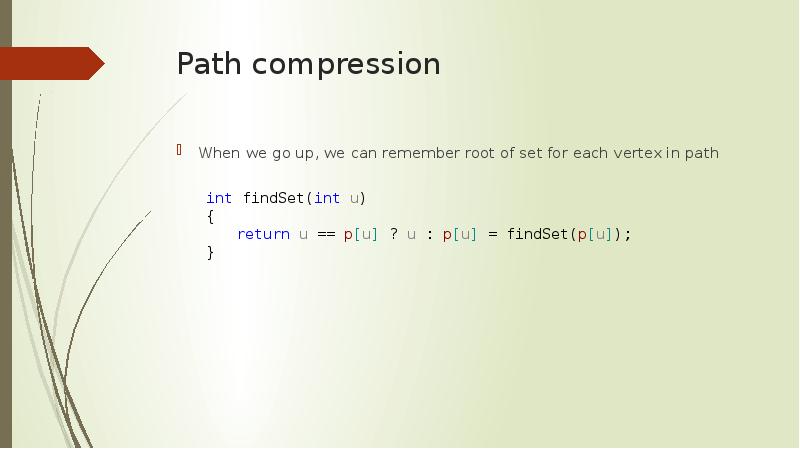
Path compression
When we go up, we can remember root of set for each vertex in path
Слайд 21
Описание слайда:
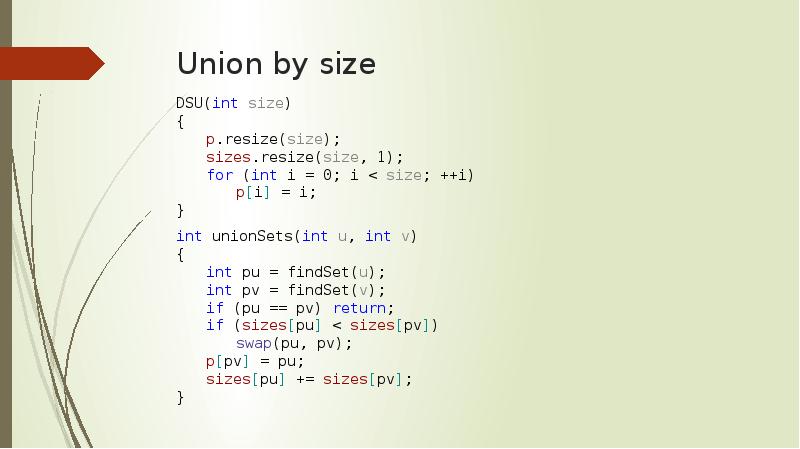
Union by size
Слайд 22
Описание слайда:
Links
https://en.wikipedia.org/wiki/Dijkstra%27s_algorithm
https://en.wikipedia.org/wiki/Floyd–Warshall_algorithm
https://en.wikipedia.org/wiki/Bellman–Ford_algorithm
https://en.wikipedia.org/wiki/Kruskal%27s_algorithm
https://en.wikipedia.org/wiki/Prim%27s_algorithm
https://en.wikipedia.org/wiki/Disjoint-set_data_structure
http://e-maxx.ru/algo/topological_sort
Слайд 23
Описание слайда:
Home task
http://ipc.susu.ac.ru/210-2.html?problem=1903
http://ipc.susu.ac.ru/210-2.html?problem=186
http://acm.timus.ru/problem.aspx?space=1&num=1982
http://acm.timus.ru/problem.aspx?space=1&num=1119
http://acm.timus.ru/problem.aspx?space=1&num=1210
http://acm.timus.ru/problem.aspx?space=1&num=1272
Скачать презентацию на тему Shortest paths and spanning trees in graphs 1 можно ниже: