The Establishment Of Modern International Relations System презентация
Содержание
- 2. Introduction The concept of the system of international relations is an
- 3. Morton Kaplan’s Theory On the basis of political realism Morton Kaplan
- 4. Morton Kaplan’s Theory Type 2 - flexible bipolar system in which
- 5. Morton Kaplan’s Theory Type 4 - a universal system - in
- 6. Systems of International Relations There are many other approaches to the
- 7. Peace of Westphalia (1648) 1) The basic idea of the
- 8. The transformation of the system of international relations in the XIX-XX
- 9. Versailles system of international relations (1919)
- 10. Creation and decay of the Yalta system (1945-1991)
- 11. Conclusion The best way to describe the system of international relations
- 12. Скачать презентацию
Слайды и текст этой презентации
Слайд 1
Описание слайда:
The Establishment Of Modern International Relations System
Made by Alex Pan’kov
Ryazan, 2013
Слайд 2
Описание слайда:
Introduction
The concept of the system of international relations is an important phenomenon in the study of the discipline. It is studied by empirical research rather than theoretical. The international systems are the system of human interactions, guided in their actions by will, consciousness, values, etc. There are a lot of different classifications of such systems. The classifications based on Marxism and neo-Marxism, liberalism and neo-liberalism, realism and neo-liberalism. But, in the generally, they theory-based on the principles of realism.
Слайд 3
Описание слайда:
Morton Kaplan’s Theory
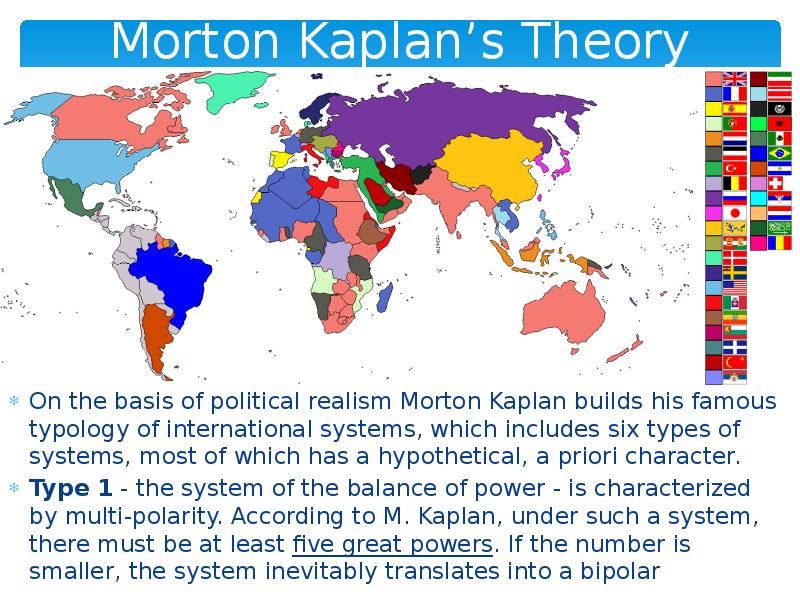
On the basis of political realism Morton Kaplan builds his famous typology of international systems, which includes six types of systems, most of which has a hypothetical, a priori character.
Type 1 - the system of the balance of power - is characterized by multi-polarity. According to M. Kaplan, under such a system, there must be at least five great powers. If the number is smaller, the system inevitably translates into a bipolar
Слайд 4
Описание слайда:
Morton Kaplan’s Theory
Type 2 - flexible bipolar system in which co-exist as actors-state, and a new type of actors - the alliances and blocs of states, as well as versatile actors - international organizations. Depending on the internal organization of the two blocks identified a number of flexible options for bipolar system, which can be: highly hierarchic and authoritarian (will head the coalition imposed its allies); not hierarchic at all (if the line of the block formed by mutual consultation between the autonomous from each other States)
Слайд 5
Описание слайда:
Morton Kaplan’s Theory
Type 4 - a universal system - in fact corresponds to the federation, which implies the dominant role of the universal actor, a greater degree of political homogeneity of the international environment and is based on the solidarity of national actors and the universal actor.
Слайд 6
Описание слайда:
Systems of International Relations
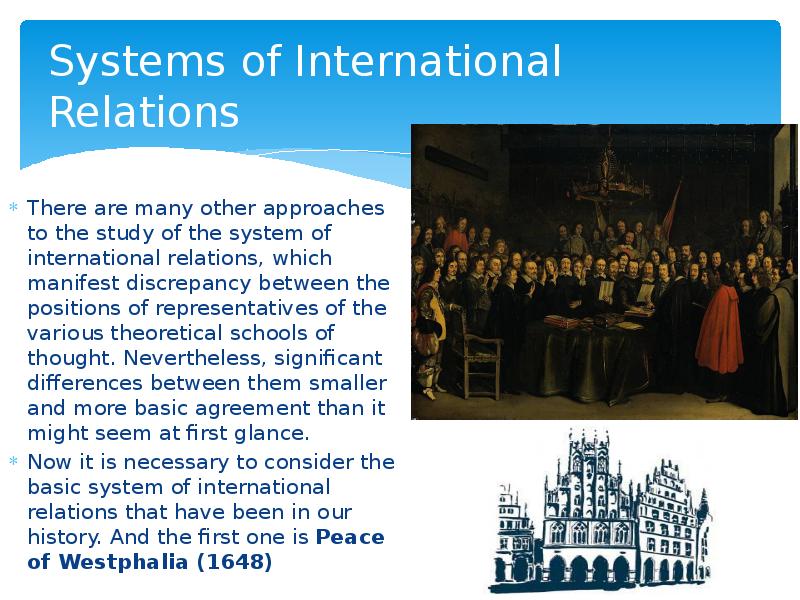
There are many other approaches to the study of the system of international relations, which manifest discrepancy between the positions of representatives of the various theoretical schools of thought. Nevertheless, significant differences between them smaller and more basic agreement than it might seem at first glance.
Now it is necessary to consider the basic system of international relations that have been in our history. And the first one is Peace of Westphalia (1648)
Слайд 7
Описание слайда:
Peace of Westphalia (1648)
1) The basic idea of the principle of political balance, proclaimed in Westphalia, according to S.A.Zhigarev, was, on the one hand, the intention to protect the freedom and independence of States, through fair and proportionate allocation between territories and people, on the other - by thwarting individual states to world domination and their attempts to make changes in the balance of power.
2) After the signing of the Peace of Westphalia the leading role of the monarchy came to the sovereign state. A crucial role is now played by the public interest, and historical and religious principles are in the past.
3) Also as a result of the Thirty Years' War, formed a definite balance, the balance of power between the states of the time at which none of them had a decisive advantage over the other. If one power to disturb the peace and tranquility right coalition was formed, the purpose of which was to restore peace and opposition to the aggressor. At the heart of all the coalitions has traditionally been the United Kingdom.
Слайд 8
Описание слайда:
The transformation of the system of international relations in the XIX-XX
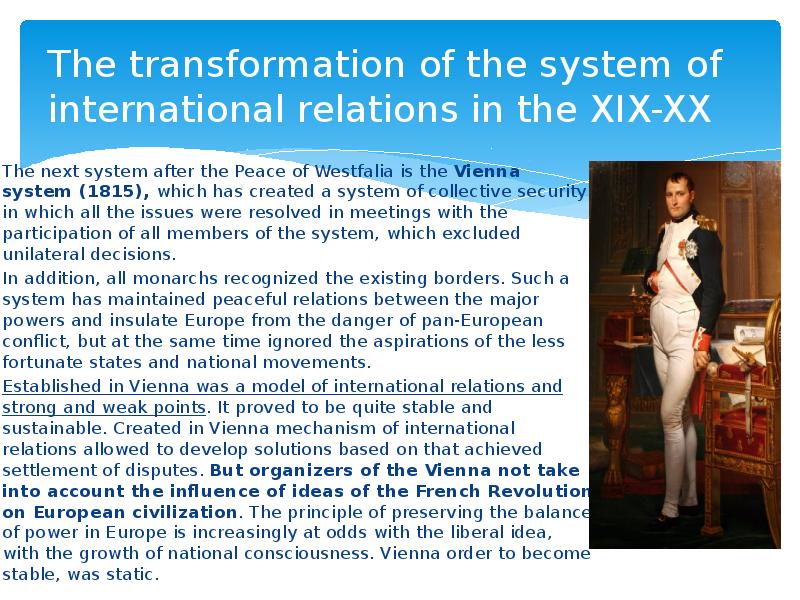
The next system after the Peace of Westfalia is the Vienna system (1815), which has created a system of collective security in which all the issues were resolved in meetings with the participation of all members of the system, which excluded unilateral decisions.
In addition, all monarchs recognized the existing borders. Such a system has maintained peaceful relations between the major powers and insulate Europe from the danger of pan-European conflict, but at the same time ignored the aspirations of the less fortunate states and national movements.
Established in Vienna was a model of international relations and strong and weak points. It proved to be quite stable and sustainable. Created in Vienna mechanism of international relations allowed to develop solutions based on that achieved settlement of disputes. But organizers of the Vienna not take into account the influence of ideas of the French Revolution on European civilization. The principle of preserving the balance of power in Europe is increasingly at odds with the liberal idea, with the growth of national consciousness. Vienna order to become stable, was static.
Слайд 9
Описание слайда:
Versailles system of international relations (1919)
Слайд 10
Описание слайда:
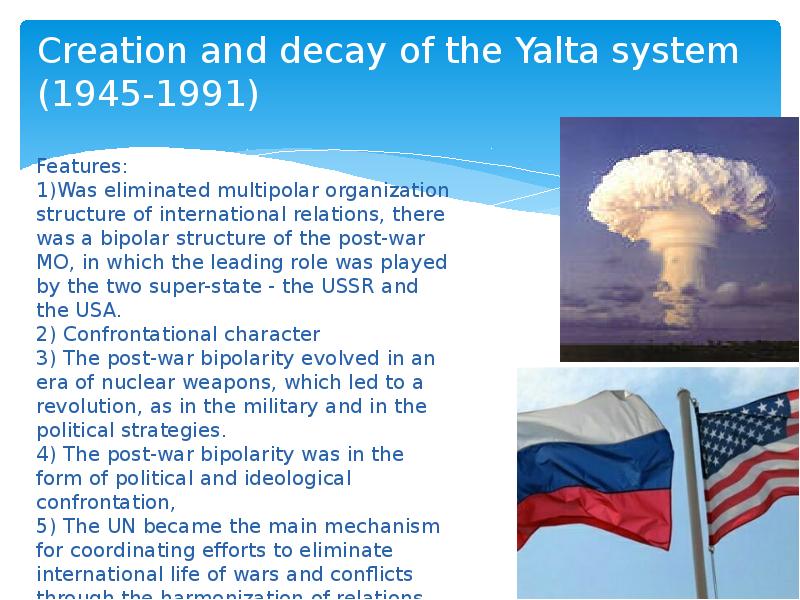
Creation and decay of the Yalta system (1945-1991)
Слайд 11
Описание слайда:
Conclusion
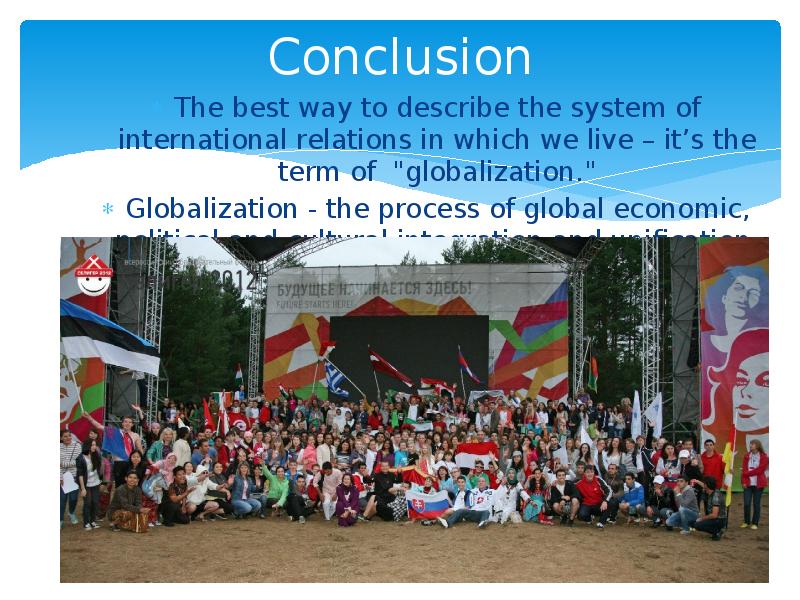
The best way to describe the system of international relations in which we live – it’s the term of "globalization."
Globalization - the process of global economic, political and cultural integration and unification.
Скачать презентацию на тему The Establishment Of Modern International Relations System можно ниже: