The Phrase (continued). Simple Sentence презентация
Содержание
- 2. Types of Syntactic Relations Syntactic relations of the phrase constituents are
- 3. Special Means of Expressing Syntactic Relations Adjoinment is described as absence
- 4. The Simple Sentence 1. The Sentence: Definition. The Sentence as a
- 5. Features of The sentence The sentence is a central syntactic construction.
- 6. The sentence is a unit of predication which, naming a certain
- 7. The general semantic category of modality is also defined by linguists
- 8. The sentence: Definition The sentence is an immediate integral unit used
- 9. 2. Classification of Sentences According to the number and types of
- 10. Simple Sentence According to the Number of the Main Parts
- 11. It is a disputed point whether the main part of such
- 12. Prof. Blokh, however, does not accept this approach. Instead he suggests
- 13. 2. According to the type of the main part of the
- 14. Elliptical Sentences One-member sentences should be kept apart from two-member sentences
- 15. Some grammarians hold another point of view recognising ellipsis also in
- 16. 3. The following types of elliptical sentences are singled out: a)
- 17. d) omission of the subject and auxiliary verb: e. g.
- 18. 4. Prof. Pocheptsov’s classification of sentences
- 19. Pocheptsov’s classification All sentences are divided into: sentences proper ; quasi-sentences.
- 20. Sentences proper: declarative (John came.); interrogative (Did John come?); optative (If
- 21. A declarative sentence is presenting some information. An interrogative sentence is
- 22. Quasi-sentences are not communications, they do not have the subject-predicate base.
- 23. Quasi-sentences: vocatives (John!); interjectional sentences expressing emotions (Oh!); meta-communicative sentences used
- 24. Скачать презентацию
Слайды и текст этой презентации
Слайд 1
Описание слайда:
The Phrase (continued).
Simple Sentence
Слайд 2
Описание слайда:
Types of Syntactic Relations
Syntactic relations of the phrase constituents are divided into two main types: agreement and government.
Agreement takes place when the subordinate word assumes a form similar to that of the word to which it is subordinate.
Government takes place when the subordinate word is used in a certain form required by its head word, the form of the subordinate word not coinciding with the form of the head word.
Слайд 3
Описание слайда:
Special Means of Expressing Syntactic Relations
Adjoinment is described as absence both of agreement and of government. Combined elements build syntactic groups without changing their forms (to nod silently, to act cautiously).
By enclosure (замыкание) some element is put between the two parts of another constituent of a phrase. It is, as it were, enclosed between two parts of another element (a pretty face, your perfect man, one good essay, the then president, a go-to-devil expression).
Слайд 4
Описание слайда:
The Simple Sentence
1. The Sentence: Definition. The Sentence as a Language Unit.
2. Classifications of Sentences.
Слайд 5
Описание слайда:
Features of The sentence
The sentence is a central syntactic construction.
It is a minimal unit of speech communication.
The phrase is a nominative unit which fulfils the function of polynomination denoting a complex referent analyzable into its component elements together with various relations between them.
Слайд 6
Описание слайда:
The sentence is a unit of predication which, naming a certain situational event, shows the relation of the denoted event towards reality.
Predication establishes the relation of the named phenomena to actual life.
Слайд 7
Описание слайда:
The general semantic category of modality is also defined by linguists as exposing the connection between the named objects and surrounding reality.
However, modality is not specifically confined to the sentence; this is a broader category revealed both in the grammatical elements of language and its lexical, purely nominative elements.
Слайд 8
Описание слайда:
The sentence: Definition
The sentence is an immediate integral unit used in speech communication, built up of words according to a definite syntactic pattern and characterized by predication.
It possesses the following properties:
predicativity;
separateness (entirety);
intonation pattern;
the highest hierarchical position relative to other structural language units.
Слайд 9
Описание слайда:
2. Classification of Sentences
According to the number and types of finite clauses:
simple;
composite:
- compound;
- complex.
Слайд 10
Описание слайда:
Simple Sentence
According to the Number of the Main Parts of the Sentence:
One-member
Two-member
One-member sentences contain only one main part
(e.g. Silence! Come here!) Such sentences contain neither the subject nor the predicate.
Слайд 11
Описание слайда:
It is a disputed point whether the main part of such a sentence should be termed subject in some cases, and predicate, in others.
As it was pointed out by academician V. Vinogradov, grammatical subject and grammatical predicate are correlative notions and the terms are meaningless outside their relation to each other.
Слайд 12
Описание слайда:
Prof. Blokh, however, does not accept this approach.
Instead he suggests that all simple sentences in English be divided into two-axis constructions and one-axis constructions.
In a two-axis sentence, the subject axis and the predicate axis are directly and explicitly expressed in the outer structure.
In a one-axis sentence only one axis or its part is explicitly expressed, the other one being non-presented in the outer structure of the sentence.
Слайд 13
Описание слайда:
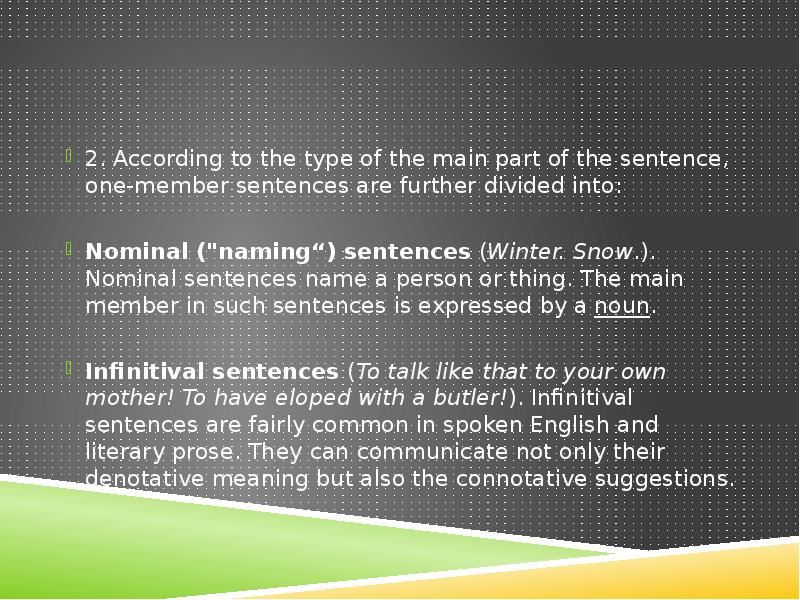
2. According to the type of the main part of the sentence, one-member sentences are further divided into:
Nominal ("naming“) sentences (Winter. Snow.). Nominal sentences name a person or thing. The main member in such sentences is expressed by a noun.
Infinitival sentences (To talk like that to your own mother! To have eloped with a butler!). Infinitival sentences are fairly common in spoken English and literary prose. They can communicate not only their denotative meaning but also the connotative suggestions.
Слайд 14
Описание слайда:
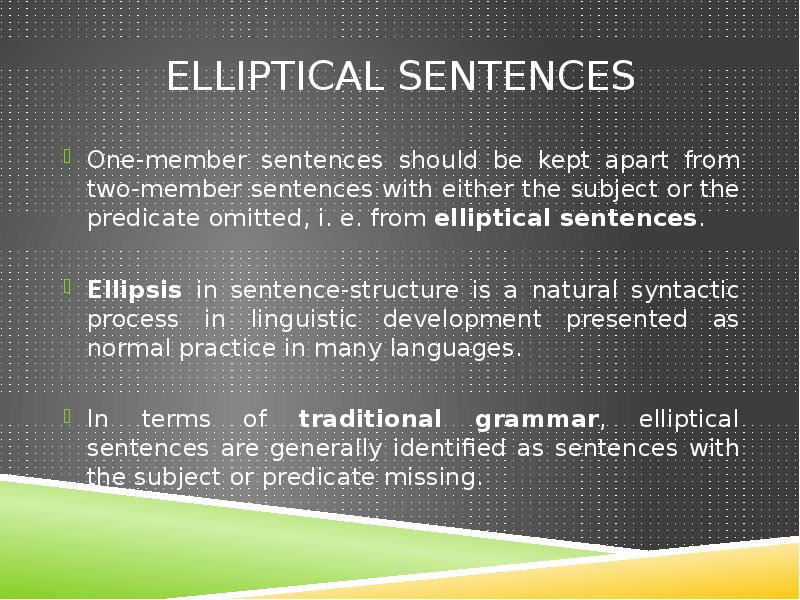
Elliptical Sentences
One-member sentences should be kept apart from two-member sentences with either the subject or the predicate omitted, i. e. from elliptical sentences.
Ellipsis in sentence-structure is a natural syntactic process in linguistic development presented as normal practice in many languages.
In terms of traditional grammar, elliptical sentences are generally identified as sentences with the subject or predicate missing.
Слайд 15
Описание слайда:
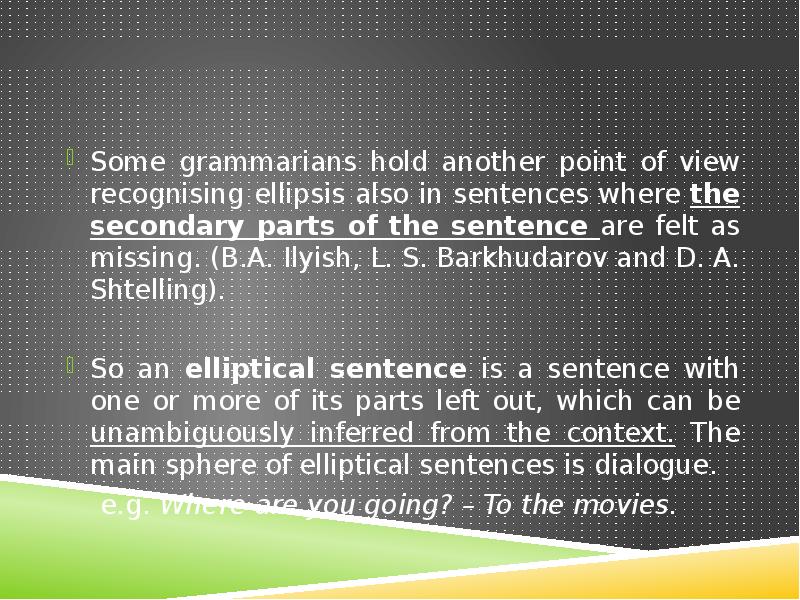
Some grammarians hold another point of view recognising ellipsis also in sentences where the secondary parts of the sentence are felt as missing. (B.A. Ilyish, L. S. Barkhudarov and D. A. Shtellіng).
So an elliptical sentence is a sentence with one or more of its parts left out, which can be unambiguously inferred from the context. The main sphere of elliptical sentences is dialogue.
e.g. Where are you going? – To the movies.
Слайд 16
Описание слайда:
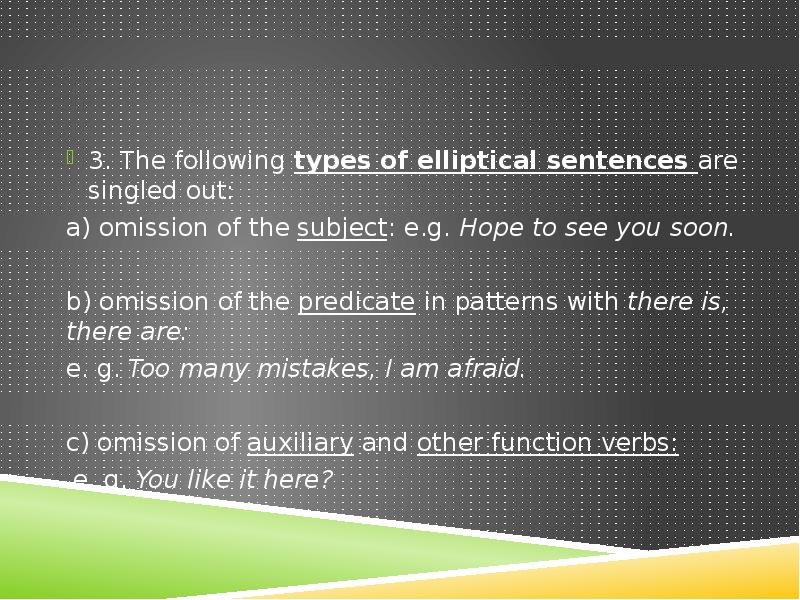
3. The following types of elliptical sentences are singled out:
a) omission of the subject: e.g. Hope to see you soon.
b) omission of the predicate in patterns with there is, there are:
e. g. Too many mistakes, I am afraid.
c) omission of auxiliary and other function verbs:
e. g. You like it here?
Слайд 17
Описание слайда:
d) omission of the subject and auxiliary verb:
e. g. Hear me?
e) omission of the subject and the link-verb:
e. g. Glad to see you again.
Слайд 18
Описание слайда:
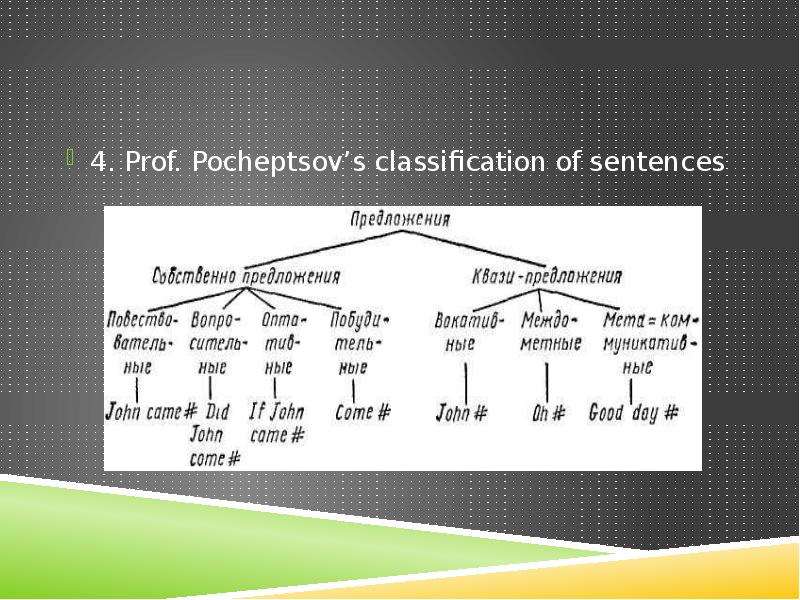
4. Prof. Pocheptsov’s classification of sentences
Слайд 19
Описание слайда:
Pocheptsov’s classification
All sentences are divided into:
sentences proper ;
quasi-sentences.
Sentences proper are communications, they have the subject-predicate base and differ in the way they relate contents to reality.
Слайд 20
Описание слайда:
Sentences proper:
declarative (John came.);
interrogative (Did John come?);
optative (If John came…);
inductive (Come.).
Слайд 21
Описание слайда:
A declarative sentence is presenting some information.
An interrogative sentence is an inquiry of information that the author of the sentence does not have.
Both optative and inductive sentences express the speaker’s voluntative attitude to some event. The difference is that in the first case the desire does not get satisfied while in the second case it is realized by means of verbal influence on the participant of the situation (the source of the corresponding action).
Слайд 22
Описание слайда:
Quasi-sentences are not communications, they do not have the subject-predicate base.
Quasi-sentences are granted the status of sentences just because they can substitute for sentences in the flow of speech being characterized by separateness and acquiring intonational characteristics of the sentence.
Слайд 23
Описание слайда:
Quasi-sentences:
vocatives (John!);
interjectional sentences expressing emotions (Oh!);
meta-communicative sentences used to open or close a speech contact (Good day!).
Скачать презентацию на тему The Phrase (continued). Simple Sentence можно ниже: