The Verb: Tense, Aspect, Phase презентация
Содержание
- 2. The concept of Time in different languages plays a very important
- 3. In most European languages the expression of time is associated with
- 4. In English the concept of time finds a very elaborate expression
- 5. The grammatical category of tense is a category which expresses the
- 6. Complexity of the grammatical category of tense: the number of categorical
- 7. Three grammatical categories: tense represents the relation of the action to
- 8. Syncretism – Present Perfect Continuous It has been raining for hours
- 9. The postulate of the grammatical category (A.I. Smirnitsky) A categorial form
- 10. The Category of Tense Time & Tense Time – an objective
- 11. The Present & Past Tenses The range of meaning of the
- 12. The present tense for future - structurally dependent In adverbial
- 13. The present tense embraces actions taking place within different periods of
- 14. The Problem of the Future Tense Threefold division of time: the
- 15. Twofold system of tenses (Jespersen, Palmer, Barkhudarov, etc.) The category of
- 16. Shall/will cannot be regarded as a morphological form Form: combinations shall/will
- 17. Twofold system of tenses: English has no special morphological form of
- 18. The Category of Aspect
- 19. Common & Continuous Aspects Aspect – a grammatical category, a meaningful
- 20. Continuous aspect is marked formally & semantically The verb denotes an
- 21. Common aspect denotes actions in more general way The verb denotes
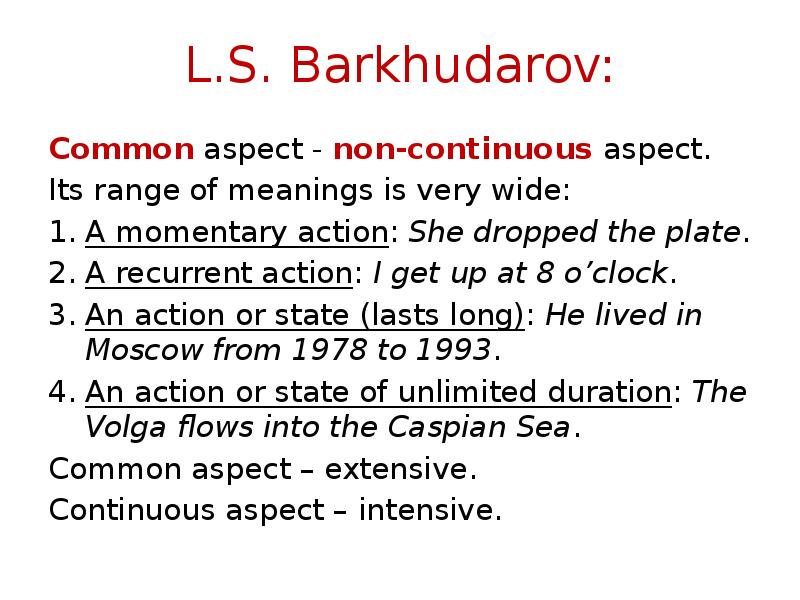
- 22. L.S. Barkhudarov: Common aspect - non-continuous aspect. Its range of
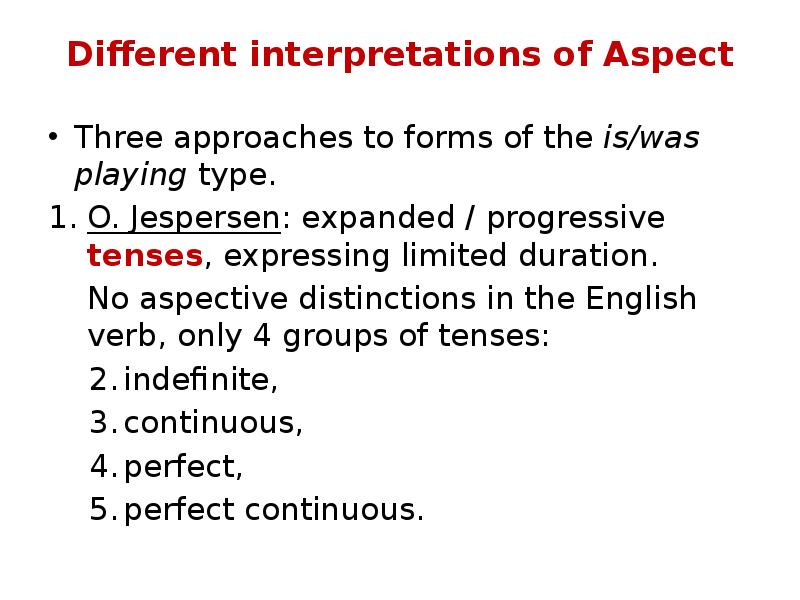
- 23. Different interpretations of Aspect Three approaches to forms of the is/was
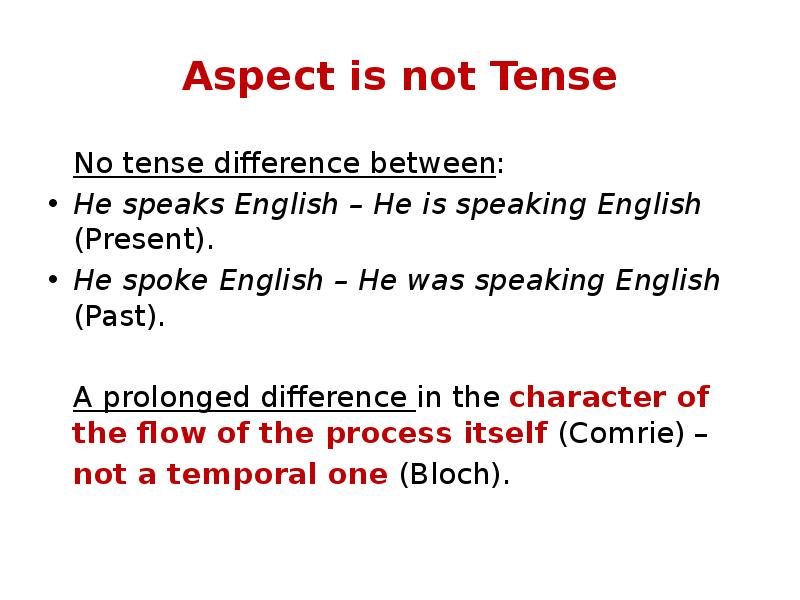
- 24. Aspect is not Tense No tense difference between: He speaks English
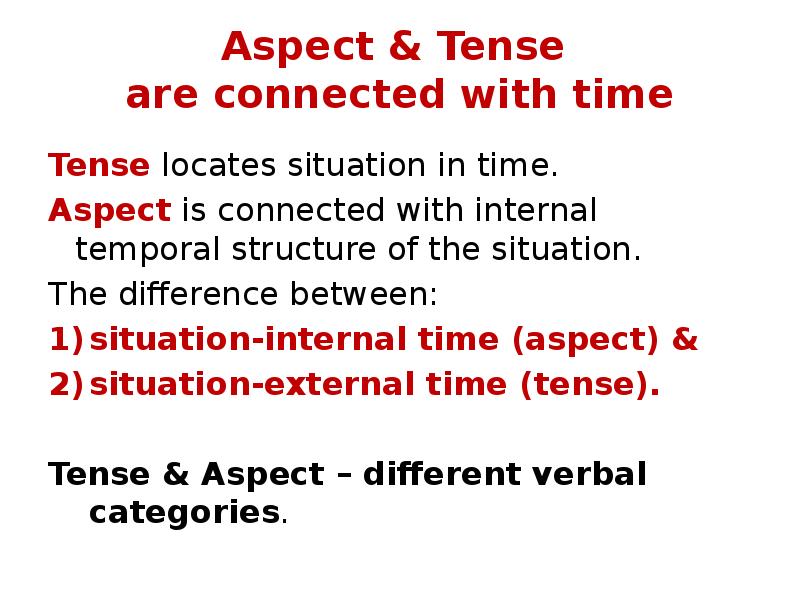
- 25. Aspect & Tense are connected with time Tense locates situation in
- 26. 2. is/was playing – tense-aspect forms (H. Sweet) definite tenses 3.
- 27. Aspective character of the verb: Terminative (limitive) – imply a limit
- 28. The Category of Phase
- 29. Perfect – Non-Perfect Phase Phase – one of the three categories
- 30. Phase – a morphosyntactic category of the verb realized in a
- 31. Grammatical meaning of Phase Priority – Non-priority Perfect forms express actions
- 32. The difference between
- 33. Tense & Phase express situation-external priority Tense expresses absolute (primary) priority
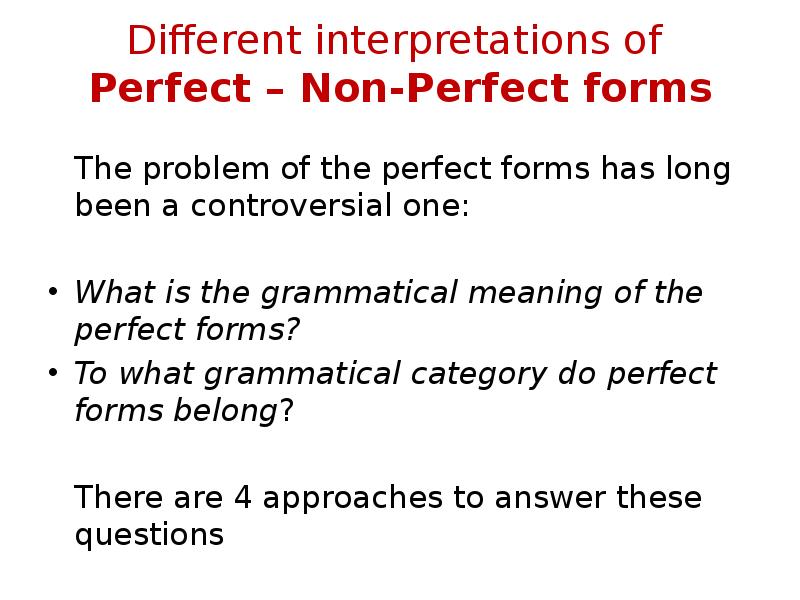
- 34. Different interpretations of Perfect – Non-Perfect forms The problem of the
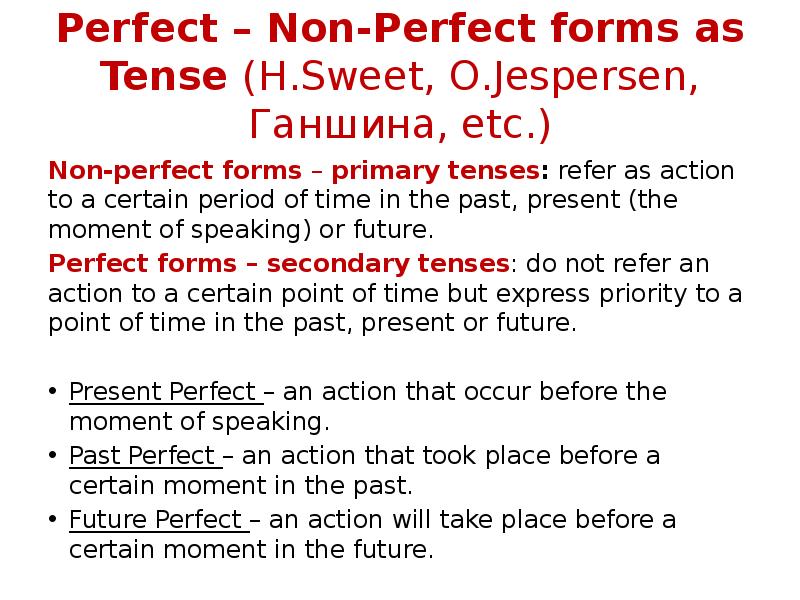
- 35. Perfect – Non-Perfect forms as Tense (H.Sweet, O.Jespersen, Ганшина, etc.) Non-perfect
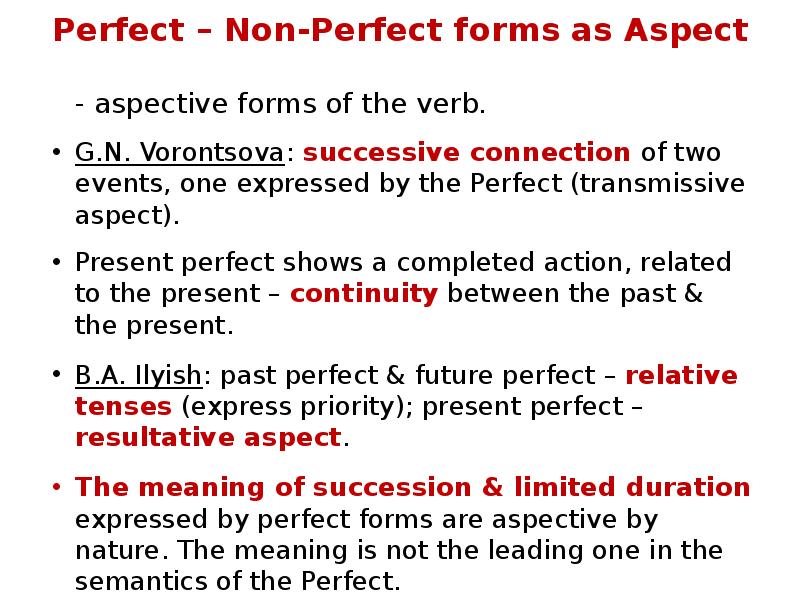
- 36. Perfect – Non-Perfect forms as Aspect - aspective forms of the
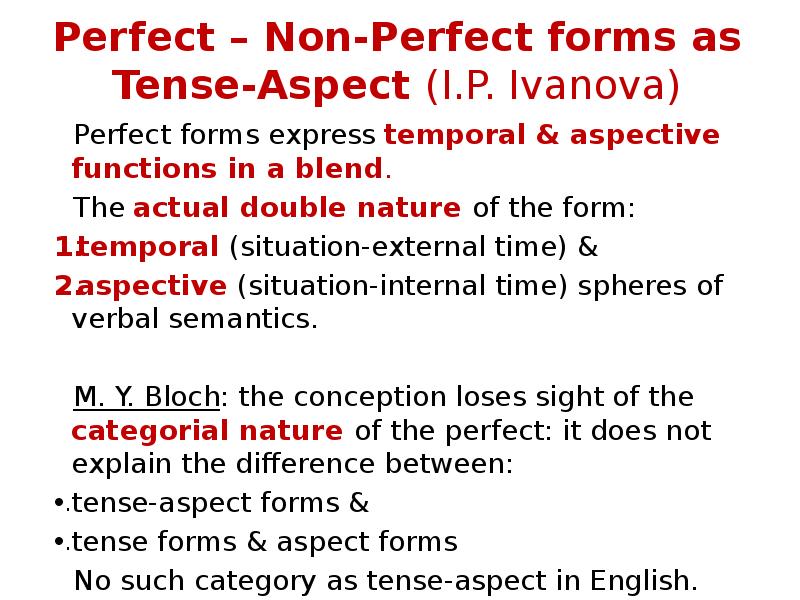
- 37. Perfect – Non-Perfect forms as Tense-Aspect (I.P. Ivanova) Perfect forms express
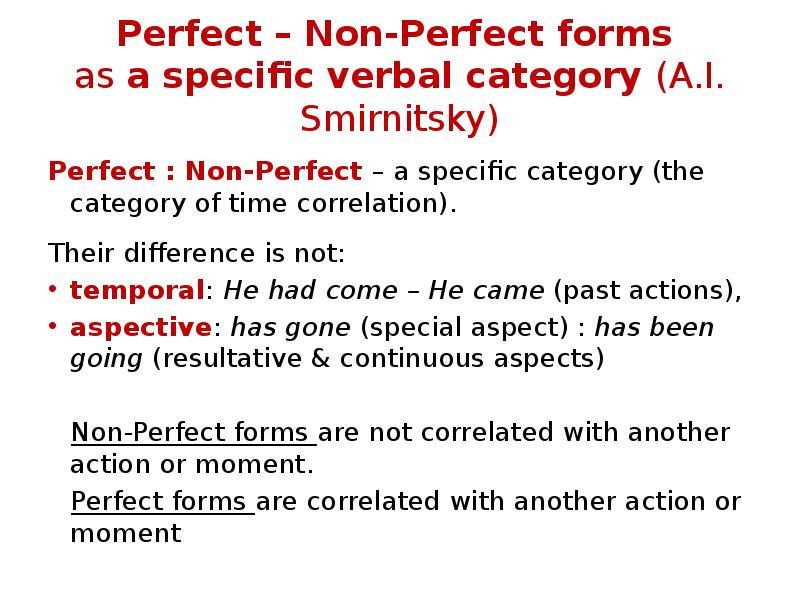
- 38. Perfect – Non-Perfect forms as a specific verbal category (A.I. Smirnitsky)
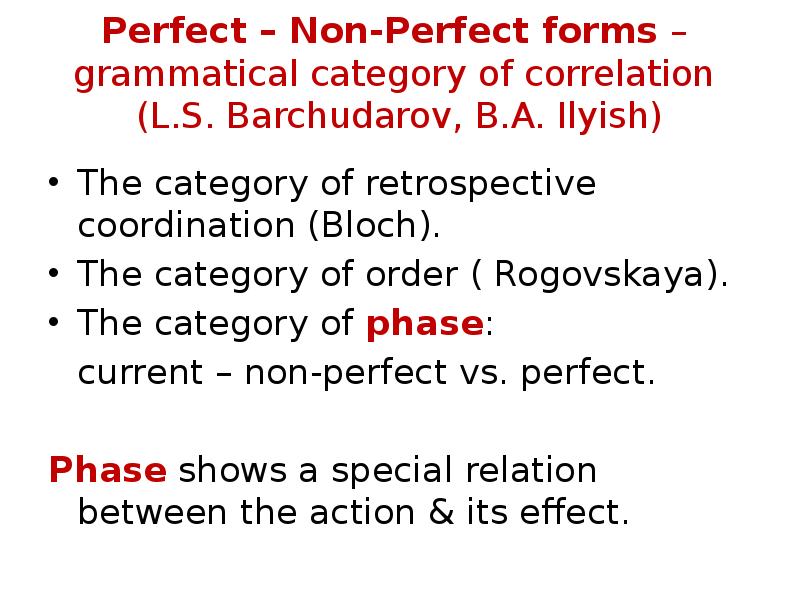
- 39. Perfect – Non-Perfect forms – grammatical category of correlation (L.S. Barchudarov,
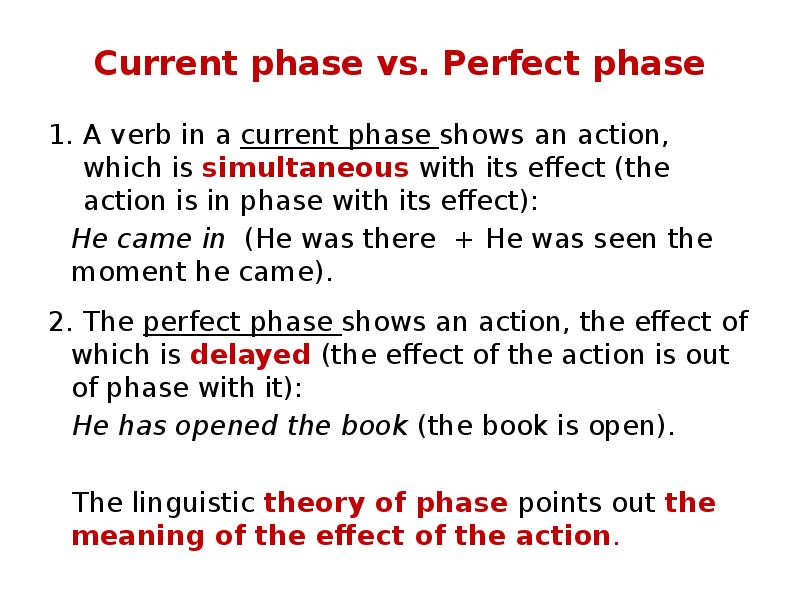
- 40. Current phase vs. Perfect phase A verb in a current phase
- 41. Скачать презентацию
Слайды и текст этой презентации
Слайд 1
Описание слайда:
The Verb: Tense, Aspect, Phase
Lecture 6
Слайд 2
Описание слайда:
The concept of Time
in different languages
plays a very important role in human life;
occupies a very important place in the conceptual picture of reality
in the semantic space of language though languages may vary greatly in expressing this concept.
Слайд 3
Описание слайда:
In most European languages the expression of time is associated with the grammatical category of tense: present, past and future.
In most European languages the expression of time is associated with the grammatical category of tense: present, past and future.
Many non-European languages do not use this time scale: (Buzarra, an Australian aboriginal language).
Hopi have a different concept of time - there are no straightforward past, present and future.
There are languages (e.g. Burmese) where time does not find a grammatical expression at all.
There are also languages in which the verb is concerned with spatial rather than temporal relations.
Слайд 4
Описание слайда:
In English the concept of time finds
a very elaborate expression
It is presented by units of various lingual levels: grammatical forms, nouns, adjectives and adverbs.
Taken together they constitute the functional-semantic category of temporality.
The grammatical category of tense the concept of time represented in aspect and time correlation (phase).
Слайд 5
Описание слайда:
The grammatical category of tense
is a category which expresses the relation between the time of the action and the moment of speech (now) or temporal relations (then);
both now and then denote stretches of time and the boundaries of these stretches are not clearly outlined: Experience fades. Memory stills;
the now and then are not stable but shifting because they present the speaker's moment of speech;
tense may be compared to the most prototypical deictic words - the pronouns. This fact differentiates the category of tense from the categories of aspect and time correlation (phase).
Слайд 6
Описание слайда:
Complexity of the grammatical category of tense:
the number of categorical forms
Linguists differ in the questions related to the scope of this category and to the number of categorial forms
1) the relations between tense and the other two verbal categories in which the concept of time is represented (aspect and time correlation /phase);
2) the status of shall/will + Infinitive, i.e. the problem of Future tense.
Слайд 7
Описание слайда:
Three grammatical categories:
tense represents the relation of the action to the moment of speech (the speaker's now);
aspect reflects the internal temporal structure of the situation as presented by the speaker, the speaker's 'vision' and interpretation of the temporal situation;
time correlation / phase presents the action in its correlation to another action or point in time as prior to it.
Слайд 8
Описание слайда:
Syncretism –
Present Perfect Continuous
It has been raining for hours
an action which began prior to the moment of speech,
has been going on for a certain period of time up to the moment of speech,
is still going on, i.e. simultaneous to the moment of speech.
Слайд 9
Описание слайда:
The postulate of the grammatical category (A.I. Smirnitsky)
A categorial form cannot express simultaneously several meanings of the same grammatical category though it can express several meanings of different grammatical categories.
Слайд 10
Описание слайда:
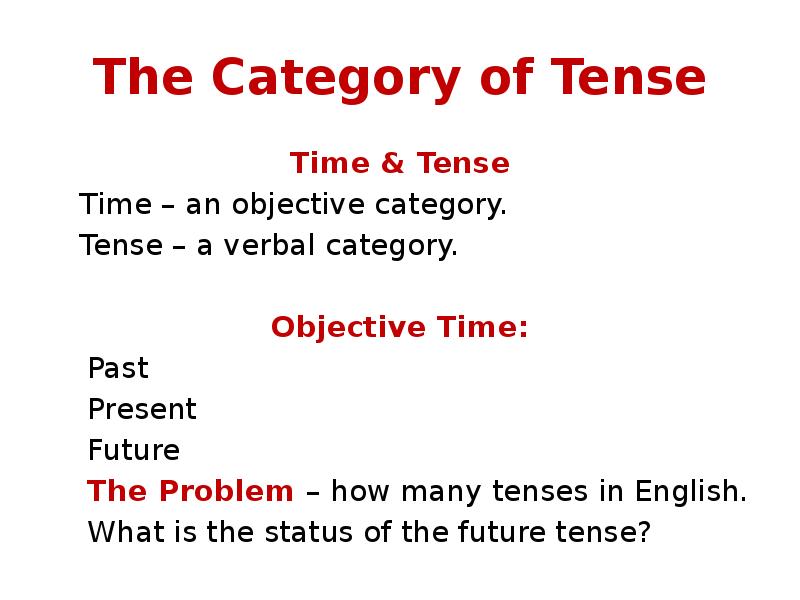
The Category of Tense
Time & Tense
Time – an objective category.
Tense – a verbal category.
Objective Time:
Past
Present
Future
The Problem – how many tenses in English.
What is the status of the future tense?
Слайд 11
Описание слайда:
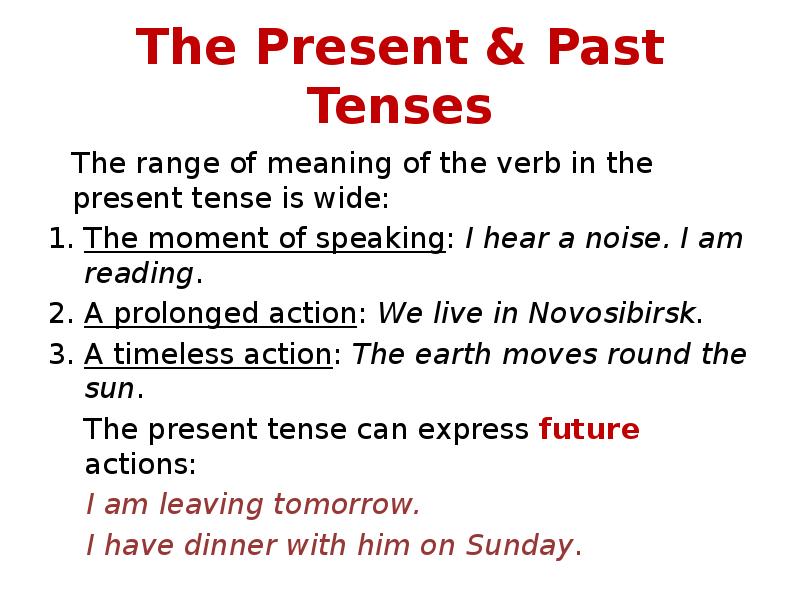
The Present & Past Tenses
The range of meaning of the verb in the present tense is wide:
The moment of speaking: I hear a noise. I am reading.
A prolonged action: We live in Novosibirsk.
A timeless action: The earth moves round the sun.
The present tense can express future actions:
I am leaving tomorrow.
I have dinner with him on Sunday.
Слайд 12
Описание слайда:
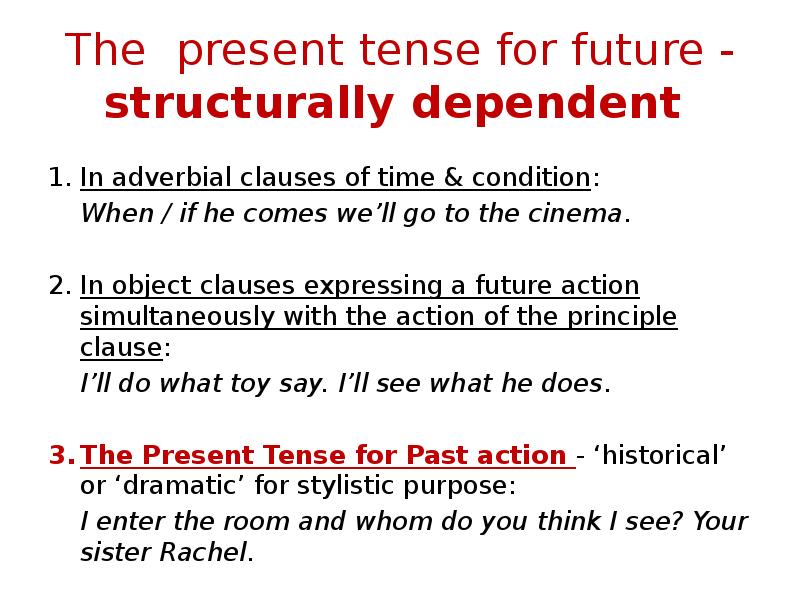
The present tense for future - structurally dependent
In adverbial clauses of time & condition:
When / if he comes we’ll go to the cinema.
In object clauses expressing a future action simultaneously with the action of the principle clause:
I’ll do what toy say. I’ll see what he does.
The Present Tense for Past action - ‘historical’ or ‘dramatic’ for stylistic purpose:
I enter the room and whom do you think I see? Your sister Rachel.
Слайд 13
Описание слайда:
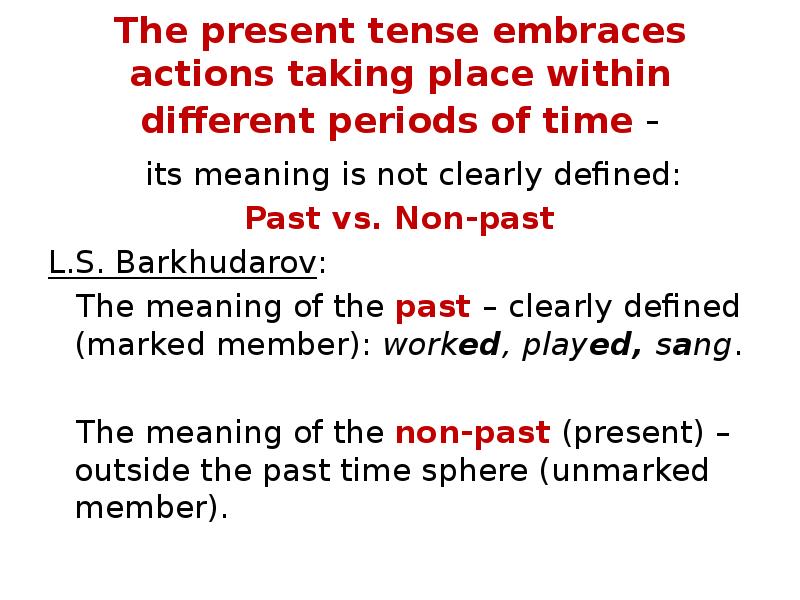
The present tense embraces actions taking place within different periods of time -
its meaning is not clearly defined:
Past vs. Non-past
L.S. Barkhudarov:
The meaning of the past – clearly defined (marked member): worked, played, sang.
The meaning of the non-past (present) – outside the past time sphere (unmarked member).
Слайд 14
Описание слайда:
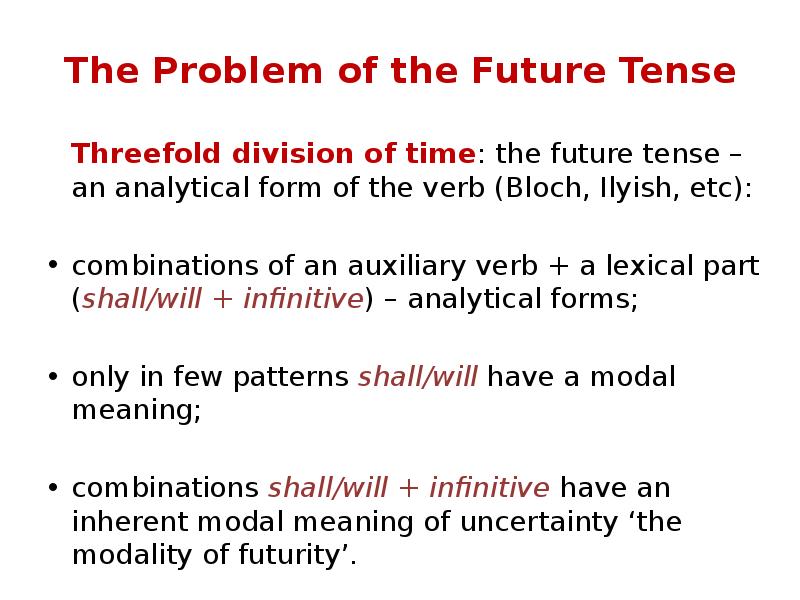
The Problem of the Future Tense
Threefold division of time: the future tense – an analytical form of the verb (Bloch, Ilyish, etc):
combinations of an auxiliary verb + a lexical part (shall/will + infinitive) – analytical forms;
only in few patterns shall/will have a modal meaning;
combinations shall/will + infinitive have an inherent modal meaning of uncertainty ‘the modality of futurity’.
Слайд 15
Описание слайда:
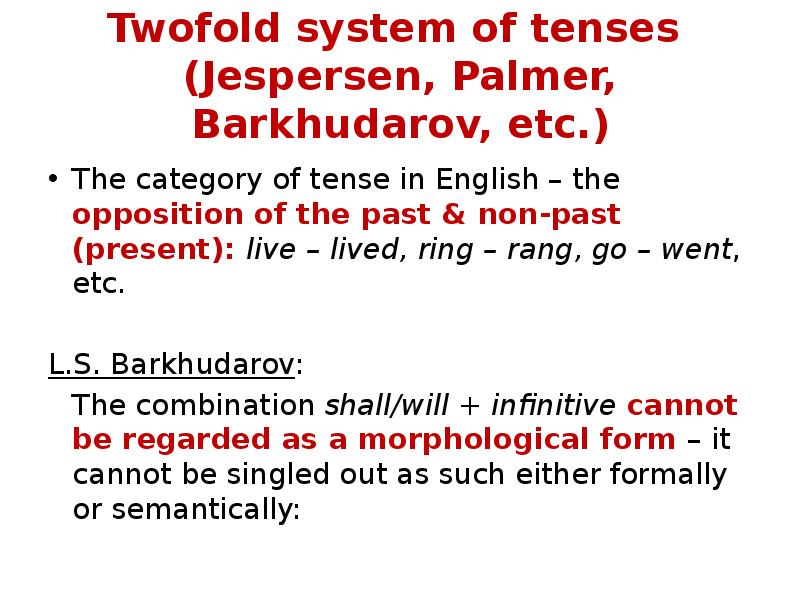
Twofold system of tenses
(Jespersen, Palmer, Barkhudarov, etc.)
The category of tense in English – the opposition of the past & non-past (present): live – lived, ring – rang, go – went, etc.
L.S. Barkhudarov:
The combination shall/will + infinitive cannot be regarded as a morphological form – it cannot be singled out as such either formally or semantically:
Слайд 16
Описание слайда:
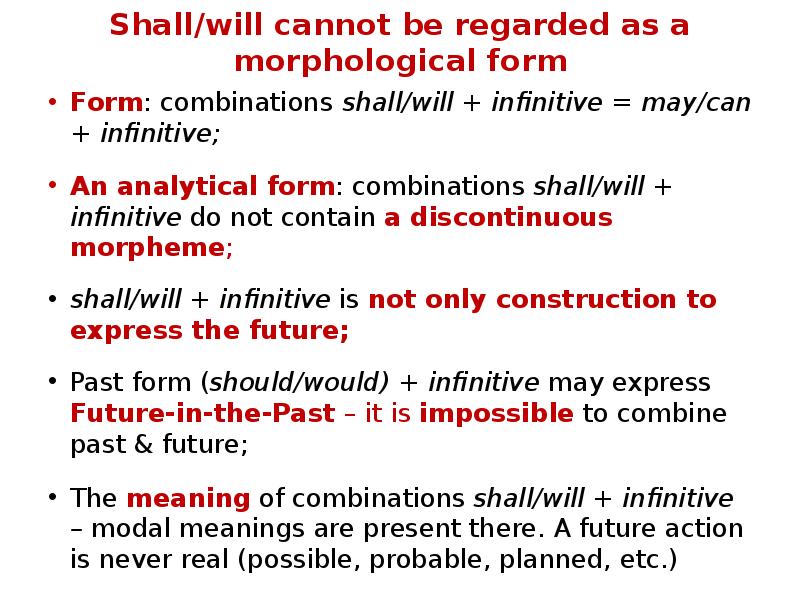
Shall/will cannot be regarded as a morphological form
Form: combinations shall/will + infinitive = may/can + infinitive;
An analytical form: combinations shall/will + infinitive do not contain a discontinuous morpheme;
shall/will + infinitive is not only construction to express the future;
Past form (should/would) + infinitive may express Future-in-the-Past – it is impossible to combine past & future;
The meaning of combinations shall/will + infinitive – modal meanings are present there. A future action is never real (possible, probable, planned, etc.)
Слайд 17
Описание слайда:
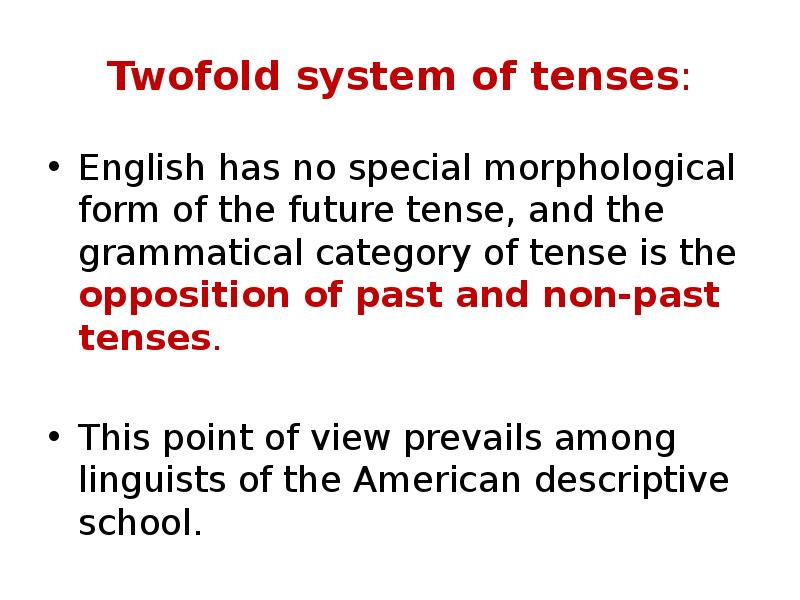
Twofold system of tenses:
English has no special morphological form of the future tense, and the grammatical category of tense is the opposition of past and non-past tenses.
This point of view prevails among linguists of the American descriptive school.
Слайд 18
Описание слайда:
The Category of Aspect
Слайд 19
Описание слайда:
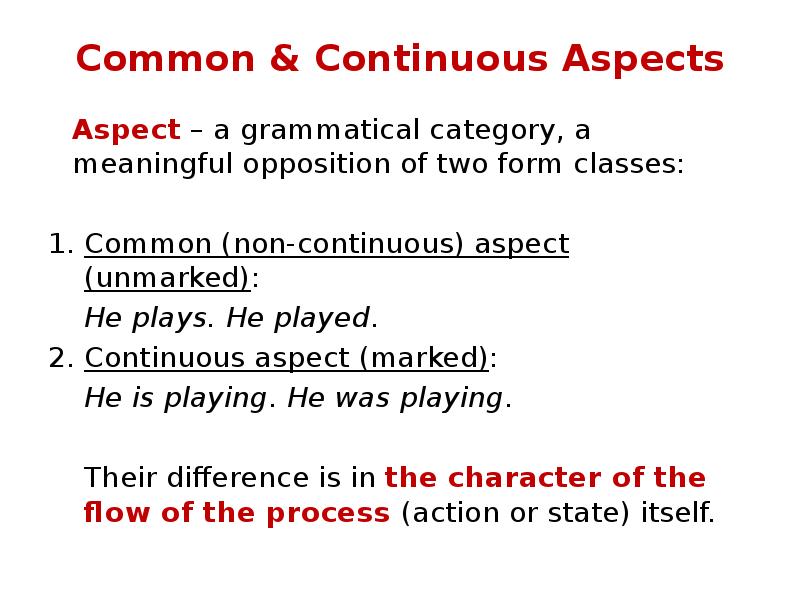
Common & Continuous Aspects
Aspect – a grammatical category, a meaningful opposition of two form classes:
Common (non-continuous) aspect (unmarked):
He plays. He played.
Continuous aspect (marked):
He is playing. He was playing.
Their difference is in the character of the flow of the process (action or state) itself.
Слайд 20
Описание слайда:
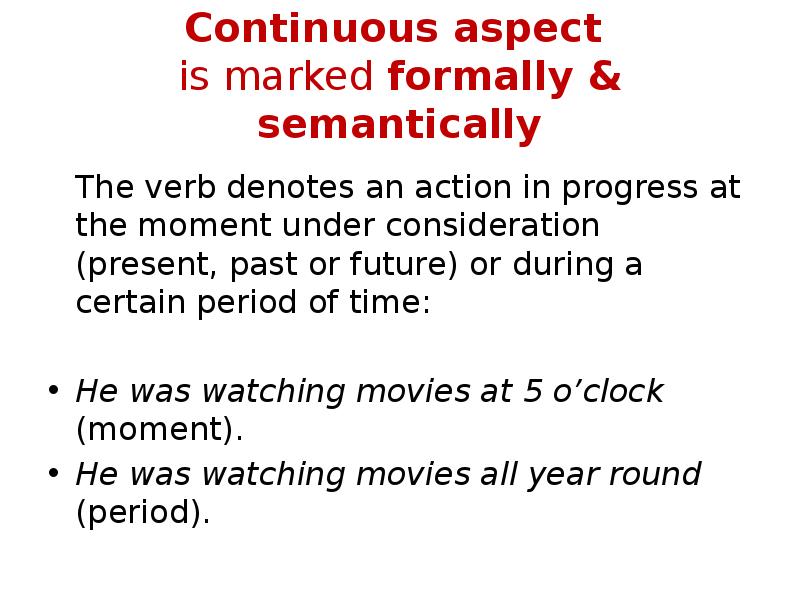
Continuous aspect
is marked formally & semantically
The verb denotes an action in progress at the moment under consideration (present, past or future) or during a certain period of time:
He was watching movies at 5 o’clock (moment).
He was watching movies all year round (period).
Слайд 21
Описание слайда:
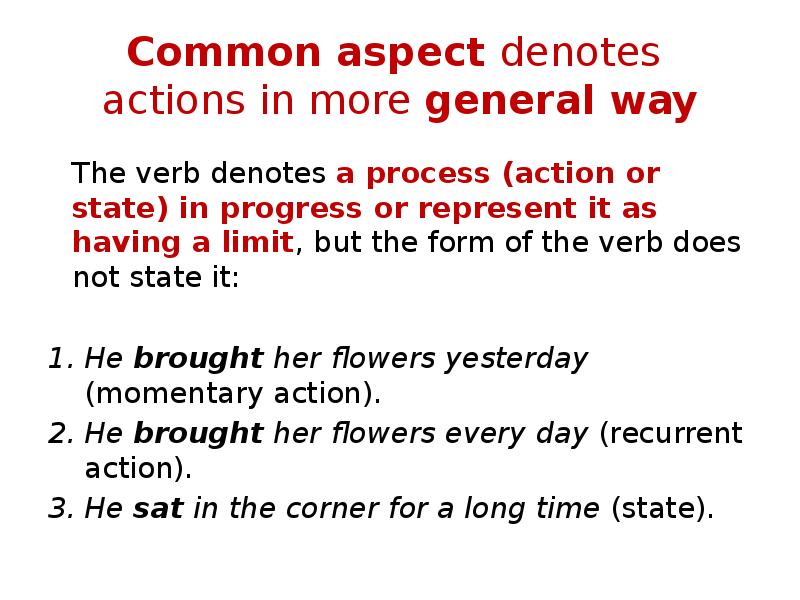
Common aspect denotes
actions in more general way
The verb denotes a process (action or state) in progress or represent it as having a limit, but the form of the verb does not state it:
He brought her flowers yesterday (momentary action).
He brought her flowers every day (recurrent action).
He sat in the corner for a long time (state).
Слайд 22
Описание слайда:
L.S. Barkhudarov:
Common aspect - non-continuous aspect.
Its range of meanings is very wide:
A momentary action: She dropped the plate.
A recurrent action: I get up at 8 o’clock.
An action or state (lasts long): He lived in Moscow from 1978 to 1993.
An action or state of unlimited duration: The Volga flows into the Caspian Sea.
Common aspect – extensive.
Continuous aspect – intensive.
Слайд 23
Описание слайда:
Different interpretations of Aspect
Three approaches to forms of the is/was playing type.
O. Jespersen: expanded / progressive tenses, expressing limited duration.
No aspective distinctions in the English verb, only 4 groups of tenses:
indefinite,
continuous,
perfect,
perfect continuous.
Слайд 24
Описание слайда:
Aspect is not Tense
No tense difference between:
He speaks English – He is speaking English (Present).
He spoke English – He was speaking English (Past).
A prolonged difference in the character of the flow of the process itself (Comrie) –
not a temporal one (Bloch).
Слайд 25
Описание слайда:
Aspect & Tense
are connected with time
Tense locates situation in time.
Aspect is connected with internal temporal structure of the situation.
The difference between:
situation-internal time (aspect) &
situation-external time (tense).
Tense & Aspect – different verbal categories.
Слайд 26
Описание слайда:
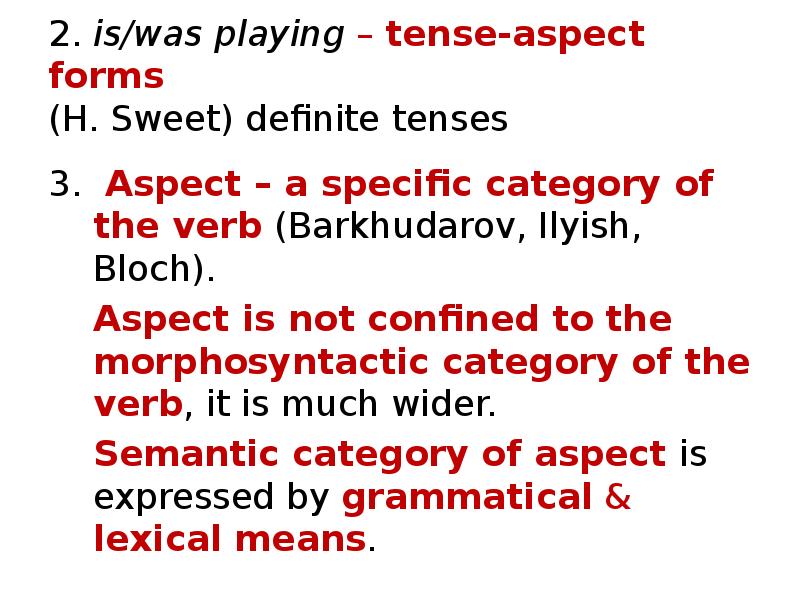
2. is/was playing – tense-aspect forms
(H. Sweet) definite tenses
3. Aspect – a specific category of the verb (Barkhudarov, Ilyish, Bloch).
Aspect is not confined to the morphosyntactic category of the verb, it is much wider.
Semantic category of aspect is expressed by grammatical & lexical means.
Слайд 27
Описание слайда:
Aspective character of the verb:
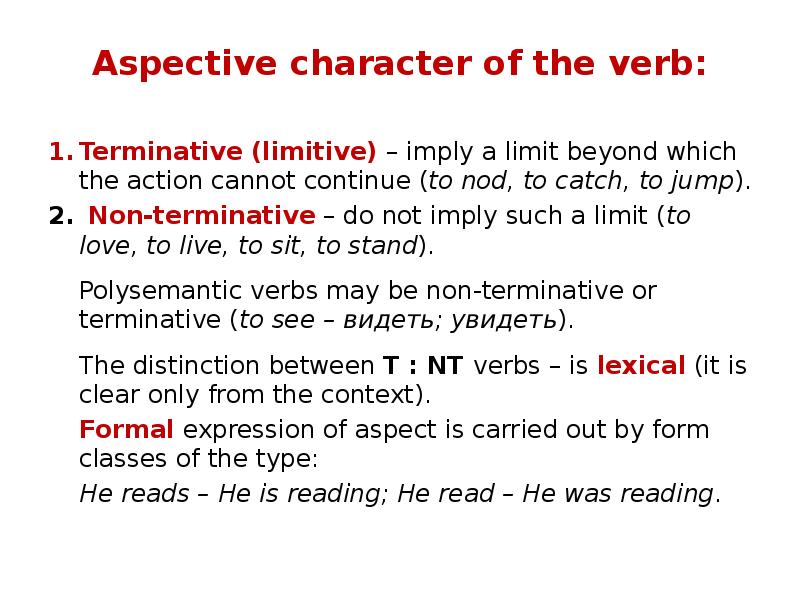
Terminative (limitive) – imply a limit beyond which the action cannot continue (to nod, to catch, to jump).
Non-terminative – do not imply such a limit (to love, to live, to sit, to stand).
Polysemantic verbs may be non-terminative or terminative (to see – видеть; увидеть).
The distinction between T : NT verbs – is lexical (it is clear only from the context).
Formal expression of aspect is carried out by form classes of the type:
He reads – He is reading; He read – He was reading.
Слайд 28
Описание слайда:
The Category of Phase
Слайд 29
Описание слайда:
Perfect – Non-Perfect Phase
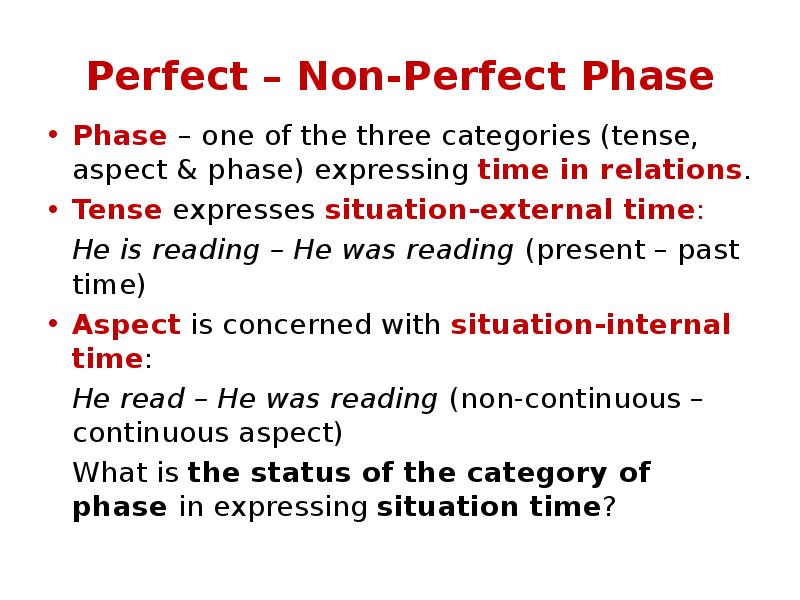
Phase – one of the three categories (tense, aspect & phase) expressing time in relations.
Tense expresses situation-external time:
He is reading – He was reading (present – past time)
Aspect is concerned with situation-internal time:
He read – He was reading (non-continuous – continuous aspect)
What is the status of the category of phase in expressing situation time?
Слайд 30
Описание слайда:
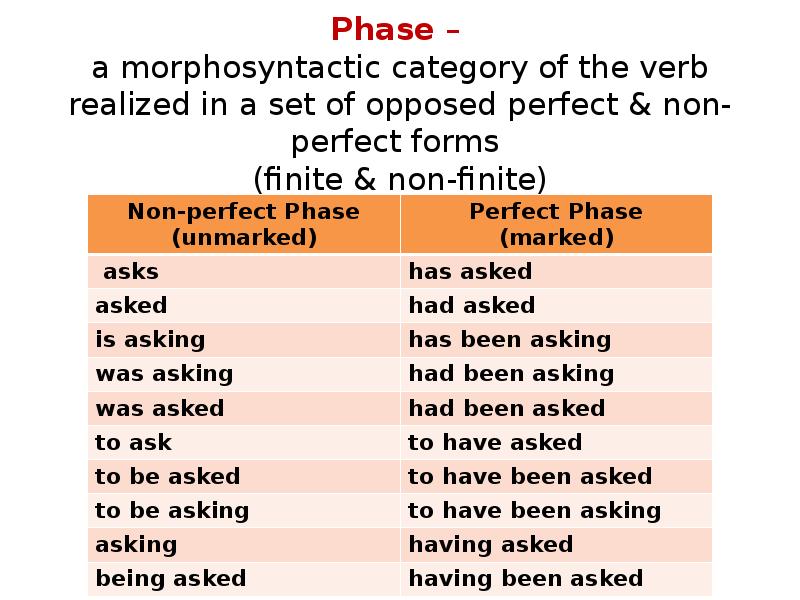
Phase –
a morphosyntactic category of the verb realized in a set of opposed perfect & non-perfect forms
(finite & non-finite)
Слайд 31
Описание слайда:
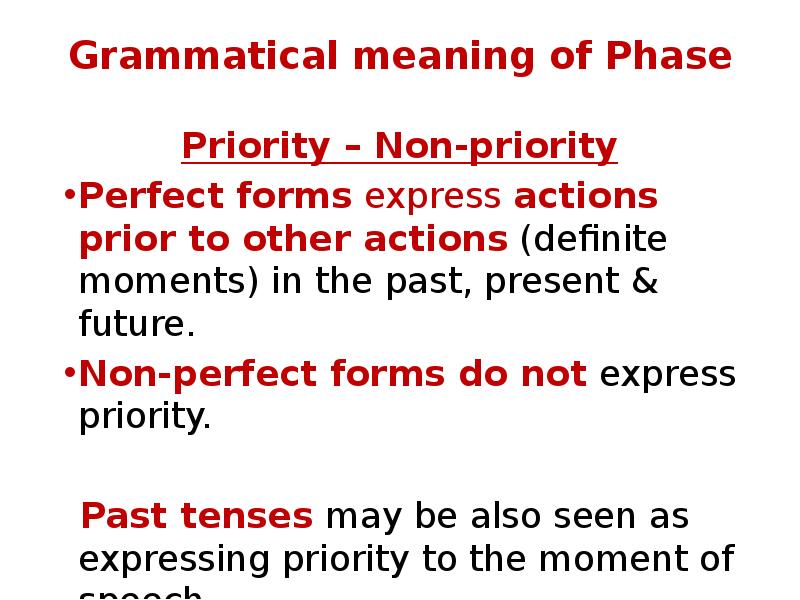
Grammatical meaning of Phase
Priority – Non-priority
Perfect forms express actions prior to other actions (definite moments) in the past, present & future.
Non-perfect forms do not express priority.
Past tenses may be also seen as expressing priority to the moment of speech.
Слайд 32
Описание слайда:
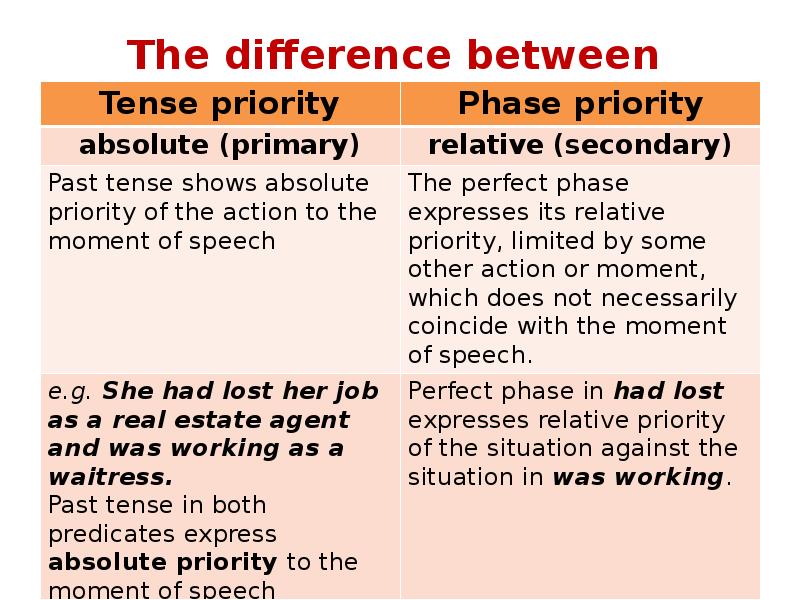
The difference between
Слайд 33
Описание слайда:
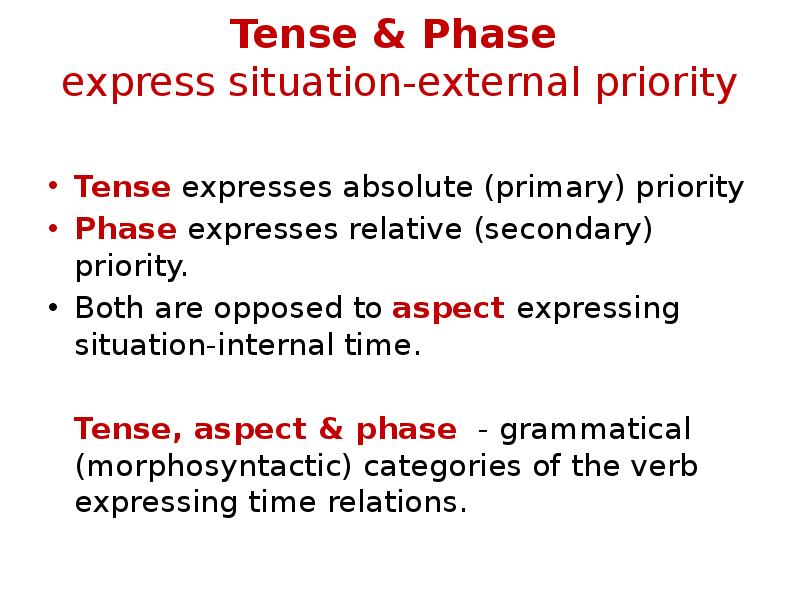
Tense & Phase
express situation-external priority
Tense expresses absolute (primary) priority
Phase expresses relative (secondary) priority.
Both are opposed to aspect expressing situation-internal time.
Tense, aspect & phase - grammatical (morphosyntactic) categories of the verb expressing time relations.
Слайд 34
Описание слайда:
Different interpretations of
Perfect – Non-Perfect forms
The problem of the perfect forms has long been a controversial one:
What is the grammatical meaning of the perfect forms?
To what grammatical category do perfect forms belong?
There are 4 approaches to answer these questions
Слайд 35
Описание слайда:
Perfect – Non-Perfect forms as Tense (H.Sweet, O.Jespersen, Ганшина, etc.)
Non-perfect forms – primary tenses: refer as action to a certain period of time in the past, present (the moment of speaking) or future.
Perfect forms – secondary tenses: do not refer an action to a certain point of time but express priority to a point of time in the past, present or future.
Present Perfect – an action that occur before the moment of speaking.
Past Perfect – an action that took place before a certain moment in the past.
Future Perfect – an action will take place before a certain moment in the future.
Слайд 36
Описание слайда:
Perfect – Non-Perfect forms as Aspect
- aspective forms of the verb.
G.N. Vorontsova: successive connection of two events, one expressed by the Perfect (transmissive aspect).
Present perfect shows a completed action, related to the present – continuity between the past & the present.
B.A. Ilyish: past perfect & future perfect – relative tenses (express priority); present perfect – resultative aspect.
The meaning of succession & limited duration expressed by perfect forms are aspective by nature. The meaning is not the leading one in the semantics of the Perfect.
Слайд 37
Описание слайда:
Perfect – Non-Perfect forms as Tense-Aspect (I.P. Ivanova)
Perfect forms express temporal & aspective functions in a blend.
The actual double nature of the form:
temporal (situation-external time) &
aspective (situation-internal time) spheres of verbal semantics.
M. Y. Bloch: the conception loses sight of the categorial nature of the perfect: it does not explain the difference between:
tense-aspect forms &
tense forms & aspect forms
No such category as tense-aspect in English.
Слайд 38
Описание слайда:
Perfect – Non-Perfect forms
as a specific verbal category (A.I. Smirnitsky)
Perfect : Non-Perfect – a specific category (the category of time correlation).
Their difference is not:
temporal: He had come – He came (past actions),
aspective: has gone (special aspect) : has been going (resultative & continuous aspects)
Non-Perfect forms are not correlated with another action or moment.
Perfect forms are correlated with another action or moment
Слайд 39
Описание слайда:
Perfect – Non-Perfect forms –
grammatical category of correlation
(L.S. Barchudarov, B.A. Ilyish)
The category of retrospective coordination (Bloch).
The category of order ( Rogovskaya).
The category of phase:
current – non-perfect vs. perfect.
Phase shows a special relation between the action & its effect.
Слайд 40
Описание слайда:
Current phase vs. Perfect phase
A verb in a current phase shows an action, which is simultaneous with its effect (the action is in phase with its effect):
He came in (He was there + He was seen the moment he came).
2. The perfect phase shows an action, the effect of which is delayed (the effect of the action is out of phase with it):
He has opened the book (the book is open).
The linguistic theory of phase points out the meaning of the effect of the action.
Скачать презентацию на тему The Verb: Tense, Aspect, Phase можно ниже: