The evolution of media effects theory презентация
Содержание
- 2. I. Persuasion Theories (1944–1963) 1. Voting research (Lazarsfeld, Berelson, & Gaudet,
- 3. II. Active Audience Theories (1944–1986) 6. Attribution theory (Heider, 1958; Kelley,
- 4. III. Active Audience Theories (1944–1986) 12. Disposition theory (Zillmann & Cantor,
- 5. IV. Social Context Theories (1955–1983) 15. Two-step flow (Katz & Lazarsfeld,
- 6. V. Societal & Media Theories (1933–1978) 21. Media hegemony/public sphere (Gramsci,
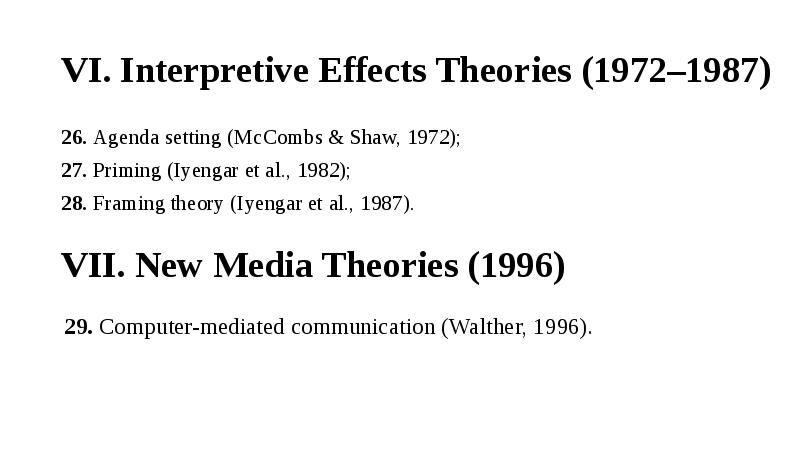
- 7. VI. Interpretive Effects Theories (1972–1987) 26. Agenda setting (McCombs &
- 8. Скачать презентацию
Слайды и текст этой презентации
Слайд 1
Описание слайда:
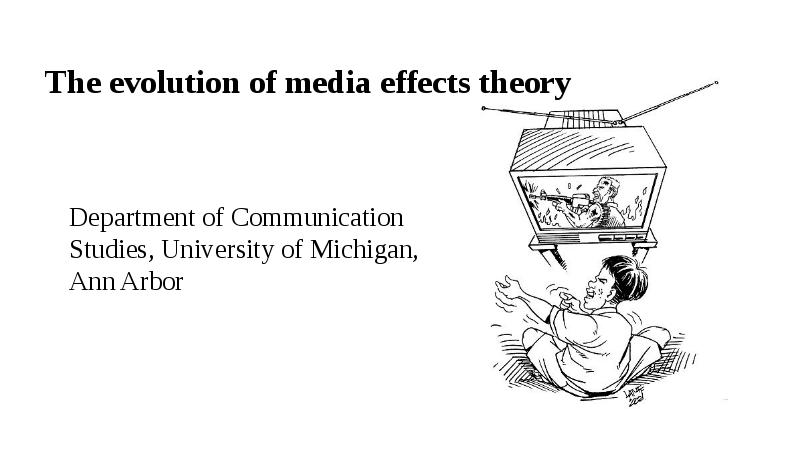
The evolution of media effects theory
Department of Communication Studies, University of Michigan, Ann Arbor
Слайд 2
Описание слайда:
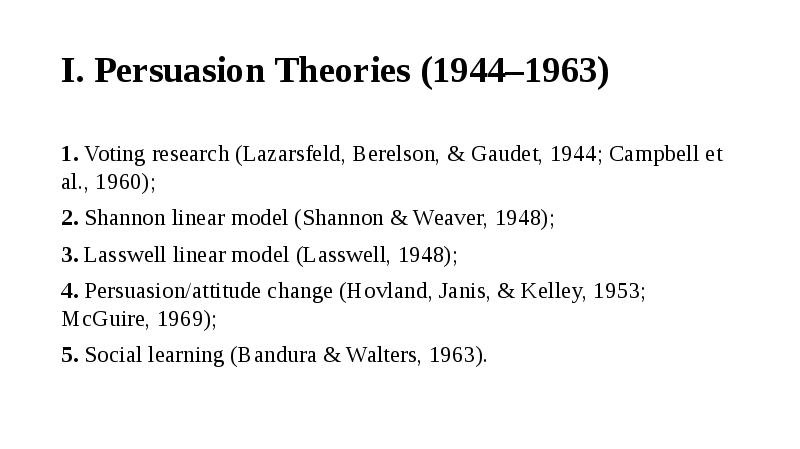
I. Persuasion Theories (1944–1963)
1. Voting research (Lazarsfeld, Berelson, & Gaudet, 1944; Campbell et al., 1960);
2. Shannon linear model (Shannon & Weaver, 1948);
3. Lasswell linear model (Lasswell, 1948);
4. Persuasion/attitude change (Hovland, Janis, & Kelley, 1953; McGuire, 1969);
5. Social learning (Bandura & Walters, 1963).
Слайд 3
Описание слайда:
II. Active Audience Theories (1944–1986)
6. Attribution theory (Heider, 1958; Kelley, 1967);
7. Uses & gratifications (Herzog, 1944; Katz, Blumler, & Gurevitch, 1974);
8. Parasocial theory (Horton & Wohl, 1956);
9. Cognitive dissonance/social identity (Festinger, 1957; Tajfel, 1982);
10. Minimal effects (Klapper, 1960);
11. Selective exposure (Sears & Freedman, 1967).
Слайд 4
Описание слайда:
III. Active Audience Theories (1944–1986)
12. Disposition theory (Zillmann & Cantor, 1976);
13. Media dependency (Ball-Rokeach & De Fleur, 1976);
14. Elaboration likelihood model (Petty & Cacioppo, 1986).
Слайд 5
Описание слайда:
IV. Social Context Theories (1955–1983)
15. Two-step flow (Katz & Lazarsfeld, 1955);
16. Diffusion theory (Rogers, 1962);
17. Knowledge gap theory (Tichenor, Donohue, & Olien, 1970);
18. Social networks/social capital (Granovetter, 1973; Putnam, 1995);
19. Spiral of silence (Noelle-Neumann, 1974);
20. Third person theory (Davison, 1983).
Слайд 6
Описание слайда:
V. Societal & Media Theories (1933–1978)
21. Media hegemony/public sphere (Gramsci, 1933; Habermas, [1962] 1989);
22. Channel effects (McLuhan, 1964);
23. Social construction of reality (Berger & Luckman, 1966);
24. Differential media exposure (Clarke & Fredin, 1978);
25. Cultivation theory (Gerbner, Gross, Jackson-Beeck, Jeffries-Fox, & Signorielli, 1978)
Слайд 7
Описание слайда:
VI. Interpretive Effects Theories (1972–1987)
26. Agenda setting (McCombs & Shaw, 1972);
27. Priming (Iyengar et al., 1982);
28. Framing theory (Iyengar et al., 1987).
Скачать презентацию на тему The evolution of media effects theory можно ниже: