VOGT-KOYANAGI-HARADA DISEASE презентация
Содержание
- 2. VKH Disease Multisystem disease Chronic, bilateral, granulomatous panuveitis associated with central
- 3. VKH Disease Individuals with a predisposing genetic background. Ethnic groups with
- 4. VKH Disease Genetic background rather than degree of skin pigmentation. Women
- 5. VKH Disease Remains unknown. T-lymphocyte mediated autoimmunity directed against one or
- 6. VKH Disease Tyrosinase family proteins are enzymes for melanin formation and
- 7. VKH Disease Th cells from peripheral blood of VKH patients produce
- 8. VKH Disease IL-23 stimulated production of IL-17 by CD4+ T
- 9. VKH Disease VKH-like disease in patients treated with interferon-alpha and ribavirin
- 10. VKH Disease Granulomatous panuveitis. Lymphocytes, epitheloid cells, few plasma cells, multinucleated
- 11. VKH Disease Dalen-Fuchs’ nodules: Lymphocytes, epitheloid cells, pigment-laden macrophages, altered and/or
- 12. VKH Disease Certain racial groups. Immunogenetic predisposition. Strong association with HLA-DR4
- 13. VKH Disease VKH disease in monozygotic twins Familial VKH disease Familial
- 14. VKH Disease Integumentary Manifestations Sensitivity of hair and skin to touch
- 15. VKH Disease Neurologic Manifestations Most common during prodromal stage. Neck stiffness,
- 16. VKH Disease Auditory Manifestations May be presenting problem Sensorineural hearing loss
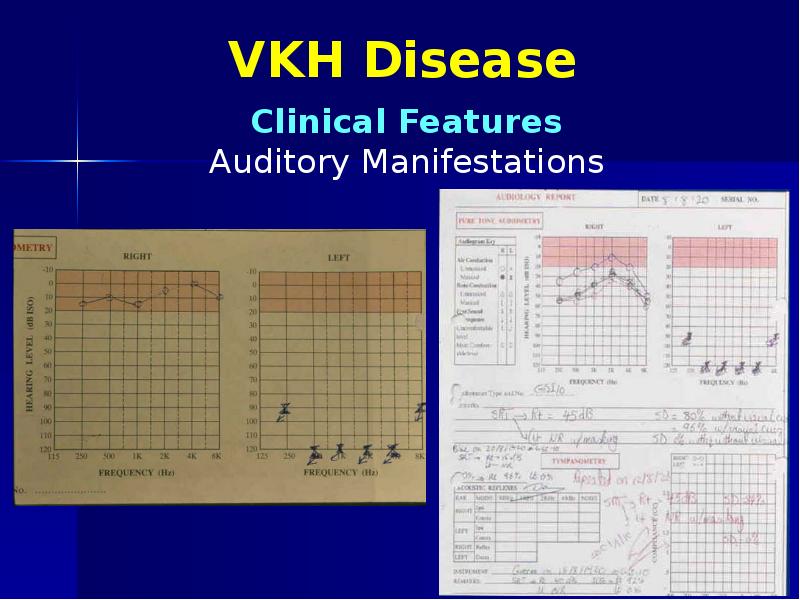
- 17. VKH Disease
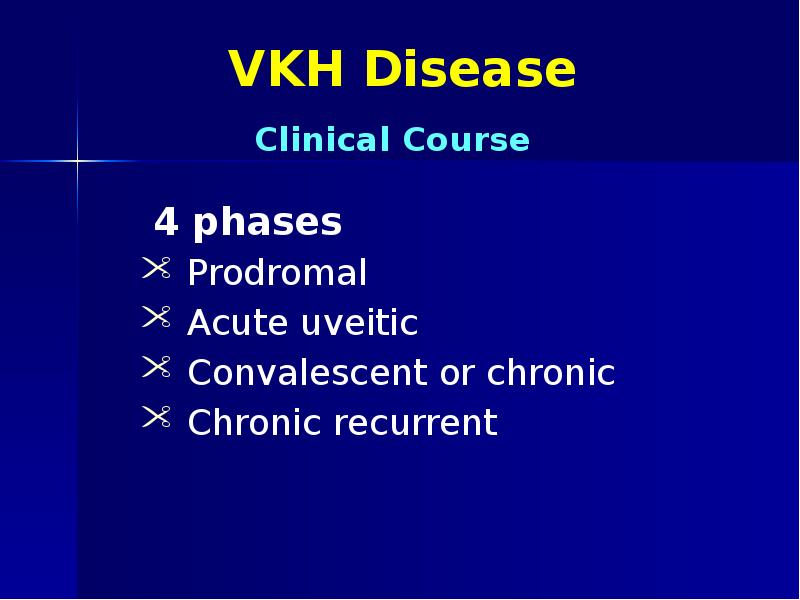
- 18. VKH Disease 4 phases Prodromal Acute uveitic Convalescent or chronic Chronic
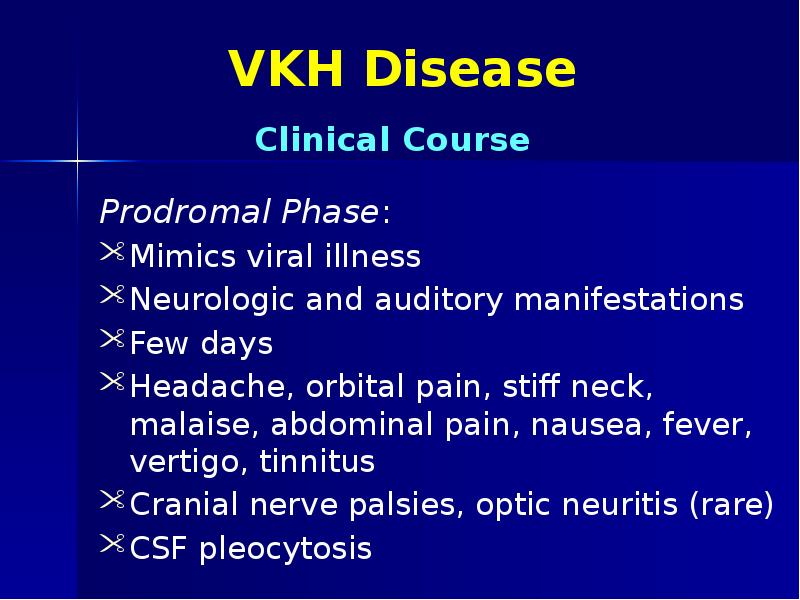
- 19. VKH Disease Prodromal Phase: Mimics viral illness Neurologic and auditory manifestations
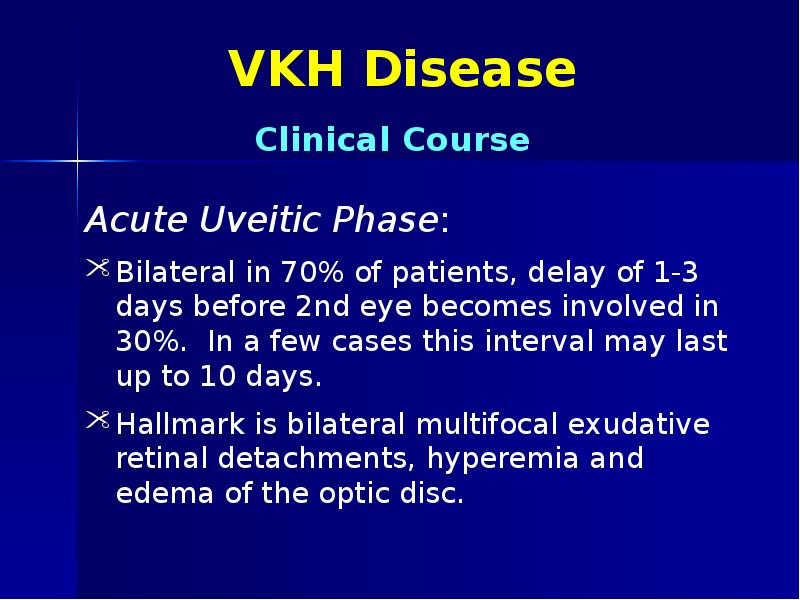
- 20. VKH Disease Acute Uveitic Phase: Bilateral in 70% of patients, delay
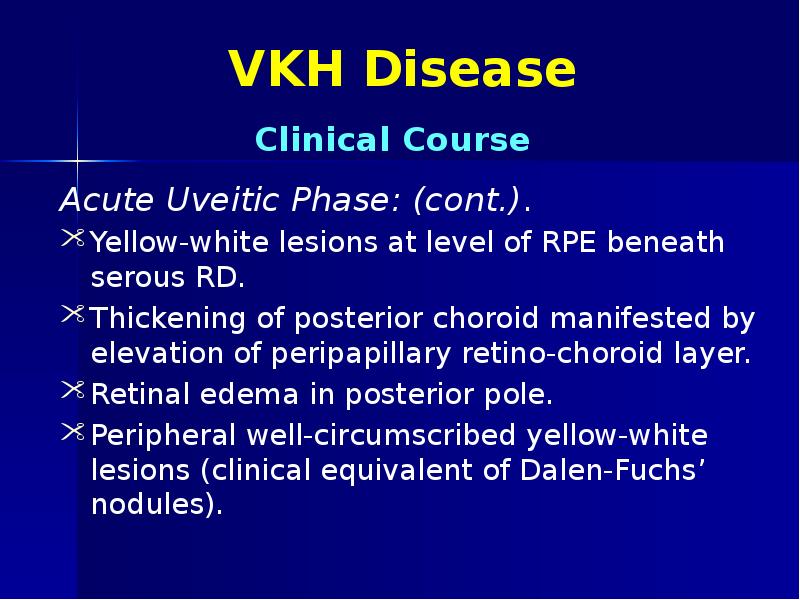
- 21. VKH Disease Acute Uveitic Phase: (cont.). Yellow-white lesions at level of
- 22. VKH Disease Acute Uveitic Phase: (cont.) No inflammation of the anterior
- 23. VKH Disease Acute Uveitic Phase: (cont.). Shallow anterior chamber Elevated IOP
- 24. VKH Disease Convalescent Phase: Integumentary and uvea depigmentation. Perilimbal vitiligo (Sugiura’s
- 25. VKH Disease Convalescent Phase: (cont.) Multiple small yellow well-circumscribed areas of
- 26. VKH Disease Chronic Recurrent Phase: Acute episodes of granulomatous anterior uveitis
- 27. VKH Disease Chronic Recurrent Phase: Patients with recurrent VKH disease had
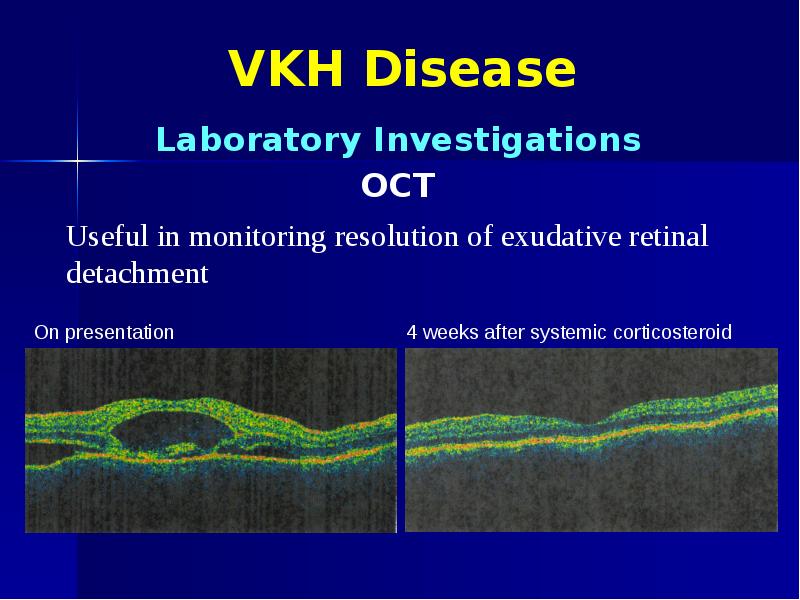
- 28. VKH Disease Fluorescein angiography Indocyanine green angiography Ultrasonography Optical coherence tomography
- 29. VKH Disease Ultrasonography: Diffuse low to medium thickening of choroid. Overlying
- 30. VKH Disease
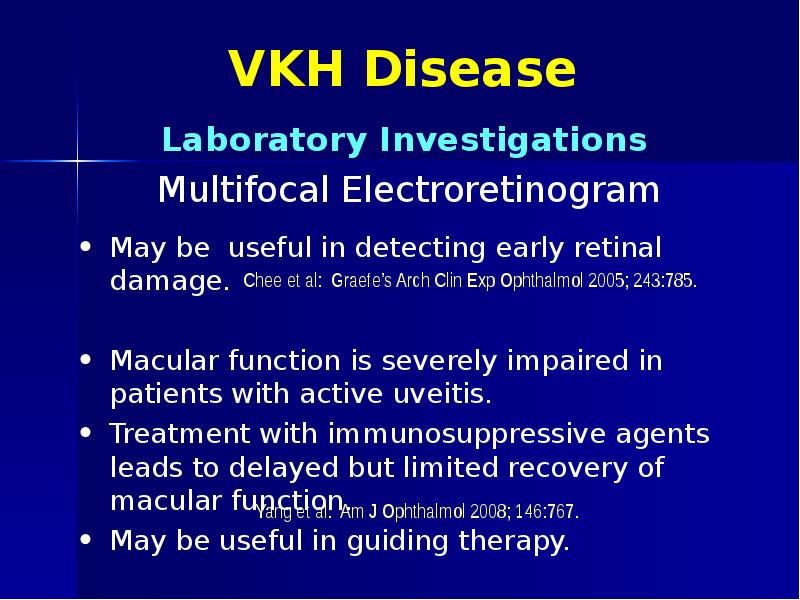
- 31. VKH Disease May be useful in detecting early retinal damage. Macular
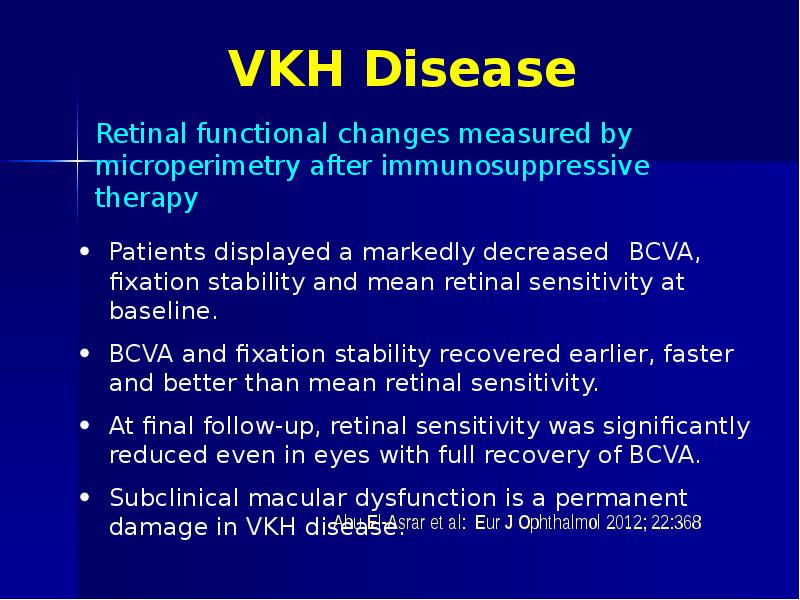
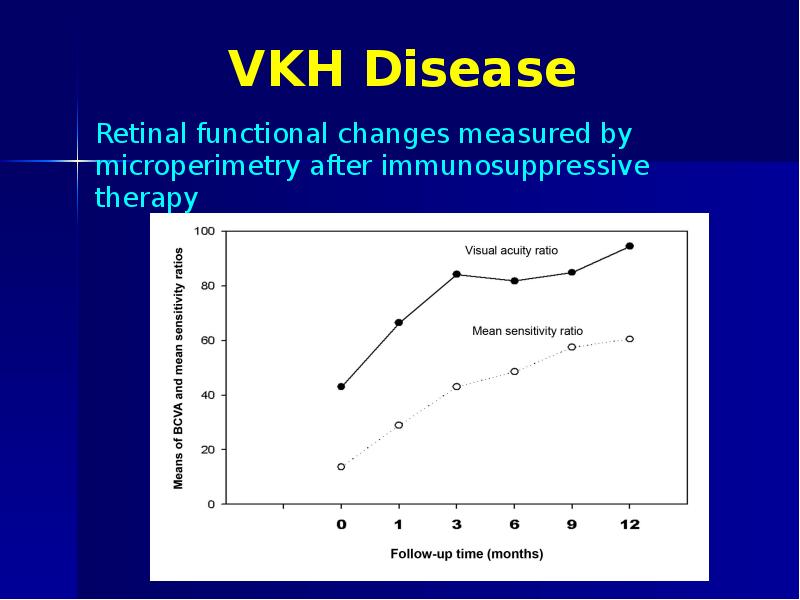
- 32. VKH Disease Patients displayed a markedly decreased BCVA, fixation stability and
- 33. VKH Disease
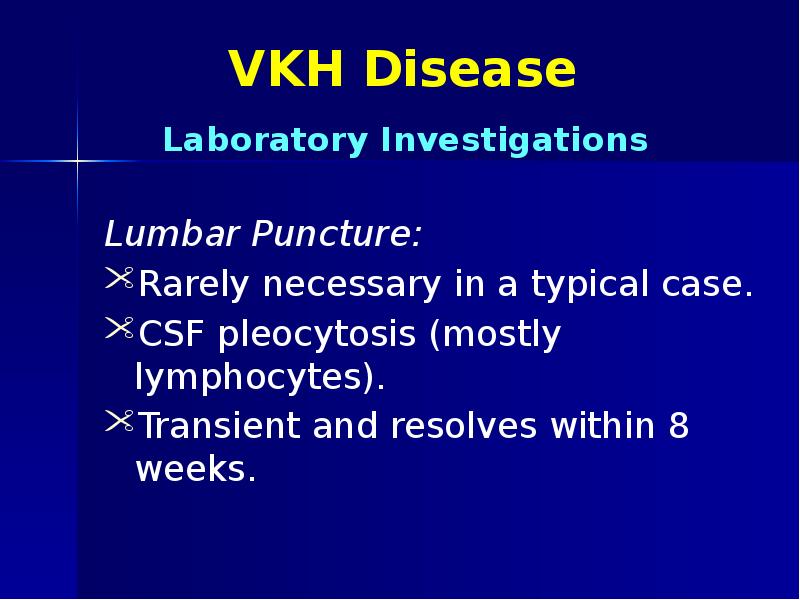
- 34. VKH Disease Lumbar Puncture: Rarely necessary in a typical case. CSF
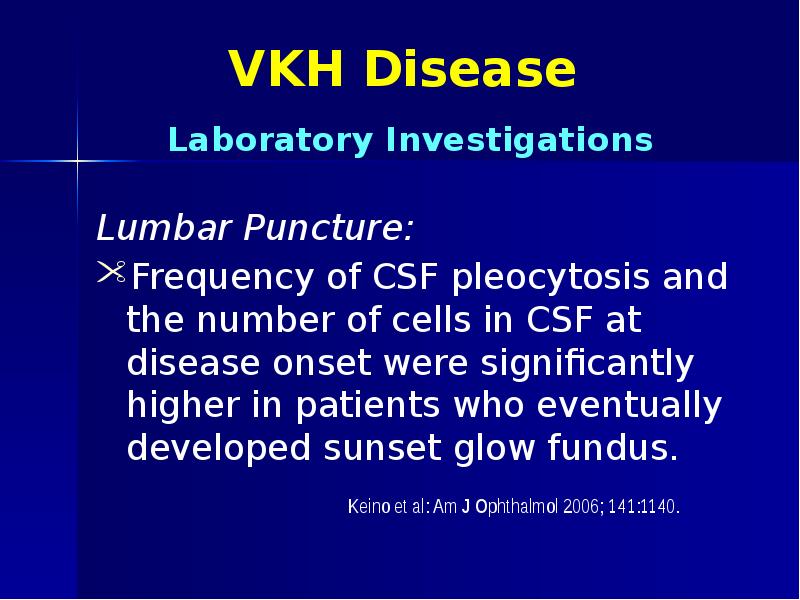
- 35. VKH Disease Lumbar Puncture: Frequency of CSF pleocytosis and the number
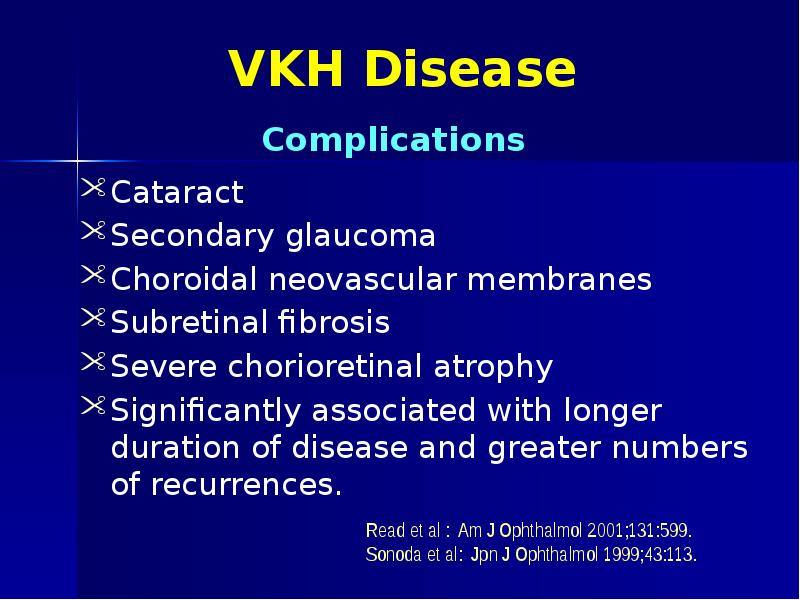
- 36. VKH Disease Cataract Secondary glaucoma Choroidal neovascular membranes Subretinal fibrosis Severe
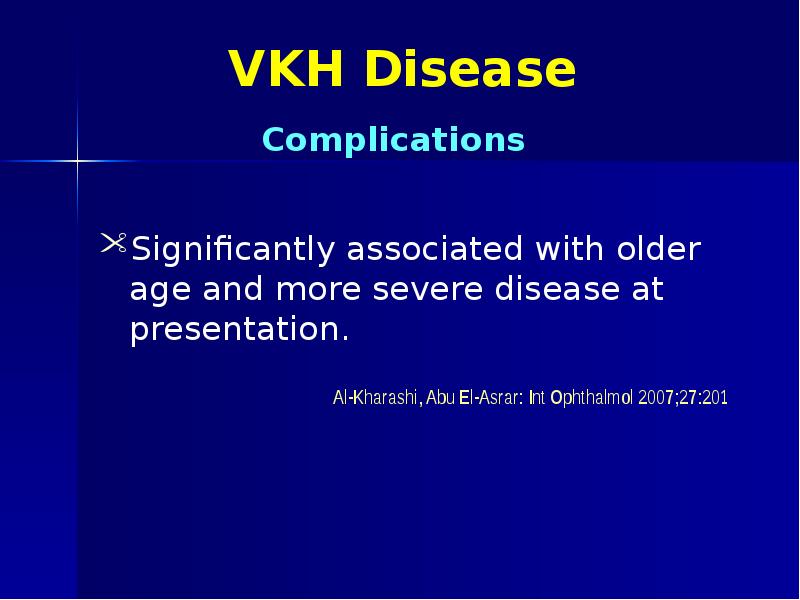
- 37. VKH Disease Significantly associated with older age and more severe disease
- 38. VKH Disease Should be prompt and aggressive. Systemic corticosteroids are mainstay
- 39. VKH Disease Intravenous high-dose pulse steroid therapy (1g/day of Methylprednisolone given
- 40. VKH Disease Such treatment may shorten duration of disease, prevent progression
- 41. VKH Disease Final VA of 20/20 was significantly associated with use
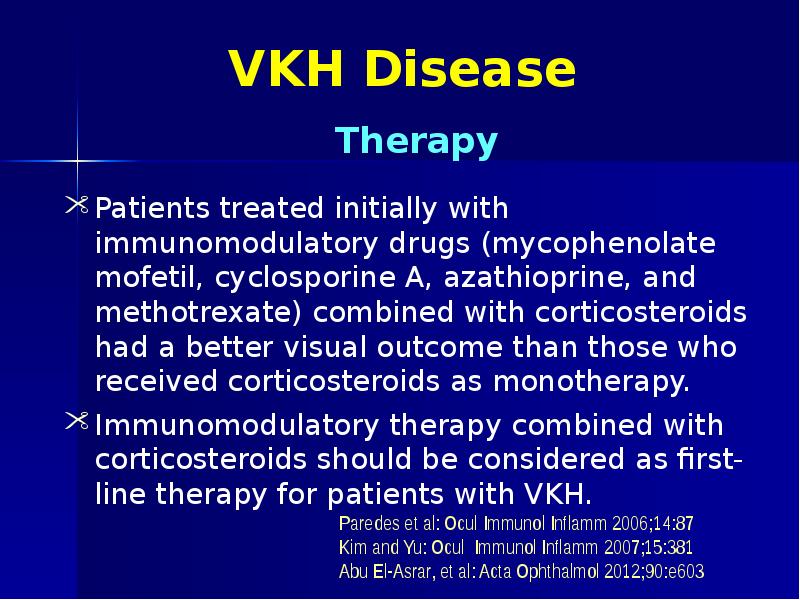
- 42. VKH Disease Patients treated initially with immunomodulatory drugs (mycophenolate mofetil, cyclosporine
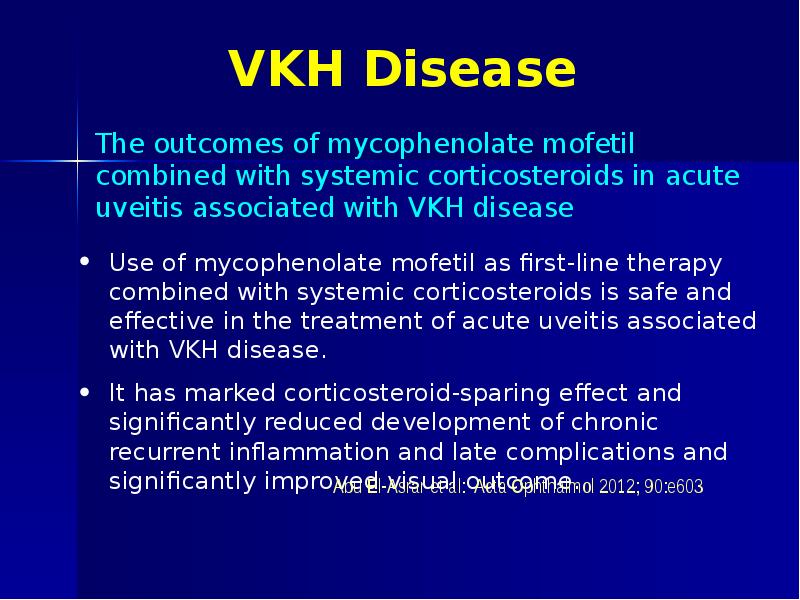
- 43. VKH Disease Use of mycophenolate mofetil as first-line therapy combined with
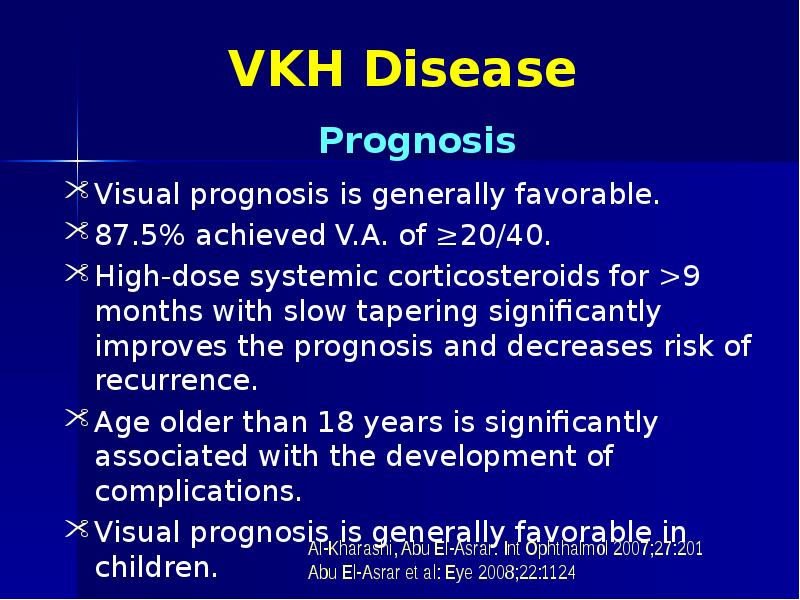
- 44. VKH Disease Visual prognosis is generally favorable. 87.5% achieved V.A. of
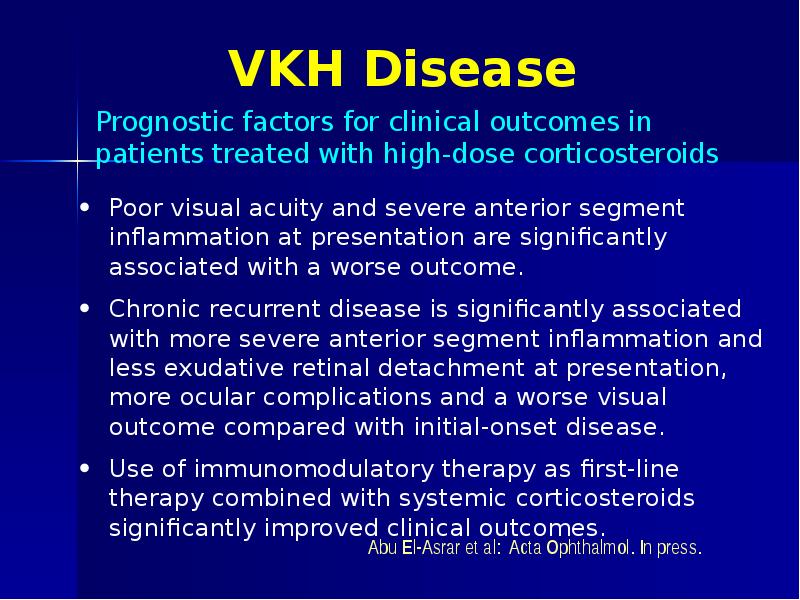
- 45. VKH Disease Poor visual acuity and severe anterior segment inflammation at
- 46. Sympathetic Ophthalmia Ahmed M. Abu El-Asrar, MD, PhD
- 47. Sympathetic Ophthalmia Rare bilateral granulomatous panuveitis that occurs as a complication
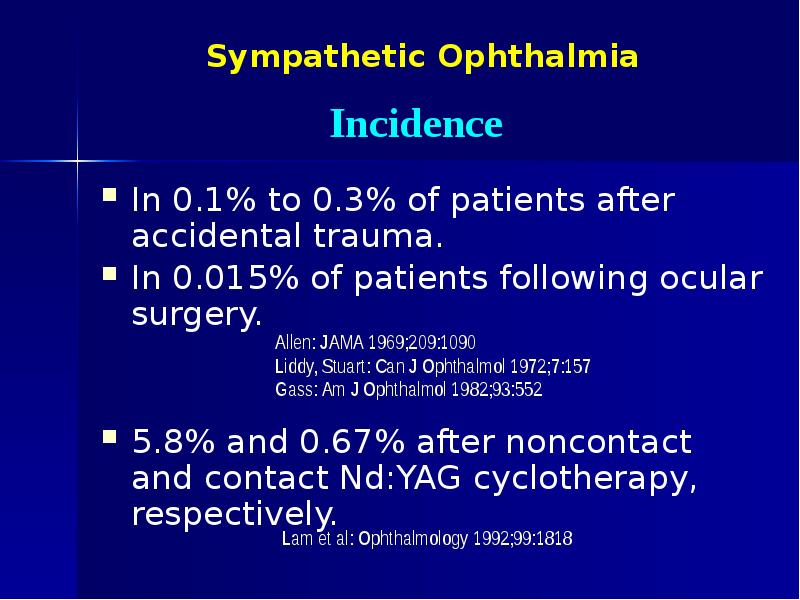
- 48. Sympathetic Ophthalmia In 0.1% to 0.3% of patients after accidental trauma.
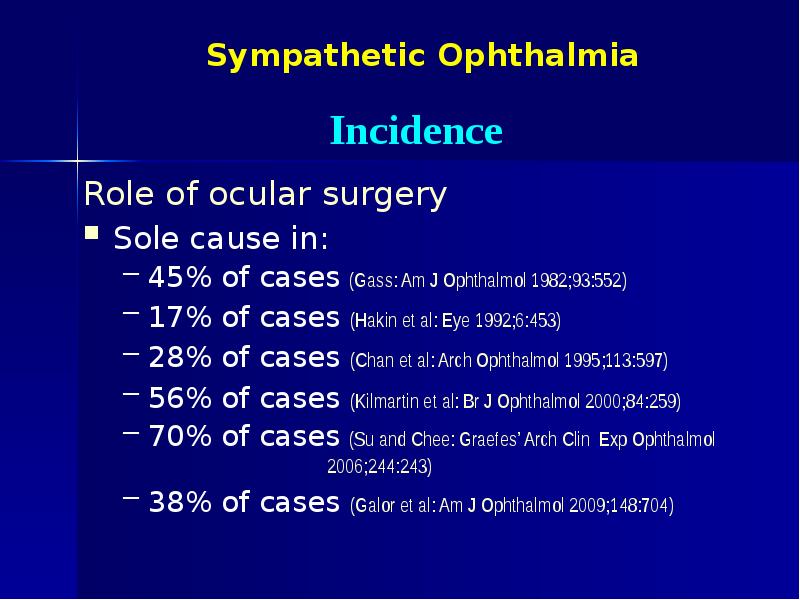
- 49. Sympathetic Ophthalmia Role of ocular surgery Sole cause in: 45% of
- 50. Sympathetic Ophthalmia Role of ocular surgery Ocular surgery, particularly retinal surgery,
- 51. Sympathetic Ophthalmia Role of vitrectomy In 0.06% of cases In 0.01%
- 52. Sympathetic Ophthalmia Role of vitrectomy Vitreoretinal surgery is an important risk
- 53. Sympathetic Ophthalmia Evisceration versus enucleation Uveal tissue may be left behind
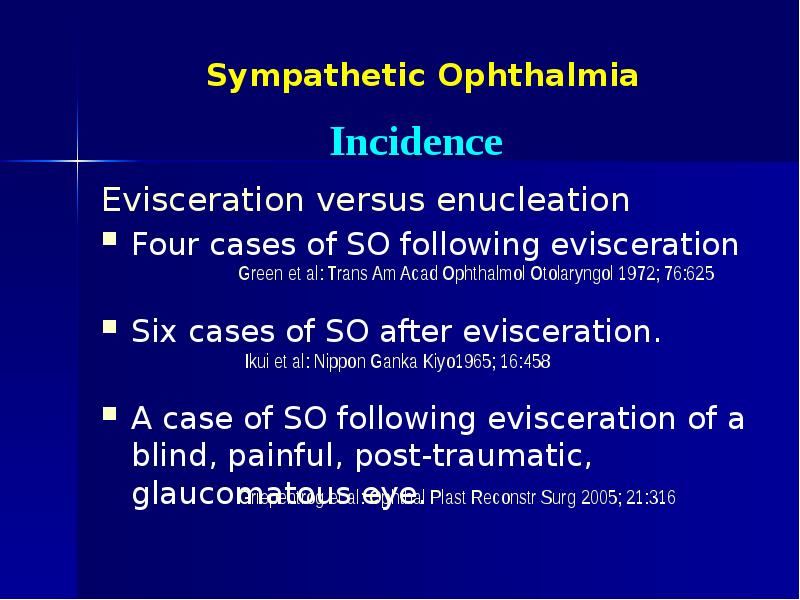
- 54. Sympathetic Ophthalmia Evisceration versus enucleation Four cases of SO following evisceration
- 55. Sympathetic Ophthalmia Evisceration versus enucleation Evisceration is safe with little risk
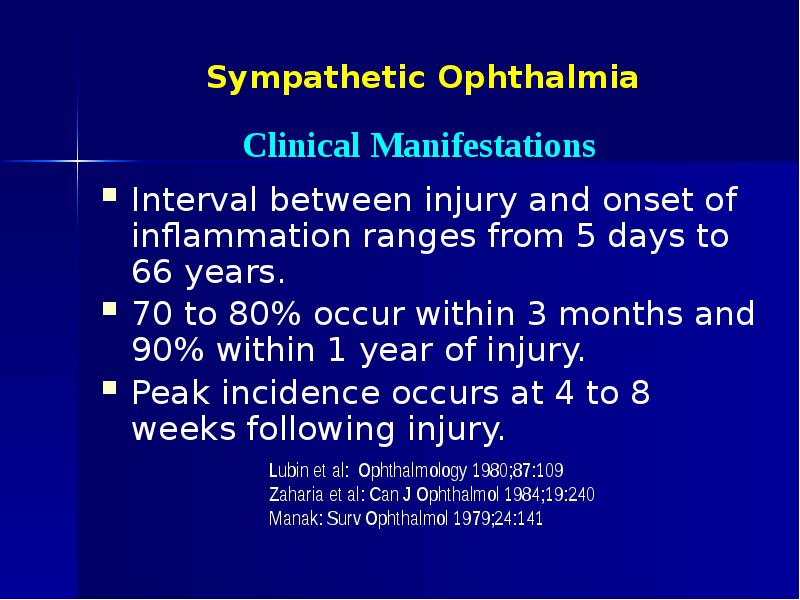
- 56. Sympathetic Ophthalmia Interval between injury and onset of inflammation ranges from
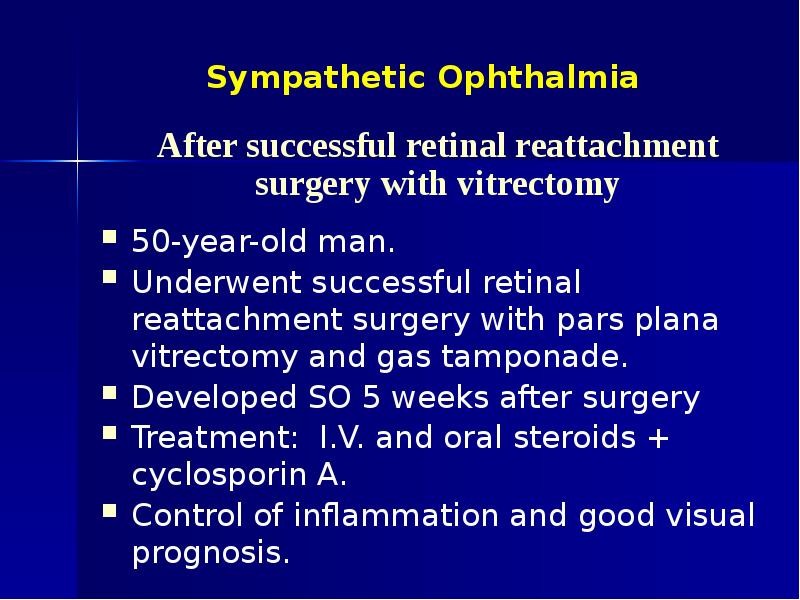
- 57. Sympathetic Ophthalmia 50-year-old man. Underwent successful retinal reattachment surgery with pars
- 58. Sympathetic Ophthalmia 31-year-old man. Underwent retinal reattachment surgery with silicone oil
- 59. Sympathetic Ophthalmia 50-year-old man. Developed SO 8 weeks after cataract surgery.
- 60. Sympathetic Ophthalmia 28-year-old man. Developed SO 12 weeks after sustaining penetrating
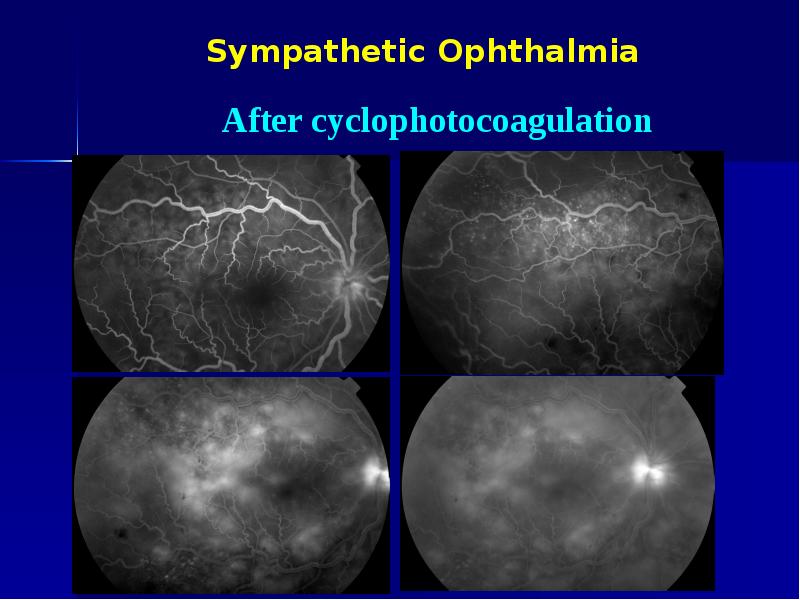
- 61. 38-year-old lady. 38-year-old lady. Lt. eye blind since childhood with no
- 62. Sympathetic Ophthalmia
- 63. Sympathetic Ophthalmia Vogt-Koyanagi-Harada disease (No previous ocular trauma or surgery)
- 64. Sympathetic Ophthalmia Immunogenetics Genetics predisposition which is very similar to VKH
- 65. Sympathetic Ophthalmia Similar in both exciting and sympathizing eyes. Classic description
- 66. Sympathetic Ophthalmia Prevention Careful microsurgical management of the wound with prompt
- 67. Sympathetic Ophthalmia Prevention Enucleation of the traumatized eye if unsalvageable by
- 68. Sympathetic Ophthalmia Controversy regarding any advantage of enucleating the exciting eye
- 69. Sympathetic Ophthalmia Enucleation within 2 weeks of onset is associated with
- 70. Sympathetic Ophthalmia Exciting eye may eventually have the better vision, or
- 71. Sympathetic Ophthalmia It is not justified to remove a functionally useful
- 72. Sympathetic Ophthalmia Early diagnosis. Prompt and effective treatment with systemic immunosuppressive
- 73. Sympathetic Ophthalmia Corticosteroids are the mainstay of treatment. I.V. pulses, I
- 74. Sympathetic Ophthalmia Successful control of inflammation and good visual prognosis is
- 75. Sympathetic Ophthalmia Rare disease. Major sight-threatening disorder. High index of suspicion
- 76. Sympathetic Ophthalmia Diagnosis is made clinically, histological proof is not required.
- 77. Sympathetic Ophthalmia Prognosis was considered poor prior to the use of
- 78. Скачать презентацию
Слайды и текст этой презентации
Слайд 1
Описание слайда:
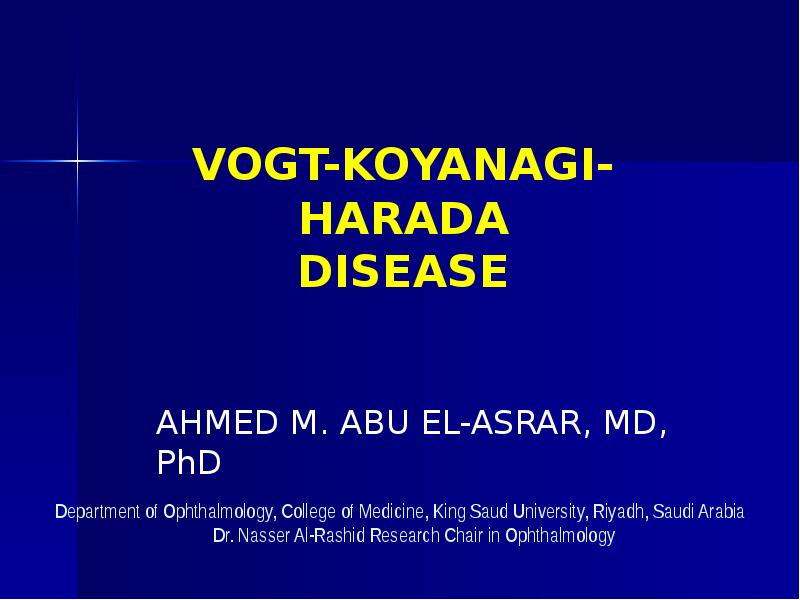
VOGT-KOYANAGI-HARADA
DISEASE
AHMED M. ABU EL-ASRAR, MD, PhD
Слайд 2
Описание слайда:
VKH Disease
Multisystem disease
Chronic, bilateral, granulomatous panuveitis associated with central nervous system, auditory and integumentary manifestations
Слайд 3
Описание слайда:
VKH Disease
Individuals with a predisposing genetic background.
Ethnic groups with more heavily pigmented skin.
Asians, Native Americans, Hispanics, Asian Indians, Middle Easterners.
Слайд 4
Описание слайда:
VKH Disease
Genetic background rather than degree of skin pigmentation.
Women more than men.
3rd – 4th decade.
Pediatric age group.
Слайд 5
Описание слайда:
VKH Disease
Remains unknown.
T-lymphocyte mediated autoimmunity directed against one or more antigens found on or associated with melanocytes found in eye, skin and hair, inner ear, CNS.
Слайд 6
Описание слайда:
VKH Disease
Tyrosinase family proteins are enzymes for melanin formation and are expressed in melanocytes.
T-lymphocytes from VKH disease patients proliferate in response to tyrosinase, TRP1 or TRP2.
Immunization of Lewis rats with tyrosinase, TRP1 or TRP2 produced an inflammatory disease that resembled VKH disease with skin lesions and meningitis.
Слайд 7
Описание слайда:
VKH Disease
Th cells from peripheral blood of VKH patients produce predominantly Th1 cytokines (IFN-gamma, IL-2) especially when stimulated
T-cell clones specific to tyrosinase family proteins established from peripheral blood mononuclear cells of patients with VKH disease showed proliferative responses to tyrosinase and/or TRP1 and produced Th1-type cytokines.
Слайд 8
Описание слайда:
VKH Disease
IL-23 stimulated production of IL-17 by CD4+ T cells may be responsible for the development of VKH disease.
Слайд 9
Описание слайда:
VKH Disease
VKH-like disease in patients treated with interferon-alpha and ribavirin therapy for chronic hepatitis C virus infection.
Слайд 10
Описание слайда:
VKH Disease
Granulomatous panuveitis.
Lymphocytes, epitheloid cells, few plasma cells, multinucleated giant cells.
Epitheloid cells and giant cells contain melanin pigment.
Слайд 11
Описание слайда:
VKH Disease
Dalen-Fuchs’ nodules: Lymphocytes, epitheloid cells, pigment-laden macrophages, altered and/or proliferated RPE cells.
Melanocytes disappear from choroid.
Слайд 12
Описание слайда:
VKH Disease
Certain racial groups.
Immunogenetic predisposition.
Strong association with HLA-DR4 and HLA-DRw53 with the most significant risk allele being HLA-DRB1*0405.
Causative pathogenic antigen binds with HLA-DRB1*0405 molecule which presents the antigen to T cells to activate them.
Слайд 13
Описание слайда:
VKH Disease
VKH disease in monozygotic twins
Familial VKH disease
Familial cases shared HLA-DR4
Слайд 14
Описание слайда:
VKH Disease
Integumentary Manifestations
Sensitivity of hair and skin to touch (early in prodromal phase).
Poliosis, vitiligo, alopecia (during convalescent stage).
Ethnic groups may manifest varying systemic symptoms.
Слайд 15
Описание слайда:
VKH Disease
Neurologic Manifestations
Most common during prodromal stage.
Neck stiffness, headache, confusion.
Occasionally focal neurologic signs.
CSF pleocytosis.
Слайд 16
Описание слайда:
VKH Disease
Auditory Manifestations
May be presenting problem
Sensorineural hearing loss usually involves higher frequencies
Tinnitus
Vertigo
May cause permanent hearing loss
Слайд 17
Описание слайда:
VKH Disease
Слайд 18
Описание слайда:
VKH Disease
4 phases
Prodromal
Acute uveitic
Convalescent or chronic
Chronic recurrent
Слайд 19
Описание слайда:
VKH Disease
Prodromal Phase:
Mimics viral illness
Neurologic and auditory manifestations
Few days
Headache, orbital pain, stiff neck, malaise, abdominal pain, nausea, fever, vertigo, tinnitus
Cranial nerve palsies, optic neuritis (rare)
CSF pleocytosis
Слайд 20
Описание слайда:
VKH Disease
Acute Uveitic Phase:
Bilateral in 70% of patients, delay of 1-3 days before 2nd eye becomes involved in 30%. In a few cases this interval may last up to 10 days.
Hallmark is bilateral multifocal exudative retinal detachments, hyperemia and edema of the optic disc.
Слайд 21
Описание слайда:
VKH Disease
Acute Uveitic Phase: (cont.).
Yellow-white lesions at level of RPE beneath serous RD.
Thickening of posterior choroid manifested by elevation of peripapillary retino-choroid layer.
Retinal edema in posterior pole.
Peripheral well-circumscribed yellow-white lesions (clinical equivalent of Dalen-Fuchs’ nodules).
Слайд 22
Описание слайда:
VKH Disease
Acute Uveitic Phase: (cont.)
No inflammation of the anterior segment or mild to moderate nongranulomatous anterior uveitis if the disease is not well controlled with appropriate treatment during the first two weeks.
Слайд 23
Описание слайда:
VKH Disease
Acute Uveitic Phase: (cont.).
Shallow anterior chamber
Elevated IOP
Acute angle closure glaucoma
Слайд 24
Описание слайда:
VKH Disease
Convalescent Phase:
Integumentary and uvea depigmentation.
Perilimbal vitiligo (Sugiura’s sign).
Fundus exhibits an orange-red discoloration (“sunset-glow” fundus).
Слайд 25
Описание слайда:
VKH Disease
Convalescent Phase: (cont.)
Multiple small yellow well-circumscribed areas of chorioretinal atrophy representing regressed Dalen-Fuchs’ nodules.
RPE clumping or migration.
Pigmented demarcation lines.
Слайд 26
Описание слайда:
VKH Disease
Chronic Recurrent Phase:
Acute episodes of granulomatous anterior uveitis with development of iris nodules
Recurrent posterior uveitis is distinctly uncommon
Complications are seen in this phase
Слайд 27
Описание слайда:
VKH Disease
Chronic Recurrent Phase:
Patients with recurrent VKH disease had a more intensive inflammation in the anterior segment and long-lasting dysfunction of the blood-aqueous barrier than those with initial onset VKH disease.
Слайд 28
Описание слайда:
VKH Disease
Fluorescein angiography
Indocyanine green angiography
Ultrasonography
Optical coherence tomography
Multifocal electroretinograms
Lumbar puncture
Слайд 29
Описание слайда:
VKH Disease
Ultrasonography:
Diffuse low to medium thickening of choroid.
Overlying exudative RD.
Слайд 30
Описание слайда:
VKH Disease
Слайд 31
Описание слайда:
VKH Disease
May be useful in detecting early retinal damage.
Macular function is severely impaired in patients with active uveitis.
Treatment with immunosuppressive agents leads to delayed but limited recovery of macular function.
May be useful in guiding therapy.
Слайд 32
Описание слайда:
VKH Disease
Patients displayed a markedly decreased BCVA, fixation stability and mean retinal sensitivity at baseline.
BCVA and fixation stability recovered earlier, faster and better than mean retinal sensitivity.
At final follow-up, retinal sensitivity was significantly reduced even in eyes with full recovery of BCVA.
Subclinical macular dysfunction is a permanent damage in VKH disease.
Слайд 33
Описание слайда:
VKH Disease
Слайд 34
Описание слайда:
VKH Disease
Lumbar Puncture:
Rarely necessary in a typical case.
CSF pleocytosis (mostly lymphocytes).
Transient and resolves within 8 weeks.
Слайд 35
Описание слайда:
VKH Disease
Lumbar Puncture:
Frequency of CSF pleocytosis and the number of cells in CSF at disease onset were significantly higher in patients who eventually developed sunset glow fundus.
Слайд 36
Описание слайда:
VKH Disease
Cataract
Secondary glaucoma
Choroidal neovascular membranes
Subretinal fibrosis
Severe chorioretinal atrophy
Significantly associated with longer duration of disease and greater numbers of recurrences.
Слайд 37
Описание слайда:
VKH Disease
Significantly associated with older age and more severe disease at presentation.
Слайд 38
Описание слайда:
VKH Disease
Should be prompt and aggressive.
Systemic corticosteroids are mainstay of therapy.
1-1.5 mg/kg/day of oral Prednisone (single morning-after-breakfast dose).
For 6-12 months with slow gradual tapering during this time.
Hospitalization with careful follow-up.
Слайд 39
Описание слайда:
VKH Disease
Intravenous high-dose pulse steroid therapy (1g/day of Methylprednisolone given for 3 days) followed by oral Prednisone (1 mg/kg/day).
Topical Prednisone 1% solution and cycloplegics for anterior uveitis.
Patients adequately treated with corticosteroids have a fair visual prognosis.
Recurrences are associated with rapid or early decrease in steroid doses.
Слайд 40
Описание слайда:
VKH Disease
Such treatment may shorten duration of disease, prevent progression into chronic stage, reduce incidence of extraocular manifestations.
Failure to prescribe proper corticosteroid therapy in initial phase may lead to chronic recurrent uveitis that may result in severe visual loss due to extensive chorioretinal atrophy.
Слайд 41
Описание слайда:
VKH Disease
Final VA of 20/20 was significantly associated with use of systemic corticosteroids for longer than 9 months and slow tapering.
Recurrent inflammation was significantly associated with rapid tapering of systemic corticosteroids.
Слайд 42
Описание слайда:
VKH Disease
Patients treated initially with immunomodulatory drugs (mycophenolate mofetil, cyclosporine A, azathioprine, and methotrexate) combined with corticosteroids had a better visual outcome than those who received corticosteroids as monotherapy.
Immunomodulatory therapy combined with corticosteroids should be considered as first-line therapy for patients with VKH.
Слайд 43
Описание слайда:
VKH Disease
Use of mycophenolate mofetil as first-line therapy combined with systemic corticosteroids is safe and effective in the treatment of acute uveitis associated with VKH disease.
It has marked corticosteroid-sparing effect and significantly reduced development of chronic recurrent inflammation and late complications and significantly improved visual outcome.
Слайд 44
Описание слайда:
VKH Disease
Visual prognosis is generally favorable.
87.5% achieved V.A. of ≥20/40.
High-dose systemic corticosteroids for >9 months with slow tapering significantly improves the prognosis and decreases risk of recurrence.
Age older than 18 years is significantly associated with the development of complications.
Visual prognosis is generally favorable in children.
Слайд 45
Описание слайда:
VKH Disease
Poor visual acuity and severe anterior segment inflammation at presentation are significantly associated with a worse outcome.
Chronic recurrent disease is significantly associated with more severe anterior segment inflammation and less exudative retinal detachment at presentation, more ocular complications and a worse visual outcome compared with initial-onset disease.
Use of immunomodulatory therapy as first-line therapy combined with systemic corticosteroids significantly improved clinical outcomes.
Слайд 46
Описание слайда:
Sympathetic Ophthalmia
Ahmed M. Abu El-Asrar, MD, PhD
Слайд 47
Описание слайда:
Sympathetic Ophthalmia
Rare bilateral granulomatous panuveitis that occurs as a complication of a penetrating injury that involves the uvea of one eye.
Accidental trauma or surgery.
Injured eye is referred to as the exciting eye and fellow eye as the sympathizing eye.
Слайд 48
Описание слайда:
Sympathetic Ophthalmia
In 0.1% to 0.3% of patients after accidental trauma.
In 0.015% of patients following ocular surgery.
5.8% and 0.67% after noncontact and contact Nd:YAG cyclotherapy, respectively.
Слайд 49
Описание слайда:
Sympathetic Ophthalmia
Role of ocular surgery
Sole cause in:
45% of cases (Gass: Am J Ophthalmol 1982;93:552)
17% of cases (Hakin et al: Eye 1992;6:453)
28% of cases (Chan et al: Arch Ophthalmol 1995;113:597)
56% of cases (Kilmartin et al: Br J Ophthalmol 2000;84:259)
70% of cases (Su and Chee: Graefes’ Arch Clin Exp Ophthalmol
2006;244:243)
38% of cases (Galor et al: Am J Ophthalmol 2009;148:704)
Слайд 50
Описание слайда:
Sympathetic Ophthalmia
Role of ocular surgery
Ocular surgery, particularly retinal surgery, is now a greater risk than accidental trauma.
Risk of one in 1152 retinal surgical procedures.
Слайд 51
Описание слайда:
Sympathetic Ophthalmia
Role of vitrectomy
In 0.06% of cases
In 0.01% when vitrectomy was the only operative procedure and penetrating wound.
A prospective surveillance for SO in UK and Ireland showed risk of one in 799 vitrectomies.
Слайд 52
Описание слайда:
Sympathetic Ophthalmia
Role of vitrectomy
Vitreoretinal surgery is an important risk factor.
It may be appropriate to counsel patients about risk of SO before performing vitrectomy
Any bilateral uveitis following vitreoretinal surgery should alert the surgeon to the possibility of SO.
Слайд 53
Описание слайда:
Sympathetic Ophthalmia
Evisceration versus enucleation
Uveal tissue may be left behind after evisceration and act as the source of the immune response.
Controversy involving evisceration and risk of SO.
Слайд 54
Описание слайда:
Sympathetic Ophthalmia
Evisceration versus enucleation
Four cases of SO following evisceration
Six cases of SO after evisceration.
A case of SO following evisceration of a blind, painful, post-traumatic, glaucomatous eye.
Слайд 55
Описание слайда:
Sympathetic Ophthalmia
Evisceration versus enucleation
Evisceration is safe with little risk of SO.
High degree of clinical suspicion is required.
Слайд 56
Описание слайда:
Sympathetic Ophthalmia
Interval between injury and onset of inflammation ranges from 5 days to 66 years.
70 to 80% occur within 3 months and 90% within 1 year of injury.
Peak incidence occurs at 4 to 8 weeks following injury.
Слайд 57
Описание слайда:
Sympathetic Ophthalmia
50-year-old man.
Underwent successful retinal reattachment surgery with pars plana vitrectomy and gas tamponade.
Developed SO 5 weeks after surgery
Treatment: I.V. and oral steroids + cyclosporin A.
Control of inflammation and good visual prognosis.
Слайд 58
Описание слайда:
Sympathetic Ophthalmia
31-year-old man.
Underwent retinal reattachment surgery with silicone oil tamponade in his left eye 3 mos. prior to presentation.
VA: CF OU
Treatment: I.V. and oral steroids + mycophenolate mofetil
Control of inflammation and good visual prognosis.
Слайд 59
Описание слайда:
Sympathetic Ophthalmia
50-year-old man.
Developed SO 8 weeks after cataract surgery.
Treatment: Oral steroids + cyclosporin A + pars plana vitrectomy and removal of IOL.
Control of inflammation and good visual prognosis.
Слайд 60
Описание слайда:
Sympathetic Ophthalmia
28-year-old man.
Developed SO 12 weeks after sustaining penetrating trauma.
Treatment: Oral steroids + cyclosporin A.
Control of inflammation and good visual outcome.
Слайд 61
Описание слайда:
38-year-old lady.
38-year-old lady.
Lt. eye blind since childhood with no known clear cause.
Developed SO 9 weeks after left eye cyclophotocoagulation that was done prior to referral.
Слайд 62
Описание слайда:
Sympathetic Ophthalmia
Слайд 63
Описание слайда:
Sympathetic Ophthalmia
Vogt-Koyanagi-Harada disease
(No previous ocular trauma or surgery)
Слайд 64
Описание слайда:
Sympathetic Ophthalmia
Immunogenetics
Genetics predisposition which is very similar to VKH disease.
Increased frequency of HLA-A11 antigen in patients with SO.
Associated with HLA-DRB1*04, DQA1*03, DQB1*04 among Japanese, British, Irish patients.
Слайд 65
Описание слайда:
Sympathetic Ophthalmia
Similar in both exciting and sympathizing eyes.
Classic description is that of a diffuse non-necrotizing granulomatous choroidal inflammation with Dalen-Fuchs nodules.
Relative sparing of the choriocapillaris or retina (uncharacteristic feature).
Слайд 66
Описание слайда:
Sympathetic Ophthalmia
Prevention
Careful microsurgical management of the wound with prompt closure of all penetrating injuries.
Слайд 67
Описание слайда:
Sympathetic Ophthalmia
Prevention
Enucleation of the traumatized eye if unsalvageable by modern surgical methods within two weeks after injury is the only known preventive way.
Problems:
No proof that this is actually of value.
Incidence of SO after penetrating injury is decreasing.
With current advanced surgical techniques many eyes may have a fair prognosis.
Слайд 68
Описание слайда:
Sympathetic Ophthalmia
Controversy regarding any advantage of enucleating the exciting eye once SO has started in the sympathizing eye.
Слайд 69
Описание слайда:
Sympathetic Ophthalmia
Enucleation within 2 weeks of onset is associated with a relatively benign clinical course and improves visual outcome.
Enucleation is valueless and should not be performed.
Enucleation of the exciting eye did not result in improved visual function in the sympathizing eye.
Слайд 70
Описание слайда:
Sympathetic Ophthalmia
Exciting eye may eventually have the better vision, or diagnosis may be incorrect.
Enucleation should be considered only in eyes with nil visual prognosis.
Слайд 71
Описание слайда:
Sympathetic Ophthalmia
It is not justified to remove a functionally useful injured eye in established cases of SO for the purpose of decreasing inflammation.
Not all inciting eyes are “lost eyes” as commonly believed.
Слайд 72
Описание слайда:
Sympathetic Ophthalmia
Early diagnosis.
Prompt and effective treatment with systemic immunosuppressive agents has improved the prognosis.
Слайд 73
Описание слайда:
Sympathetic Ophthalmia
Corticosteroids are the mainstay of treatment.
I.V. pulses, I g/day methylprednisolone, 3 consecutive days for immediate control of inflammation.
Followed by oral prednisone 1-1.5 mg/ Kg/day.
Dose is reduced gradually following clinical resolution of uveitis.
Continued for at least 6 months.
Слайд 74
Описание слайда:
Sympathetic Ophthalmia
Successful control of inflammation and good visual prognosis is related to prompt and adequate systemic immunosuppression using combination of systemic steroids and steroid sparing agents such as cyclosporin A, azathioprine, mycophenolate mofetil.
Слайд 75
Описание слайда:
Sympathetic Ophthalmia
Rare disease.
Major sight-threatening disorder.
High index of suspicion must be maintained whenever inflammation occurs in fellow eyes of an eye that has suffered penetrating trauma or intraocular surgery.
Infection should be carefully ruled out.
Слайд 76
Описание слайда:
Sympathetic Ophthalmia
Diagnosis is made clinically, histological proof is not required.
Injured eyes which have potential vision should not be enucleated in an attempt to prevent or lessen SO or to provide confirmatory pathology.
Слайд 77
Описание слайда:
Sympathetic Ophthalmia
Prognosis was considered poor prior to the use of systemic immunosuppression.
Today, it should no longer be regarded as a blinding disease.
Prompt and adequate systemic immunosuppressive therapy with systemic steroids and steroid-sparing agents has improved prognosis.
Скачать презентацию на тему VOGT-KOYANAGI-HARADA DISEASE можно ниже: