embeddedindirect-questions-grammar-drills-grammar-guides 68489 презентация
Содержание
- 2. Rewrite the sentences without changing the meaning Where is the nearest
- 3. Read the options and write the right one on provided spaces
- 4. An embedded question is a question that is included inside another
- 5. If the embedded question is part of a statement, use a
- 6. Rule Two If the embedded question includes an auxiliary verb or
- 7. Rule Three Do not use a verbal contraction at the end
- 8. Rule Four Embedded questions are introduced by whether, whether or not,
- 9. Rule Five The infinitive can follow a question word or whether
- 10. Using Embedded Questions There are times when native English speakers prefer
- 11. THANK YOU FOR YOUR ATTENTION
- 12. Скачать презентацию

Слайды и текст этой презентации
Слайд 1
Описание слайда:
Слайд 2
Описание слайда:
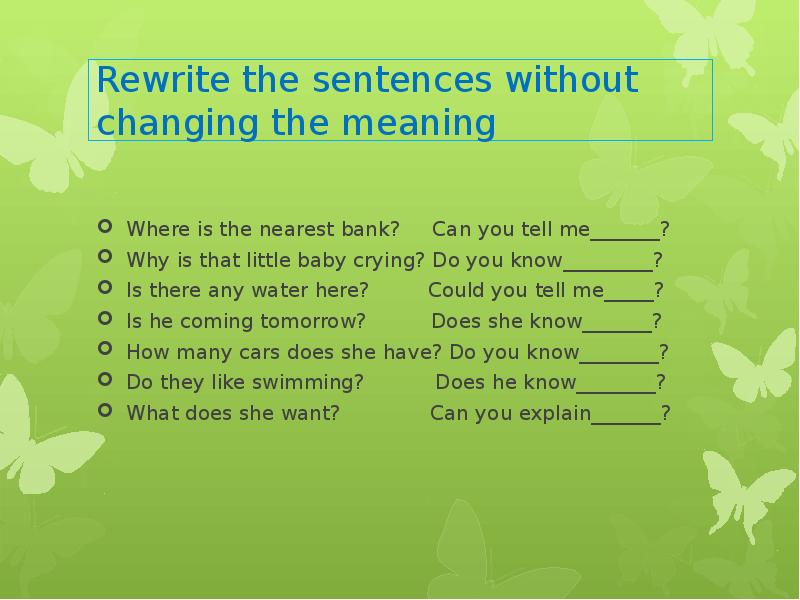
Rewrite the sentences without changing the meaning
Where is the nearest bank? Can you tell me_______?
Why is that little baby crying? Do you know_________?
Is there any water here? Could you tell me_____?
Is he coming tomorrow? Does she know_______?
How many cars does she have? Do you know________?
Do they like swimming? Does he know________?
What does she want? Can you explain_______?
Слайд 3
Описание слайда:
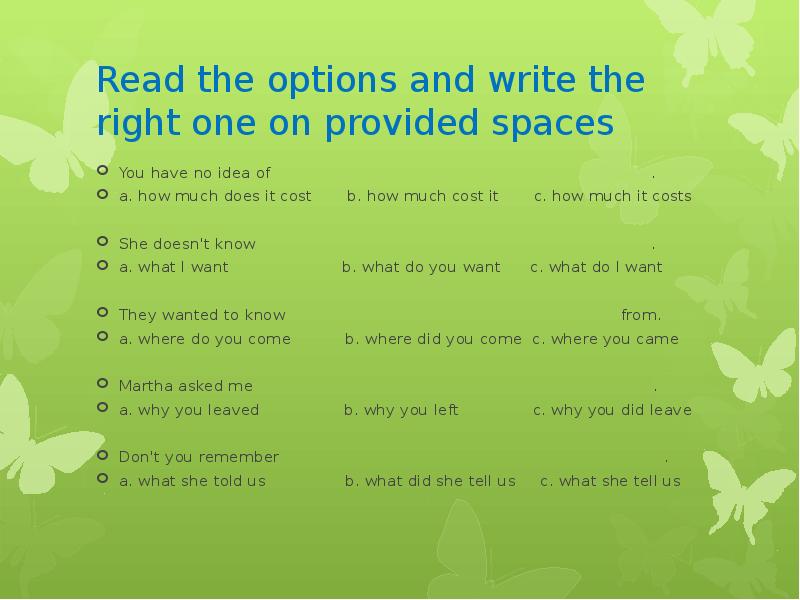
Read the options and write the right one on provided spaces
You have no idea of .
a. how much does it cost b. how much cost it c. how much it costs
She doesn't know .
a. what I want b. what do you want c. what do I want
They wanted to know from.
a. where do you come b. where did you come c. where you came
Martha asked me .
a. why you leaved b. why you left c. why you did leave
Don't you remember .
a. what she told us b. what did she tell us c. what she tell us
Слайд 4
Описание слайда:
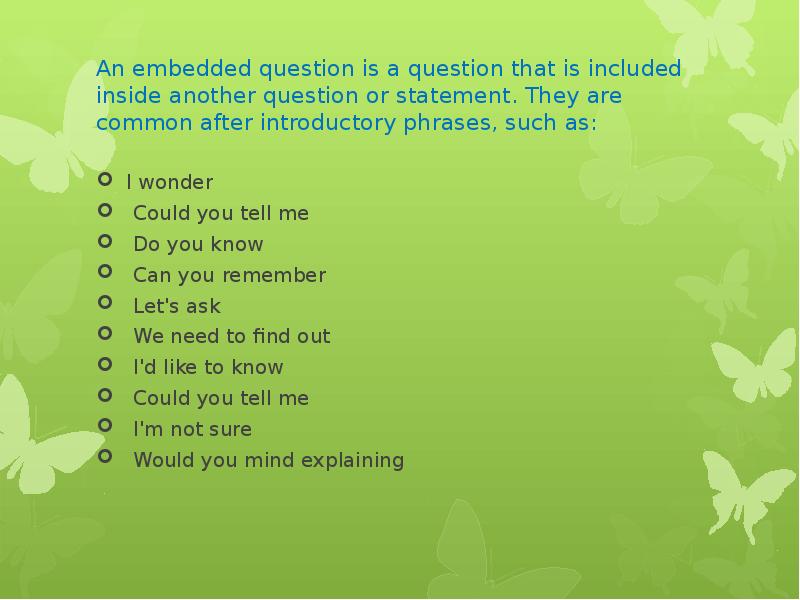
An embedded question is a question that is included inside another question or statement. They are common after introductory phrases, such as:
I wonder
Could you tell me
Do you know
Can you remember
Let's ask
We need to find out
I'd like to know
Could you tell me
I'm not sure
Would you mind explaining
Слайд 5
Описание слайда:
If the embedded question is part of a statement, use a period and not a question mark at the end of the sentence. Also, if the question is in the present or past simple verb tense, omit the auxiliary verbs do, does, and did and change the verb to its appropriate form, as in the example below.
Direct Question
What time did he leave?
Embedded Question
I wonder what time he left.
Слайд 6
Описание слайда:
Rule Two
If the embedded question includes an auxiliary verb or the verb "to be", reverse the positions of the subject and the auxiliary verb, as in the examples below.
Direct Question
What did he say?
Embedded Question
Could you tell me what he said?
Direct Question
Can you help me?
Embedded Question
I wonder if you could help me?
Direct Question
Is he a doctor?
Embedded Question
Do you know if he is a doctor?
Слайд 7
Описание слайда:
Rule Three
Do not use a verbal contraction at the end of the sentence.
Direct Question
Where is she?
Correct Embedded Question
Do you know where he is?
Incorrect Embedded Question
Do you know where he's?
Слайд 8
Описание слайда:
Rule Four
Embedded questions are introduced by whether, whether or not, and if when there is no question word in the sentence (yes/no questions).
Direct Yes/No Question
Will he be there?
Embedded Question
Do you know if he will be there?
Do you know whether or not he will be there?
Do you know whether he will be there or not?
Слайд 9
Описание слайда:
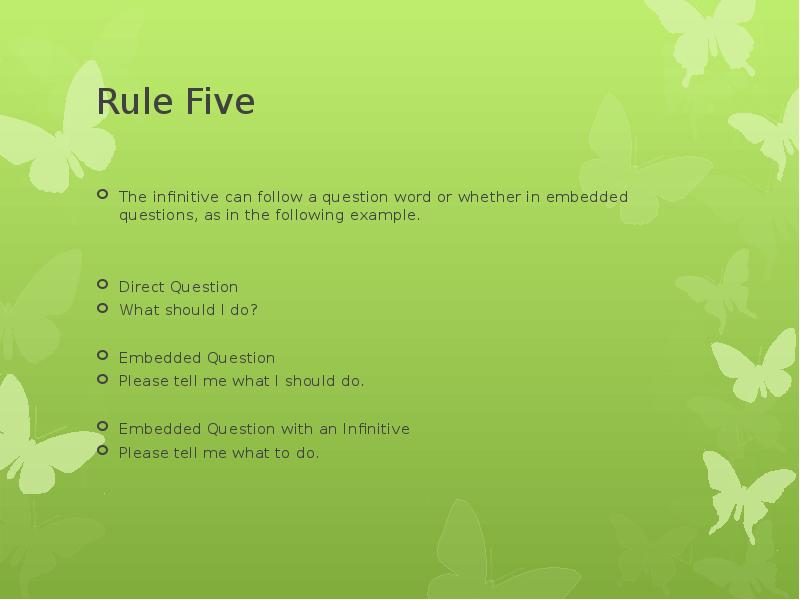
Rule Five
The infinitive can follow a question word or whether in embedded questions, as in the following example.
Direct Question
What should I do?
Embedded Question
Please tell me what I should do.
Embedded Question with an Infinitive
Please tell me what to do.
Слайд 10
Описание слайда:
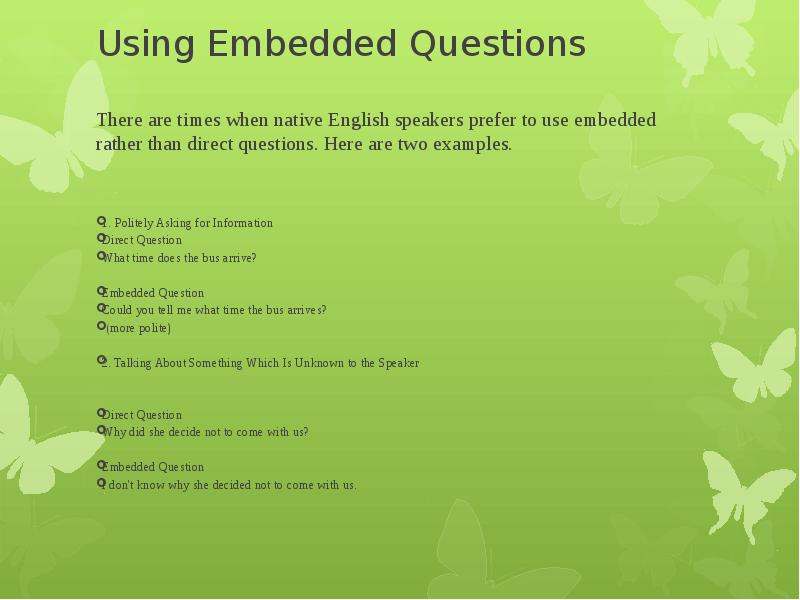
Using Embedded Questions
There are times when native English speakers prefer to use embedded rather than direct questions. Here are two examples.
1. Politely Asking for Information
Direct Question
What time does the bus arrive?
Embedded Question
Could you tell me what time the bus arrives?
(more polite)
2. Talking About Something Which Is Unknown to the Speaker
Direct Question
Why did she decide not to come with us?
Embedded Question
I don't know why she decided not to come with us.
Слайд 11
Описание слайда:
THANK YOU FOR YOUR ATTENTION
Скачать презентацию на тему embeddedindirect-questions-grammar-drills-grammar-guides 68489 можно ниже: