observation презентация
Содержание
- 2. Problems with survey research Respondents interpret different meanings from questions Omission
- 3. What is structured observation? A method of systematically observing people’s behaviour
- 5. Types of observation research Structured/systematic observation Participant observation (qualitative) Non-participant observation
- 6. Observation without Intervention Naturalistic Observation: Observation in natural (“real-world”)
- 7. Observation with Intervention Most psychological and marketing research involves observation
- 8. Participant Observation Observer is an active participant in the natural setting
- 9. Participant Observation Reactivity occurs when people change their usual behavior because
- 10. Structured Observation Researcher sets up (structures) a specific situation in order
- 11. Field Experiment Researcher manipulates an independent variable in a natural setting
- 12. Lab Observation
- 13. Recording Behavior Researchers can obtain a comprehensive record of people’s behavior
- 14. Qualitative Records Researchers use narrative records when they want a complete
- 15. Quantitative Records Selected Behaviors: Researchers choose the behavior they want to
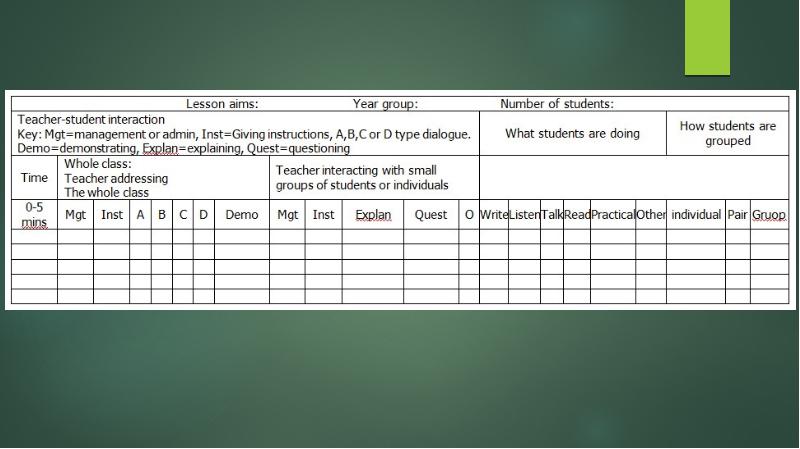
- 16. The observation schedule Must have a clear focus and be easy
- 17. Flanders (1970) Interaction Analysis Categories (FIAC)
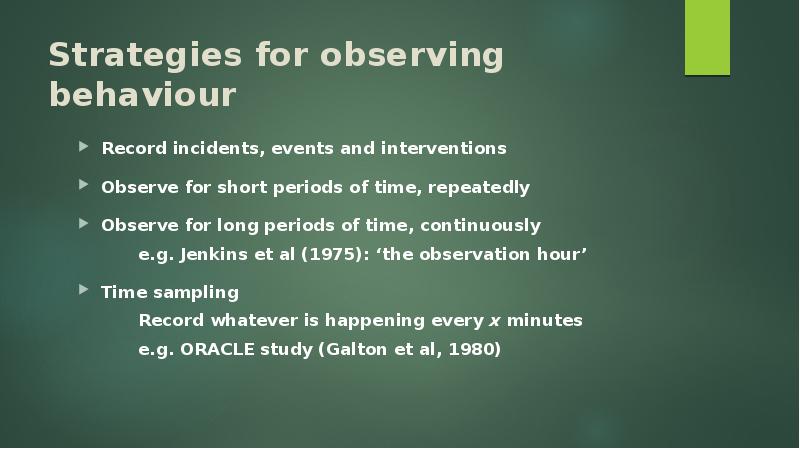
- 19. Strategies for observing behaviour Record incidents, events and interventions Observe for
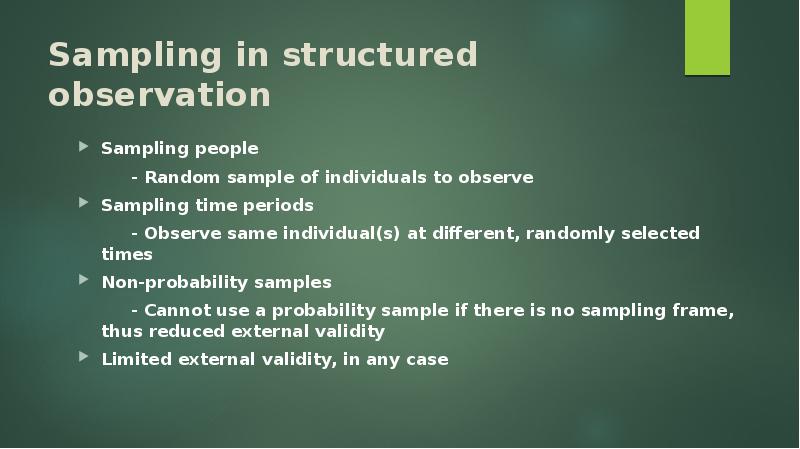
- 20. Sampling in structured observation Sampling people - Random sample of individuals
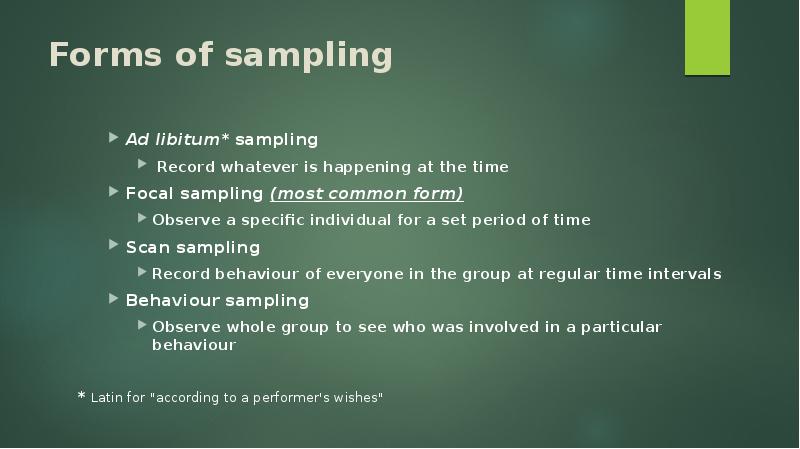
- 21. Forms of sampling Ad libitum* sampling Record whatever is happening
- 22. Issues of reliability and validity Reliability Inter-observer consistency (measured by Cohen’s
- 23. What is the reactive effect? Webb et al. (1966) wrote about
- 24. Field stimulations Salancik (1979) used ‘field stimulation’ to describe a form
- 25. Criticisms of structured observation Imposes an irrelevant framework on the social
- 26. On the other hand... It is more accurate than interviews and
- 27. Home reading A. Bryman Social Research Methods 4th edition. Chapter 12.
- 28. Скачать презентацию


Слайды и текст этой презентации
Слайд 1
Описание слайда:
observation
Слайд 2
Описание слайда:
Problems with survey research
Respondents interpret different meanings from questions
Omission of key terms when reading questions
Reliance on people’s memories of their behaviour
Social desirability effect
Threatening questions - invalid answers
Interviewer bias
Gap between stated and actual behaviour
Capacity to answer questions
Слайд 3
Описание слайда:
What is structured observation?
A method of systematically observing people’s behaviour
By grouping behaviour into categories
Direct observation, not reports or inference, make it an alternative to survey methods
Aggregates and compares behaviour of everyone in the sample
Uses a cross-sectional research design
Слайд 4
Описание слайда:
Слайд 5
Описание слайда:
Types of observation research
Structured/systematic observation
Participant observation (qualitative)
Non-participant observation
Unstructured observation (inductive)
Simple/contrived observation - a form of participant observation where the situation is left as-is or is changed (Webb et al.1966)
Слайд 6
Описание слайда:
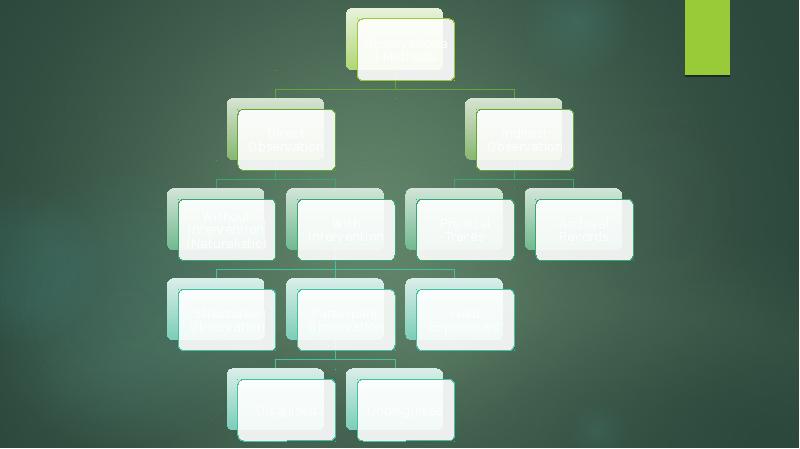
Observation without Intervention
Naturalistic Observation:
Observation in natural (“real-world”) settings without an attempt to intervene or change the situation.
Goals: Describe behavior as it normally occurs, examine relationships among naturally occurring variables.
Naturalistic observation helps to establish the external validity of laboratory findings.
Naturalistic observation is used when ethical and moral considerations prevent experimental manipulation.
Role of emotions (emotional ties with observed peope|events)
Слайд 7
Описание слайда:
Observation with Intervention
Most psychological and marketing research involves observation with intervention.
Researchers typically choose from three methods of observation with intervention in natural settings:
Participant observation (‘observing participation’}
Structured observation
Field experiment
Слайд 8
Описание слайда:
Participant Observation
Observer is an active participant in the natural setting he or she observes.
undisguised: people in the setting know they are being observed
disguised: people don’t know they are being observed
Disguised participant observation helps control for reactivity, one of the main problems associated with observation.
Слайд 9
Описание слайда:
Participant Observation
Reactivity occurs when people change their usual behavior because they know they are being observed.
Participant observers may sometimes lose their objectivity by becoming too involved in the situation.
Participant observers may influence the behavior of people they are observing.
Слайд 10
Описание слайда:
Structured Observation
Researcher sets up (structures) a specific situation in order to observe people’s behavior.
Examples: clinical and developmental observations of behavior, psychological testing
Structured observation is useful when behavior is difficult to observe as it naturally occurs.
Researchers often use confederates to create the structured situation.
Problems occur when observers don’t follow the same procedures across observations or observers, and when important variables are not controlled.
Слайд 11
Описание слайда:
Field Experiment
Researcher manipulates an independent variable in a natural setting and observes behavior (dependent variable).
There must be two or more conditions to compare (independent variable).
Researchers often use confederates to create these different conditions.
Researchers attempt to have the most control in field experiments.
Слайд 12
Описание слайда:
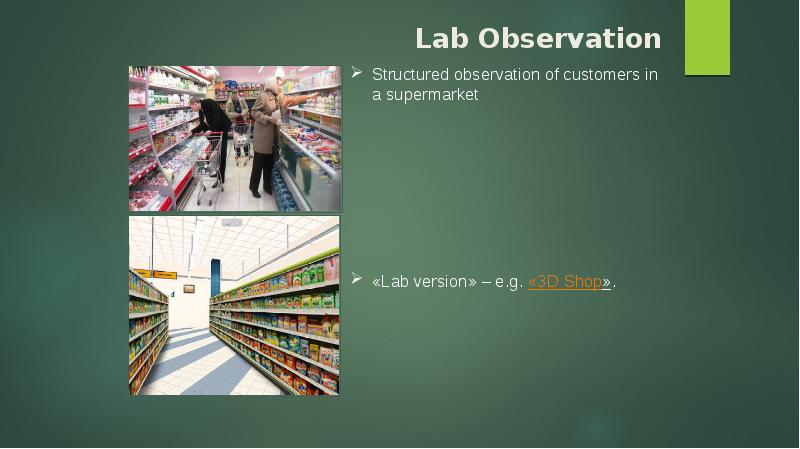
Lab Observation
Слайд 13
Описание слайда:
Recording Behavior
Researchers can obtain a comprehensive record of people’s behavior (e.g., video tapes) or select specific behaviors to record.
The method for recording behavior determines how the results of the study are eventually measured, summarized, analyzed, and reported.
Qualitative
Quantitative
Слайд 14
Описание слайда:
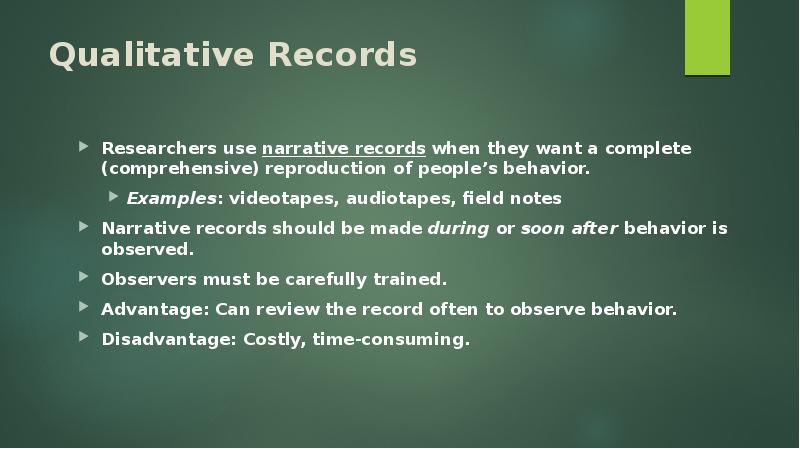
Qualitative Records
Researchers use narrative records when they want a complete (comprehensive) reproduction of people’s behavior.
Examples: videotapes, audiotapes, field notes
Narrative records should be made during or soon after behavior is observed.
Observers must be carefully trained.
Advantage: Can review the record often to observe behavior.
Disadvantage: Costly, time-consuming.
Слайд 15
Описание слайда:
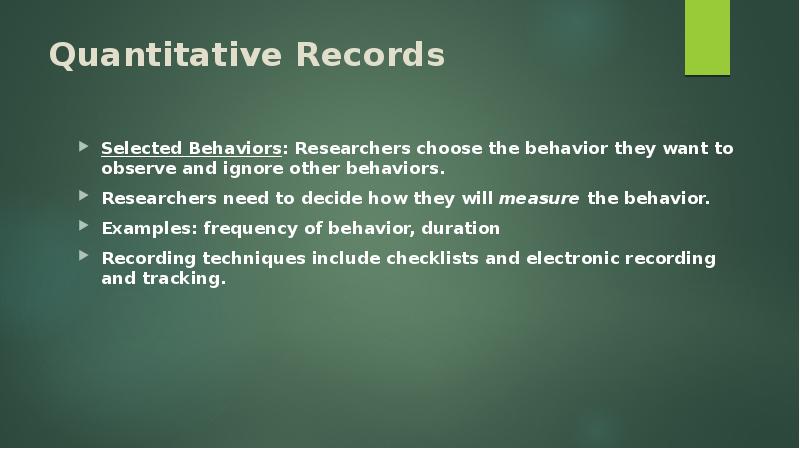
Quantitative Records
Selected Behaviors: Researchers choose the behavior they want to observe and ignore other behaviors.
Researchers need to decide how they will measure the behavior.
Examples: frequency of behavior, duration
Recording techniques include checklists and electronic recording and tracking.
Слайд 16
Описание слайда:
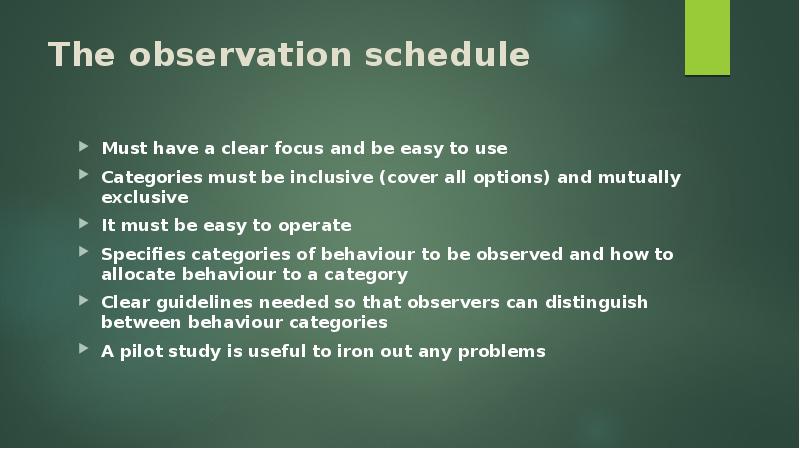
The observation schedule
Must have a clear focus and be easy to use
Categories must be inclusive (cover all options) and mutually exclusive
It must be easy to operate
Specifies categories of behaviour to be observed and how to allocate behaviour to a category
Clear guidelines needed so that observers can distinguish between behaviour categories
A pilot study is useful to iron out any problems
Слайд 17
Описание слайда:
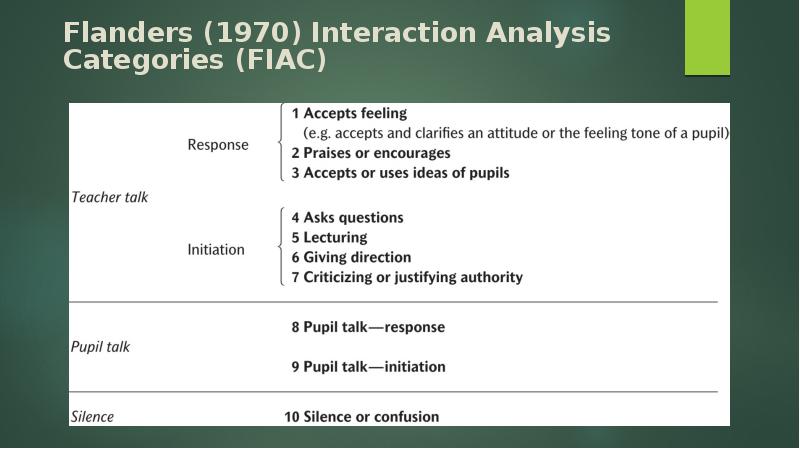
Flanders (1970) Interaction Analysis Categories (FIAC)
Слайд 18
Описание слайда:
Слайд 19
Описание слайда:
Strategies for observing behaviour
Record incidents, events and interventions
Observe for short periods of time, repeatedly
Observe for long periods of time, continuously
e.g. Jenkins et al (1975): ‘the observation hour’
Time sampling
Record whatever is happening every x minutes
e.g. ORACLE study (Galton et al, 1980)
Слайд 20
Описание слайда:
Sampling in structured observation
Sampling people
- Random sample of individuals to observe
Sampling time periods
- Observe same individual(s) at different, randomly selected times
Non-probability samples
- Cannot use a probability sample if there is no sampling frame, thus reduced external validity
Limited external validity, in any case
Слайд 21
Описание слайда:
Forms of sampling
Ad libitum* sampling
Record whatever is happening at the time
Focal sampling (most common form)
Observe a specific individual for a set period of time
Scan sampling
Record behaviour of everyone in the group at regular time intervals
Behaviour sampling
Observe whole group to see who was involved in a particular behaviour
* Latin for "according to a performer's wishes"
Слайд 22
Описание слайда:
Issues of reliability and validity
Reliability
Inter-observer consistency (measured by Cohen’s kappa)
Intra-observer consistency (lapses of attention)
Measurement validity
Does schedule measure underlying concept?
Implementation of schedule
Presence of observer - reactive effect
Слайд 23
Описание слайда:
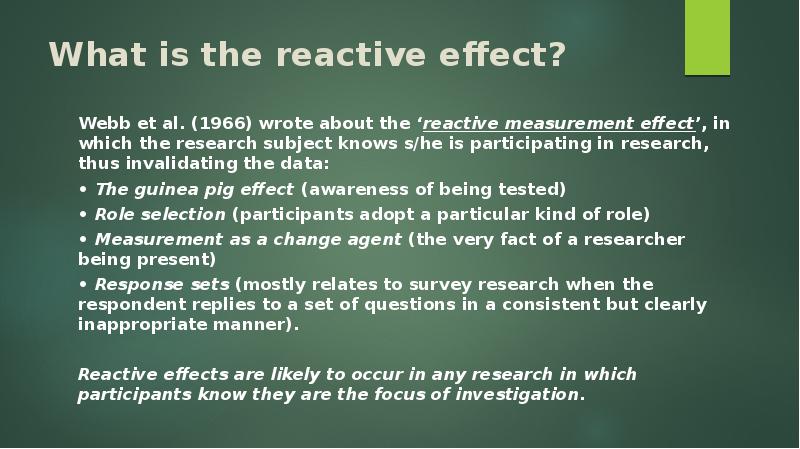
What is the reactive effect?
Webb et al. (1966) wrote about the ‘reactive measurement effect’, in which the research subject knows s/he is participating in research, thus invalidating the data:
• The guinea pig effect (awareness of being tested)
• Role selection (participants adopt a particular kind of role)
• Measurement as a change agent (the very fact of a researcher being present)
• Response sets (mostly relates to survey research when the respondent replies to a set of questions in a consistent but clearly inappropriate manner).
Reactive effects are likely to occur in any research in which participants know they are the focus of investigation.
Слайд 24
Описание слайда:
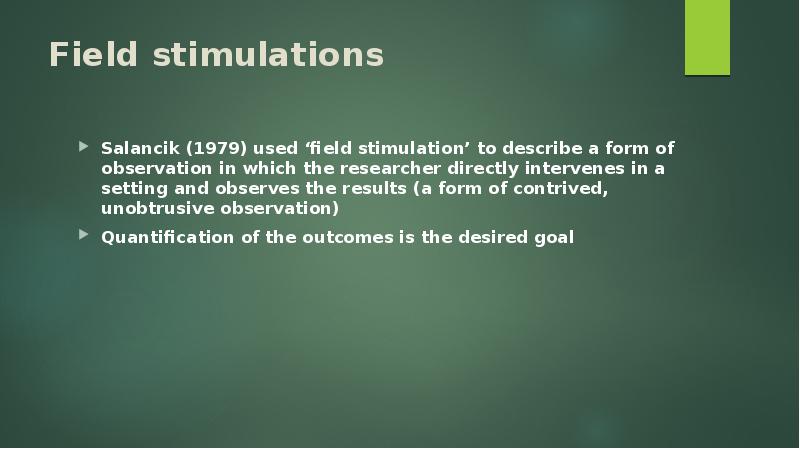
Field stimulations
Salancik (1979) used ‘field stimulation’ to describe a form of observation in which the researcher directly intervenes in a setting and observes the results (a form of contrived, unobtrusive observation)
Quantification of the outcomes is the desired goal
Слайд 25
Описание слайда:
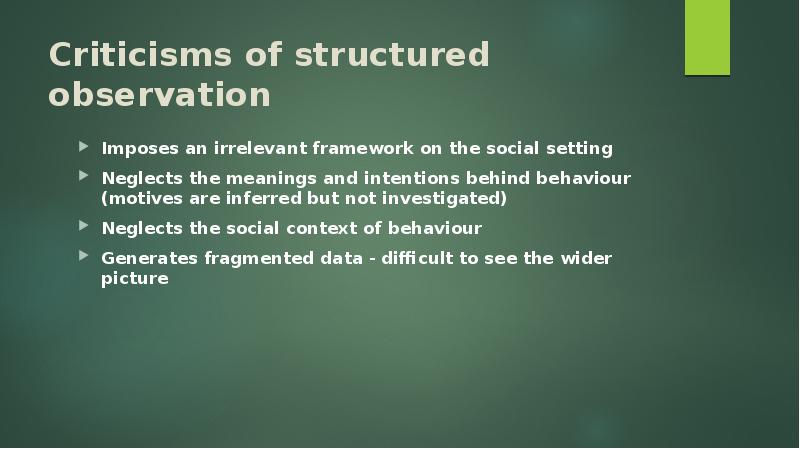
Criticisms of structured observation
Imposes an irrelevant framework on the social setting
Neglects the meanings and intentions behind behaviour (motives are inferred but not investigated)
Neglects the social context of behaviour
Generates fragmented data - difficult to see the wider picture
Слайд 26
Описание слайда:
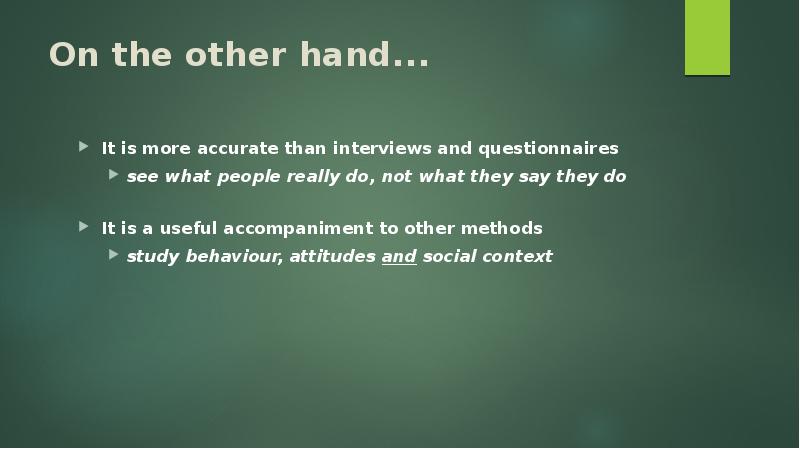
On the other hand...
It is more accurate than interviews and questionnaires
see what people really do, not what they say they do
It is a useful accompaniment to other methods
study behaviour, attitudes and social context
Слайд 27
Описание слайда:
Home reading
A. Bryman Social Research Methods 4th edition. Chapter 12.
Скачать презентацию на тему observation можно ниже: