Llandaff cathedral school презентация
Содержание
- 2. The Cathedral School, Llandaff
- 3. History The school survived an impoverished time during 1691, when
- 4. Structure. Curriculum The Cathedral School consists of three sections: Infant
- 5. Pastoral Care Every pupil in the Senior Section is a
- 6. Activities Music Both boy choristers and choral scholars have done
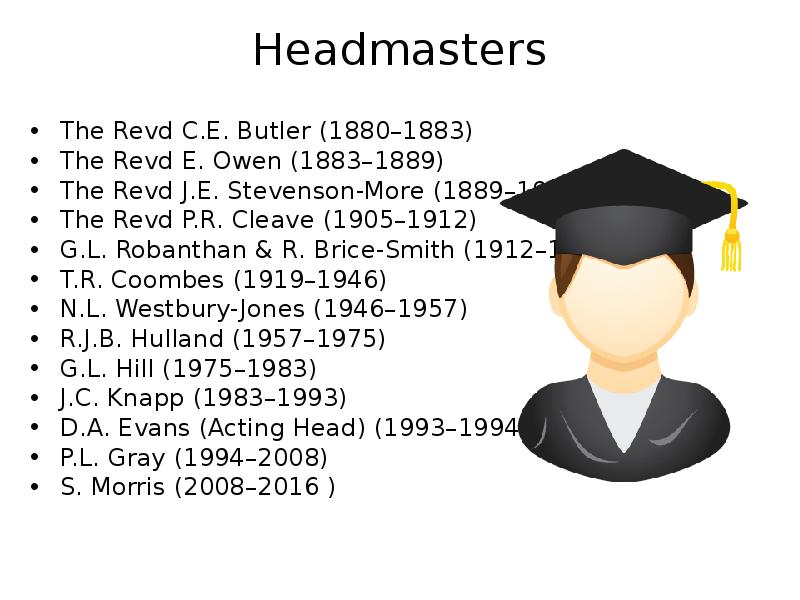
- 7. Headmasters The Revd C.E. Butler (1880–1883) The Revd E. Owen
- 9. Скачать презентацию

Слайды и текст этой презентации
Слайд 1
Описание слайда:
Llandaff Cathedral School
Слайд 2
Описание слайда:
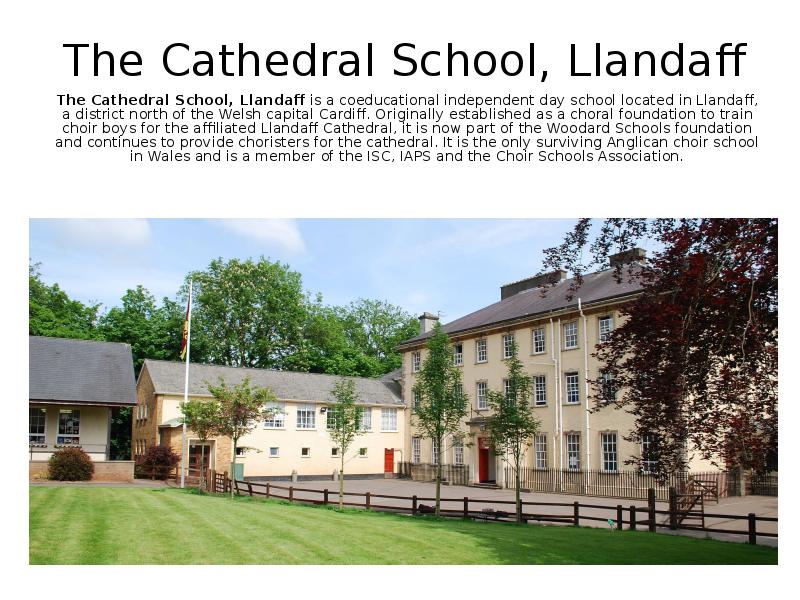
The Cathedral School, Llandaff
Слайд 3
Описание слайда:
History
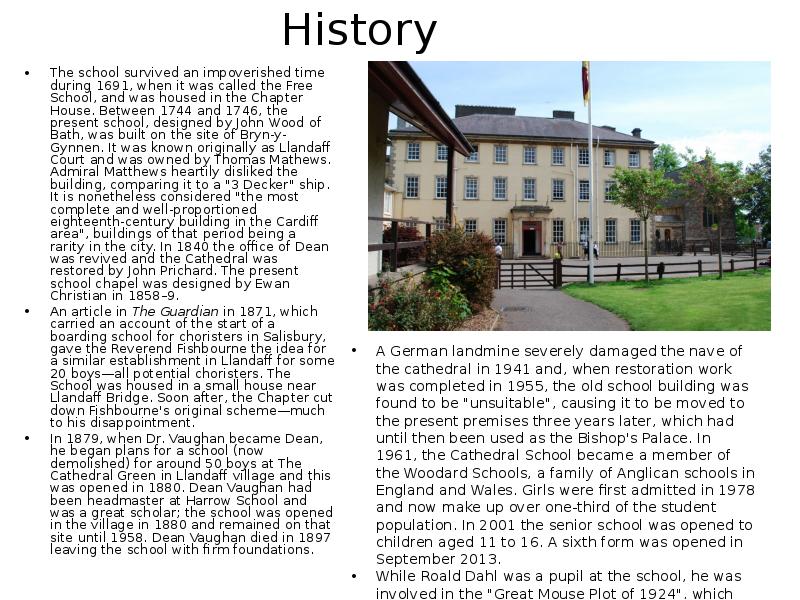
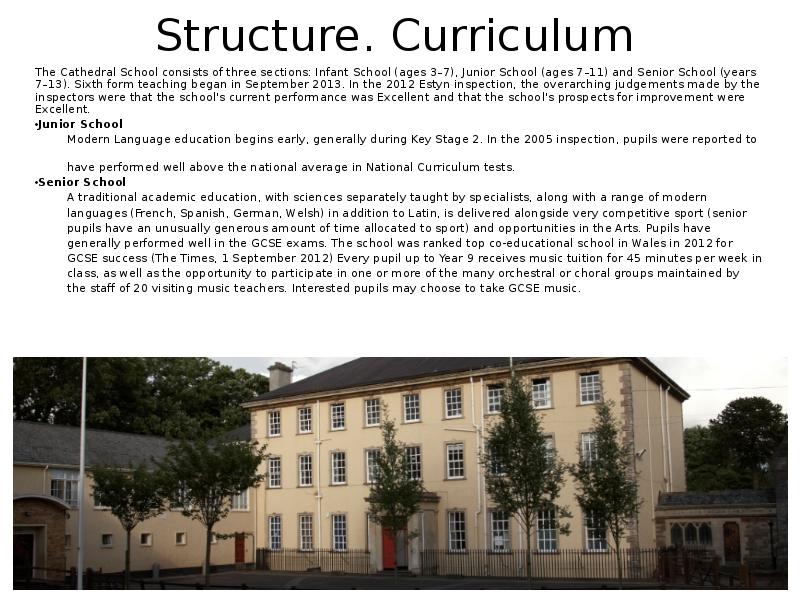
The school survived an impoverished time during 1691, when it was called the Free School, and was housed in the Chapter House. Between 1744 and 1746, the present school, designed by John Wood of Bath, was built on the site of Bryn-y-Gynnen. It was known originally as Llandaff Court and was owned by Thomas Mathews. Admiral Matthews heartily disliked the building, comparing it to a "3 Decker" ship. It is nonetheless considered "the most complete and well-proportioned eighteenth-century building in the Cardiff area", buildings of that period being a rarity in the city. In 1840 the office of Dean was revived and the Cathedral was restored by John Prichard. The present school chapel was designed by Ewan Christian in 1858–9.
An article in The Guardian in 1871, which carried an account of the start of a boarding school for choristers in Salisbury, gave the Reverend Fishbourne the idea for a similar establishment in Llandaff for some 20 boys—all potential choristers. The School was housed in a small house near Llandaff Bridge. Soon after, the Chapter cut down Fishbourne's original scheme—much to his disappointment.
In 1879, when Dr. Vaughan became Dean, he began plans for a school (now demolished) for around 50 boys at The Cathedral Green in Llandaff village and this was opened in 1880. Dean Vaughan had been headmaster at Harrow School and was a great scholar; the school was opened in the village in 1880 and remained on that site until 1958. Dean Vaughan died in 1897 leaving the school with firm foundations.
Слайд 4
Описание слайда:
Structure. Curriculum
The Cathedral School consists of three sections: Infant School (ages 3–7), Junior School (ages 7–11) and Senior School (years 7–13). Sixth form teaching began in September 2013. In the 2012 Estyn inspection, the overarching judgements made by the inspectors were that the school's current performance was Excellent and that the school's prospects for improvement were Excellent.
Junior School
Modern Language education begins early, generally during Key Stage 2. In the 2005 inspection, pupils were reported to
have performed well above the national average in National Curriculum tests.
Senior School
A traditional academic education, with sciences separately taught by specialists, along with a range of modern
languages (French, Spanish, German, Welsh) in addition to Latin, is delivered alongside very competitive sport (senior
pupils have an unusually generous amount of time allocated to sport) and opportunities in the Arts. Pupils have
generally performed well in the GCSE exams. The school was ranked top co-educational school in Wales in 2012 for
GCSE success (The Times, 1 September 2012) Every pupil up to Year 9 receives music tuition for 45 minutes per week in
class, as well as the opportunity to participate in one or more of the many orchestral or choral groups maintained by
the staff of 20 visiting music teachers. Interested pupils may choose to take GCSE music.
Слайд 5
Описание слайда:
Pastoral Care
Every pupil in the Senior Section is a member of one of three senior Houses, named after the Llandaff saints: Dyfrig, Euddogwy and Teilo. The pupils are cared for by one of five House Tutors, who in turn are overseen by a Housemaster/mistress. Housemasters, assisted by their tutor teams, are responsible for pupils' pastoral care, oversight of their academic progress and personal development. Pupils exercise their leadership skills within the House context, growing in confidence and ability to relate to others, and to lead and manage people and events.
Слайд 6
Описание слайда:
Activities
Music
Both boy choristers and choral scholars have done work in the Wales Millennium Centre, with Welsh National Opera, Bryn Terfel and Carlo Rizzi, respectively. Music in general at the Cathedral School is very strong with numerous pupils at Grade 8 standard. The music department is housed in the Jubilee building, with a full range of instruments at one's disposal. There are also specialist teachers in 20 different instruments. There are numerous school groups as well, from School Orchestra to Swing Band, from Flute Group to Senior Chamber Choir. Most recently, the school hosted its St Cecilia's Day Concert at the Wales Millennium Centre, showcasing the broad spectrum of the school's finest choirs and instrumental ensembles, culminating in an impressive performance of Fauré’s Requiem.
Слайд 7
Описание слайда:
Headmasters
The Revd C.E. Butler (1880–1883)
The Revd E. Owen (1883–1889)
The Revd J.E. Stevenson-More (1889–1905)
The Revd P.R. Cleave (1905–1912)
G.L. Robanthan & R. Brice-Smith (1912–1919)
T.R. Coombes (1919–1946)
N.L. Westbury-Jones (1946–1957)
R.J.B. Hulland (1957–1975)
G.L. Hill (1975–1983)
J.C. Knapp (1983–1993)
D.A. Evans (Acting Head) (1993–1994)
P.L. Gray (1994–2008)
S. Morris (2008–2016 )
Слайд 8
Описание слайда:
Скачать презентацию на тему Llandaff cathedral school можно ниже: