The canadian model of occupational performance and engagement презентация
Содержание
- 2. Background Developed from the Canadian Model of Occupational Performance (CMOP)
- 3. Assumptions Based on shared assumptions of the profession Client-centredness is key
- 4. Theories that inform CMOP-E Humanistic theories- client centred principles Developmental theories-
- 5. Focus of model Occupational performance Occupational Engagement Both are a
- 6. Engagement Refers to all that people do to become occupied Speaks
- 7. Depiction of model
- 8. Components of CMOP-E Person Occupation Environment
- 9. Person Made up of three performance components: Cognitive Affective Physical
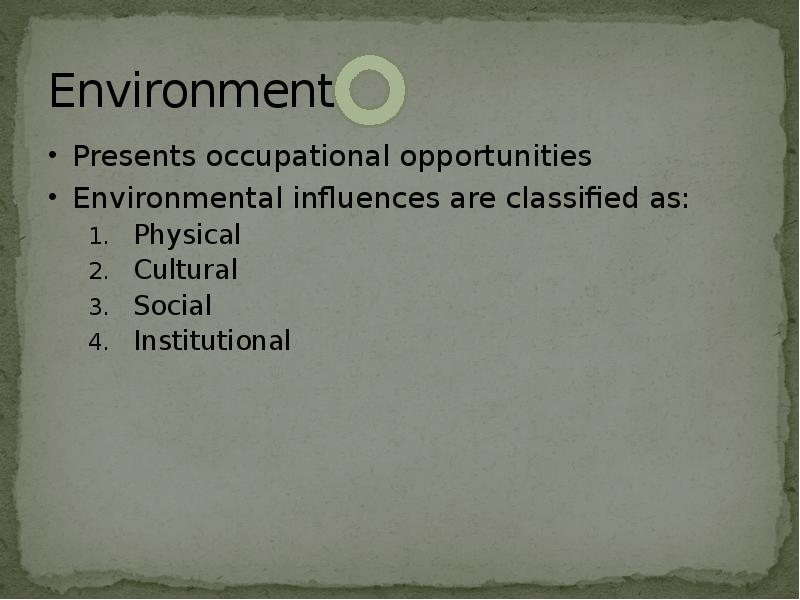
- 10. Environment Presents occupational opportunities Environmental influences are classified as: Physical Cultural
- 11. Occupation Link between the person and the environment Vehicle that
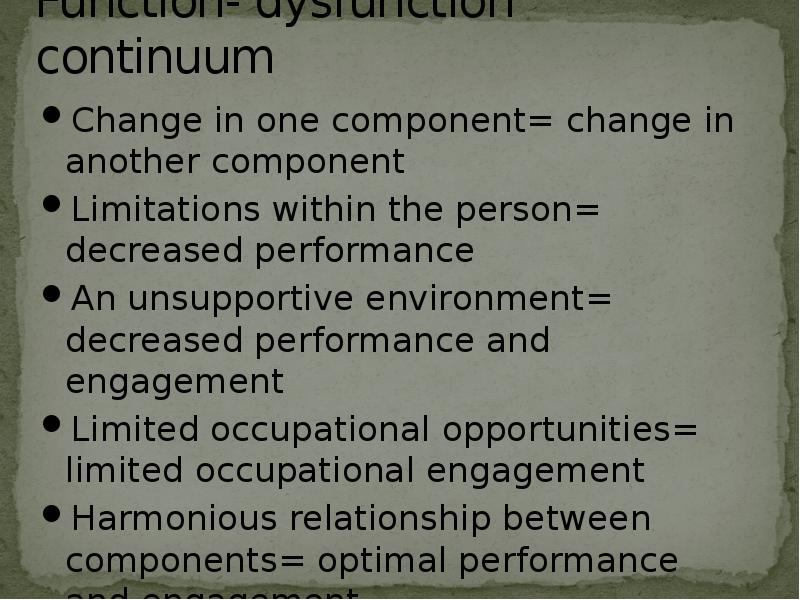
- 12. Function- dysfunction continuum Change in one component= change in another component
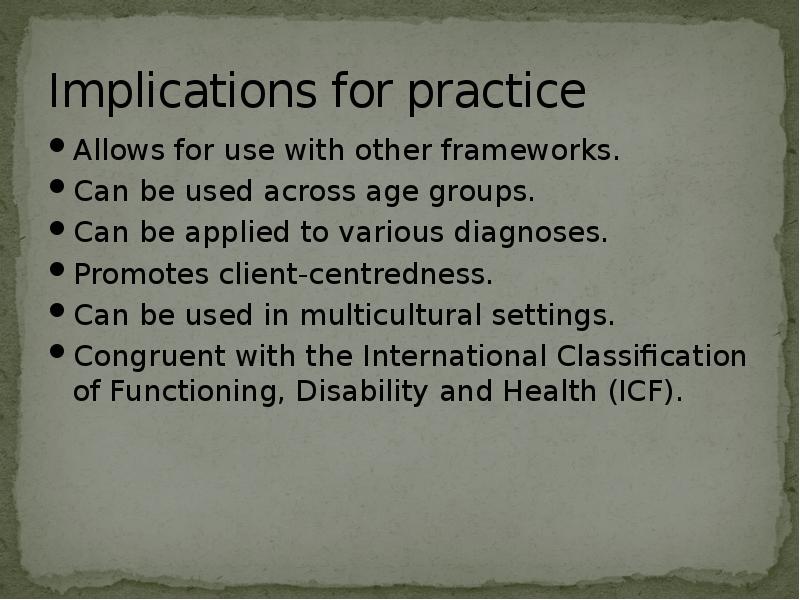
- 13. Implications for practice Allows for use with other frameworks. Can be
- 14. Implications for practice Directs focus of practice on creating environments that
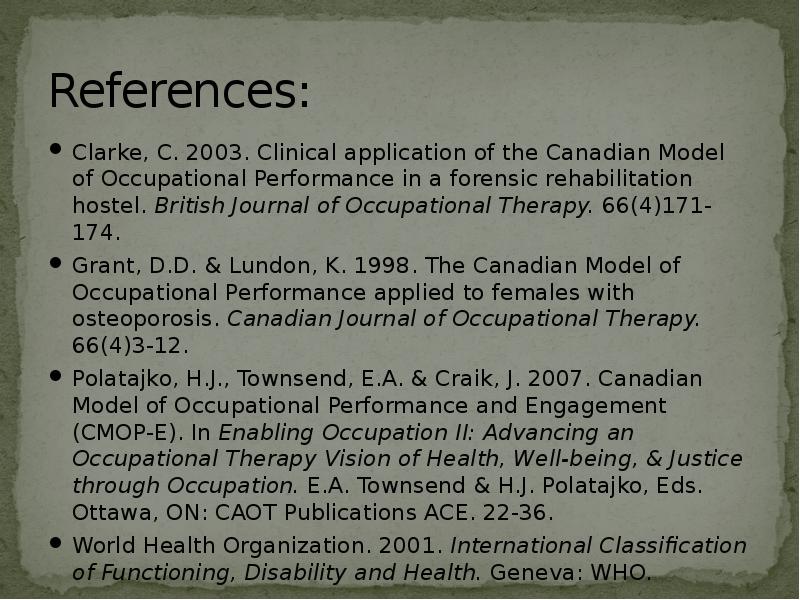
- 15. References: Clarke, C. 2003. Clinical application of the Canadian Model of
- 16. This work is licensed under the Creative Commons Attribution-Non Commercial-Share Alike
- 17. Скачать презентацию





Слайды и текст этой презентации
Слайд 1
Описание слайда:
The Canadian Model of Occupational Performance and Engagement
Polatajko, Townsend & Craik 2007.
Слайд 2
Описание слайда:
Background
Developed from the Canadian Model of Occupational Performance (CMOP)
Captures the occupational perspective of human occupation
Positions profession beyond the medical model
Envisions health, well-being and justice as attainable through occupation
Introduces engagement as an important construct in understanding human occupation
Слайд 3
Описание слайда:
Assumptions
Based on shared assumptions of the profession
Client-centredness is key
Слайд 4
Описание слайда:
Theories that inform CMOP-E
Humanistic theories- client centred principles
Developmental theories- adaptation and development of occupational roles
Environmental theories- the influence of environment on occupation and the person
Слайд 5
Описание слайда:
Focus of model
Occupational performance
Occupational Engagement
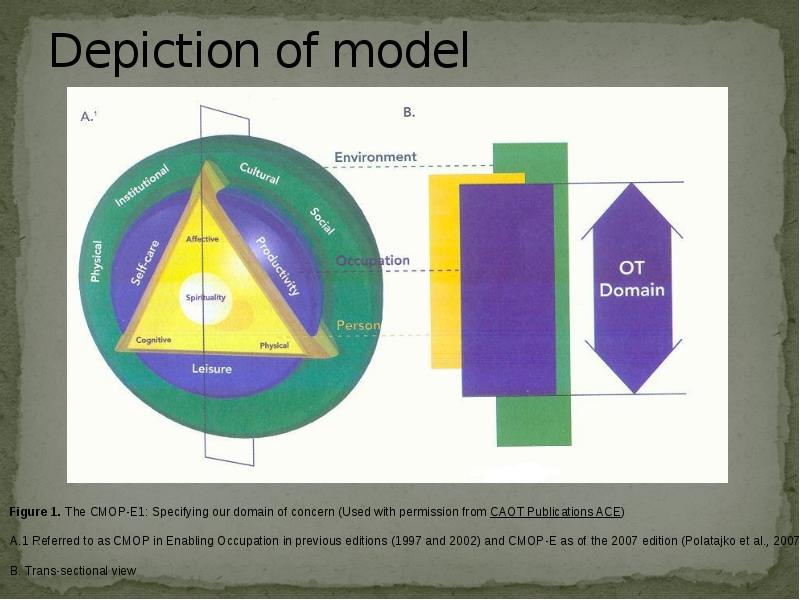
Both are a result of a dynamic interaction between components of the model.
Presents a transverse view of model that situates occupation as the core focus of the profession.
Слайд 6
Описание слайда:
Engagement
Refers to all that people do to become occupied
Speaks to occupying self or others
Relates to having occupations and not only performing them
Presents a broader view of human occupation
Слайд 7
Описание слайда:
Depiction of model
Слайд 8
Описание слайда:
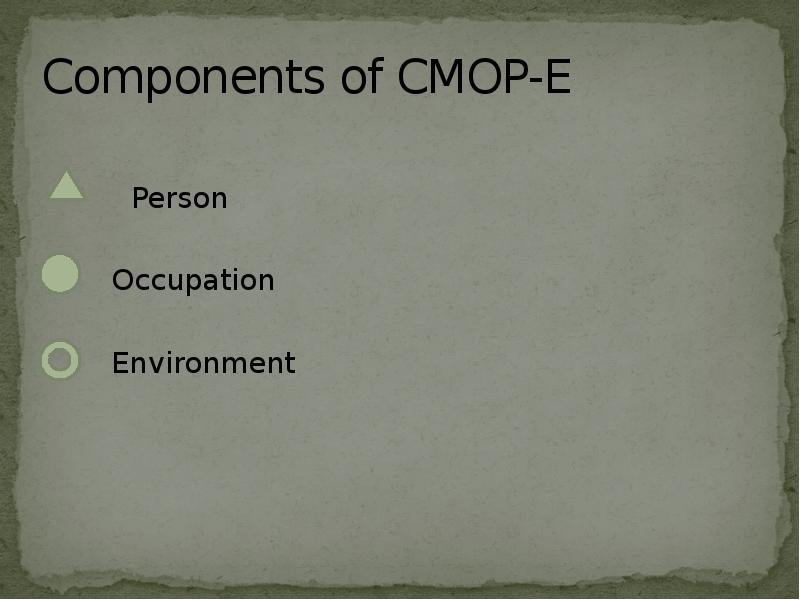
Components of CMOP-E
Person
Occupation
Environment
Слайд 9
Описание слайда:
Person
Made up of three performance components:
Cognitive
Affective
Physical
With spirituality as the core of the person
Слайд 10
Описание слайда:
Environment
Presents occupational opportunities
Environmental influences are classified as:
Physical
Cultural
Social
Institutional
Слайд 11
Описание слайда:
Occupation
Link between the person and the environment
Vehicle that enables acting on the environment
Made up of three occupational areas:
Self-care
Productivity
Leisure
Слайд 12
Описание слайда:
Function- dysfunction continuum
Change in one component= change in another component
Limitations within the person= decreased performance
An unsupportive environment= decreased performance and engagement
Limited occupational opportunities= limited occupational engagement
Harmonious relationship between components= optimal performance and engagement
Слайд 13
Описание слайда:
Implications for practice
Allows for use with other frameworks.
Can be used across age groups.
Can be applied to various diagnoses.
Promotes client-centredness.
Can be used in multicultural settings.
Congruent with the International Classification of Functioning, Disability and Health (ICF).
Слайд 14
Описание слайда:
Implications for practice
Directs focus of practice on creating environments that are occupationally supportive
Means through which health and well-being may be attained.
Слайд 15
Описание слайда:
References:
Clarke, C. 2003. Clinical application of the Canadian Model of Occupational Performance in a forensic rehabilitation hostel. British Journal of Occupational Therapy. 66(4)171-174.
Grant, D.D. & Lundon, K. 1998. The Canadian Model of Occupational Performance applied to females with osteoporosis. Canadian Journal of Occupational Therapy. 66(4)3-12.
Polatajko, H.J., Townsend, E.A. & Craik, J. 2007. Canadian Model of Occupational Performance and Engagement (CMOP-E). In Enabling Occupation II: Advancing an Occupational Therapy Vision of Health, Well-being, & Justice through Occupation. E.A. Townsend & H.J. Polatajko, Eds. Ottawa, ON: CAOT Publications ACE. 22-36.
World Health Organization. 2001. International Classification of Functioning, Disability and Health. Geneva: WHO.
Слайд 16
Описание слайда:
This work is licensed under the Creative Commons Attribution-Non Commercial-Share Alike 2.5 South Africa License. To view a copy of this license, visit http://creativecommons.org/licenses/by-sa/2.5/za/
Скачать презентацию на тему The canadian model of occupational performance and engagement можно ниже: