3. Java Persistence API. 5. Transaction Management презентация
Содержание
- 2. Database Transaction A database transaction is a sequence of actions that
- 3. ACID (1 of 2) Atomicity. A transaction should be treated as
- 4. ACID (2 of 2) Isolation. There may be many transactions processing
- 5. Spring Transaction Management Spring framework provides an abstract layer on top
- 6. Local Transactions Local transaction management can be useful in a centralized
- 7. Global Transactions Global transaction management is required in a distributed computing
- 8. Programmatic vs. Declarative Spring supports two types of transaction management: Programmatic
- 9. Programmatic vs. Declarative Declarative transaction management is preferable over programmatic transaction
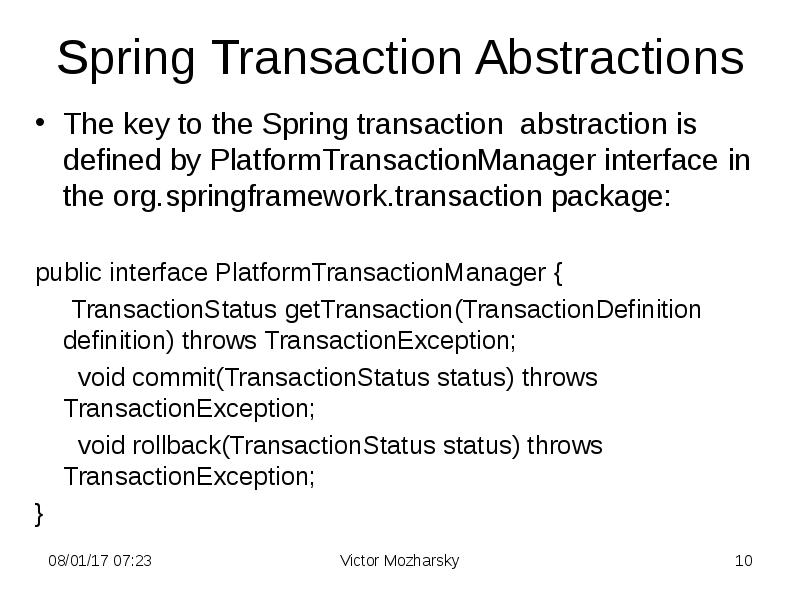
- 10. Spring Transaction Abstractions The key to the Spring transaction abstraction is
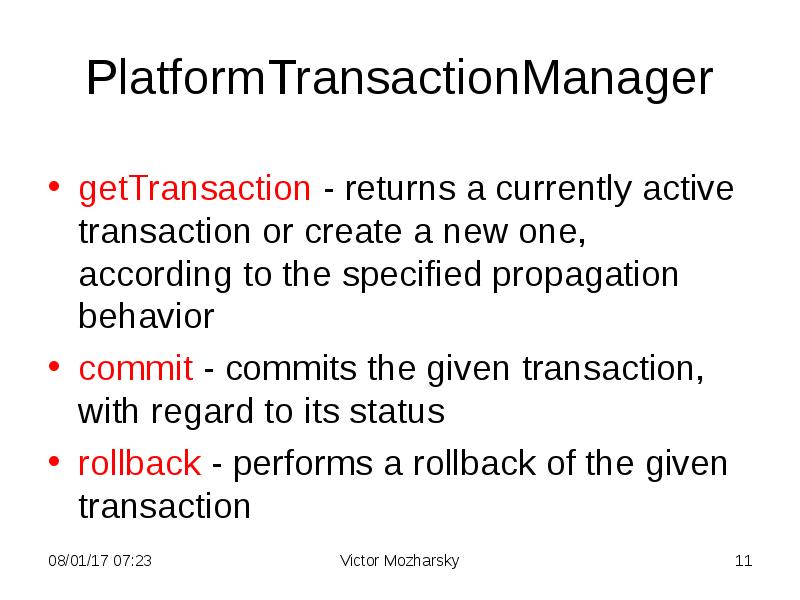
- 11. PlatformTransactionManager getTransaction - returns a currently active transaction or create a
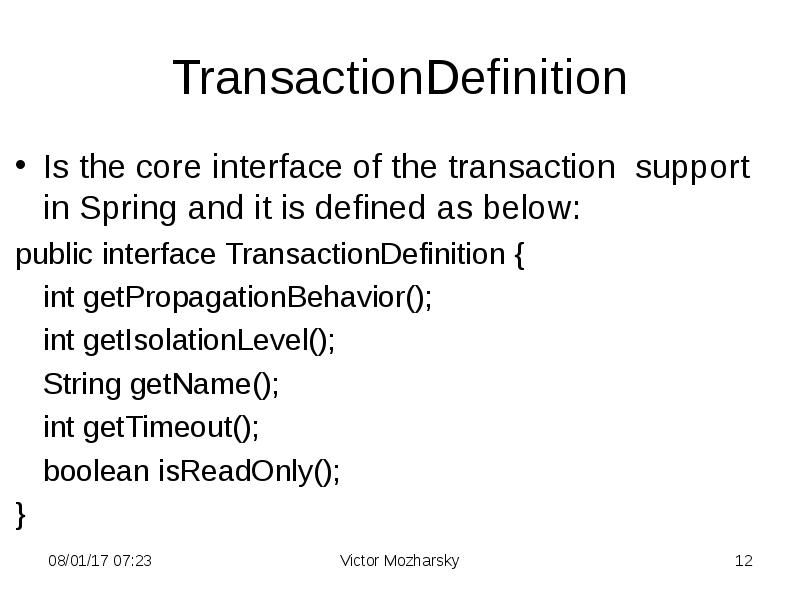
- 12. TransactionDefinition Is the core interface of the transaction support in Spring
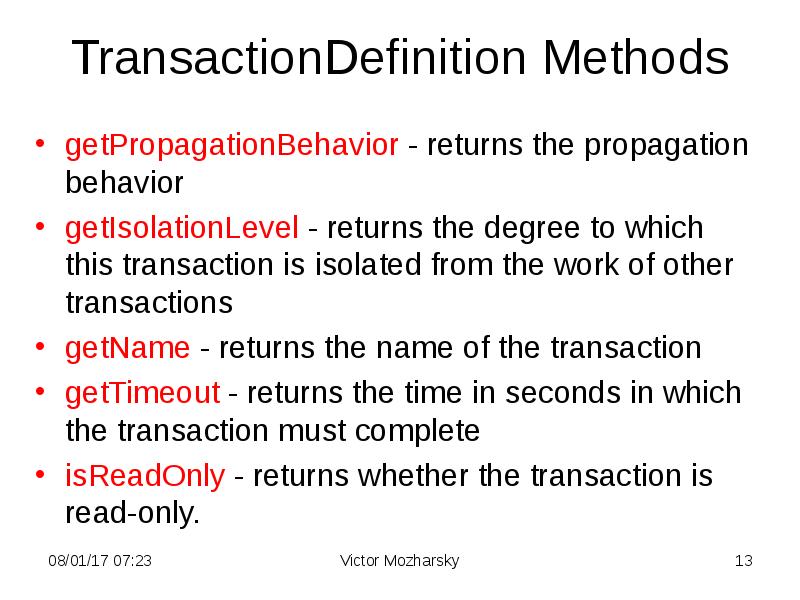
- 13. TransactionDefinition Methods getPropagationBehavior - returns the propagation behavior getIsolationLevel - returns
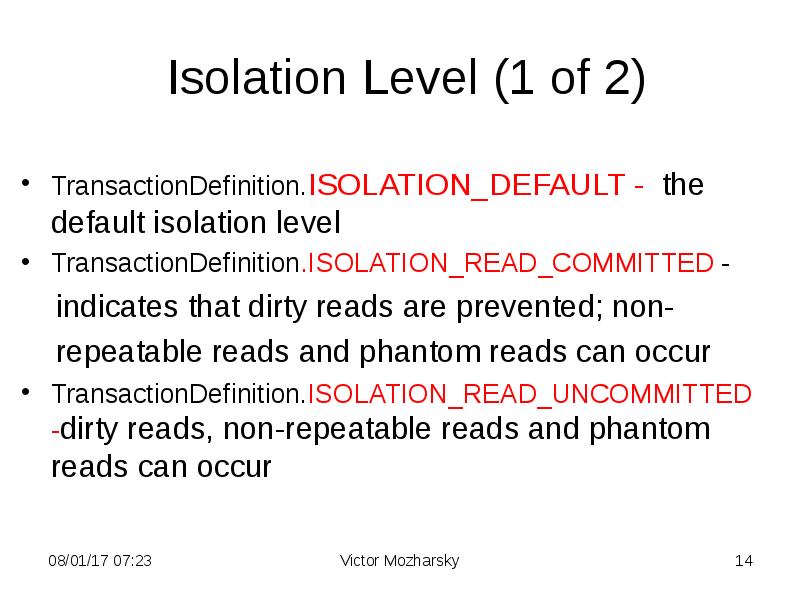
- 14. Isolation Level (1 of 2) TransactionDefinition.ISOLATION_DEFAULT - the default isolation level
- 15. Isolation Level (2 of 2) TransactionDefinition.ISOLATION_REPEATABLE_READ - dirty reads and non-repeatable
- 16. Propagation Types (1 of 2) TransactionDefinition.PROPAGATION_MANDATORY - support a current transaction;
- 17. Propagation Types (2 of 2) TransactionDefinition.PROPAGATION_REQUIRED - support a current transaction;
- 18. TransactionStatus interface Provides a simple way for transactional code to control
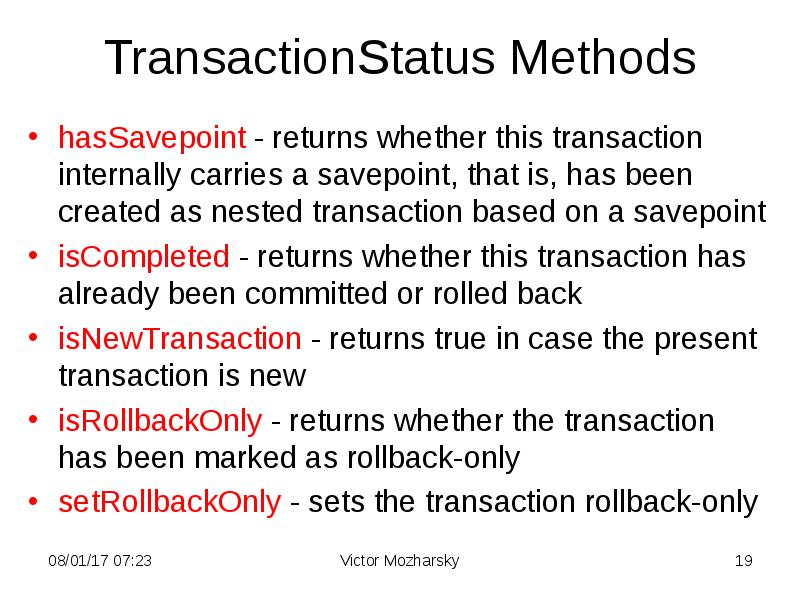
- 19. TransactionStatus Methods hasSavepoint - returns whether this transaction internally carries a
- 20. Declarative Transaction Management This approach allows you to manage the transaction
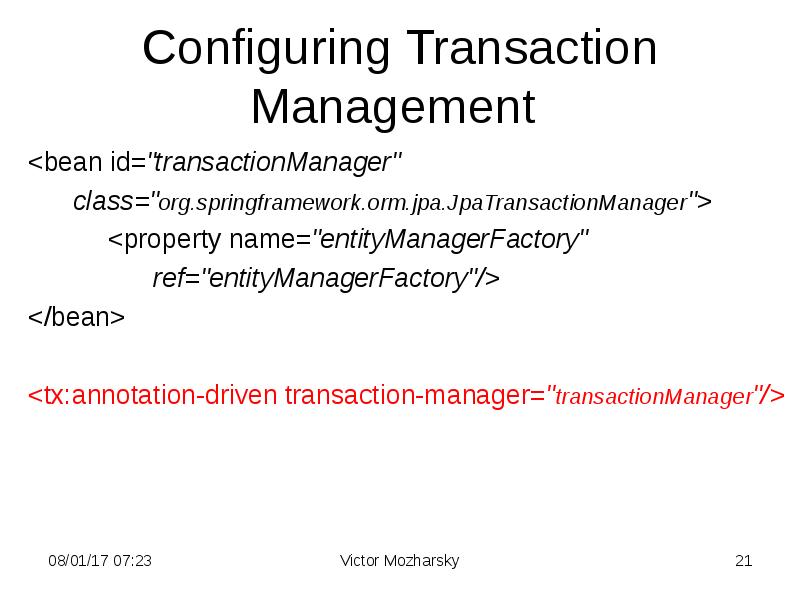
- 21. Configuring Transaction Management <bean id="transactionManager" class="org.springframework.orm.jpa.JpaTransactionManager"> <property
- 22. Using @Transactional You can place the @Transactional annotation before a class definition,
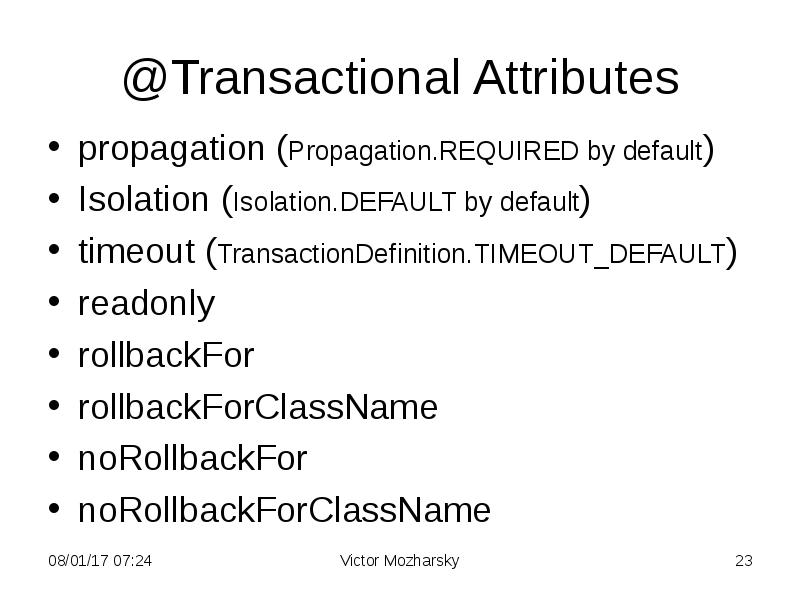
- 23. @Transactional Attributes propagation (Propagation.REQUIRED by default) Isolation (Isolation.DEFAULT by default) timeout
- 24. Exercise: Insert New Customer Insert new record to the CUSTOMER DB
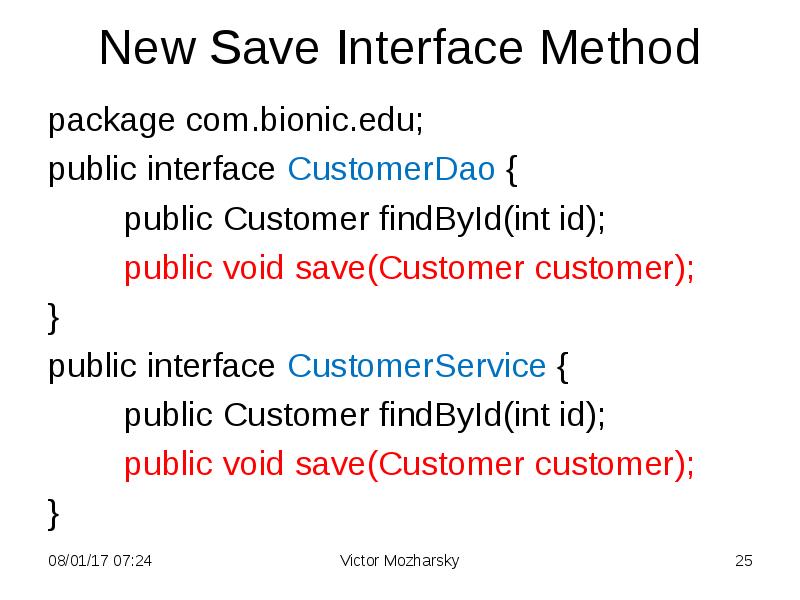
- 25. New Save Interface Method package com.bionic.edu; public interface CustomerDao {
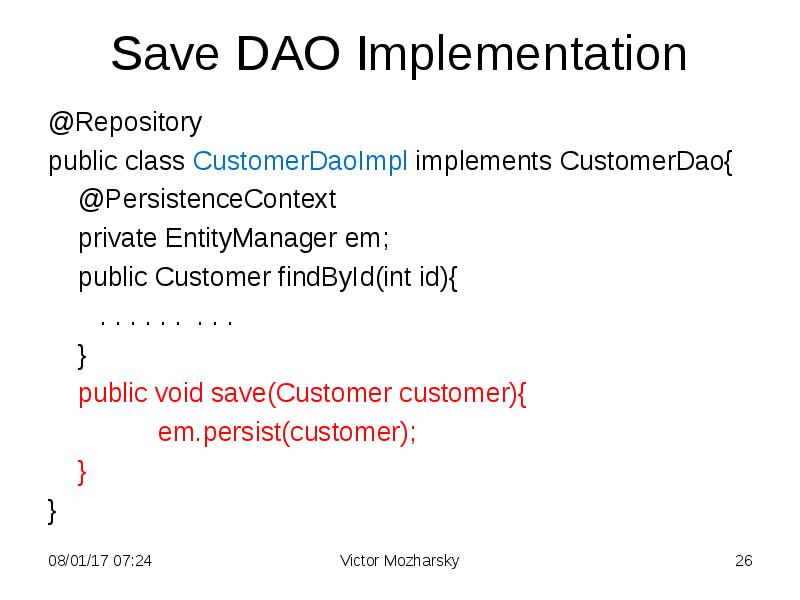
- 26. Save DAO Implementation @Repository public class CustomerDaoImpl implements CustomerDao{ @PersistenceContext
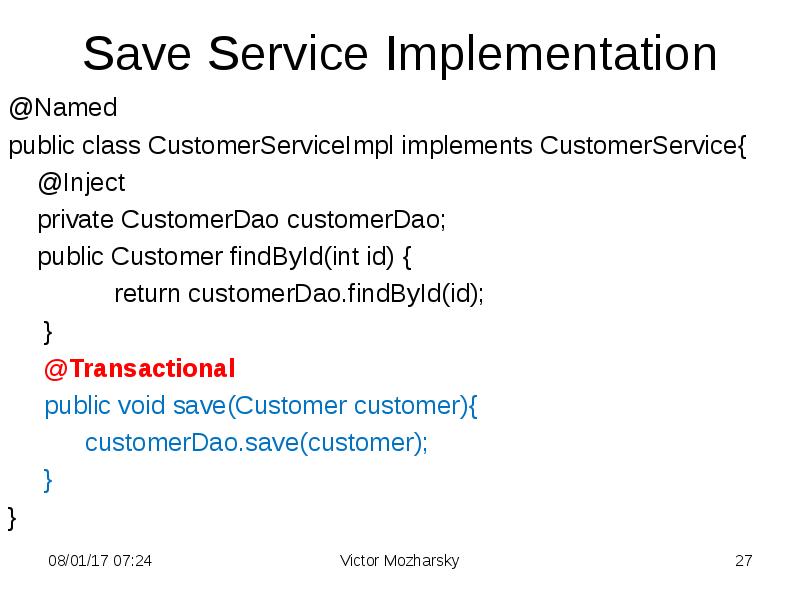
- 27. Save Service Implementation @Named public class CustomerServiceImpl implements CustomerService{ @Inject
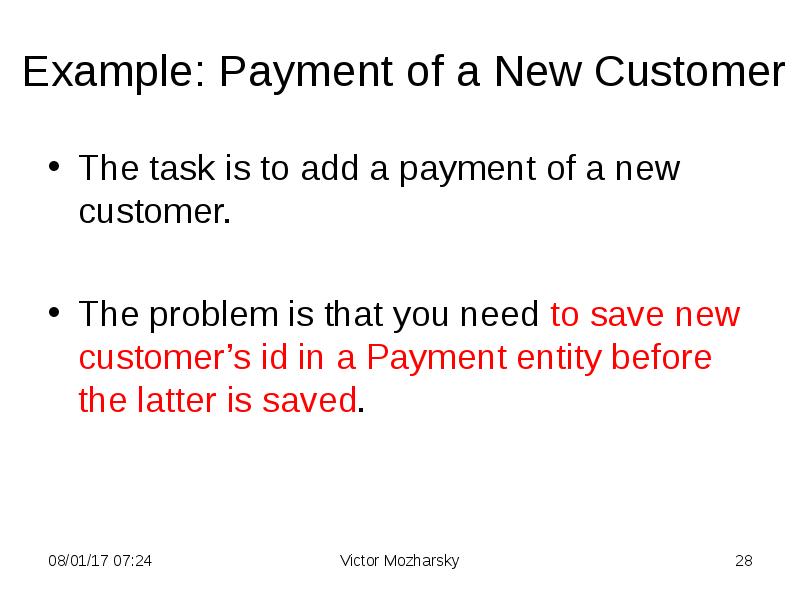
- 28. Example: Payment of a New Customer The task is to add
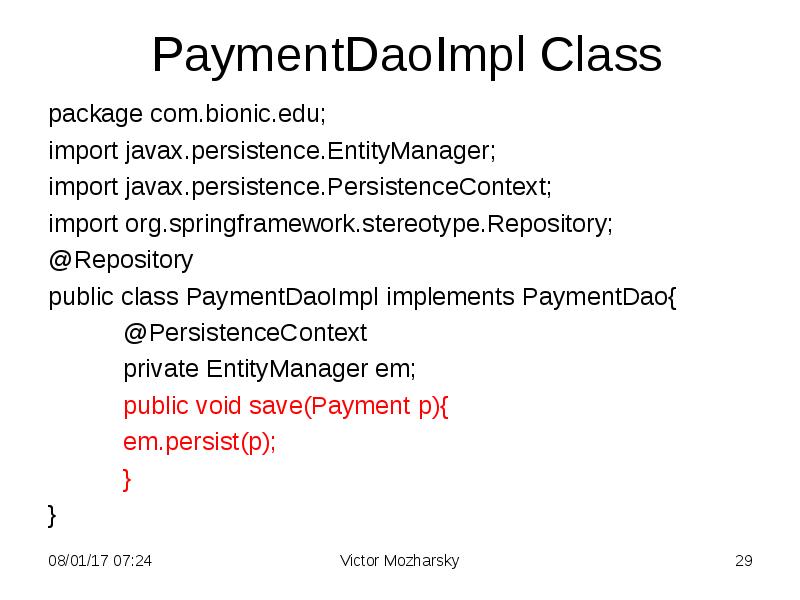
- 29. PaymentDaoImpl Class package com.bionic.edu; import javax.persistence.EntityManager; import javax.persistence.PersistenceContext; import org.springframework.stereotype.Repository; @Repository
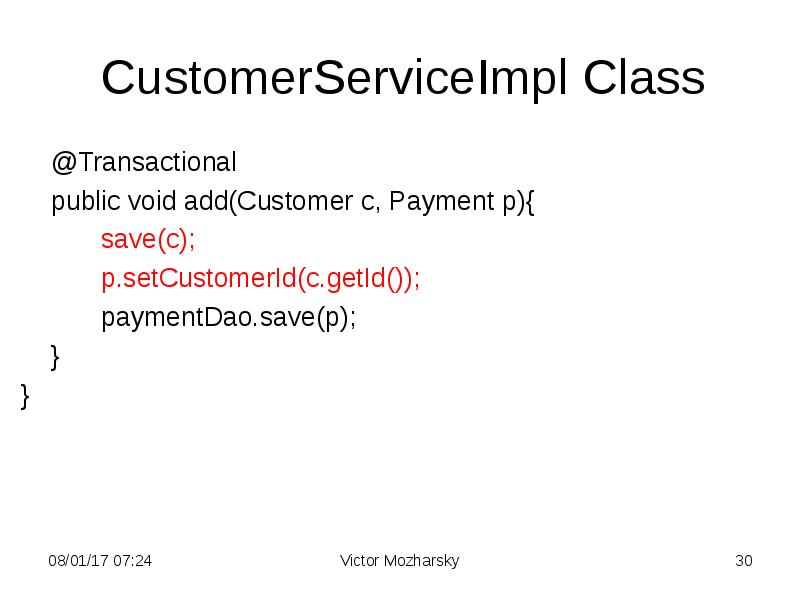
- 30. CustomerServiceImpl Class @Transactional public void add(Customer c, Payment p){
- 31. Output INSERT on table 'PAYMENT' caused a violation of foreign key
- 32. CustomerServiceImpl Class package com.bionic.edu; import javax.inject.Inject; import javax.inject.Named; import org.springframework.transaction.annotation.Transactional; @Named
- 33. PaymentServiceImpl Class @Named public class PaymentServiceImpl implements PaymentService{ @Inject
- 34. Output INSERT on table 'PAYMENT' caused a violation of foreign key
- 35. CustomerServiceImpl Class package com.bionic.edu; import javax.inject.Inject; import javax.inject.Named; import org.springframework.transaction.annotation.Transactional; @Named
- 36. Output JpaDialect does not support savepoints - check your JPA provider's
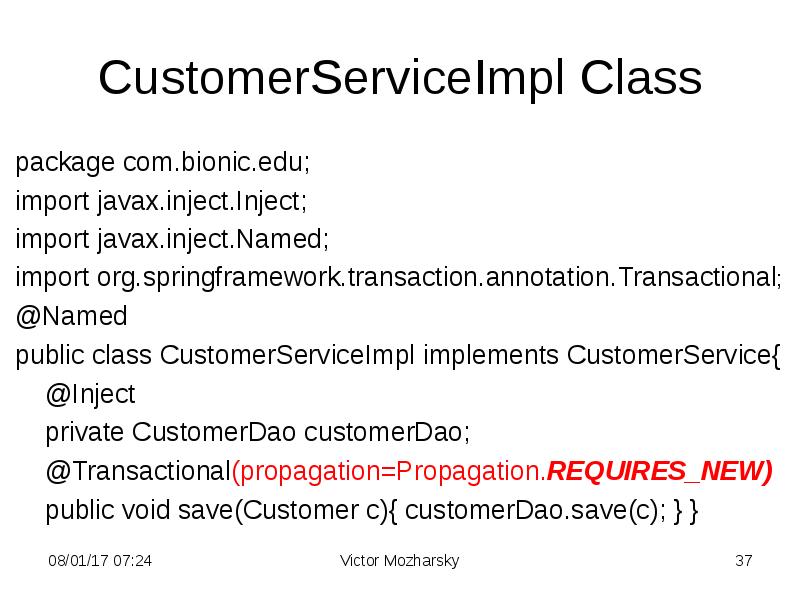
- 37. CustomerServiceImpl Class package com.bionic.edu; import javax.inject.Inject; import javax.inject.Named; import org.springframework.transaction.annotation.Transactional; @Named
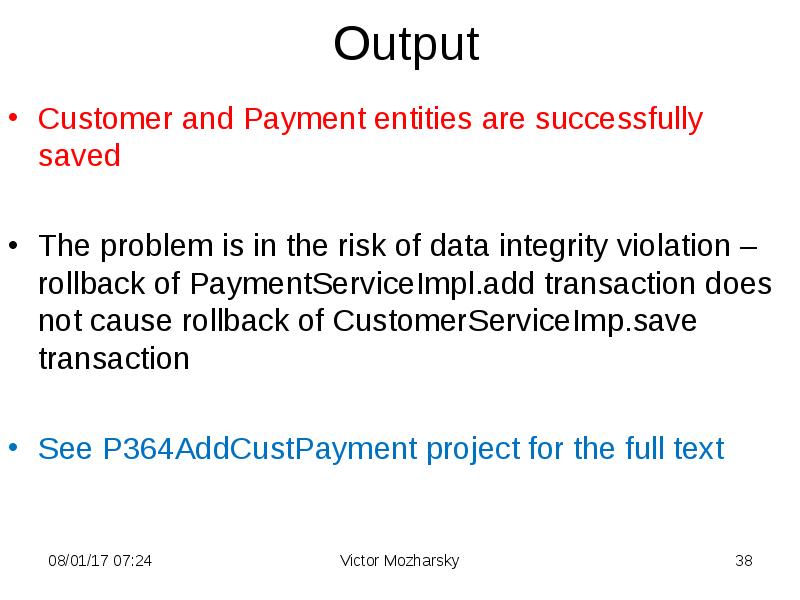
- 38. Output Customer and Payment entities are successfully saved The problem
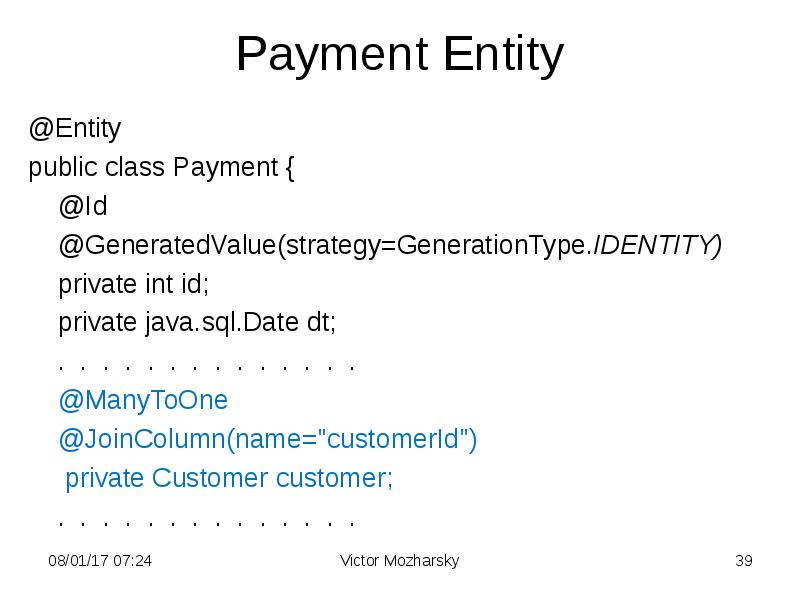
- 39. Payment Entity @Entity public class Payment { @Id @GeneratedValue(strategy=GenerationType.IDENTITY)
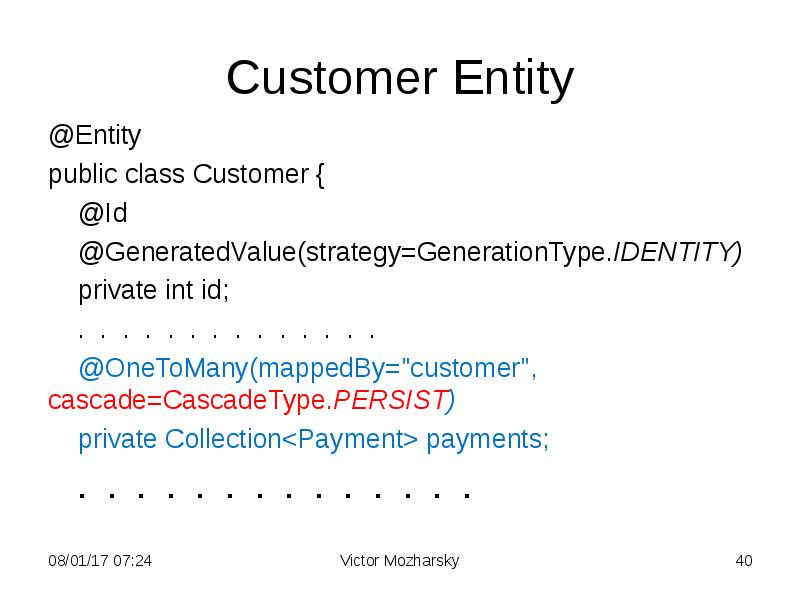
- 40. Customer Entity @Entity public class Customer { @Id @GeneratedValue(strategy=GenerationType.IDENTITY)
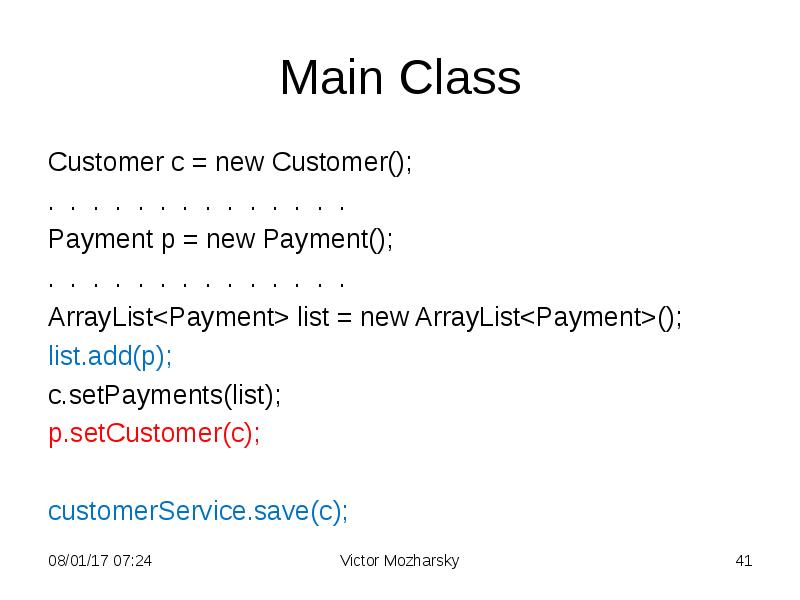
- 41. Main Class Customer c = new Customer(); . . . .
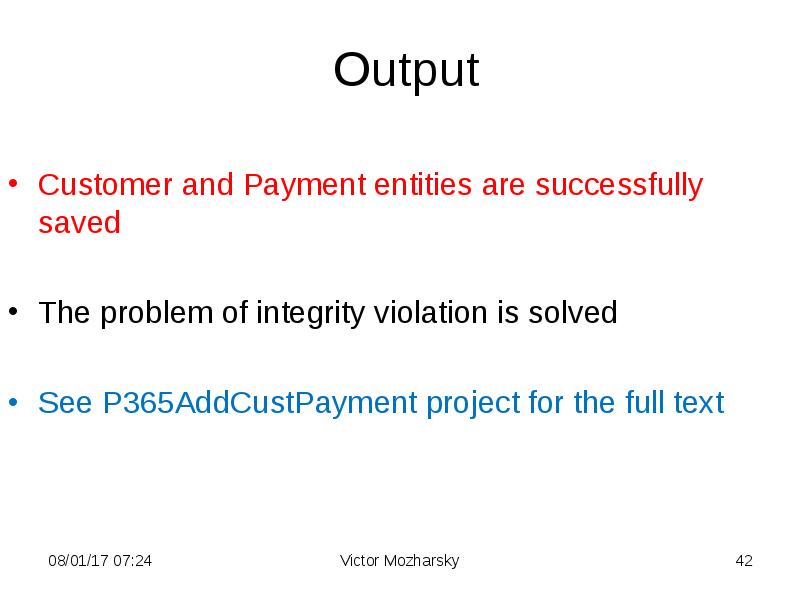
- 42. Output Customer and Payment entities are successfully saved The problem
- 43. Скачать презентацию


Слайды и текст этой презентации
Слайд 1
Описание слайда:
3. Java Persistence API
5. Transaction Management
Слайд 2
Описание слайда:
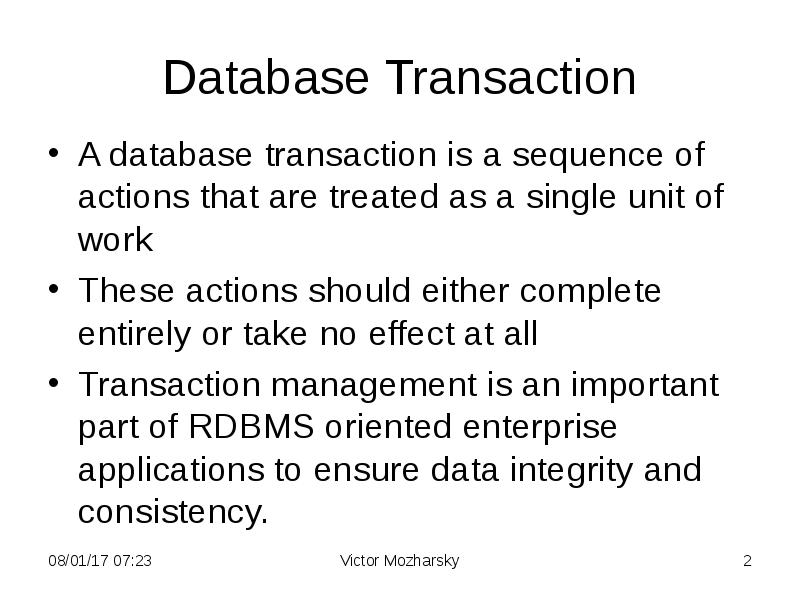
Database Transaction
A database transaction is a sequence of actions that are treated as a single unit of work
These actions should either complete entirely or take no effect at all
Transaction management is an important part of RDBMS oriented enterprise applications to ensure data integrity and consistency.
Слайд 3
Описание слайда:
ACID (1 of 2)
Atomicity. A transaction should be treated as a single unit of operation which means either the entire sequence of operations is successful or unsuccessful
Consistency. This represents the consistency of the referential integrity of the database, unique primary keys in tables etc
Слайд 4
Описание слайда:
ACID (2 of 2)
Isolation. There may be many transactions processing with the same data set at the same time, each transaction should be isolated from others to prevent data corruption
Durability. Once a transaction has completed, the results of this transaction have to be made permanent and cannot be erased from the database due to system failure.
Слайд 5
Описание слайда:
Spring Transaction Management
Spring framework provides an abstract layer on top of different underlying transaction management APIs
Local transactions are specific to a single transactional resource like a JDBC connection
Global transactions can span multiple transactional resources like transaction in a distributed system
Слайд 6
Описание слайда:
Local Transactions
Local transaction management can be useful in a centralized computing environment where application components and resources are located at a single site, and transaction management only involves a local data manager running on a single machine
Local transactions are easier to be implemented
Слайд 7
Описание слайда:
Global Transactions
Global transaction management is required in a distributed computing environment where all the resources are distributed across multiple systems
A global transaction is executed across multiple systems, and its execution requires coordination between the global transaction management system and all the local data managers of all the involved systems
Слайд 8
Описание слайда:
Programmatic vs. Declarative
Spring supports two types of transaction management:
Programmatic transaction management: you have manage the transaction with the help of programming. That gives you extreme flexibility, but it is difficult to maintain
Declarative transaction management: you separate transaction management from the business code. You only use annotations or XML based configuration to manage the transactions
Слайд 9
Описание слайда:
Programmatic vs. Declarative
Declarative transaction management is preferable over programmatic transaction management
Слайд 10
Описание слайда:
Spring Transaction Abstractions
The key to the Spring transaction abstraction is defined by PlatformTransactionManager interface in the org.springframework.transaction package:
public interface PlatformTransactionManager {
TransactionStatus getTransaction(TransactionDefinition definition) throws TransactionException;
void commit(TransactionStatus status) throws TransactionException;
void rollback(TransactionStatus status) throws TransactionException;
}
Слайд 11
Описание слайда:
PlatformTransactionManager
getTransaction - returns a currently active transaction or create a new one, according to the specified propagation behavior
commit - commits the given transaction, with regard to its status
rollback - performs a rollback of the given transaction
Слайд 12
Описание слайда:
TransactionDefinition
Is the core interface of the transaction support in Spring and it is defined as below:
public interface TransactionDefinition {
int getPropagationBehavior();
int getIsolationLevel();
String getName();
int getTimeout();
boolean isReadOnly();
}
Слайд 13
Описание слайда:
TransactionDefinition Methods
getPropagationBehavior - returns the propagation behavior
getIsolationLevel - returns the degree to which this transaction is isolated from the work of other transactions
getName - returns the name of the transaction
getTimeout - returns the time in seconds in which the transaction must complete
isReadOnly - returns whether the transaction is read-only.
Слайд 14
Описание слайда:
Isolation Level (1 of 2)
TransactionDefinition.ISOLATION_DEFAULT - the default isolation level
TransactionDefinition.ISOLATION_READ_COMMITTED -
indicates that dirty reads are prevented; non-
repeatable reads and phantom reads can occur
TransactionDefinition.ISOLATION_READ_UNCOMMITTED -dirty reads, non-repeatable reads and phantom reads can occur
Слайд 15
Описание слайда:
Isolation Level (2 of 2)
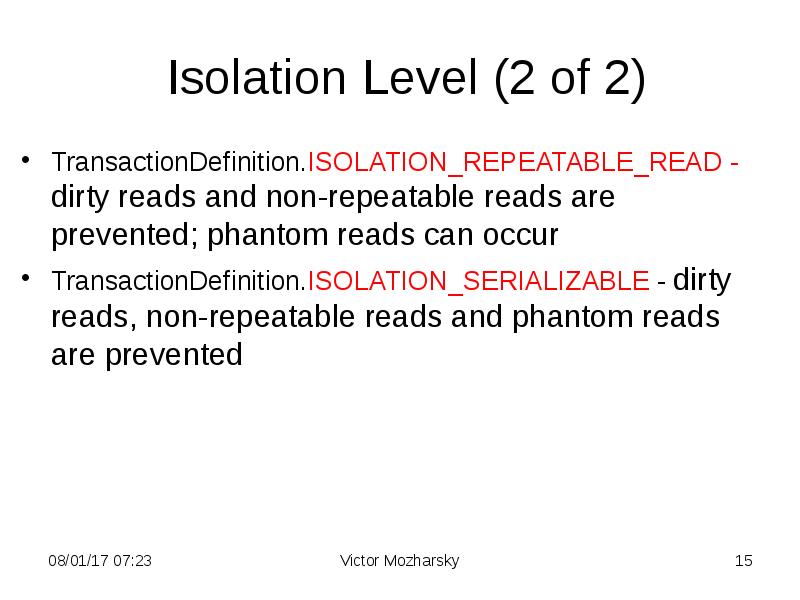
TransactionDefinition.ISOLATION_REPEATABLE_READ - dirty reads and non-repeatable reads are prevented; phantom reads can occur
TransactionDefinition.ISOLATION_SERIALIZABLE - dirty reads, non-repeatable reads and phantom reads are prevented
Слайд 16
Описание слайда:
Propagation Types (1 of 2)
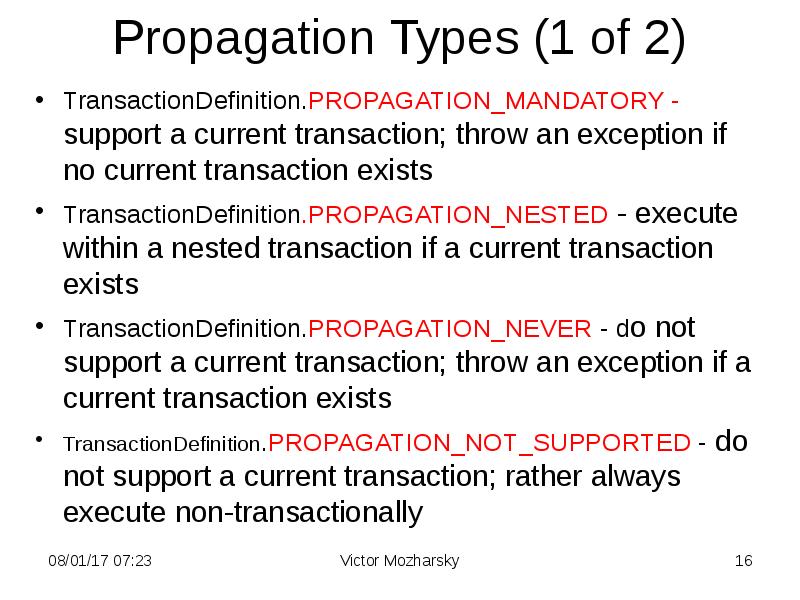
TransactionDefinition.PROPAGATION_MANDATORY - support a current transaction; throw an exception if no current transaction exists
TransactionDefinition.PROPAGATION_NESTED - execute within a nested transaction if a current transaction exists
TransactionDefinition.PROPAGATION_NEVER - do not support a current transaction; throw an exception if a current transaction exists
TransactionDefinition.PROPAGATION_NOT_SUPPORTED - do not support a current transaction; rather always execute non-transactionally
Слайд 17
Описание слайда:
Propagation Types (2 of 2)
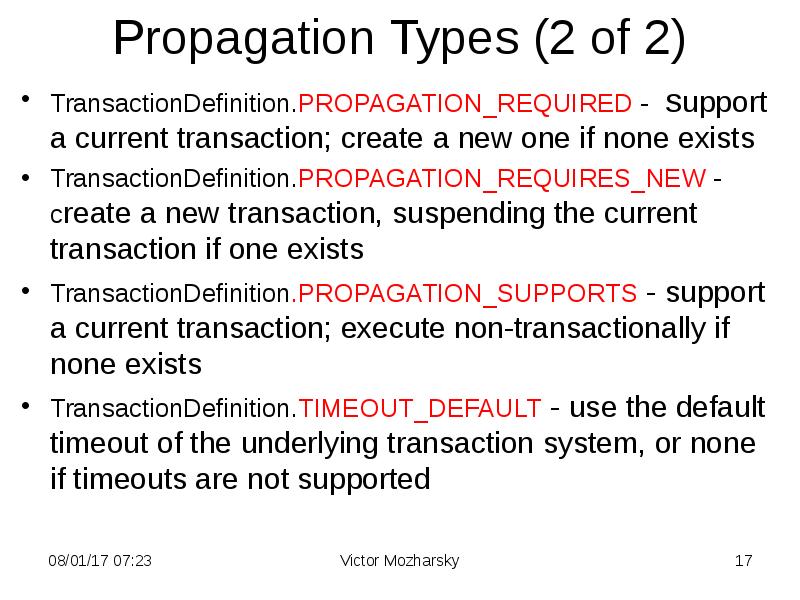
TransactionDefinition.PROPAGATION_REQUIRED - support a current transaction; create a new one if none exists
TransactionDefinition.PROPAGATION_REQUIRES_NEW - create a new transaction, suspending the current transaction if one exists
TransactionDefinition.PROPAGATION_SUPPORTS - support a current transaction; execute non-transactionally if none exists
TransactionDefinition.TIMEOUT_DEFAULT - use the default timeout of the underlying transaction system, or none if timeouts are not supported
Слайд 18
Описание слайда:
TransactionStatus interface
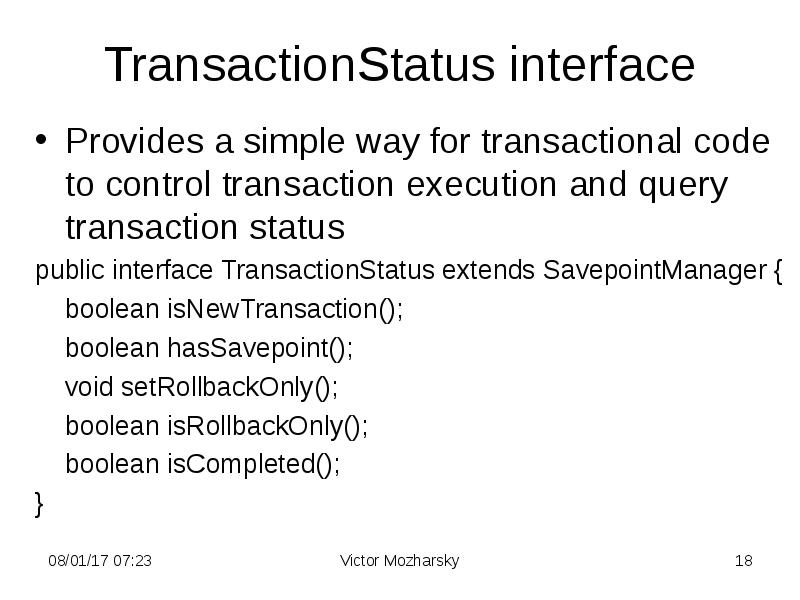
Provides a simple way for transactional code to control transaction execution and query transaction status
public interface TransactionStatus extends SavepointManager {
boolean isNewTransaction();
boolean hasSavepoint();
void setRollbackOnly();
boolean isRollbackOnly();
boolean isCompleted();
}
Слайд 19
Описание слайда:
TransactionStatus Methods
hasSavepoint - returns whether this transaction internally carries a savepoint, that is, has been created as nested transaction based on a savepoint
isCompleted - returns whether this transaction has already been committed or rolled back
isNewTransaction - returns true in case the present transaction is new
isRollbackOnly - returns whether the transaction has been marked as rollback-only
setRollbackOnly - sets the transaction rollback-only
Слайд 20
Описание слайда:
Declarative Transaction Management
This approach allows you to manage the transaction with the help of configuration instead of hard coding in your source code
So you can separate transaction management from the business code by using annotations or XML based configuration to manage the transactions
The bean configuration will specify the methods to be transactional
Слайд 21
Описание слайда:
Configuring Transaction Management
<bean id="transactionManager"
class="org.springframework.orm.jpa.JpaTransactionManager">
<property name="entityManagerFactory"
ref="entityManagerFactory"/>
</bean>
<tx:annotation-driven transaction-manager="transactionManager"/>
Слайд 22
Описание слайда:
Using @Transactional
You can place the @Transactional annotation
before a class definition, or a public method on a class
A transaction begins before method annotated with @Transactional. It commits after method ends normally, and rollbacks if RuntimeException occurs.
All methods for class annotated with @Transactional are transactional.
Слайд 23
Описание слайда:
@Transactional Attributes
propagation (Propagation.REQUIRED by default)
Isolation (Isolation.DEFAULT by default)
timeout (TransactionDefinition.TIMEOUT_DEFAULT)
readonly
rollbackFor
rollbackForClassName
noRollbackFor
noRollbackForClassName
Слайд 24
Описание слайда:
Exercise: Insert New Customer
Insert new record to the CUSTOMER DB table – this problem was solved in P322AddCustomer project
Слайд 25
Описание слайда:
New Save Interface Method
package com.bionic.edu;
public interface CustomerDao {
public Customer findById(int id);
public void save(Customer customer);
}
public interface CustomerService {
public Customer findById(int id);
public void save(Customer customer);
}
Слайд 26
Описание слайда:
Save DAO Implementation
@Repository
public class CustomerDaoImpl implements CustomerDao{
@PersistenceContext
private EntityManager em;
public Customer findById(int id){
. . . . . . . . .
}
public void save(Customer customer){
em.persist(customer);
}
}
Слайд 27
Описание слайда:
Save Service Implementation
@Named
public class CustomerServiceImpl implements CustomerService{
@Inject
private CustomerDao customerDao;
public Customer findById(int id) {
return customerDao.findById(id);
}
@Transactional
public void save(Customer customer){
customerDao.save(customer);
}
}
Слайд 28
Описание слайда:
Example: Payment of a New Customer
The task is to add a payment of a new customer.
The problem is that you need to save new customer’s id in a Payment entity before the latter is saved.
Слайд 29
Описание слайда:
PaymentDaoImpl Class
package com.bionic.edu;
import javax.persistence.EntityManager;
import javax.persistence.PersistenceContext;
import org.springframework.stereotype.Repository;
@Repository
public class PaymentDaoImpl implements PaymentDao{
@PersistenceContext
private EntityManager em;
public void save(Payment p){
em.persist(p);
}
}
Слайд 30
Описание слайда:
CustomerServiceImpl Class
@Transactional
public void add(Customer c, Payment p){
save(c);
p.setCustomerId(c.getId());
paymentDao.save(p);
}
}
Слайд 31
Описание слайда:
Output
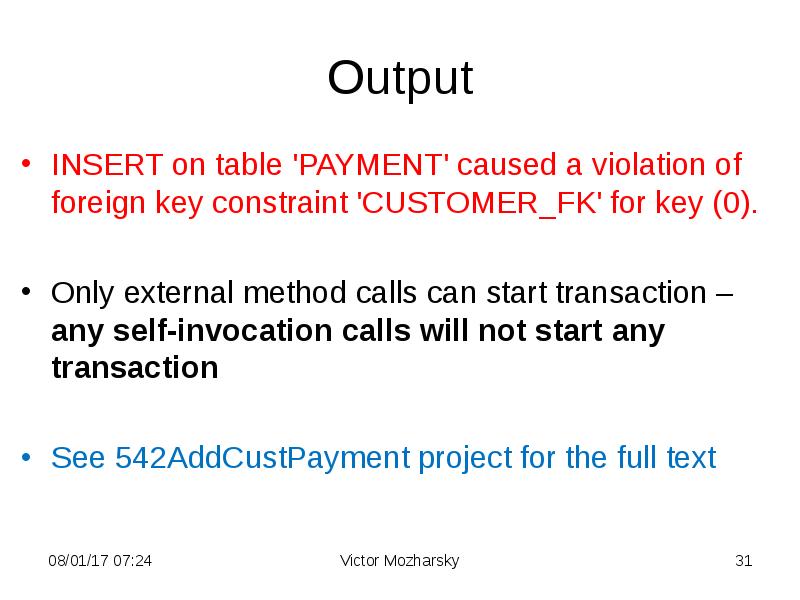
INSERT on table 'PAYMENT' caused a violation of foreign key constraint 'CUSTOMER_FK' for key (0).
Only external method calls can start transaction –any self-invocation calls will not start any transaction
See 542AddCustPayment project for the full text
Слайд 32
Описание слайда:
CustomerServiceImpl Class
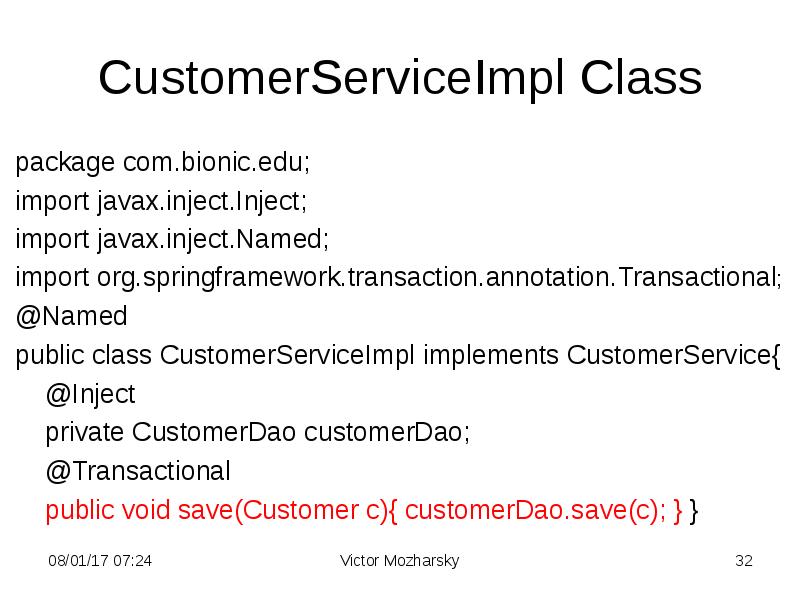
package com.bionic.edu;
import javax.inject.Inject;
import javax.inject.Named;
import org.springframework.transaction.annotation.Transactional;
@Named
public class CustomerServiceImpl implements CustomerService{
@Inject
private CustomerDao customerDao;
@Transactional
public void save(Customer c){ customerDao.save(c); } }
Слайд 33
Описание слайда:
PaymentServiceImpl Class
@Named
public class PaymentServiceImpl implements PaymentService{
@Inject
private PaymentDao paymentDao;
@Inject
private CustomerService customerService;
@Transactional
public void add(Customer c, Payment p){
customerService.save(c);
p.setCustomerId(c.getId());
paymentDao.save(p);
}}
Слайд 34
Описание слайда:
Output
INSERT on table 'PAYMENT' caused a violation of foreign key constraint 'CUSTOMER_FK' for key (0).
The reason is that propagation value of @Transactional annotation is REQUERED by default – so transaction for customerService.save(c) method will be commited along with paymentService.add(Customer c, Payment p) method
See P362AddCustPayment project for the full text
Слайд 35
Описание слайда:
CustomerServiceImpl Class
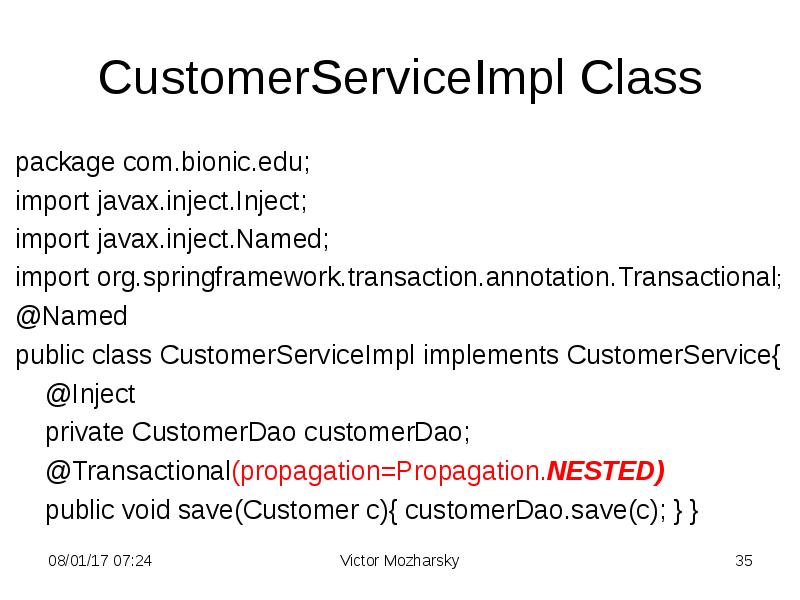
package com.bionic.edu;
import javax.inject.Inject;
import javax.inject.Named;
import org.springframework.transaction.annotation.Transactional;
@Named
public class CustomerServiceImpl implements CustomerService{
@Inject
private CustomerDao customerDao;
@Transactional(propagation=Propagation.NESTED)
public void save(Customer c){ customerDao.save(c); } }
Слайд 36
Описание слайда:
Output
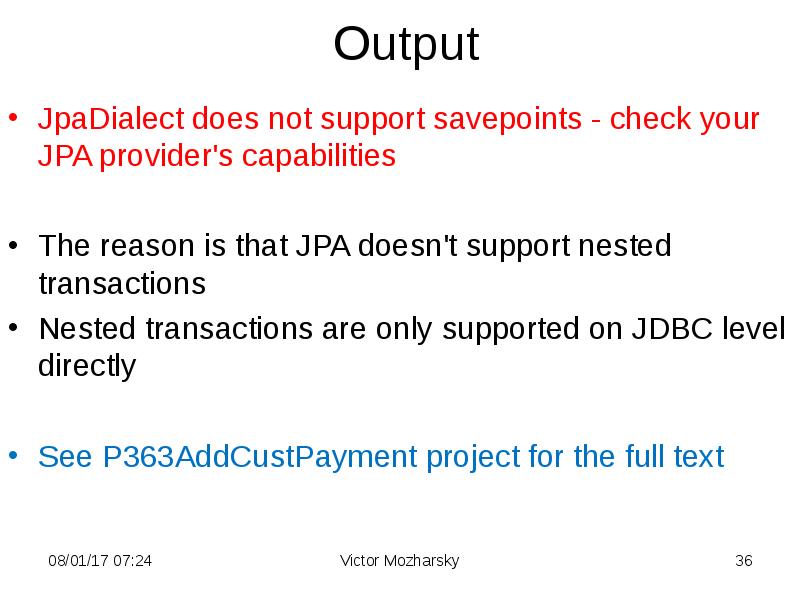
JpaDialect does not support savepoints - check your JPA provider's capabilities
The reason is that JPA doesn't support nested transactions
Nested transactions are only supported on JDBC level directly
See P363AddCustPayment project for the full text
Слайд 37
Описание слайда:
CustomerServiceImpl Class
package com.bionic.edu;
import javax.inject.Inject;
import javax.inject.Named;
import org.springframework.transaction.annotation.Transactional;
@Named
public class CustomerServiceImpl implements CustomerService{
@Inject
private CustomerDao customerDao;
@Transactional(propagation=Propagation.REQUIRES_NEW)
public void save(Customer c){ customerDao.save(c); } }
Слайд 38
Описание слайда:
Output
Customer and Payment entities are successfully saved
The problem is in the risk of data integrity violation – rollback of PaymentServiceImpl.add transaction does not cause rollback of CustomerServiceImp.save transaction
See P364AddCustPayment project for the full text
Слайд 39
Описание слайда:
Payment Entity
@Entity
public class Payment {
@Id
@GeneratedValue(strategy=GenerationType.IDENTITY)
private int id;
private java.sql.Date dt;
. . . . . . . . . . . . . .
@ManyToOne
@JoinColumn(name="customerId")
private Customer customer;
. . . . . . . . . . . . . .
Слайд 40
Описание слайда:
Customer Entity
@Entity
public class Customer {
@Id
@GeneratedValue(strategy=GenerationType.IDENTITY)
private int id;
. . . . . . . . . . . . . .
@OneToMany(mappedBy="customer", cascade=CascadeType.PERSIST)
private Collection<Payment> payments;
. . . . . . . . . . . . . .
Слайд 41
Описание слайда:
Main Class
Customer c = new Customer();
. . . . . . . . . . . . . .
Payment p = new Payment();
. . . . . . . . . . . . . .
ArrayList<Payment> list = new ArrayList<Payment>();
list.add(p);
c.setPayments(list);
p.setCustomer(c);
customerService.save(c);
Слайд 42
Описание слайда:
Output
Customer and Payment entities are successfully saved
The problem of integrity violation is solved
See P365AddCustPayment project for the full text
Скачать презентацию на тему 3. Java Persistence API. 5. Transaction Management можно ниже: