Hacker techniques, tools, and incident handling. (Chapter 1) презентация
Содержание
- 2. Learning Objective Explore the history and current state of hacking and
- 3. Key Concepts Birth and evolution of hacking 1960s: individuals of technology
- 4. Types of Hackers Script kiddies are beginners and possess basic
- 5. TAP Principle of Controls
- 6. Hacker Motives
- 7. Common Attacks (1) Theft of access: stealing passwords, subverting access mechanisms
- 8. Common Attacks (2) Dumpster diving: gathering discarded materials Malicious coding:
- 9. History of Hacking
- 10. Famous Hacks over Time 1988 Robert T. Morris: the first Internet
- 11. Famous Hackers and Groups Individual Hackers: Kevin Poulsen, Frank Abagnale,
- 12. Modern Hacking and Cybercriminals Transformation of hobbyist hacking to cybercrime
- 13. Ethical Hacking and Penetration Testing Ethical hackers require permission to engage
- 14. Key Points about Ethical Hacking It requires explicit permission of “victim”
- 15. C-I-A Triad
- 16. C-I-A Triad Confidentiality: safeguarding information or services against disclosure to unauthorized
- 17. Common Hacking Methodologies
- 18. Hacking Methodologies Footprinting: An attacker passively acquires information about the intended
- 19. Penetration Testing Flow
- 20. Performing a Penetration Test Next logical step beyond ethical hacking Require
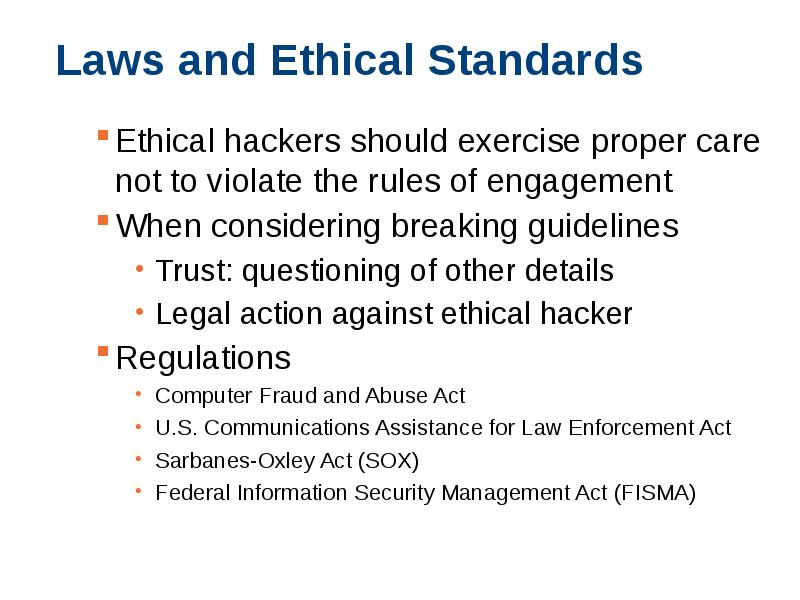
- 21. Laws and Ethical Standards Ethical hackers should exercise proper care not
- 22. Summary Birth and evolution of hacking Ethical hacking and penetration testing
- 23. Скачать презентацию
Слайды и текст этой презентации
Слайд 1
Описание слайда:
Hacker Techniques, Tools, and Incident Handling
Chapter 1
Hacking: The Next Generation
Слайд 2
Описание слайда:
Learning Objective
Explore the history and current state of hacking and penetration testing, including their ethical and legal implications.
Слайд 3
Описание слайда:
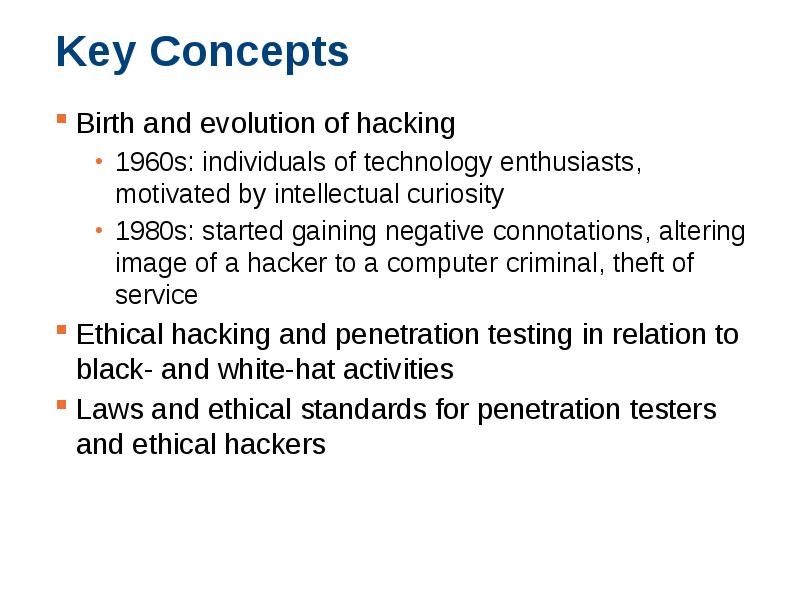
Key Concepts
Birth and evolution of hacking
1960s: individuals of technology enthusiasts, motivated by intellectual curiosity
1980s: started gaining negative connotations, altering image of a hacker to a computer criminal, theft of service
Ethical hacking and penetration testing in relation to black- and white-hat activities
Laws and ethical standards for penetration testers and ethical hackers
Слайд 4
Описание слайда:
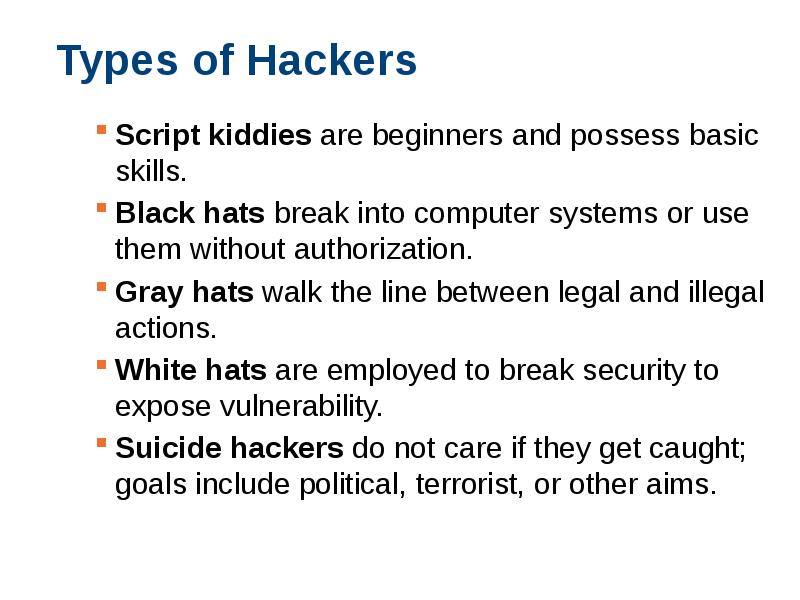
Types of Hackers
Script kiddies are beginners and possess basic skills.
Black hats break into computer systems or use them without authorization.
Gray hats walk the line between legal and illegal actions.
White hats are employed to break security to expose vulnerability.
Suicide hackers do not care if they get caught; goals include political, terrorist, or other aims.
Слайд 5
Описание слайда:
TAP Principle of Controls
Слайд 6
Описание слайда:
Hacker Motives
Слайд 7
Описание слайда:
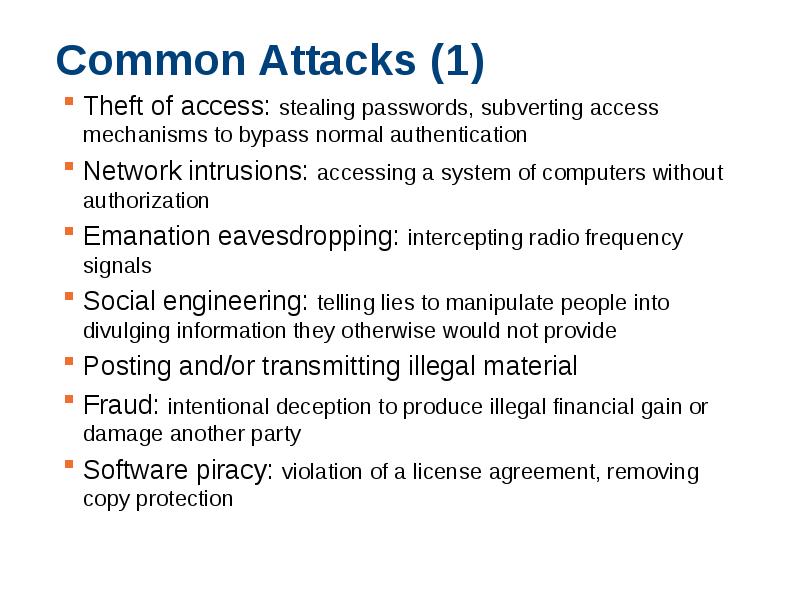
Common Attacks (1)
Theft of access: stealing passwords, subverting access mechanisms to bypass normal authentication
Network intrusions: accessing a system of computers without authorization
Emanation eavesdropping: intercepting radio frequency signals
Social engineering: telling lies to manipulate people into divulging information they otherwise would not provide
Posting and/or transmitting illegal material
Fraud: intentional deception to produce illegal financial gain or damage another party
Software piracy: violation of a license agreement, removing copy protection
Слайд 8
Описание слайда:
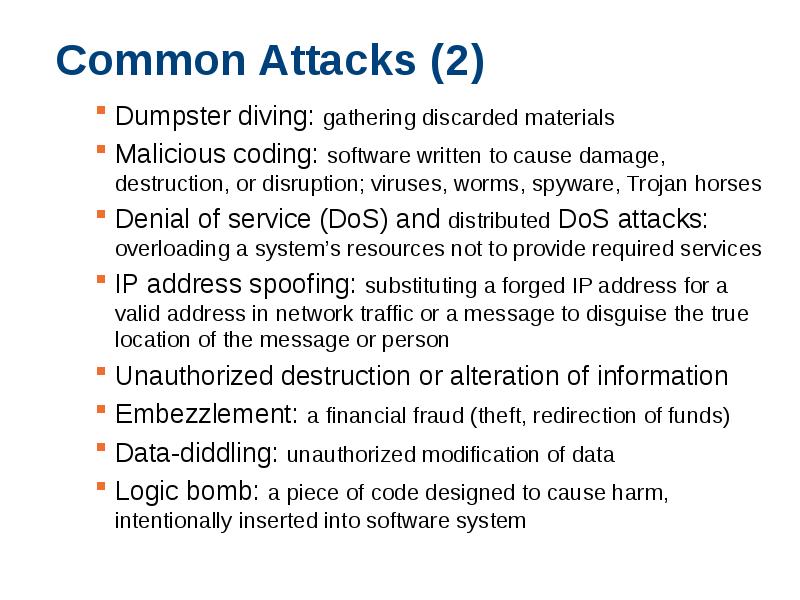
Common Attacks (2)
Dumpster diving: gathering discarded materials
Malicious coding: software written to cause damage, destruction, or disruption; viruses, worms, spyware, Trojan horses
Denial of service (DoS) and distributed DoS attacks: overloading a system’s resources not to provide required services
IP address spoofing: substituting a forged IP address for a valid address in network traffic or a message to disguise the true location of the message or person
Unauthorized destruction or alteration of information
Embezzlement: a financial fraud (theft, redirection of funds)
Data-diddling: unauthorized modification of data
Logic bomb: a piece of code designed to cause harm, intentionally inserted into software system
Слайд 9
Описание слайда:
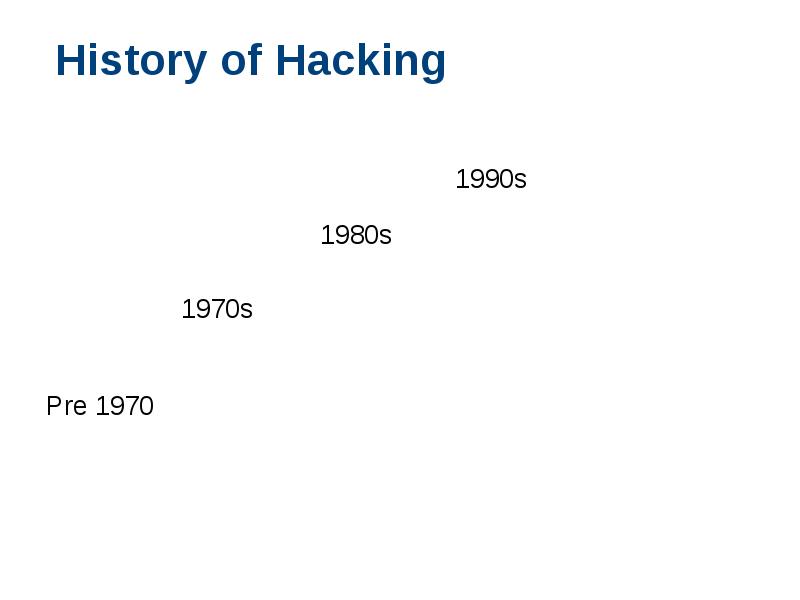
History of Hacking
Слайд 10
Описание слайда:
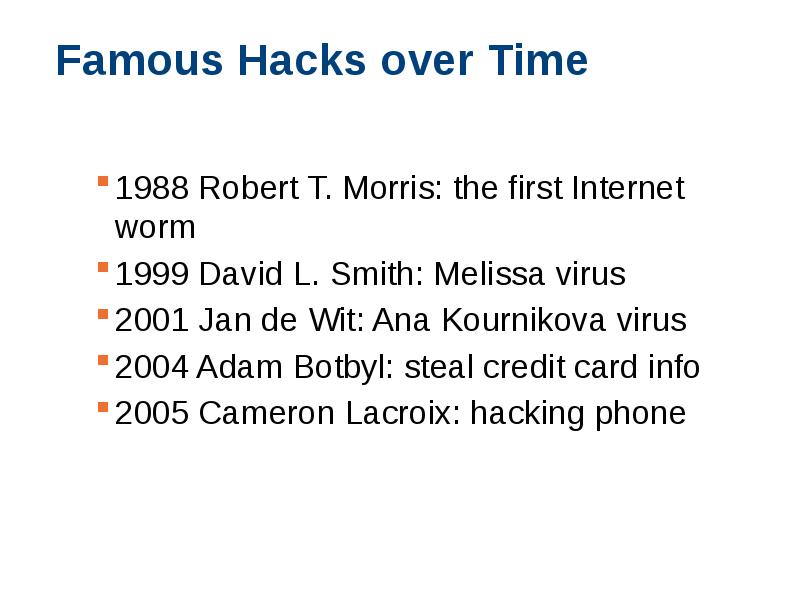
Famous Hacks over Time
1988 Robert T. Morris: the first Internet worm
1999 David L. Smith: Melissa virus
2001 Jan de Wit: Ana Kournikova virus
2004 Adam Botbyl: steal credit card info
2005 Cameron Lacroix: hacking phone
Слайд 11
Описание слайда:
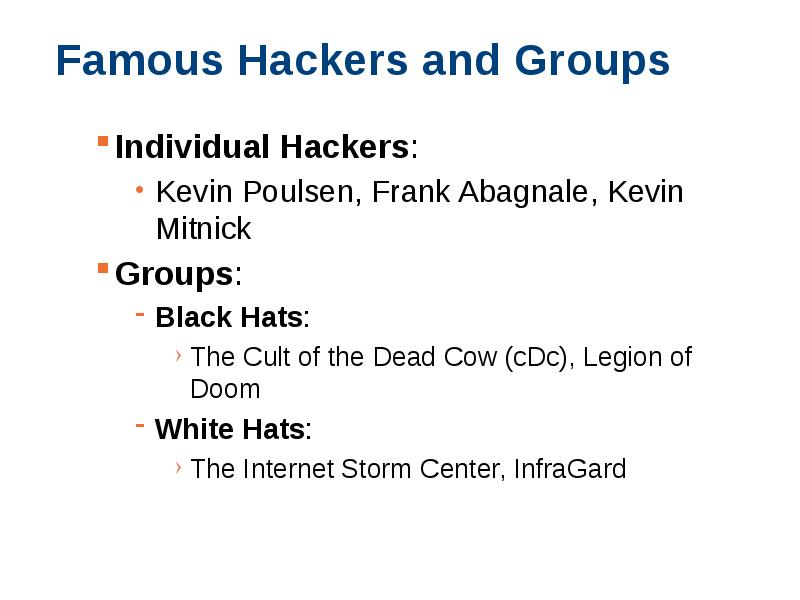
Famous Hackers and Groups
Individual Hackers:
Kevin Poulsen, Frank Abagnale, Kevin Mitnick
Groups:
Black Hats:
The Cult of the Dead Cow (cDc), Legion of Doom
White Hats:
The Internet Storm Center, InfraGard
Слайд 12
Описание слайда:
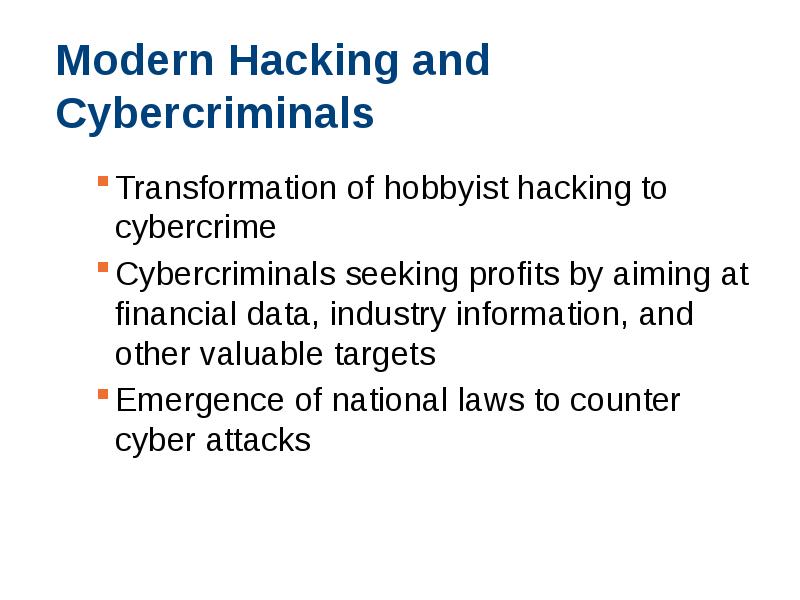
Modern Hacking and Cybercriminals
Transformation of hobbyist hacking to cybercrime
Cybercriminals seeking profits by aiming at financial data, industry information, and other valuable targets
Emergence of national laws to counter cyber attacks
Слайд 13
Описание слайда:
Ethical Hacking and Penetration Testing
Ethical hackers require permission to engage in penetration testing
Penetration testing is the structured and methodical means of investigating, uncovering, attacking, and reporting on a target system’s strengths and vulnerabilities
Penetration tests are commonly part of IT audits
Слайд 14
Описание слайда:
Key Points about Ethical Hacking
It requires explicit permission of “victim”
Participants use the same tactics and strategies as regular hackers
It can harm a system if you do not exercise proper care
It requires detailed advance knowledge of actual techniques a regular hacker will use.
It requires that rules of engagement or guidelines be established prior to any testing
Слайд 15
Описание слайда:
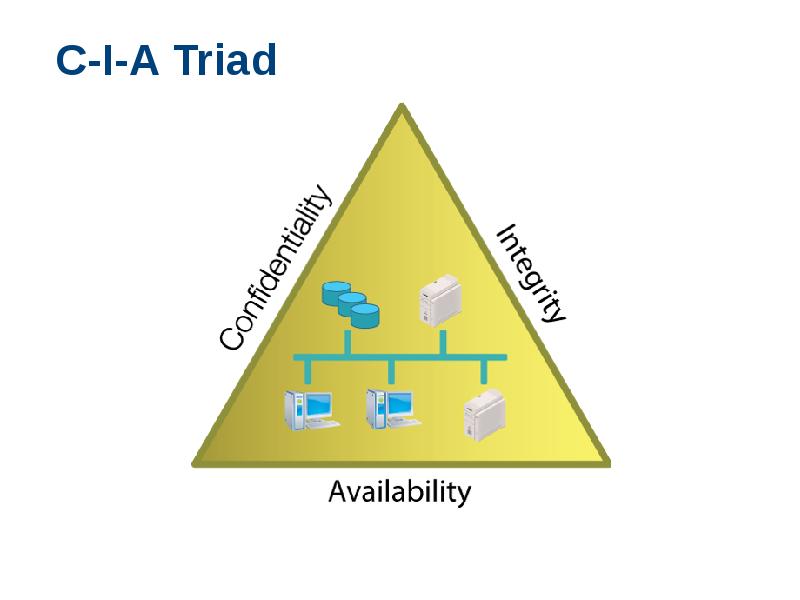
C-I-A Triad
Слайд 16
Описание слайда:
C-I-A Triad
Confidentiality: safeguarding information or services against disclosure to unauthorized parties
Integrity: ensuring that information is in its intended format or state, i.e., ensuring that data is not altered
Availability: ensuring that information or a service can be accessed or used whenever requested
Anti-triad
Disclosure: Information is accessed by an unauthorized party
Alteration: Information is maliciously or accidentally modified
Disruption: Information and/or services are not accessible or usable when called upon
Слайд 17
Описание слайда:
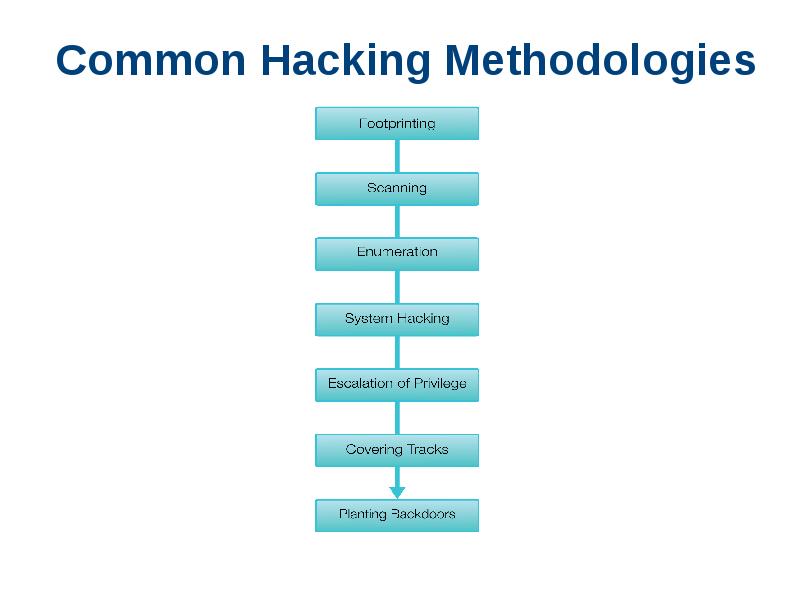
Common Hacking Methodologies
Слайд 18
Описание слайда:
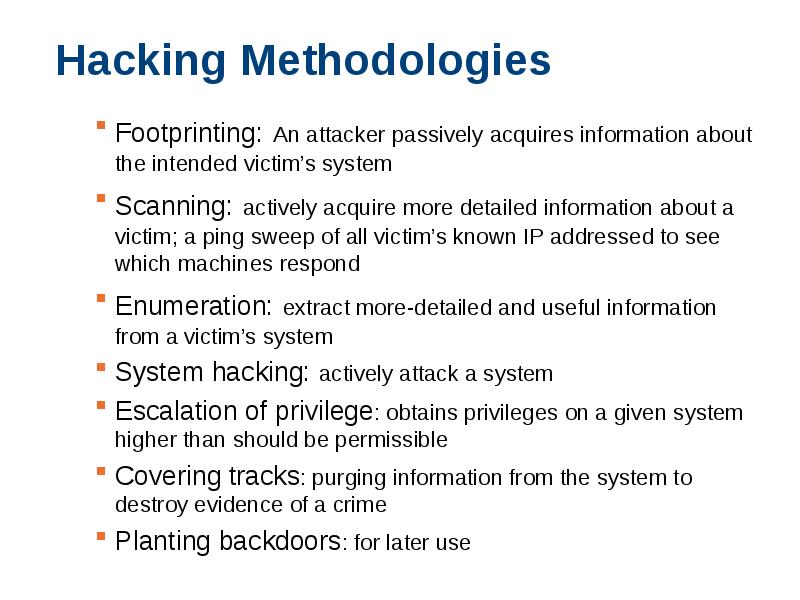
Hacking Methodologies
Footprinting: An attacker passively acquires information about the intended victim’s system
Scanning: actively acquire more detailed information about a victim; a ping sweep of all victim’s known IP addressed to see which machines respond
Enumeration: extract more-detailed and useful information from a victim’s system
System hacking: actively attack a system
Escalation of privilege: obtains privileges on a given system higher than should be permissible
Covering tracks: purging information from the system to destroy evidence of a crime
Planting backdoors: for later use
Слайд 19
Описание слайда:
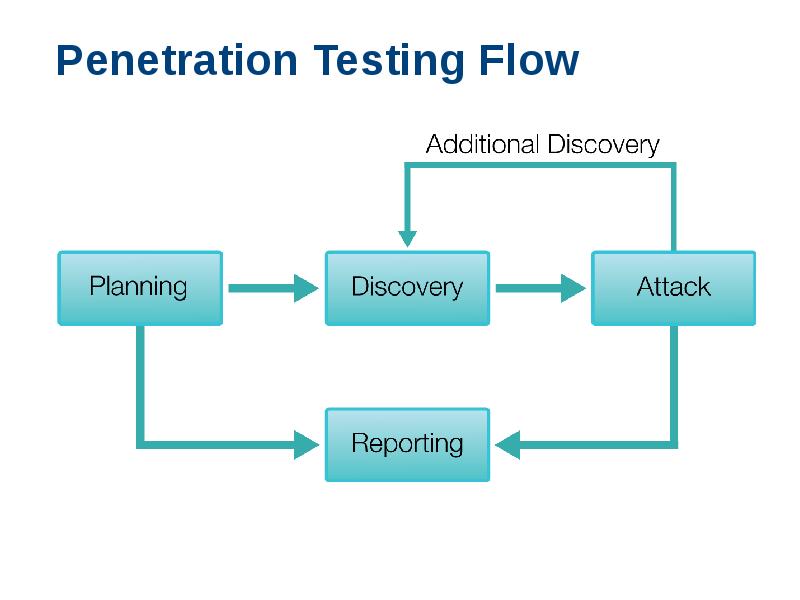
Penetration Testing Flow
Слайд 20
Описание слайда:
Performing a Penetration Test
Next logical step beyond ethical hacking
Require rules to be agreed upon in advance
NIST 800-42 Guideline on network security testing
Technical attack
Administrative attack
Physical attack
Слайд 21
Описание слайда:
Laws and Ethical Standards
Ethical hackers should exercise proper care not to violate the rules of engagement
When considering breaking guidelines
Trust: questioning of other details
Legal action against ethical hacker
Regulations
Computer Fraud and Abuse Act
U.S. Communications Assistance for Law Enforcement Act
Sarbanes-Oxley Act (SOX)
Federal Information Security Management Act (FISMA)
Слайд 22
Описание слайда:
Summary
Birth and evolution of hacking
Ethical hacking and penetration testing in relation to black- and white-hat activities
Laws and ethical standards for penetration testers and ethical hackers
Скачать презентацию на тему Hacker techniques, tools, and incident handling. (Chapter 1) можно ниже: