Introduction to serialization презентация
Содержание
- 2. Agenda
- 3. What is Serialization? Serialization is the process of transforming an object
- 4. Serialization in .NET
- 5. Serialization in .NET .NET Framework has classes (in the System.Runtime.Serialization and
- 6. Binary serialization
- 7. BinaryFormatter [Serializable] class Person { private int _id; public
- 8. BinaryFormatter
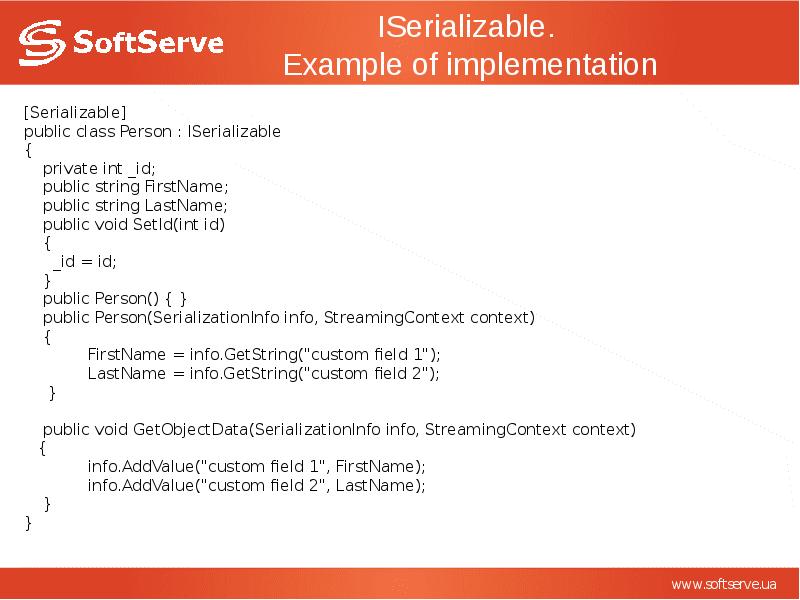
- 9. Custom serialization. ISerializable With a custom serialization, you can specify exactly
- 10. ISerializable. Example of implementation
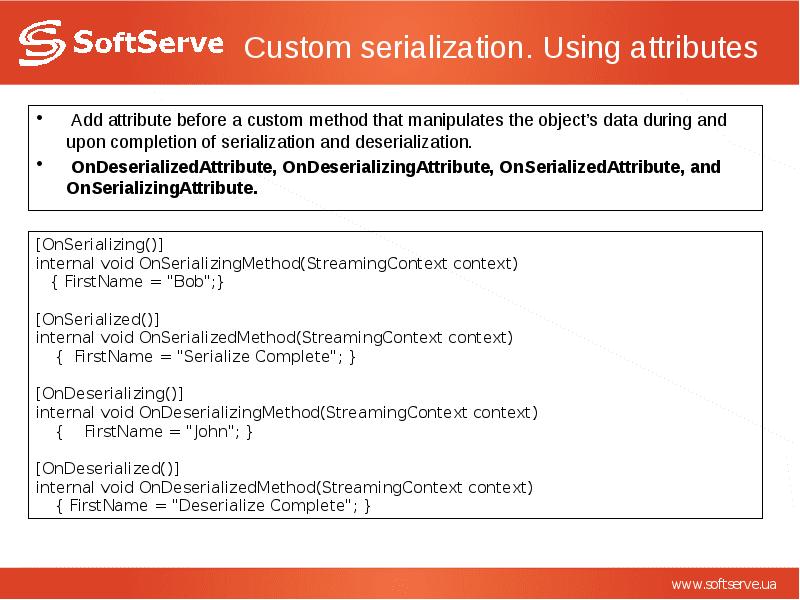
- 11. Custom serialization. Using attributes Add attribute before a custom method that
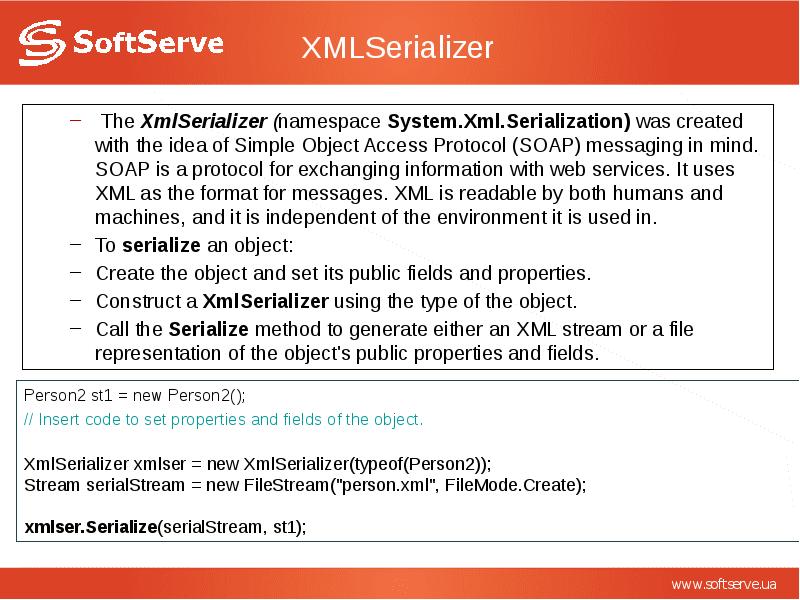
- 12. XMLSerializer The XmlSerializer (namespace System.Xml.Serialization) was created with the idea of
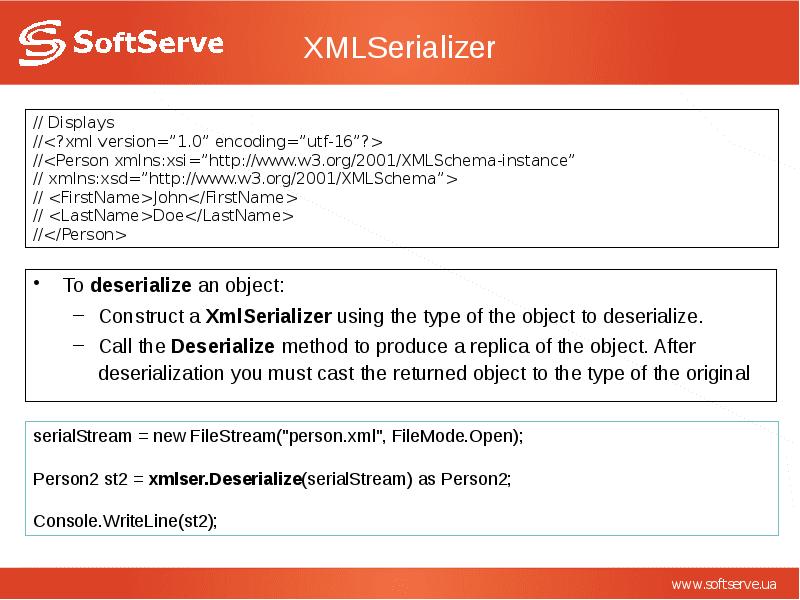
- 13. XMLSerializer To deserialize an object: Construct a XmlSerializer using the type
- 14. XMLSerializer You can configure how the XmlSerializer serializes your type by
- 15. Complex and derived types serialization
- 16. Complex and derived types serialization
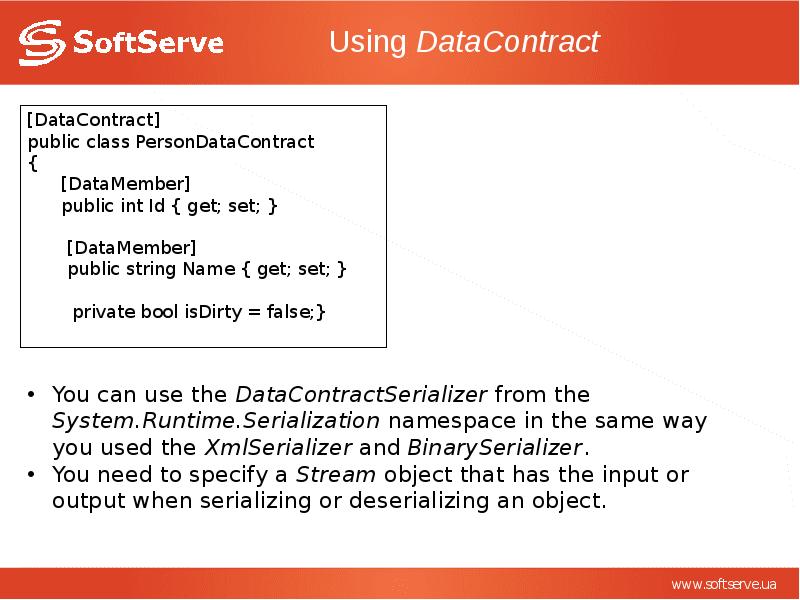
- 17. Using DataContract DataContract is used when you use WCF. The
- 18. Using DataContract
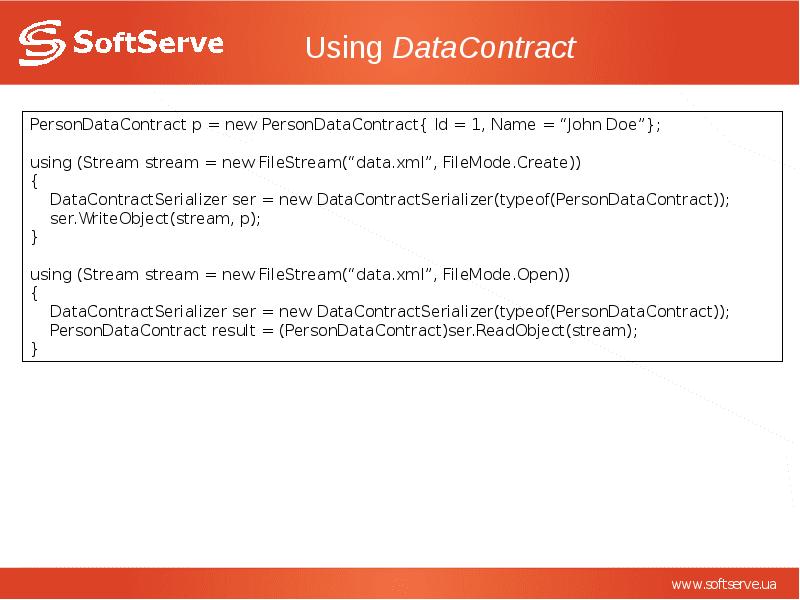
- 19. Using DataContract
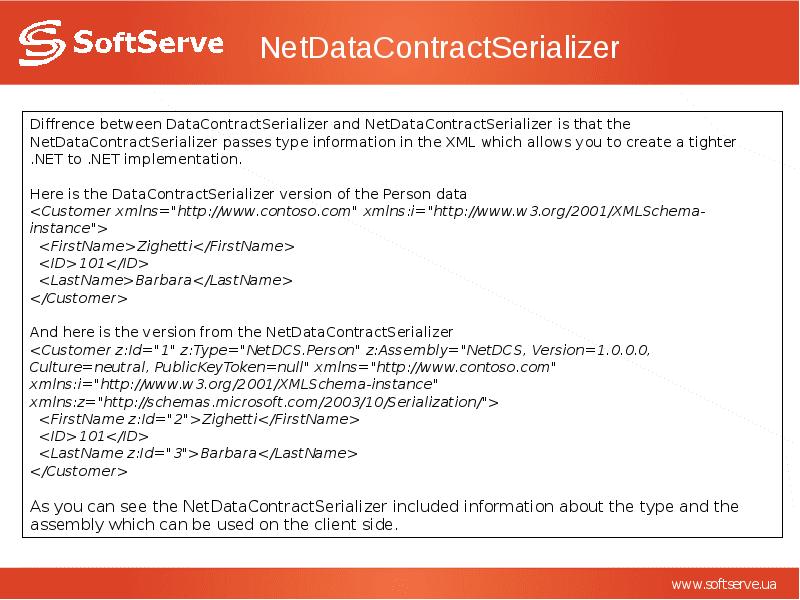
- 20. NetDataContractSerializer
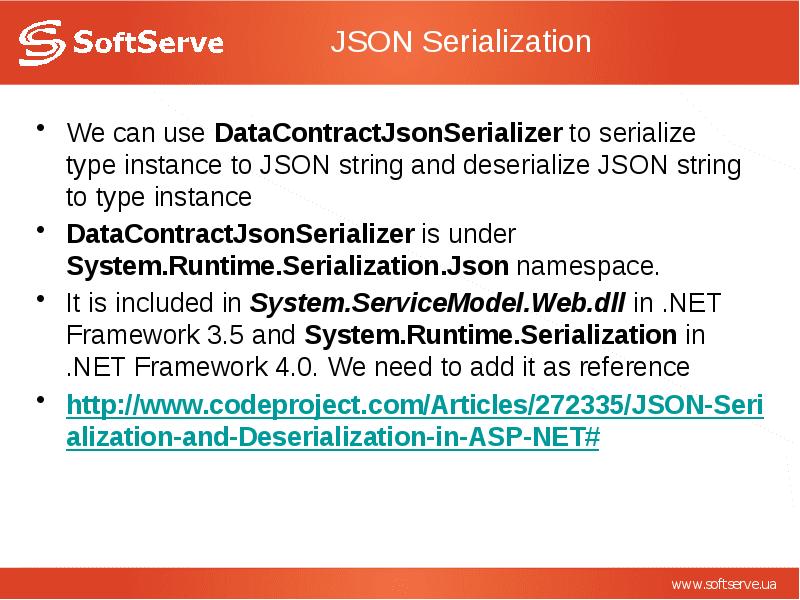
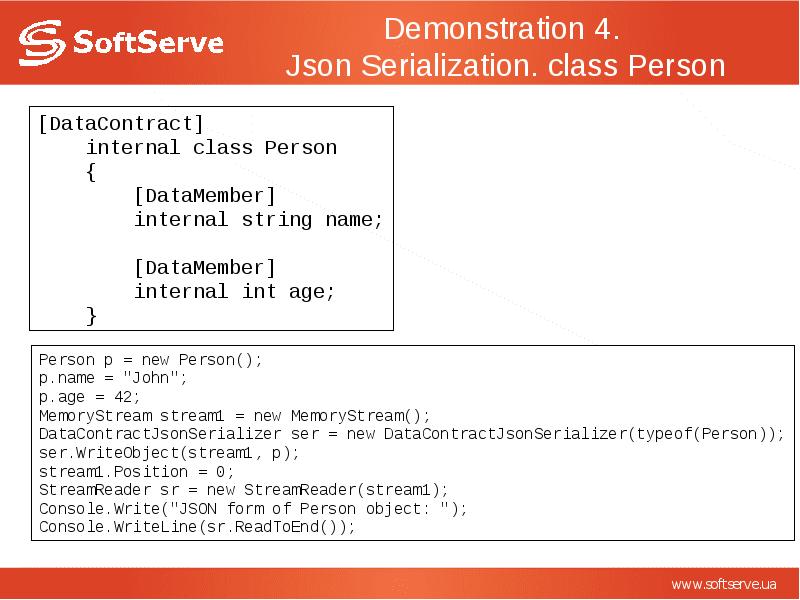
- 21. JSON Serialization We can use DataContractJsonSerializer to serialize type instance
- 22. Demonstration 4. Json Serialization. class Person
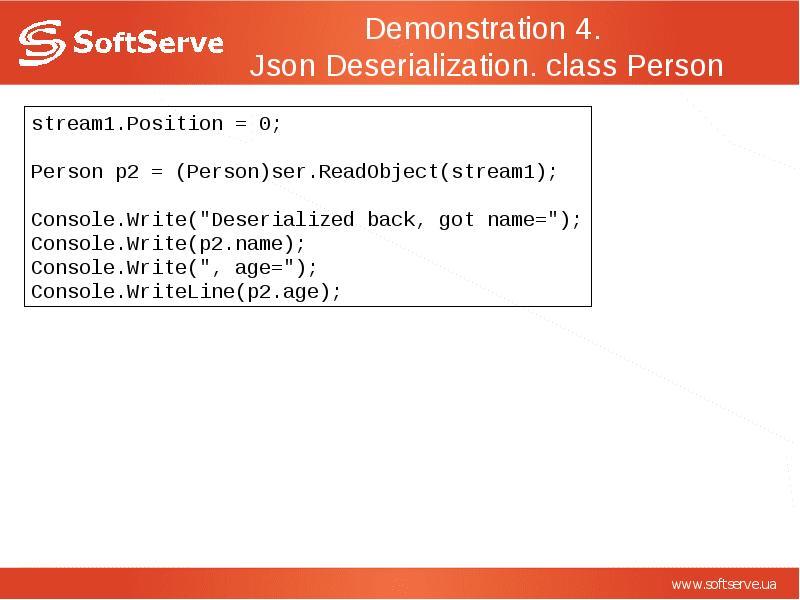
- 23. Demonstration 4. Json Deserialization. class Person
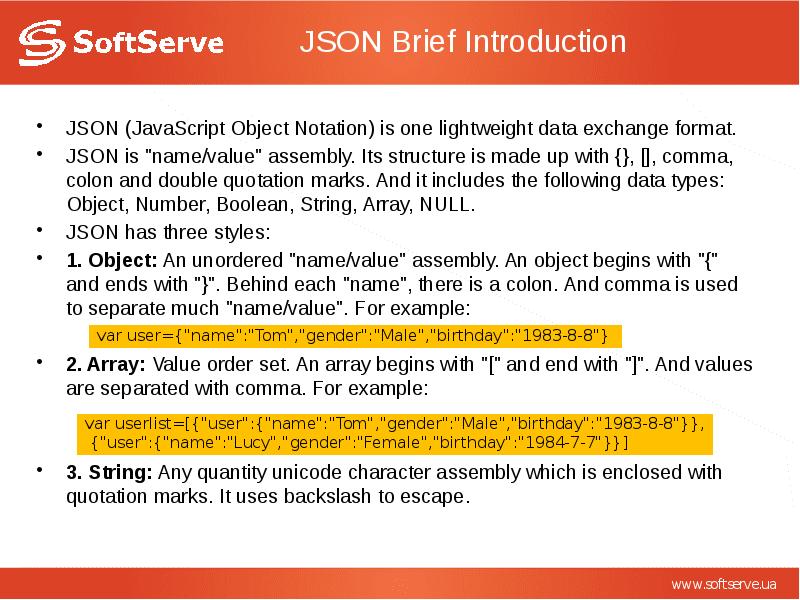
- 24. JSON Brief Introduction JSON (JavaScript Object Notation) is one lightweight data
- 25. Questions?
- 26. Скачать презентацию
![BinaryFormatter
[Serializable]
class Person {
private int _id;](/documents_3/bcd1bef017a4969b07b51745607f3eaf/img6.jpg "BinaryFormatter
[Serializable]
class Person {
private int _id;")

Слайды и текст этой презентации
Слайд 1
Описание слайда:
Introduction to Serialization
Last update:
Lesya Klakovych
August 2016
Reviewed by Nazar Ivchenko
Слайд 2
Описание слайда:
Agenda
Слайд 3
Описание слайда:
What is Serialization?
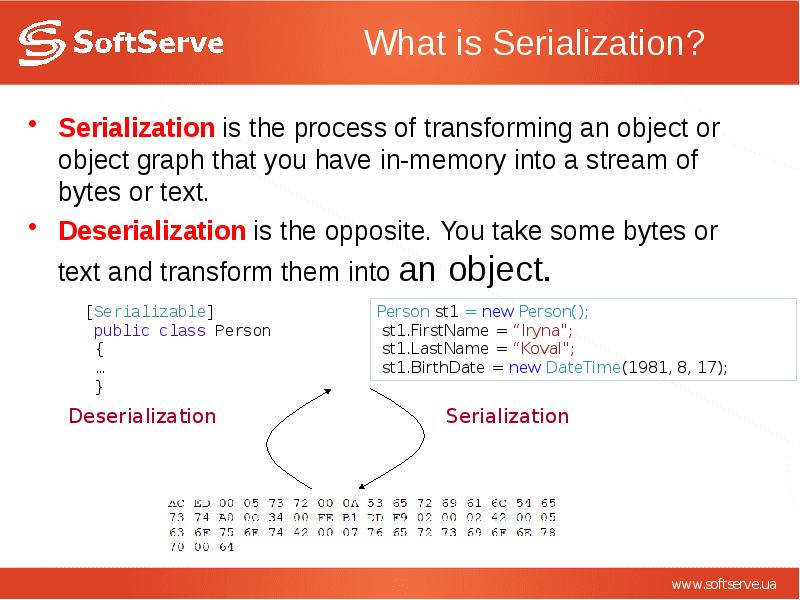
Serialization is the process of transforming an object or object graph that you have in-memory into a stream of bytes or text.
Deserialization is the opposite. You take some bytes or text and transform them into an object.
Слайд 4
Описание слайда:
Serialization in .NET
Слайд 5
Описание слайда:
Serialization in .NET
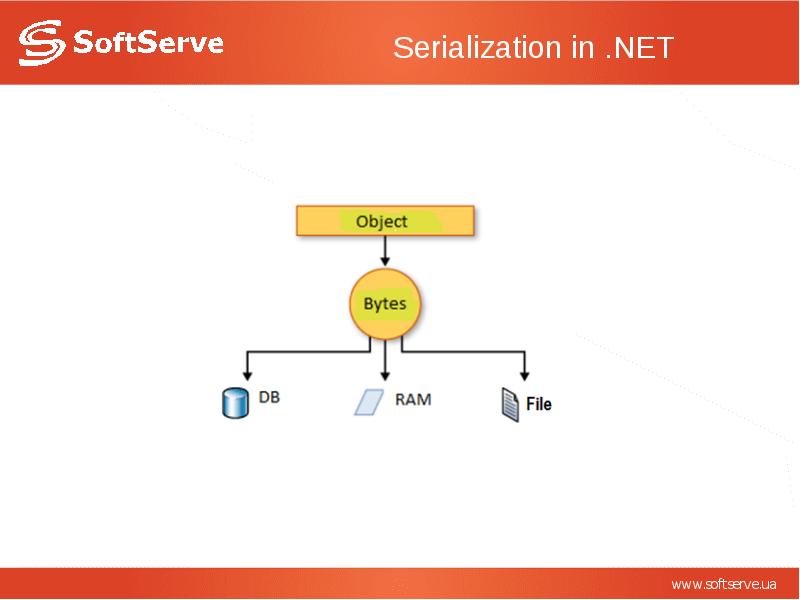
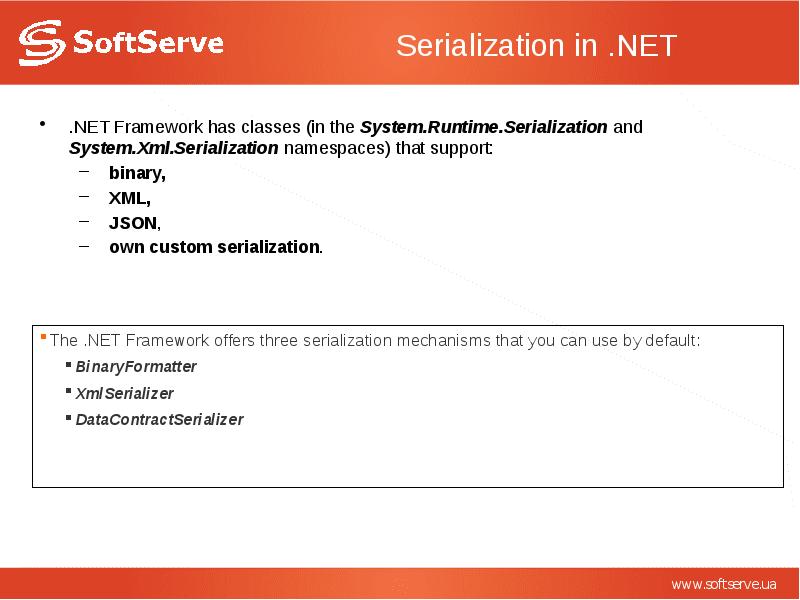
.NET Framework has classes (in the System.Runtime.Serialization and System.Xml.Serialization namespaces) that support:
binary,
XML,
JSON,
own custom serialization.
Слайд 6
Описание слайда:
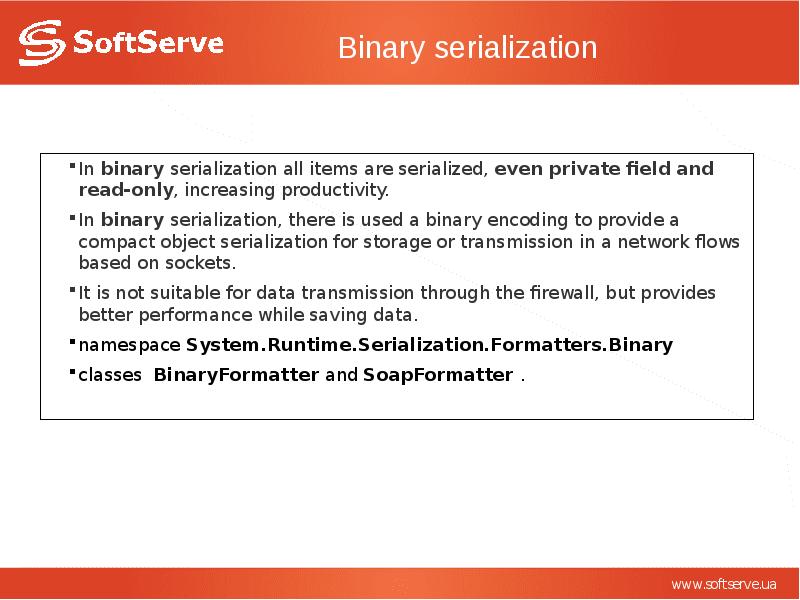
Binary serialization
Слайд 7
Описание слайда:
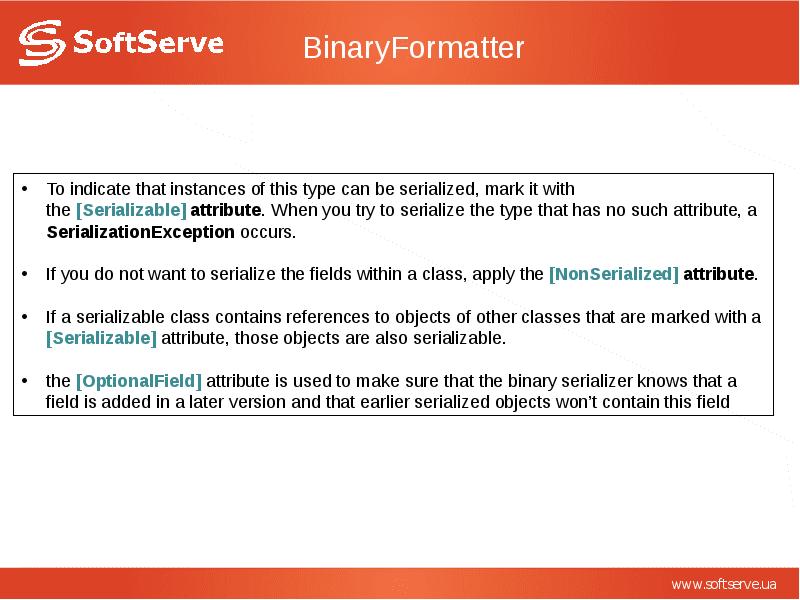
BinaryFormatter
[Serializable]
class Person {
private int _id;
public string FirstName;
public string LastName;
public void SetId(int id)
{
_id = id;
}
}
Слайд 8
Описание слайда:
BinaryFormatter
Слайд 9
Описание слайда:
Custom serialization. ISerializable
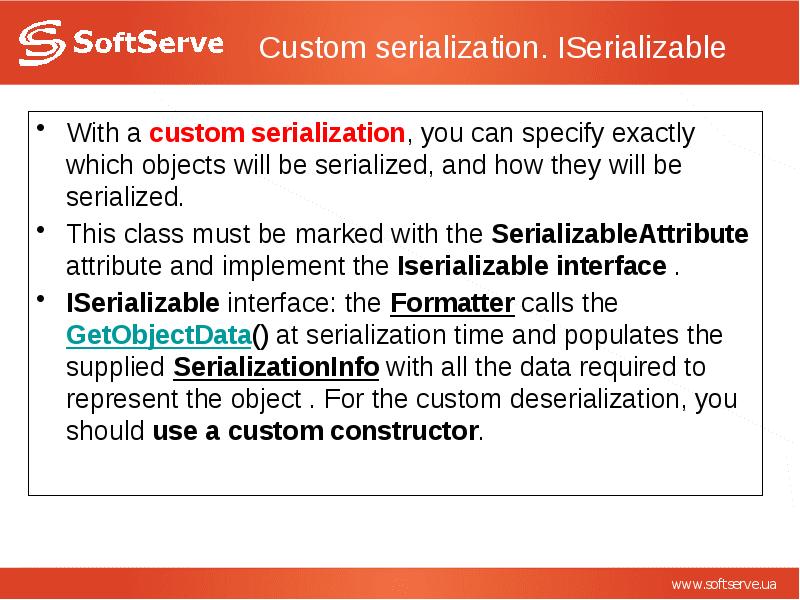
With a custom serialization, you can specify exactly which objects will be serialized, and how they will be serialized.
This class must be marked with the SerializableAttribute attribute and implement the Iserializable interface .
ISerializable interface: the Formatter calls the GetObjectData() at serialization time and populates the supplied SerializationInfo with all the data required to represent the object . For the custom deserialization, you should use a custom constructor.
Слайд 10
Описание слайда:
ISerializable.
Example of implementation
Слайд 11
Описание слайда:
Custom serialization. Using attributes
Add attribute before a custom method that manipulates the object’s data during and upon completion of serialization and deserialization.
OnDeserializedAttribute, OnDeserializingAttribute, OnSerializedAttribute, and OnSerializingAttribute.
Слайд 12
Описание слайда:
XMLSerializer
The XmlSerializer (namespace System.Xml.Serialization) was created with the idea of Simple Object Access Protocol (SOAP) messaging in mind. SOAP is a protocol for exchanging information with web services. It uses XML as the format for messages. XML is readable by both humans and machines, and it is independent of the environment it is used in.
To serialize an object:
Create the object and set its public fields and properties.
Construct a XmlSerializer using the type of the object.
Call the Serialize method to generate either an XML stream or a file representation of the object's public properties and fields.
Слайд 13
Описание слайда:
XMLSerializer
To deserialize an object:
Construct a XmlSerializer using the type of the object to deserialize.
Call the Deserialize method to produce a replica of the object. After deserialization you must cast the returned object to the type of the original
Слайд 14
Описание слайда:
XMLSerializer
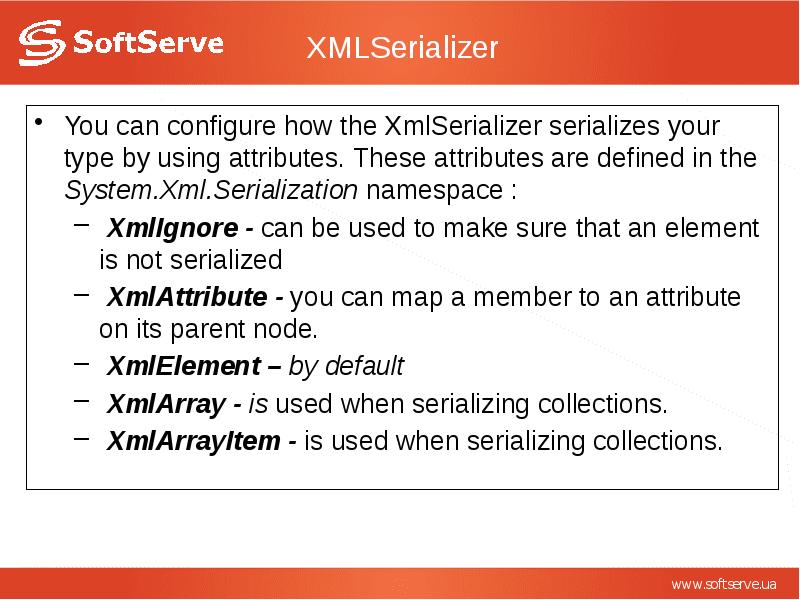
You can configure how the XmlSerializer serializes your type by using attributes. These attributes are defined in the System.Xml.Serialization namespace :
XmlIgnore - can be used to make sure that an element is not serialized
XmlAttribute - you can map a member to an attribute on its parent node.
XmlElement – by default
XmlArray - is used when serializing collections.
XmlArrayItem - is used when serializing collections.
Слайд 15
Описание слайда:
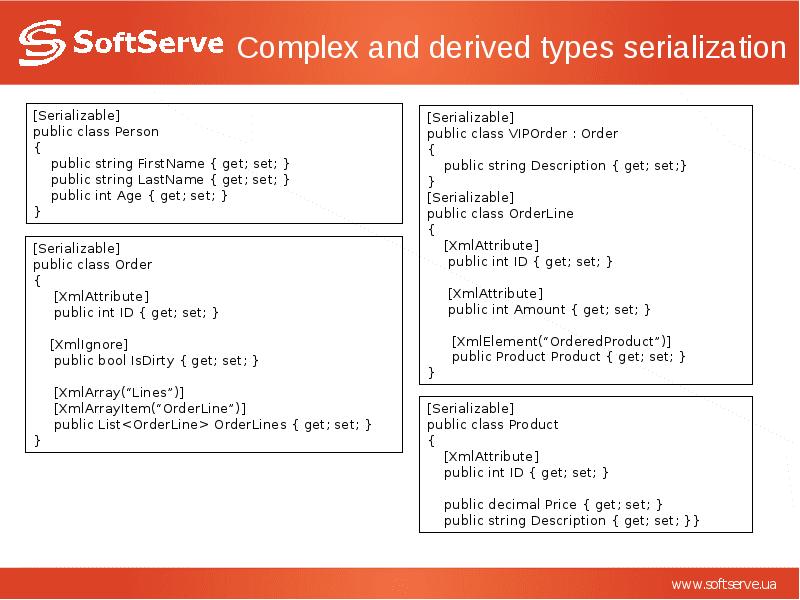
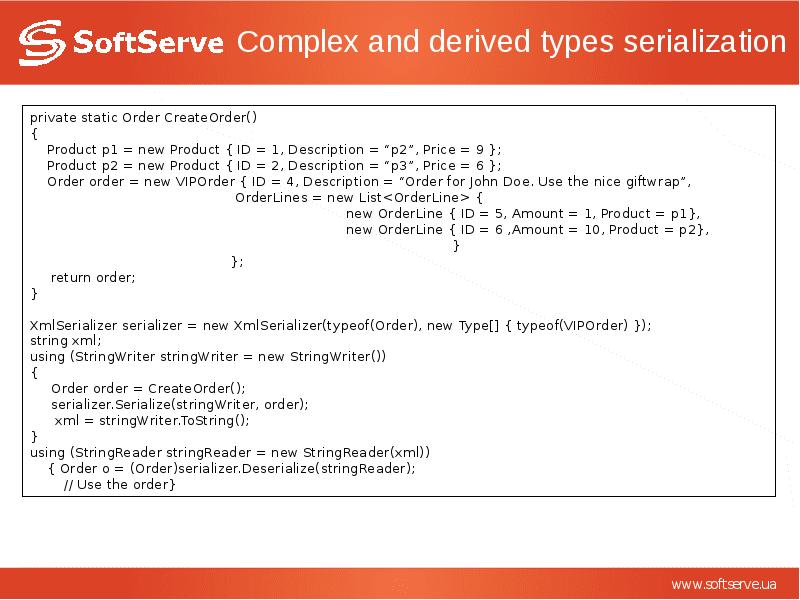
Complex and derived types serialization
Слайд 16
Описание слайда:
Complex and derived types serialization
Слайд 17
Описание слайда:
Using DataContract
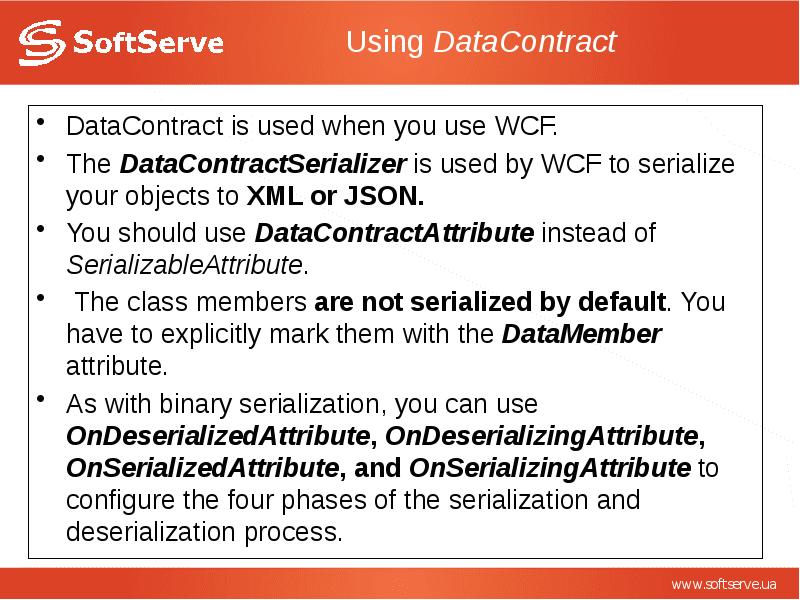
DataContract is used when you use WCF.
The DataContractSerializer is used by WCF to serialize your objects to XML or JSON.
You should use DataContractAttribute instead of SerializableAttribute.
The class members are not serialized by default. You have to explicitly mark them with the DataMember attribute.
As with binary serialization, you can use OnDeserializedAttribute, OnDeserializingAttribute, OnSerializedAttribute, and OnSerializingAttribute to configure the four phases of the serialization and deserialization process.
Слайд 18
Описание слайда:
Using DataContract
Слайд 19
Описание слайда:
Using DataContract
Слайд 20
Описание слайда:
NetDataContractSerializer
Слайд 21
Описание слайда:
JSON Serialization
We can use DataContractJsonSerializer to serialize type instance to JSON string and deserialize JSON string to type instance
DataContractJsonSerializer is under System.Runtime.Serialization.Json namespace.
It is included in System.ServiceModel.Web.dll in .NET Framework 3.5 and System.Runtime.Serialization in .NET Framework 4.0. We need to add it as reference
http://www.codeproject.com/Articles/272335/JSON-Serialization-and-Deserialization-in-ASP-NET#
Слайд 22
Описание слайда:
Demonstration 4.
Json Serialization. class Person
Слайд 23
Описание слайда:
Demonstration 4.
Json Deserialization. class Person
Слайд 24
Описание слайда:
JSON Brief Introduction
JSON (JavaScript Object Notation) is one lightweight data exchange format.
JSON is "name/value" assembly. Its structure is made up with {}, [], comma, colon and double quotation marks. And it includes the following data types: Object, Number, Boolean, String, Array, NULL.
JSON has three styles:
1. Object: An unordered "name/value" assembly. An object begins with "{" and ends with "}". Behind each "name", there is a colon. And comma is used to separate much "name/value". For example:
2. Array: Value order set. An array begins with "[" and end with "]". And values are separated with comma. For example:
3. String: Any quantity unicode character assembly which is enclosed with quotation marks. It uses backslash to escape.
Слайд 25
Описание слайда:
Questions?
Скачать презентацию на тему Introduction to serialization можно ниже: