Intrusion Detection. Chapter 8. Computer Security: Principles and Practice презентация
Содержание
- 2. Classes of intruders: criminals Individuals or members of an organized crime
- 3. Classes of intruders: activists Are either individuals, usually working as insiders,
- 4. Intruders: state-sponsored Groups of hackers sponsored by governments to conduct espionage
- 5. Intruders: others Hackers with motivations other than those previously listed Include
- 6. Skill level: apprentice Hackers with minimal technical skill who primarily use
- 7. Skill level: journeyman Hackers with sufficient technical skills to modify and
- 8. Skill level: master Hackers with high-level technical skills capable of discovering
- 9. Intruders: another classification Masquerader: unauthorized individuals who penetrates a system Misfeasor:
- 10. User and software trespass User trespass: unauthorized logon, privilege abuse Software
- 11. Example of intrusion Remote root compromise Web server defacement Guessing/cracking passwords
- 12. Intruder behavior Target acquisition and information gathering Initial access Privilege escalation
- 13. Hacker behavior example Select target using IP lookup tools Map
- 14. Criminal intruder behavior Act quickly and precisely to make their activities
- 15. Insider intruder behavior Create network accounts for themselves and their friends
- 16. Insider attacks Among most difficult to detect and prevent Employees have
- 17. Security intrusion & detection (RFC 2828) Security intrusion: a security event,
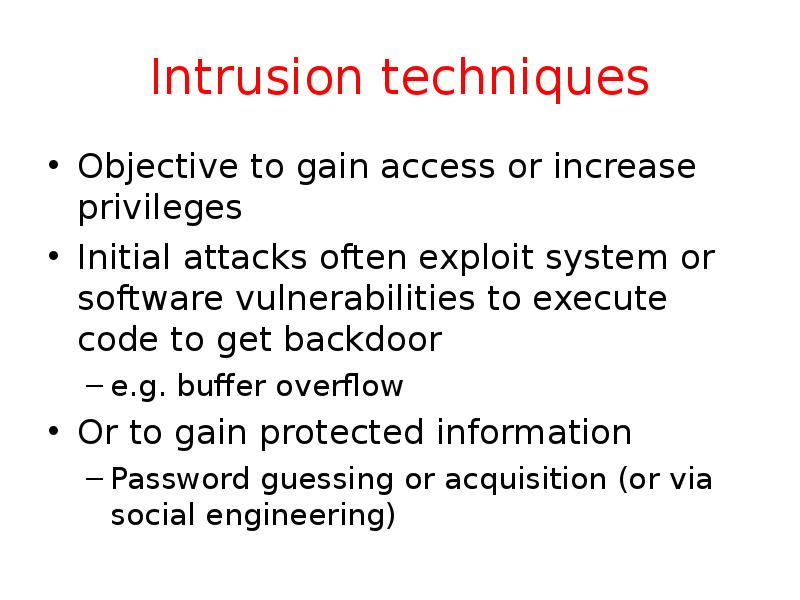
- 18. Intrusion techniques Objective to gain access or increase privileges Initial attacks
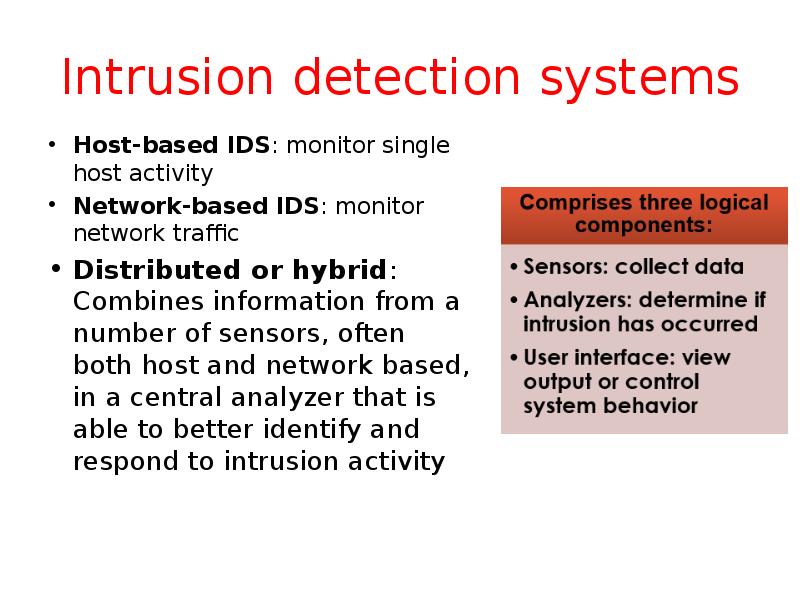
- 19. Intrusion detection systems Host-based IDS: monitor single host activity Network-based IDS:
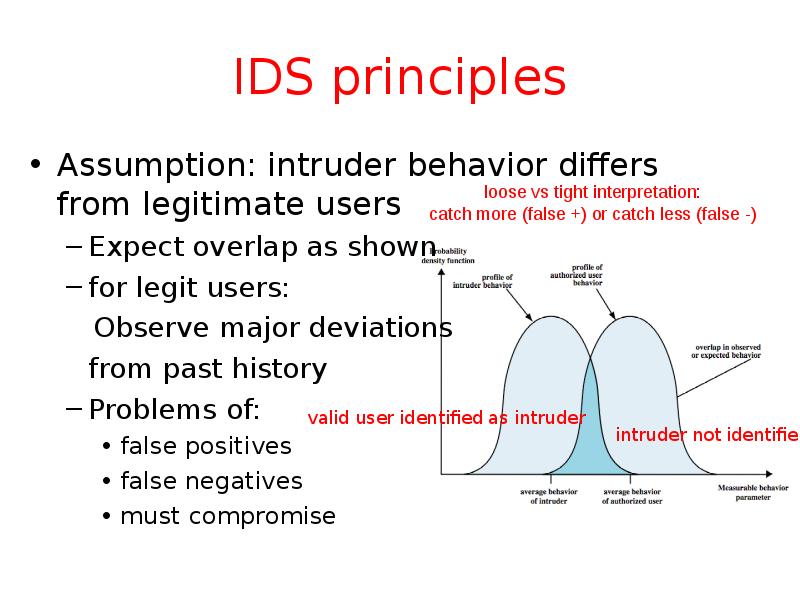
- 20. IDS principles Assumption: intruder behavior differs from legitimate users Expect overlap
- 21. IDS requirements
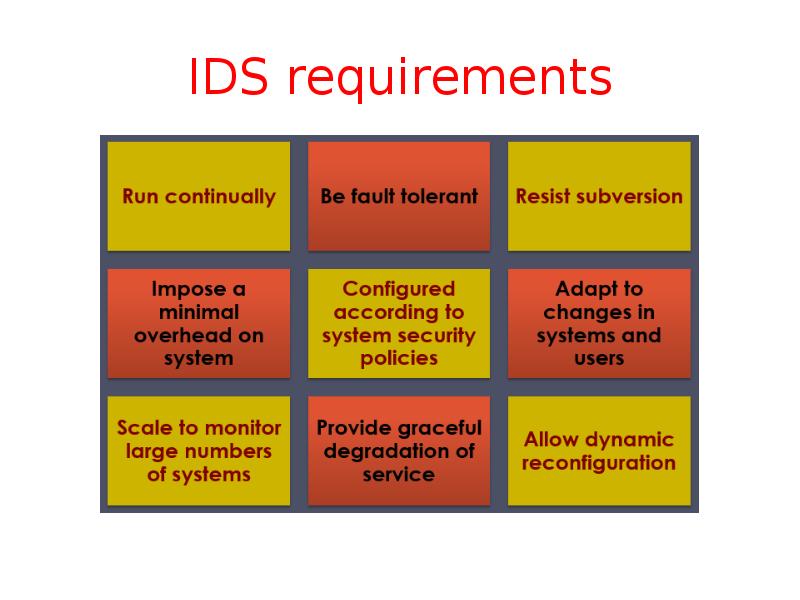
- 22. IDS requirements Run continually with minimal human supervision Be fault tolerant:
- 23. Detection techniques Anomaly (behavior) detection Signature/heuristic detection
- 24. IDS: anomaly (behavior) detection Involves the collection of data relating to
- 25. Anomaly detection Threshold detection checks excessive event occurrences over time alone
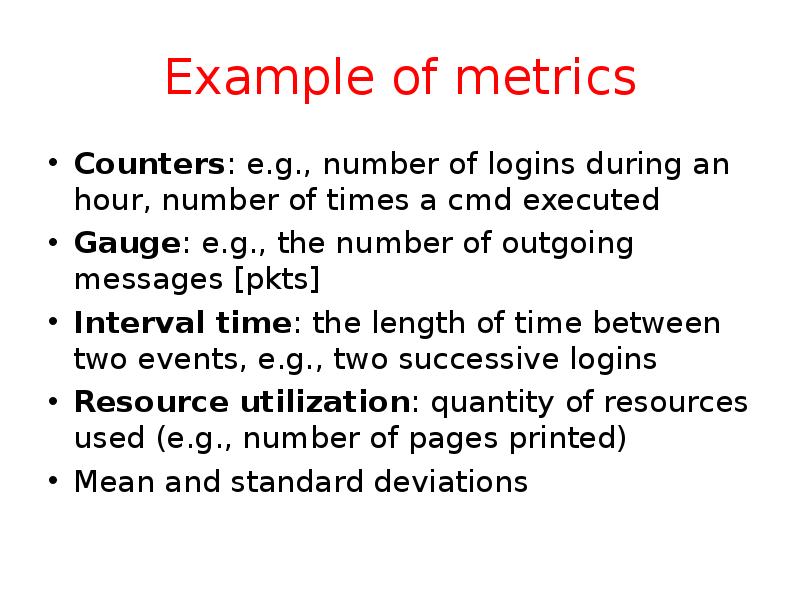
- 26. Example of metrics Counters: e.g., number of logins during an hour,
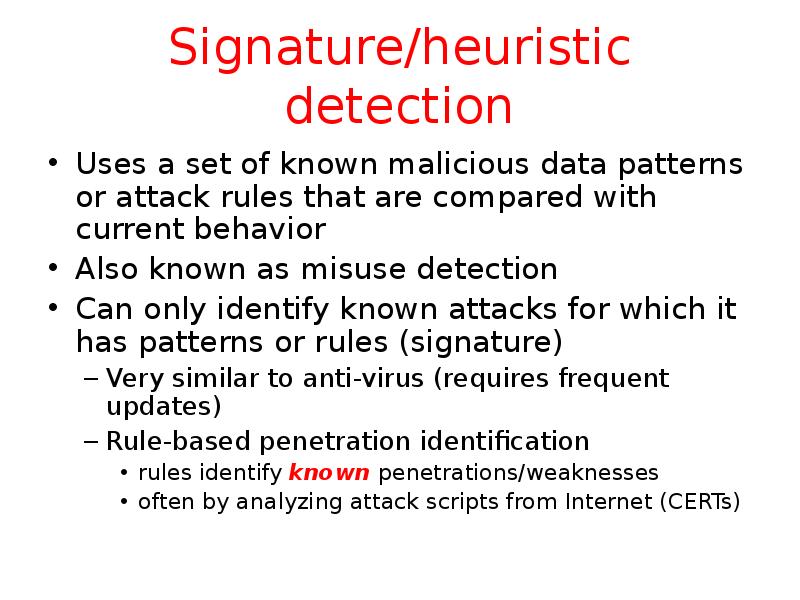
- 27. Signature/heuristic detection Uses a set of known malicious data patterns or
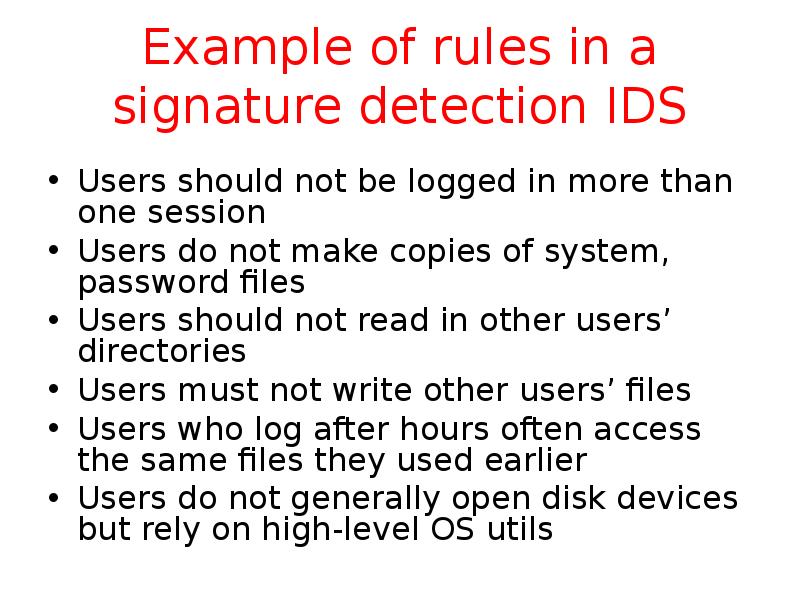
- 28. Example of rules in a signature detection IDS Users should not
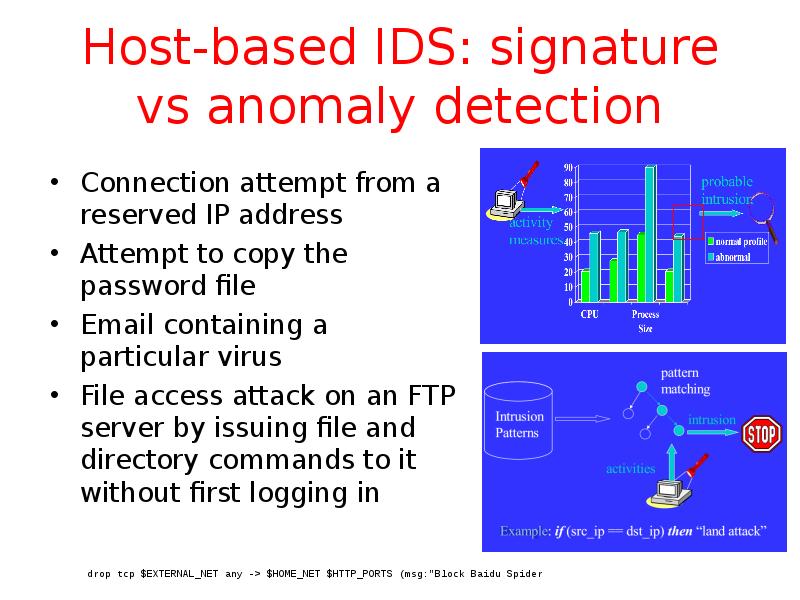
- 29. Host-based IDS: signature vs anomaly detection Connection attempt from a reserved
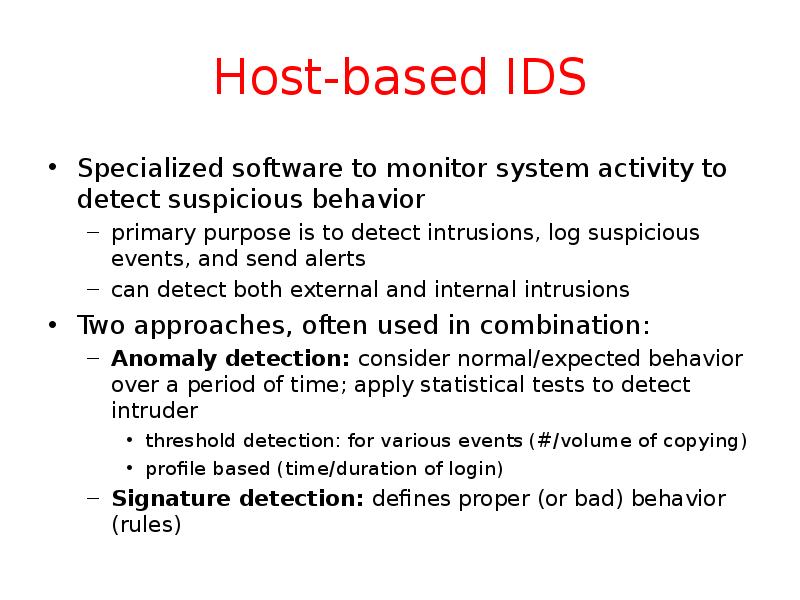
- 30. Host-based IDS Specialized software to monitor system activity to detect suspicious
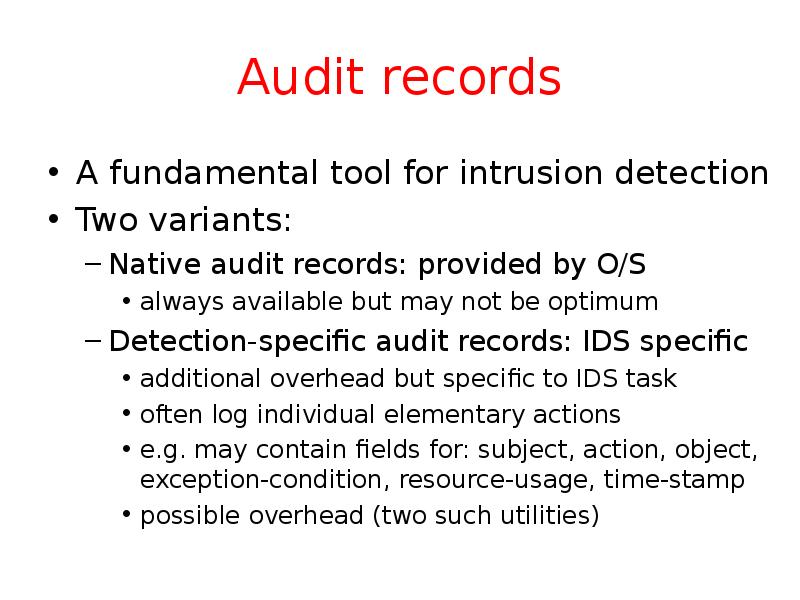
- 31. Audit records A fundamental tool for intrusion detection Two variants:
- 32. Common data sources Common data sources include: System call traces Audit
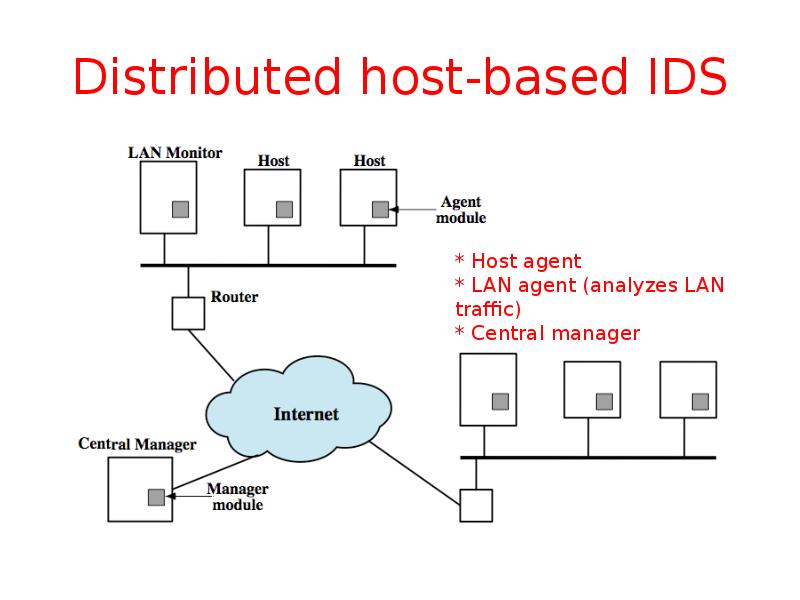
- 33. Distributed host-based IDS
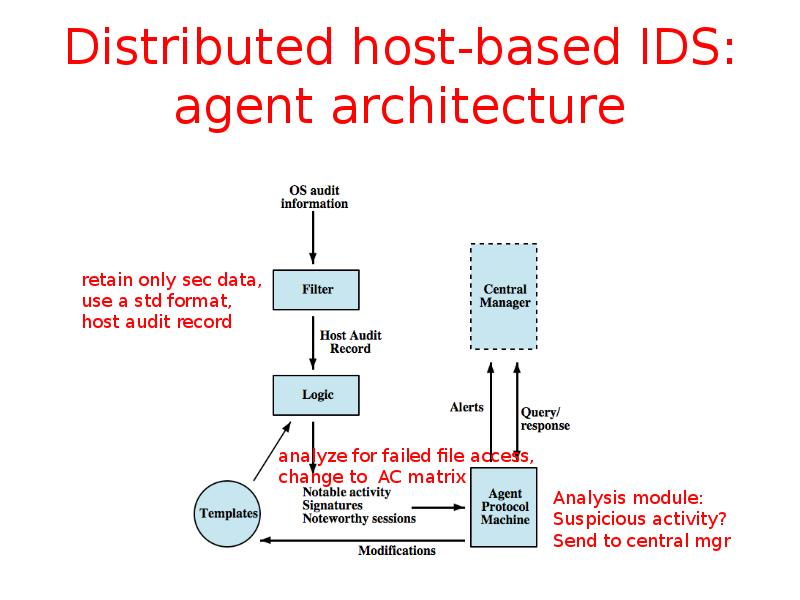
- 34. Distributed host-based IDS: agent architecture
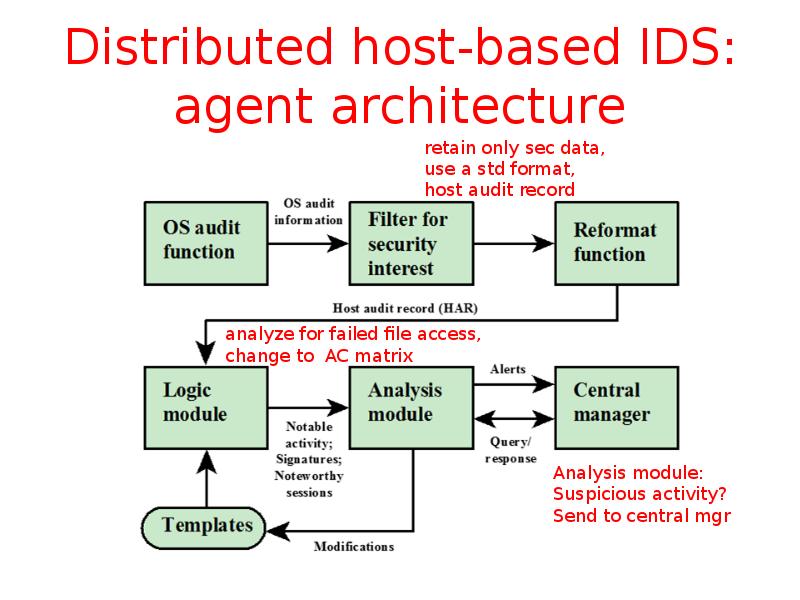
- 35. Distributed host-based IDS: agent architecture
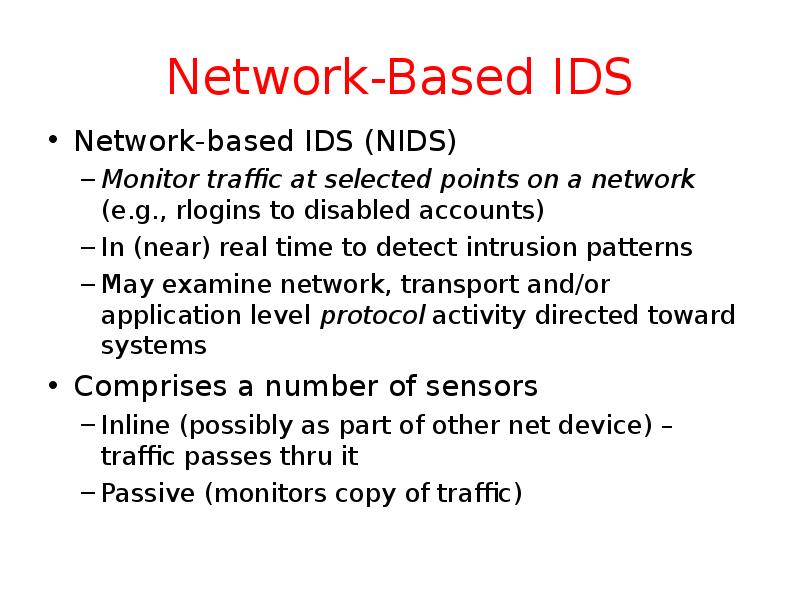
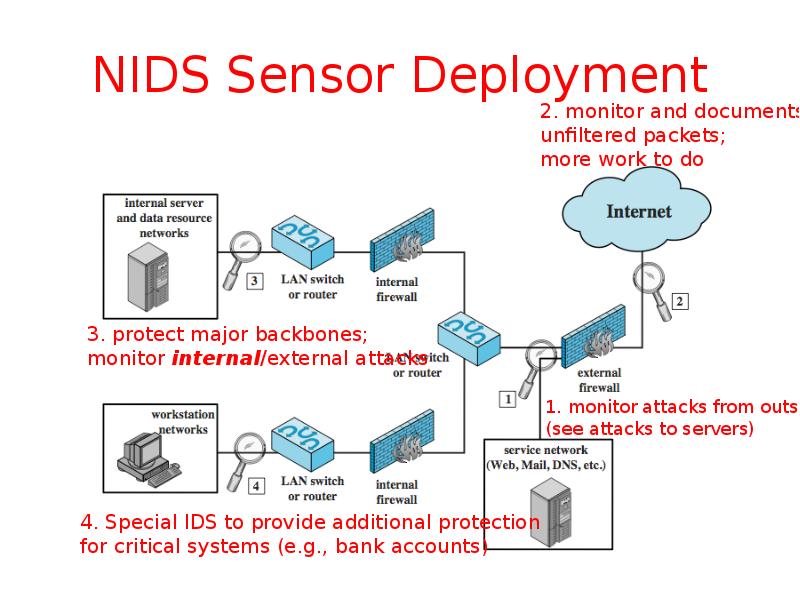
- 36. Network-Based IDS Network-based IDS (NIDS) Monitor traffic at selected points on
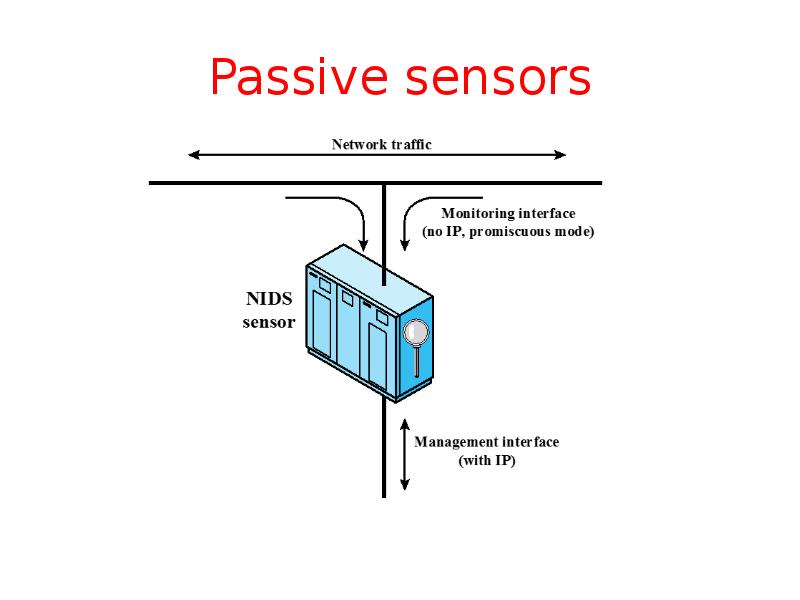
- 37. Passive sensors
- 38. NIDS Sensor Deployment
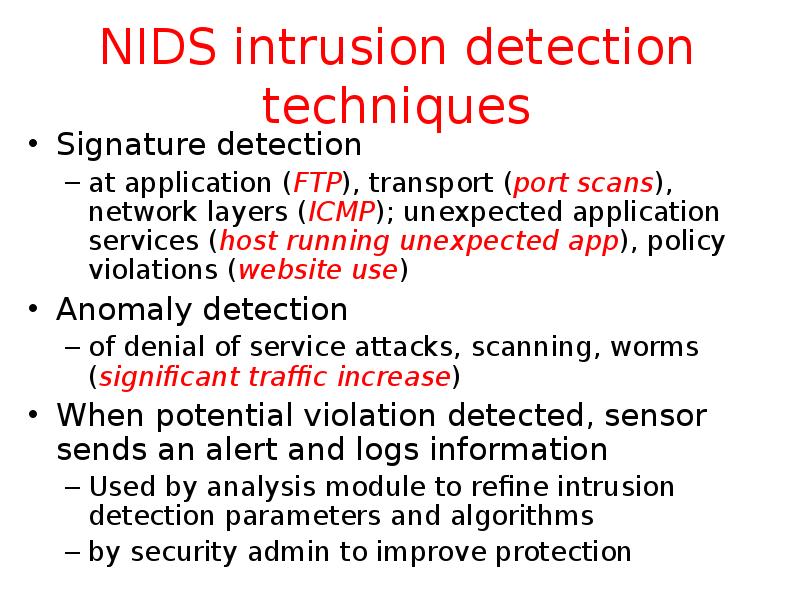
- 39. NIDS intrusion detection techniques Signature detection at application (FTP), transport (port
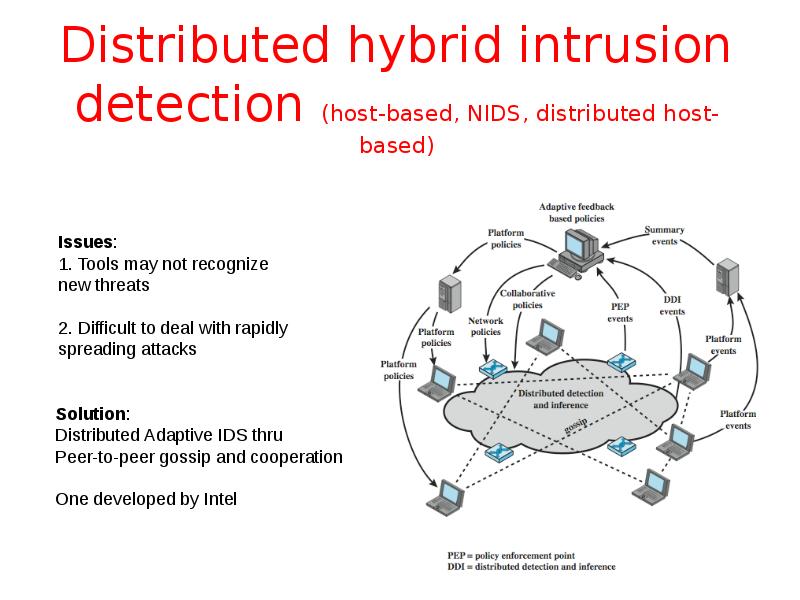
- 40. Distributed hybrid intrusion detection (host-based, NIDS, distributed host-based)
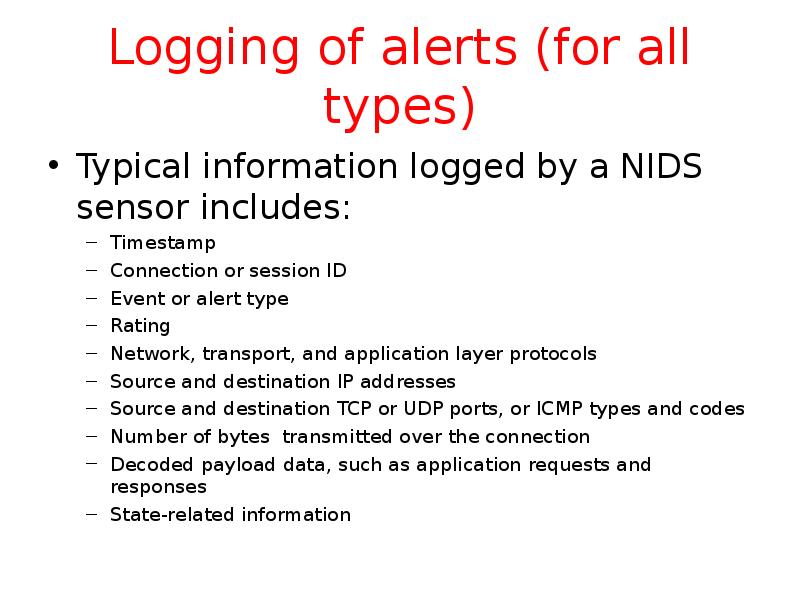
- 41. Logging of alerts (for all types) Typical information logged by a
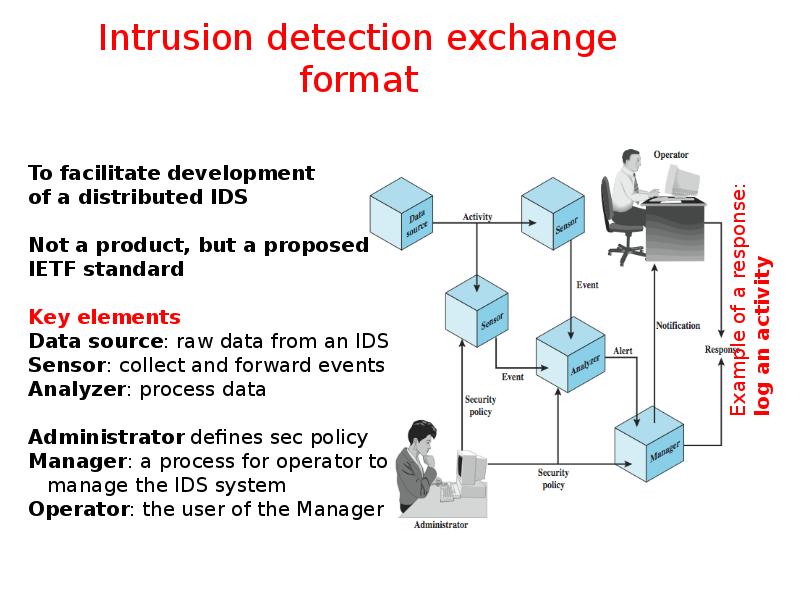
- 42. Intrusion detection exchange format
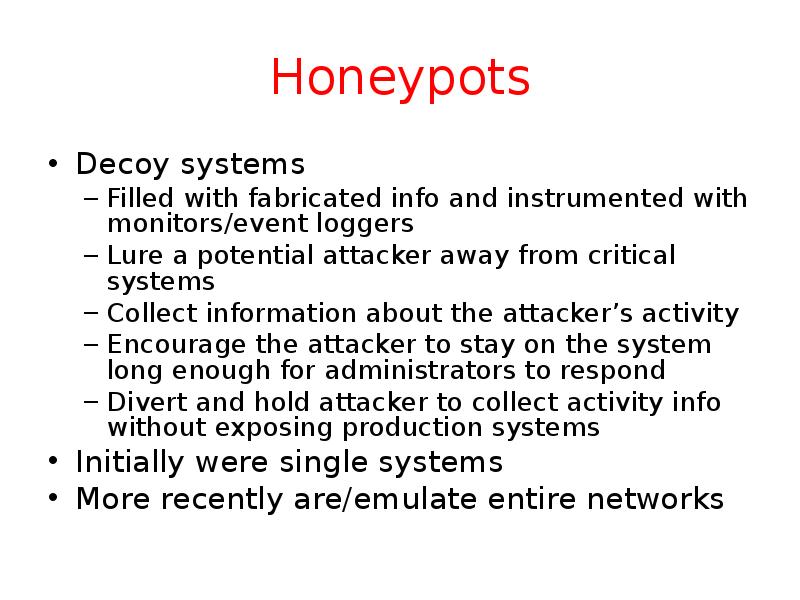
- 43. Honeypots Decoy systems Filled with fabricated info and instrumented with monitors/event
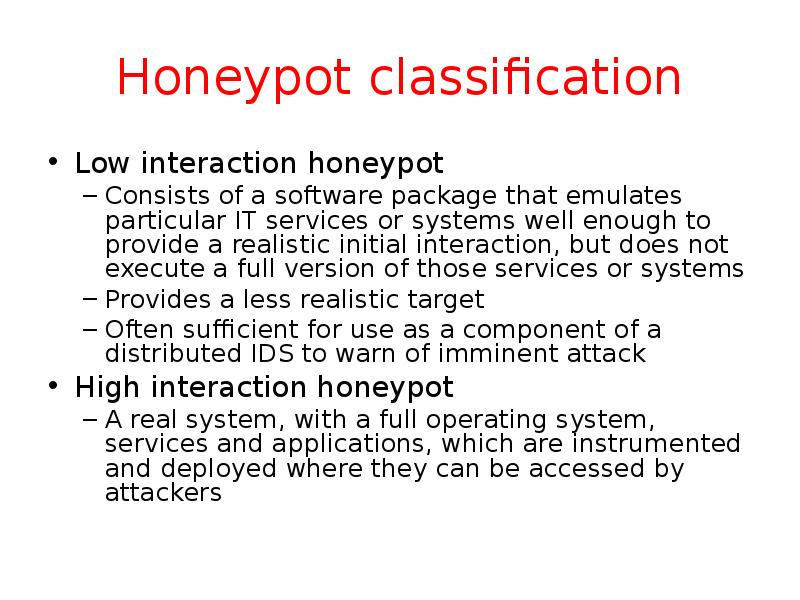
- 44. Honeypot classification Low interaction honeypot Consists of a software package that
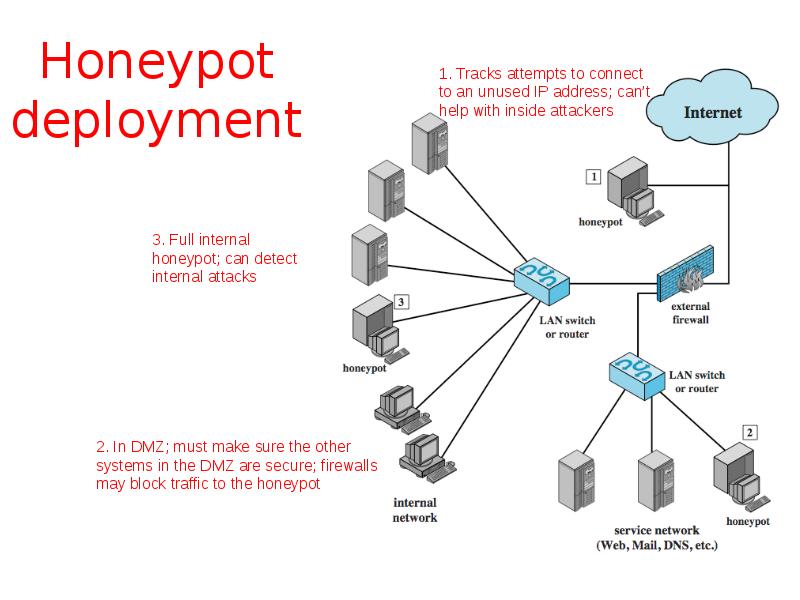
- 45. Honeypot deployment
- 46. Snort IDS Lightweight IDS Open source (rule-based) Real-time packet capture and
- 47. SNORT Rules Use a simple, flexible rule definition language Fixed header
- 48. Summary Introduced intruders & intrusion detection Hackers, criminals, insiders Intrusion detection
- 49. Скачать презентацию

Слайды и текст этой презентации
Слайд 1
Описание слайда:
Computer Security: Principles and Practice
EECS710: Information Security
Professor Hossein Saiedian
Fall 2014
Слайд 2
Описание слайда:
Classes of intruders: criminals
Individuals or members of an organized crime group with a goal of financial reward
Identity theft
Theft of financial credentials
Corporate espionage
Data theft
Data ransoming
Typically young, often Eastern European, Russian, or southeast Asian hackers, who do business on the Web
Meet in underground forums to trade tips and data and coordinate attacks
Слайд 3
Описание слайда:
Classes of intruders: activists
Are either individuals, usually working as insiders, or members of a larger group of outsider attackers, who are motivated by social or political causes
Also known as hacktivists
Skill level is often quite low
Aim of their attacks is often to promote and publicize their cause typically through:
Website defacement
Denial of service attacks
Theft and distribution of data that results in negative publicity or compromise of their targets
Слайд 4
Описание слайда:
Intruders: state-sponsored
Groups of hackers sponsored by governments to conduct espionage or sabotage activities
Also known as Advanced Persistent Threats (APTs) due to the covert nature and persistence over extended periods involved with any attacks in this class
Widespread nature and scope of these activities by a wide range of countries from China to the USA, UK, and their intelligence allies
Слайд 5
Описание слайда:
Intruders: others
Hackers with motivations other than those previously listed
Include classic hackers or crackers who are motivated by technical challenge or by peer-group esteem and reputation
Many of those responsible for discovering new categories of buffer overflow vulnerabilities could be regarded as members of this class
Given the wide availability of attack toolkits, there is a pool of “hobby hackers” using them to explore system and network security (Lamer)
Слайд 6
Описание слайда:
Skill level: apprentice
Hackers with minimal technical skill who primarily use existing attack toolkits
They likely comprise the largest number of attackers, including many criminal and activist attackers
Given their use of existing known tools, these attackers are the easiest to defend against
Also known as “script-kiddies”, due to their use of existing scripts (tools), or “Lamers”
Слайд 7
Описание слайда:
Skill level: journeyman
Hackers with sufficient technical skills to modify and extend attack toolkits to use newly discovered, or purchased, vulnerabilities
They may be able to locate new vulnerabilities to exploit that are similar to some already known
Hackers with such skills are likely found in all intruder classes
Adapt tools for use by others
Слайд 8
Описание слайда:
Skill level: master
Hackers with high-level technical skills capable of discovering brand new categories of vulnerabilities
Write new powerful attack toolkits
Some of the better known classical hackers are of this level
Some are employed by state-sponsored organizations
Defending against these attacks is of the highest difficulty
Слайд 9
Описание слайда:
Intruders: another classification
Masquerader: unauthorized individuals who penetrates a system
Misfeasor: legit user who accesses unauthorized data
Clandestine: seizes supervisory control
Слайд 10
Описание слайда:
User and software trespass
User trespass: unauthorized logon, privilege abuse
Software trespass: virus, worm, or Trojan horse
Слайд 11
Описание слайда:
Example of intrusion
Remote root compromise
Web server defacement
Guessing/cracking passwords
Copying databases containing credit card numbers
Viewing sensitive data without authorization
Running a packet sniffer
Distributing pirated software
Using an unsecured modem to access internal network
Impersonating an executive to get information
Using an unattended workstation
Слайд 12
Описание слайда:
Intruder behavior
Target acquisition and information gathering
Initial access
Privilege escalation
Information gathering or system exploit
Maintaining access
Covering tracks
Слайд 13
Описание слайда:
Hacker behavior example
Select target using IP lookup tools
Map network for accessible services
study physical connectivity (via NMAP – looks for open ports)
Identify potentially vulnerable services
Brute force (guess) passwords
Install remote administration tool
Wait for admin to log on and capture password
Use password to access remainder of network
Слайд 14
Описание слайда:
Criminal intruder behavior
Act quickly and precisely to make their activities harder to detect
Exploit perimeter via vulnerable ports
Use Trojan horses (hidden software) to leave back doors for re-entry
Use sniffers to capture passwords
Do not stick around until noticed
Make few or no mistakes
Слайд 15
Описание слайда:
Insider intruder behavior
Create network accounts for themselves and their friends
Access accounts and applications they wouldn't normally use for their daily jobs
E-mail former and prospective employers
Conduct furtive (covert) instant-messaging chats
Visit web sites that cater to disgruntled employees, such as f*dcompany.com
Perform large downloads and file copying
Access the network during off hours
Слайд 16
Описание слайда:
Insider attacks
Among most difficult to detect and prevent
Employees have access & systems knowledge
May be motivated by revenge/entitlement
When employment terminated
Taking customer data when move to competitor
IDS/IPS may help but also need
Least privilege, monitor logs, strong authentication, termination process to block access & take mirror image of employee’s HD (for future purposes)
Слайд 17
Описание слайда:
Security intrusion & detection (RFC 2828)
Security intrusion: a security event, or combination of multiple security events, that constitutes a security incident in which an intruder gains, or attempts to gain, access to a system (or system resource) without having authorization to do so.
Intrusion detection: a security service that monitors and analyzes system events for the purpose of finding, and providing real-time or near real-time warning of attempts to access system resources in an unauthorized manner.
Слайд 18
Описание слайда:
Intrusion techniques
Objective to gain access or increase privileges
Initial attacks often exploit system or software vulnerabilities to execute code to get backdoor
e.g. buffer overflow
Or to gain protected information
Password guessing or acquisition (or via social engineering)
Слайд 19
Описание слайда:
Intrusion detection systems
Host-based IDS: monitor single host activity
Network-based IDS: monitor network traffic
Distributed or hybrid: Combines information from a number of sensors, often both host and network based, in a central analyzer that is able to better identify and respond to intrusion activity
Слайд 20
Описание слайда:
IDS principles
Assumption: intruder behavior differs from legitimate users
Expect overlap as shown
for legit users:
Observe major deviations
from past history
Problems of:
false positives
false negatives
must compromise
Слайд 21
Описание слайда:
IDS requirements
Слайд 22
Описание слайда:
IDS requirements
Run continually with minimal human supervision
Be fault tolerant: recover from crashes
Resist subversion: monitor itself from changes by the intruder
Impose a minimal overhead on system
Configured according to system security policies
Adapt to changes in systems and users
Scale to monitor large numbers of systems
Provide graceful degradation of service: if one component fails, others should continue to work
Allow dynamic reconfiguration
Слайд 23
Описание слайда:
Detection techniques
Anomaly (behavior) detection
Signature/heuristic detection
Слайд 24
Описание слайда:
IDS: anomaly (behavior) detection
Involves the collection of data relating to the behavior of legitimate users over a period of time
Current observed behavior is analyzed to determine whether this behavior is that of a legitimate user or that of an intruder
Слайд 25
Описание слайда:
Anomaly detection
Threshold detection
checks excessive event occurrences over time
alone a crude and ineffective intruder detector
must determine both thresholds and time intervals
lots of false positive/false negative may be possible
Profile based
characterize past behavior of users/groups
then detect significant deviations
based on analysis of audit records: gather metrics
Слайд 26
Описание слайда:
Example of metrics
Counters: e.g., number of logins during an hour, number of times a cmd executed
Gauge: e.g., the number of outgoing messages [pkts]
Interval time: the length of time between two events, e.g., two successive logins
Resource utilization: quantity of resources used (e.g., number of pages printed)
Mean and standard deviations
Слайд 27
Описание слайда:
Signature/heuristic detection
Uses a set of known malicious data patterns or attack rules that are compared with current behavior
Also known as misuse detection
Can only identify known attacks for which it has patterns or rules (signature)
Very similar to anti-virus (requires frequent updates)
Rule-based penetration identification
rules identify known penetrations/weaknesses
often by analyzing attack scripts from Internet (CERTs)
Слайд 28
Описание слайда:
Example of rules in a signature detection IDS
Users should not be logged in more than one session
Users do not make copies of system, password files
Users should not read in other users’ directories
Users must not write other users’ files
Users who log after hours often access the same files they used earlier
Users do not generally open disk devices but rely on high-level OS utils
Слайд 29
Описание слайда:
Host-based IDS: signature vs anomaly detection
Connection attempt from a reserved IP address
Attempt to copy the password file
Email containing a particular virus
File access attack on an FTP server by issuing file and directory commands to it without first logging in
Слайд 30
Описание слайда:
Host-based IDS
Specialized software to monitor system activity to detect suspicious behavior
primary purpose is to detect intrusions, log suspicious events, and send alerts
can detect both external and internal intrusions
Two approaches, often used in combination:
Anomaly detection: consider normal/expected behavior over a period of time; apply statistical tests to detect intruder
threshold detection: for various events (#/volume of copying)
profile based (time/duration of login)
Signature detection: defines proper (or bad) behavior (rules)
Слайд 31
Описание слайда:
Audit records
A fundamental tool for intrusion detection
Two variants:
Native audit records: provided by O/S
always available but may not be optimum
Detection-specific audit records: IDS specific
additional overhead but specific to IDS task
often log individual elementary actions
e.g. may contain fields for: subject, action, object, exception-condition, resource-usage, time-stamp
possible overhead (two such utilities)
Слайд 32
Описание слайда:
Common data sources
Common data sources include:
System call traces
Audit (log file) records
File integrity checksums
Registry access
Слайд 33
Описание слайда:
Distributed host-based IDS
Слайд 34
Описание слайда:
Distributed host-based IDS: agent architecture
Слайд 35
Описание слайда:
Distributed host-based IDS: agent architecture
Слайд 36
Описание слайда:
Network-Based IDS
Network-based IDS (NIDS)
Monitor traffic at selected points on a network (e.g., rlogins to disabled accounts)
In (near) real time to detect intrusion patterns
May examine network, transport and/or application level protocol activity directed toward systems
Comprises a number of sensors
Inline (possibly as part of other net device) – traffic passes thru it
Passive (monitors copy of traffic)
Слайд 37
Описание слайда:
Passive sensors
Слайд 38
Описание слайда:
NIDS Sensor Deployment
Слайд 39
Описание слайда:
NIDS intrusion detection techniques
Signature detection
at application (FTP), transport (port scans), network layers (ICMP); unexpected application services (host running unexpected app), policy violations (website use)
Anomaly detection
of denial of service attacks, scanning, worms (significant traffic increase)
When potential violation detected, sensor sends an alert and logs information
Used by analysis module to refine intrusion detection parameters and algorithms
by security admin to improve protection
Слайд 40
Описание слайда:
Distributed hybrid intrusion detection (host-based, NIDS, distributed host-based)
Слайд 41
Описание слайда:
Logging of alerts (for all types)
Typical information logged by a NIDS sensor includes:
Timestamp
Connection or session ID
Event or alert type
Rating
Network, transport, and application layer protocols
Source and destination IP addresses
Source and destination TCP or UDP ports, or ICMP types and codes
Number of bytes transmitted over the connection
Decoded payload data, such as application requests and responses
State-related information
Слайд 42
Описание слайда:
Intrusion detection exchange format
Слайд 43
Описание слайда:
Honeypots
Decoy systems
Filled with fabricated info and instrumented with monitors/event loggers
Lure a potential attacker away from critical systems
Collect information about the attacker’s activity
Encourage the attacker to stay on the system long enough for administrators to respond
Divert and hold attacker to collect activity info without exposing production systems
Initially were single systems
More recently are/emulate entire networks
Слайд 44
Описание слайда:
Honeypot classification
Low interaction honeypot
Consists of a software package that emulates particular IT services or systems well enough to provide a realistic initial interaction, but does not execute a full version of those services or systems
Provides a less realistic target
Often sufficient for use as a component of a distributed IDS to warn of imminent attack
High interaction honeypot
A real system, with a full operating system, services and applications, which are instrumented and deployed where they can be accessed by attackers
Слайд 45
Описание слайда:
Honeypot deployment
Слайд 46
Описание слайда:
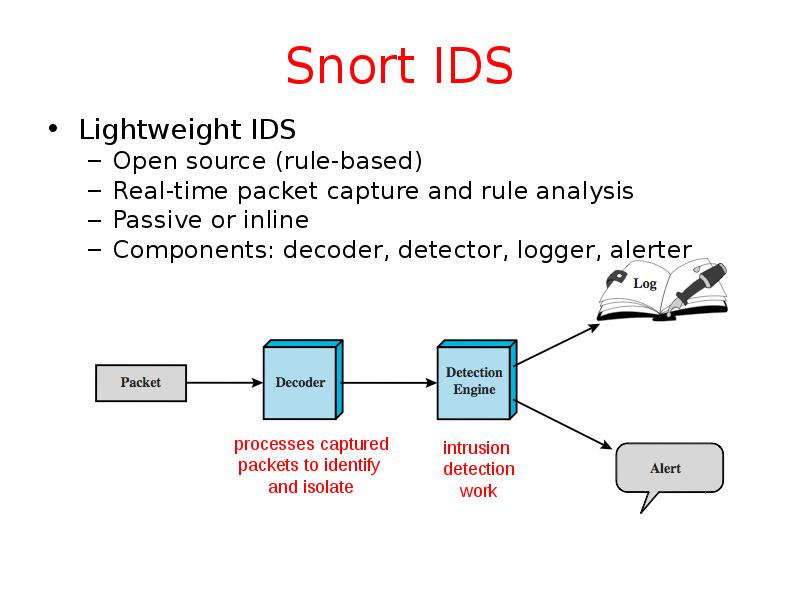
Snort IDS
Lightweight IDS
Open source (rule-based)
Real-time packet capture and rule analysis
Passive or inline
Components: decoder, detector, logger, alerter
Слайд 47
Описание слайда:
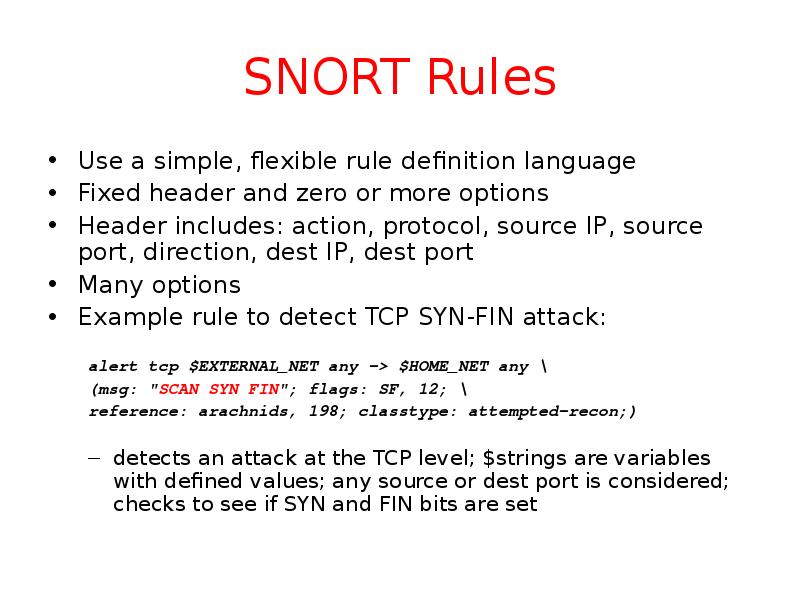
SNORT Rules
Use a simple, flexible rule definition language
Fixed header and zero or more options
Header includes: action, protocol, source IP, source port, direction, dest IP, dest port
Many options
Example rule to detect TCP SYN-FIN attack:
alert tcp $EXTERNAL_NET any -> $HOME_NET any \
(msg: "SCAN SYN FIN"; flags: SF, 12; \
reference: arachnids, 198; classtype: attempted-recon;)
detects an attack at the TCP level; $strings are variables with defined values; any source or dest port is considered; checks to see if SYN and FIN bits are set
Слайд 48
Описание слайда:
Summary
Introduced intruders & intrusion detection
Hackers, criminals, insiders
Intrusion detection approaches
Host-based (single and distributed)
Network
Distributed adaptive
Honeypots
Snort example
Скачать презентацию на тему Intrusion Detection. Chapter 8. Computer Security: Principles and Practice можно ниже: