Linear scan. Register allocation презентация
Содержание
- 2. Introduction Register Allocation: The problem of mapping an unbounded number of
- 3. Motivation On-line compilers need generate code quickly Just-In-Time compilation Dynamic code
- 4. Definitions Live interval: A sequence of instructions, outside of which a
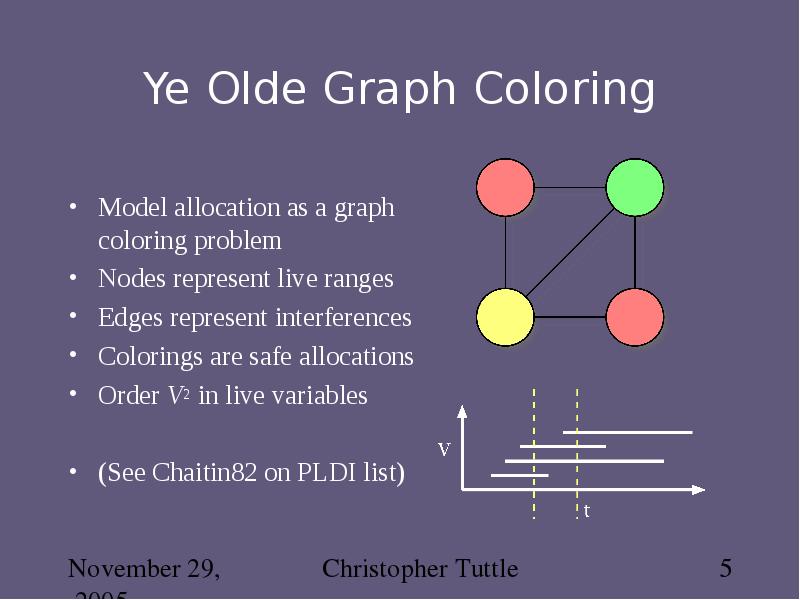
- 5. Ye Olde Graph Coloring Model allocation as a graph coloring problem
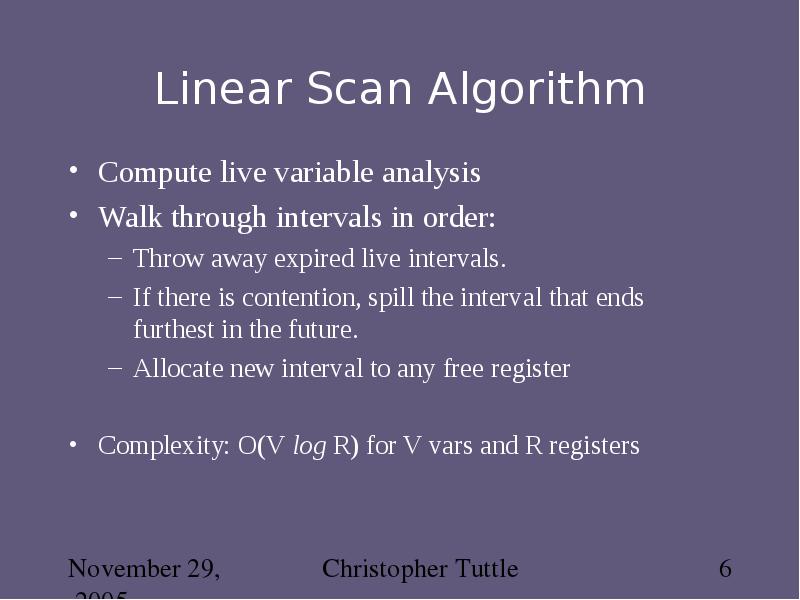
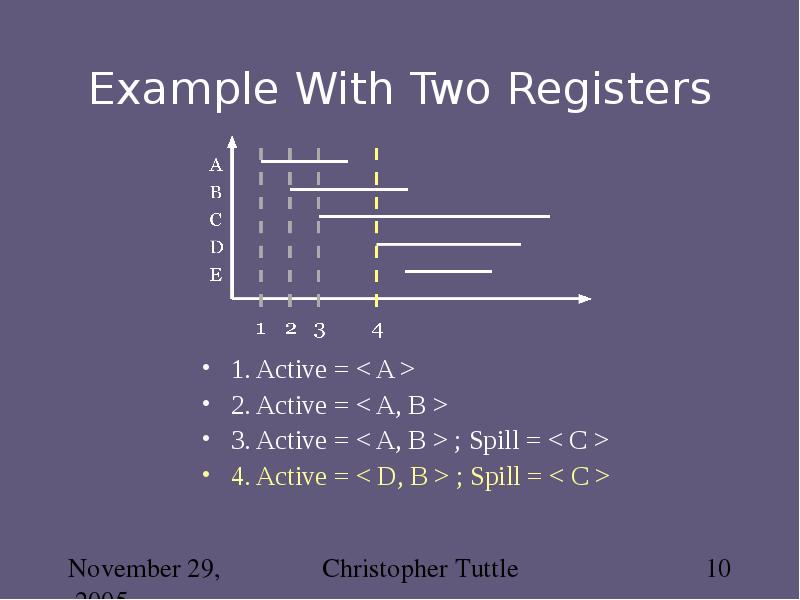
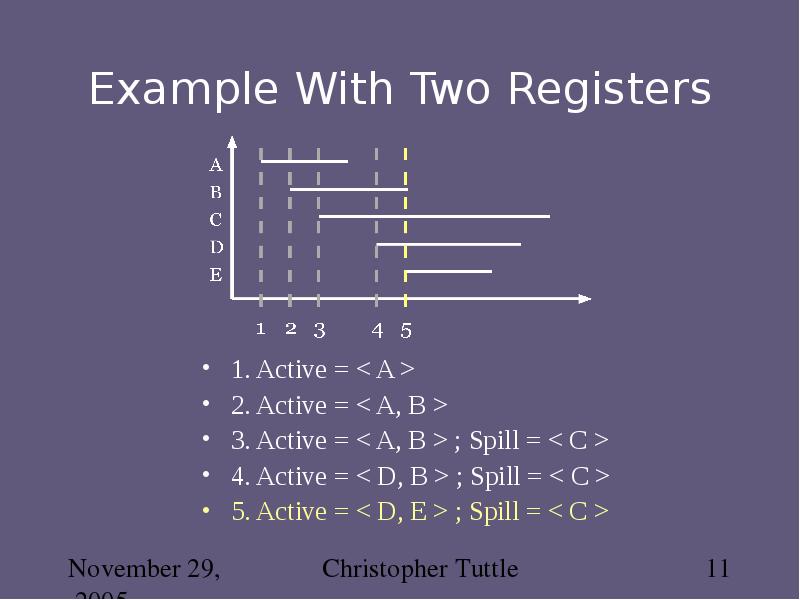
- 6. Linear Scan Algorithm Compute live variable analysis Walk through intervals in
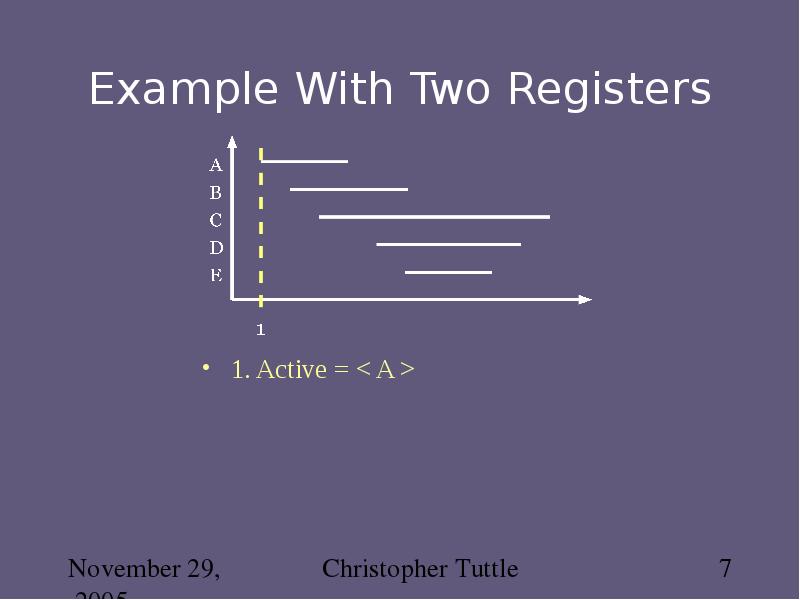
- 7. Example With Two Registers 1. Active = < A >
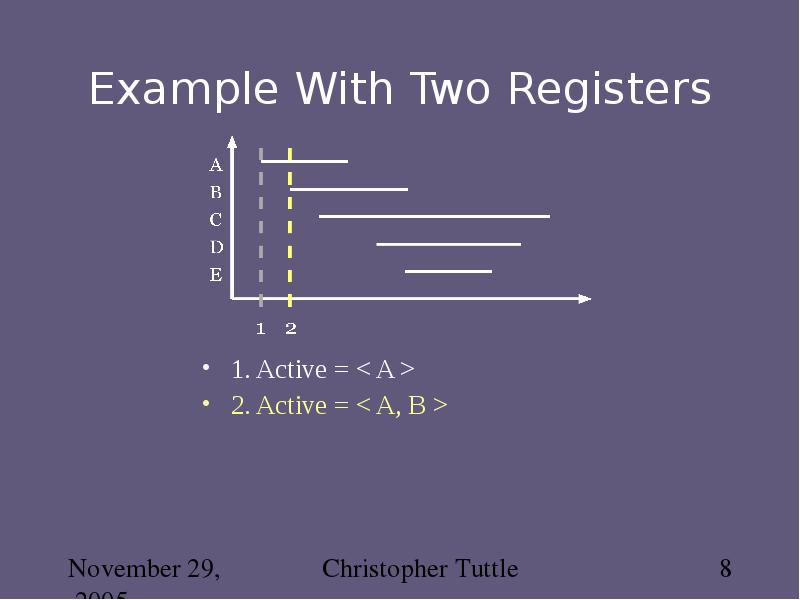
- 8. Example With Two Registers 1. Active = < A > 2.
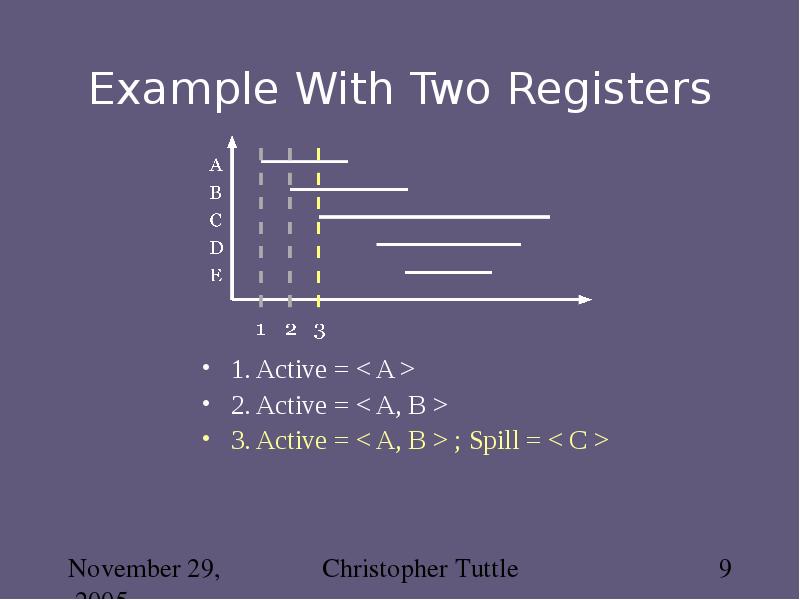
- 9. Example With Two Registers 1. Active = < A > 2.
- 10. Example With Two Registers 1. Active = < A > 2.
- 11. Example With Two Registers 1. Active = < A > 2.
- 12. Evaluation Overview Evaluate both compile-time and run-time performance Two Implementations ICODE
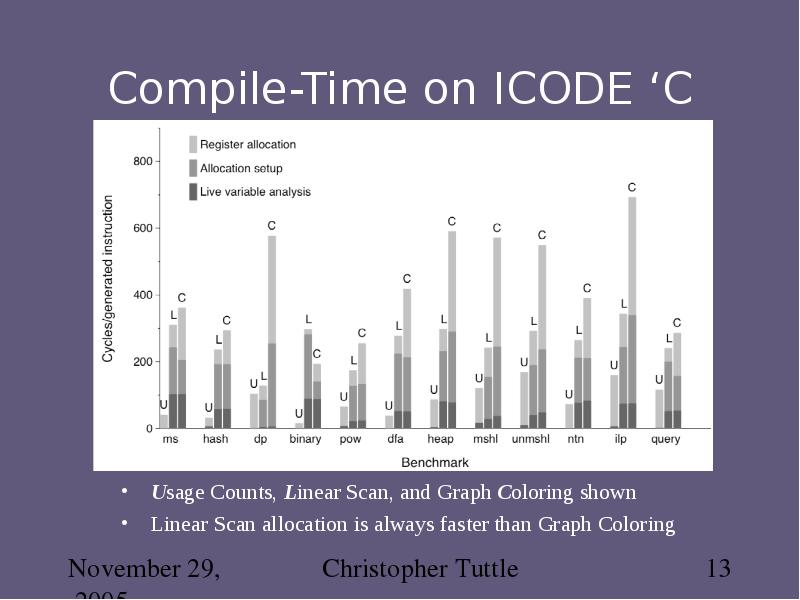
- 13. Compile-Time on ICODE ‘C Usage Counts, Linear Scan, and Graph Coloring
- 14. Compile-Time on SUIF Linear Scan allocation is around twice as fast
- 15. Pathological Cases N live variable ranges interfering over the entire program
- 16. Compile-Time Bottom Line Linear Scan is faster than Binpacking and
- 17. Run-Time on ICODE ‘C Usage Counts, Linear Scan, and Graph Coloring
- 18. Run-Time on SUIF / SPEC Usage Counts, Linear Scan, Graph Coloring
- 19. Evaluation Summary Linear Scan is faster than Binpacking and Graph
- 20. Conclusions Linear Scan is a faster alternative to Graph Coloring for
- 21. Questions?
- 22. Скачать презентацию


Слайды и текст этой презентации
Слайд 1
Описание слайда:
Linear Scan Register Allocation
Massimiliano Poletto (MIT)
and
Vivek Sarkar (IBM Watson)
Слайд 2
Описание слайда:
Introduction
Register Allocation: The problem of mapping an unbounded number of virtual registers to physical ones
Good register allocation is necessary for performance
Several SPEC benchmarks benefit an order of magnitude from good allocation
Core memory (and even caches) are slow relative to registers
Register allocation is expensive
Most algorithms are variations on Graph Coloring
Non-trivial algorithms require liveness analysis
Allocators can be quadratic in the number of live intervals
Слайд 3
Описание слайда:
Motivation
On-line compilers need generate code quickly
Just-In-Time compilation
Dynamic code generation in language extensions (‘C)
Interactive environments (IDEs, etc.)
Sacrifice code speed for a quicker compile.
Find a faster allocation algorithm
Compare it to the best allocation algorithms
Слайд 4
Описание слайда:
Definitions
Live interval: A sequence of instructions, outside of which a variable v is never live.
(For this paper, intervals are assumed to be contiguous)
Spilling: Variables are spilled when they are stored on the stack
Interference: Two live ranges interfere if they are simultaneously live in a program.
Слайд 5
Описание слайда:
Ye Olde Graph Coloring
Model allocation as a graph coloring problem
Nodes represent live ranges
Edges represent interferences
Colorings are safe allocations
Order V2 in live variables
(See Chaitin82 on PLDI list)
Слайд 6
Описание слайда:
Linear Scan Algorithm
Compute live variable analysis
Walk through intervals in order:
Throw away expired live intervals.
If there is contention, spill the interval that ends furthest in the future.
Allocate new interval to any free register
Complexity: O(V log R) for V vars and R registers
Слайд 7
Описание слайда:
Example With Two Registers
1. Active = < A >
Слайд 8
Описание слайда:
Example With Two Registers
1. Active = < A >
2. Active = < A, B >
Слайд 9
Описание слайда:
Example With Two Registers
1. Active = < A >
2. Active = < A, B >
3. Active = < A, B > ; Spill = < C >
Слайд 10
Описание слайда:
Example With Two Registers
1. Active = < A >
2. Active = < A, B >
3. Active = < A, B > ; Spill = < C >
4. Active = < D, B > ; Spill = < C >
Слайд 11
Описание слайда:
Example With Two Registers
1. Active = < A >
2. Active = < A, B >
3. Active = < A, B > ; Spill = < C >
4. Active = < D, B > ; Spill = < C >
5. Active = < D, E > ; Spill = < C >
Слайд 12
Описание слайда:
Evaluation Overview
Evaluate both compile-time and run-time performance
Two Implementations
ICODE dynamic ‘C compiler; (already had efficient allocators)
Benchmarks from the previously used ICODE suite (all small)
Compare against tuned graph-coloring and usage counts
Also evaluate a few pathological program examples
Machine SUIF
Selected benchmarks from SPEC92 and SPEC95
Compare against graph-coloring, usage counts, and second-chance binpacking
Compare both metrics on both implementations
Слайд 13
Описание слайда:
Compile-Time on ICODE ‘C
Usage Counts, Linear Scan, and Graph Coloring shown
Linear Scan allocation is always faster than Graph Coloring
Слайд 14
Описание слайда:
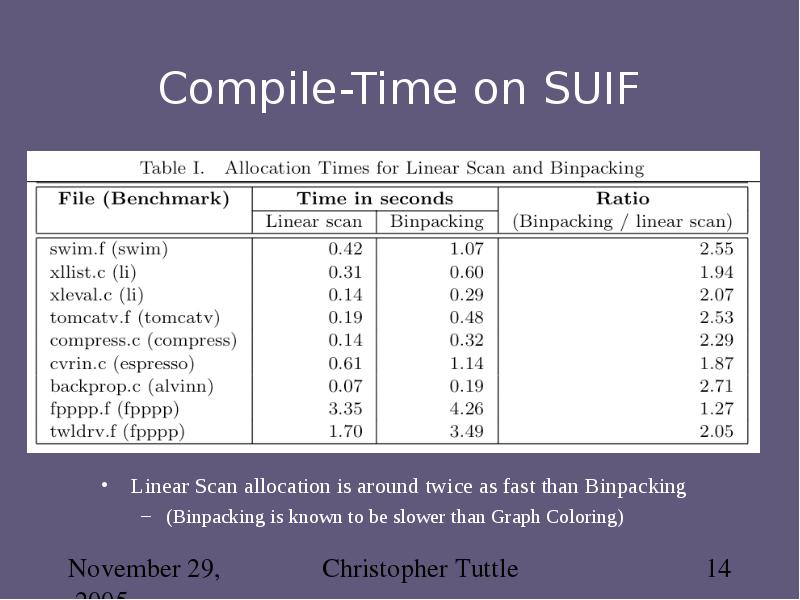
Compile-Time on SUIF
Linear Scan allocation is around twice as fast than Binpacking
(Binpacking is known to be slower than Graph Coloring)
Слайд 15
Описание слайда:
Pathological Cases
N live variable ranges interfering over the entire program execution
Other pathological cases omitted for brevity; see Figure 6.
Слайд 16
Описание слайда:
Compile-Time Bottom Line
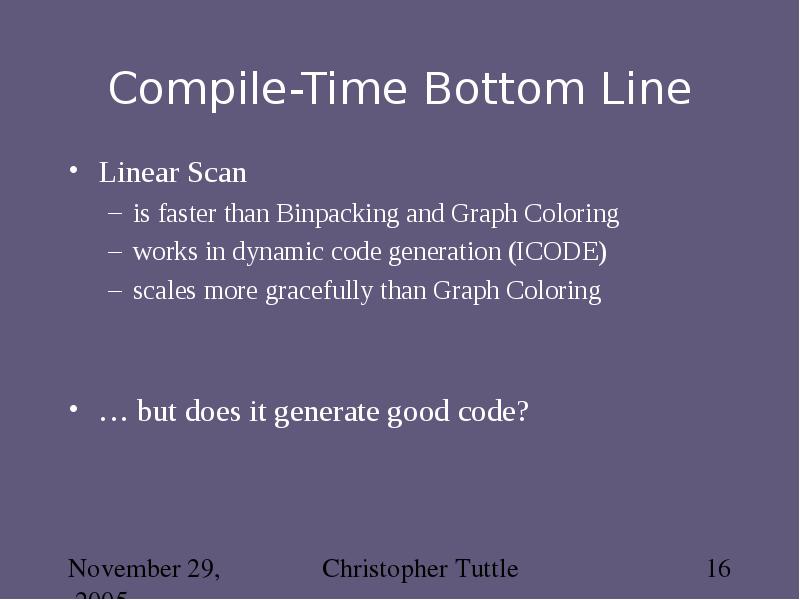
Linear Scan
is faster than Binpacking and Graph Coloring
works in dynamic code generation (ICODE)
scales more gracefully than Graph Coloring
… but does it generate good code?
Слайд 17
Описание слайда:
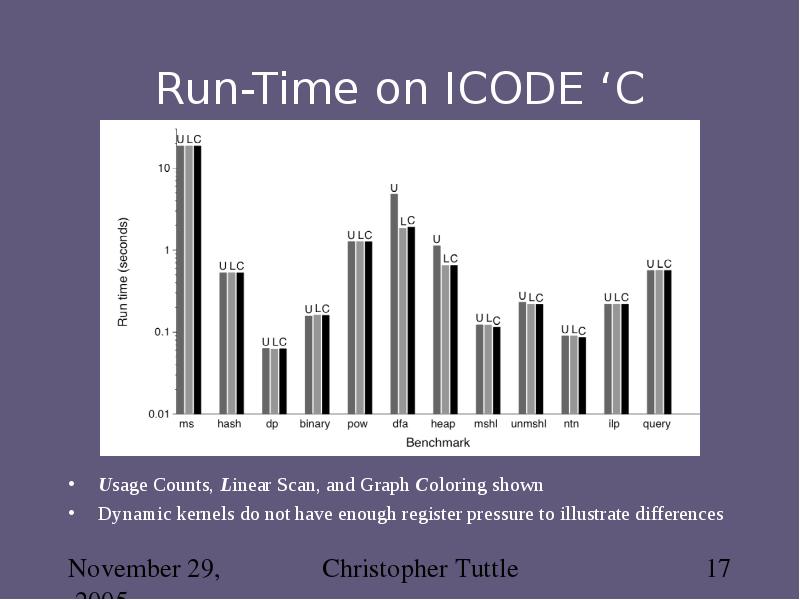
Run-Time on ICODE ‘C
Usage Counts, Linear Scan, and Graph Coloring shown
Dynamic kernels do not have enough register pressure to illustrate differences
Слайд 18
Описание слайда:
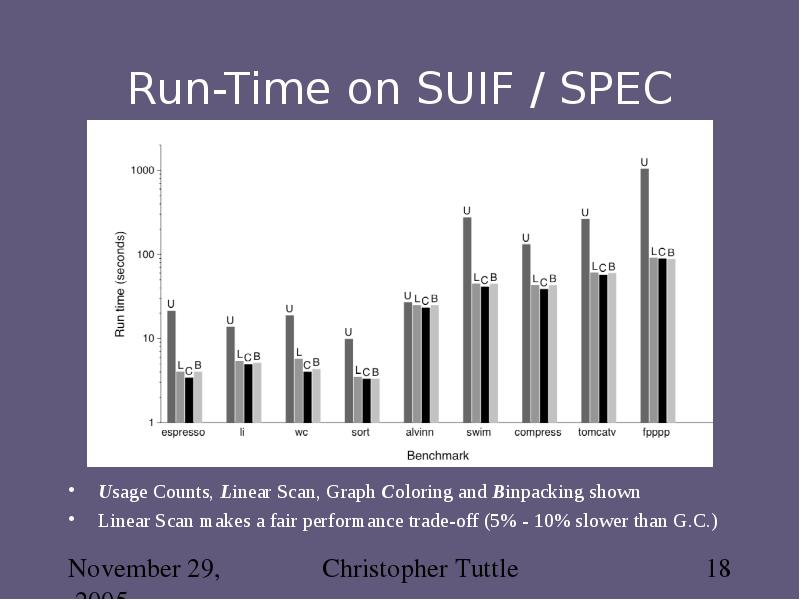
Run-Time on SUIF / SPEC
Usage Counts, Linear Scan, Graph Coloring and Binpacking shown
Linear Scan makes a fair performance trade-off (5% - 10% slower than G.C.)
Слайд 19
Описание слайда:
Evaluation Summary
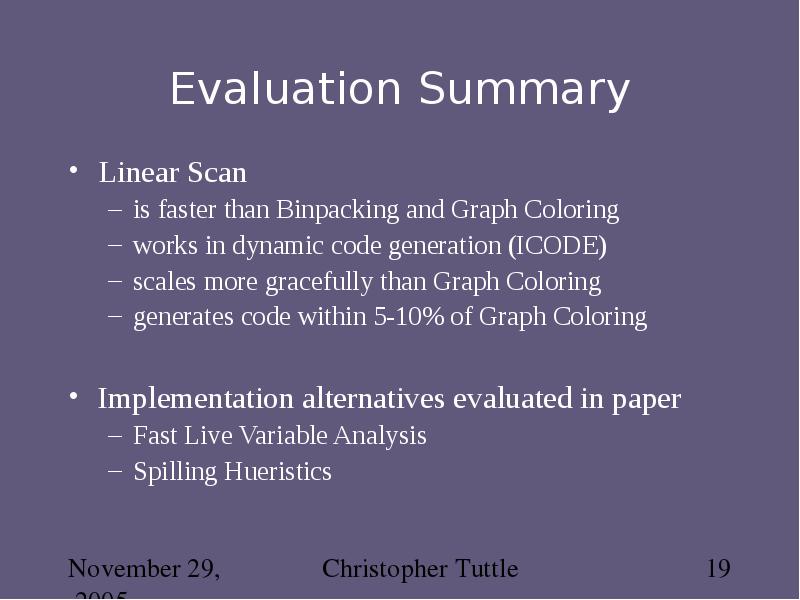
Linear Scan
is faster than Binpacking and Graph Coloring
works in dynamic code generation (ICODE)
scales more gracefully than Graph Coloring
generates code within 5-10% of Graph Coloring
Implementation alternatives evaluated in paper
Fast Live Variable Analysis
Spilling Hueristics
Слайд 20
Описание слайда:
Conclusions
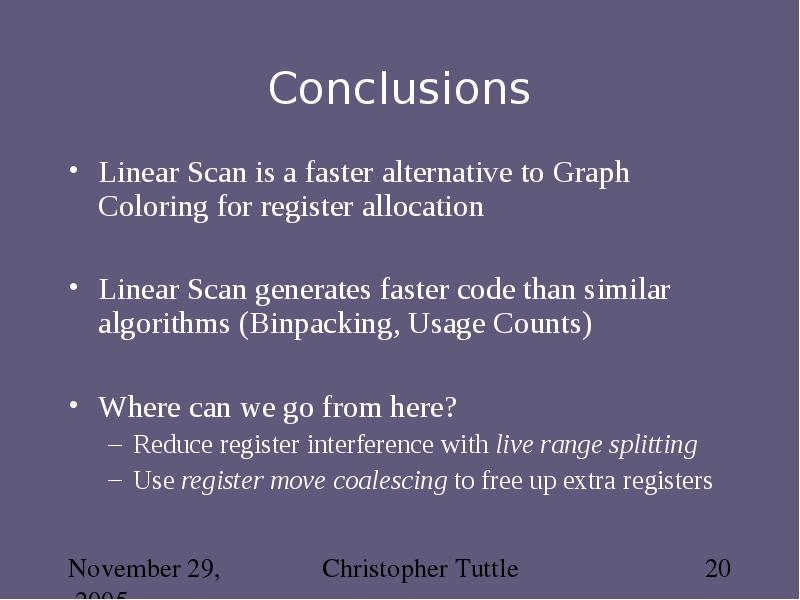
Linear Scan is a faster alternative to Graph Coloring for register allocation
Linear Scan generates faster code than similar algorithms (Binpacking, Usage Counts)
Where can we go from here?
Reduce register interference with live range splitting
Use register move coalescing to free up extra registers
Слайд 21
Описание слайда:
Questions?
Скачать презентацию на тему Linear scan. Register allocation можно ниже: