Operating system. Processes презентация
Содержание
- 4. Introduction מערכות המחשב (ומערכות ההפעלה) הראשונות: אפשרו הרצת תכנית אחת (בלבד)
- 5. מטרות השיעור להציג את ה"תהליך" (process) – תוכנית בהרצה (program in
- 6. Process Concept בקורס נשתמש במושגים job ו- process כחליפיים Jobs –
- 7. Process in Memory
- 8. Program and Process
- 9. Process State במהלך ריצתו משנה התהליך את מצבו (state): new: The
- 10. Diagram of Process State
- 11. Process Control Block (PCB) Information associated with each process Process state
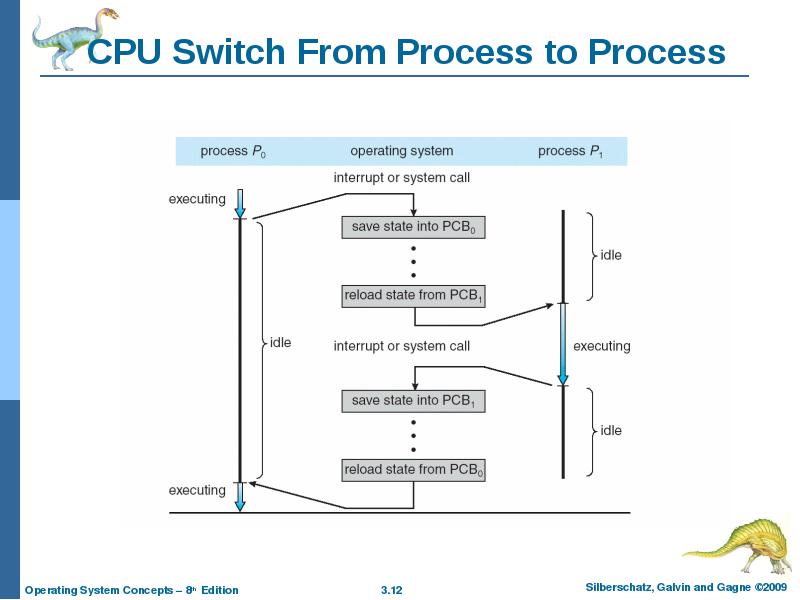
- 12. CPU Switch From Process to Process
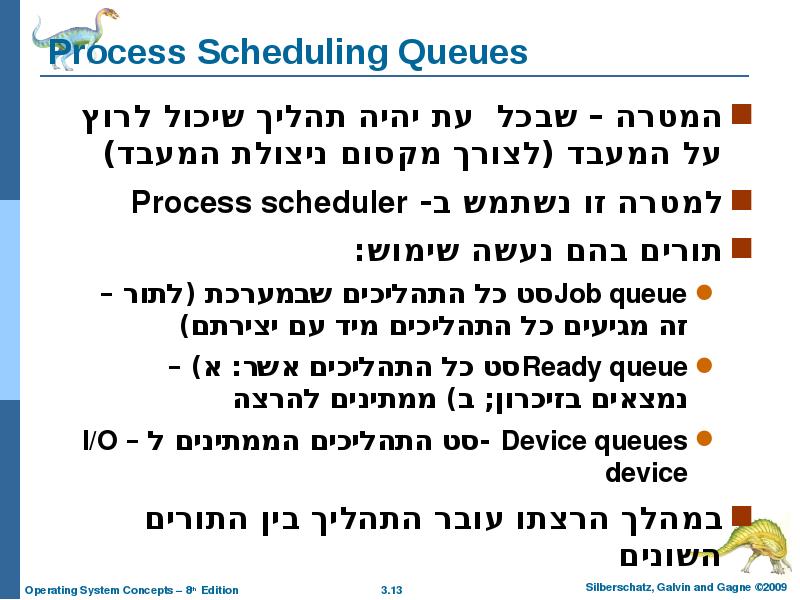
- 13. Process Scheduling Queues המטרה – שבכל עת יהיה תהליך שיכול לרוץ
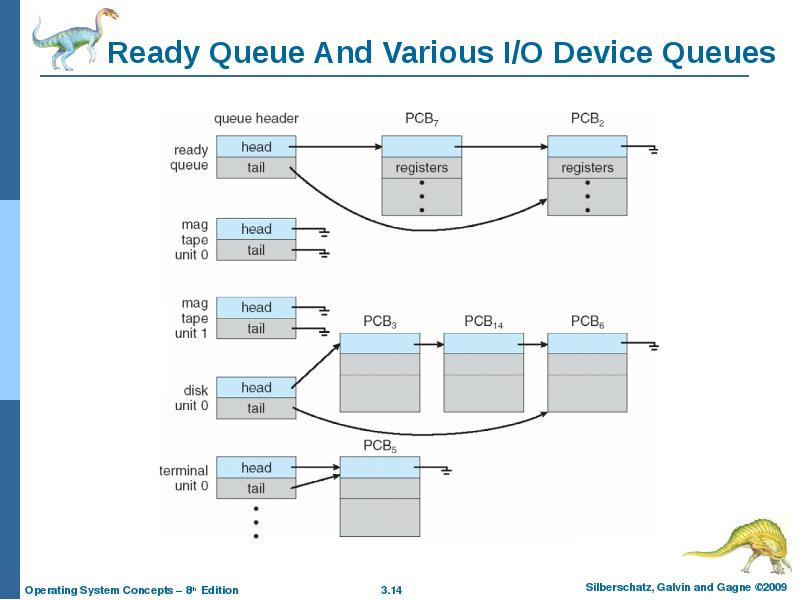
- 14. Ready Queue And Various I/O Device Queues
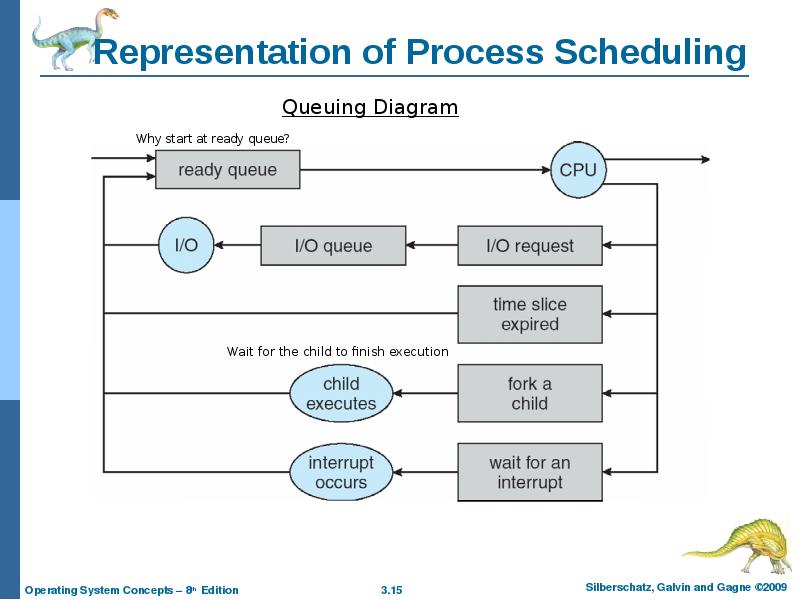
- 15. Representation of Process Scheduling
- 16. Schedulers Long-term scheduler (or job scheduler) – selects which processes should
- 17. Schedulers (Cont) ה- short-term scheduler נכנס לפעולה בצורה תדירה (כל מספר
- 18. Schedulers (Cont) תהליכים מאופיינים כ: I/O bound – מבלים את רוב
- 19. Context Switch כאשר המעבד עובר לטפל בתהליך אחר, המערכת חייבת לשמור
- 21. Process Creation Creating a process – using create process system call
- 22. Process Creation (Cont) Execution Parent and children execute concurrently Parent waits
- 23. Process Creation
- 24. C Program Forking Separate Process int main() { pid_t pid; /*
- 25. Process Termination בסיום פעולתו נדרש התהליך להריץ את הפקודה exit: מערכת
- 26. Interprocess Communication תהליכים צריכים דרך לחלוק ולשתף מידע ביניהם: בין שרצים
- 27. Communications Models
- 28. Producer-Consumer Problem Paradigm for cooperating processes, producer process produces information that
- 29. Bounded-Buffer – Shared-Memory Solution Shared data #define BUFFER_SIZE 10 typedef struct
- 30. Bounded-Buffer – Producer while (true) { /* Produce an item
- 31. Bounded Buffer – Consumer while (true) { while (in
- 32. Interprocess Communication – Message Passing מהווה מכאניזם לתקשורת וסנכרון בין תהליכים
- 33. Direct Communication Processes must name each other explicitly: send (P, message)
- 34. Indirect Communication Messages are directed and received from mailboxes (also referred
- 35. Indirect Communication Operations create a new mailbox send and receive messages
- 36. Indirect Communication Mailbox sharing P1, P2, and P3 share mailbox A
- 37. Synchronization מנגנון ה- message passing יכול להיות מאופיין כ- blocking or
- 38. Buffering Whether direct or indirect, messages must reside in a queue;
- 39. Communications in Client-Server Systems Sockets Remote Procedure Calls Remote Method Invocation
- 40. Sockets A socket is defined as an endpoint for communication Concatenation
- 41. What is a socket? An interface between application and network The
- 42. Socket Communication
- 43. Remote Procedure Calls Remote procedure call (RPC) abstracts procedure calls between
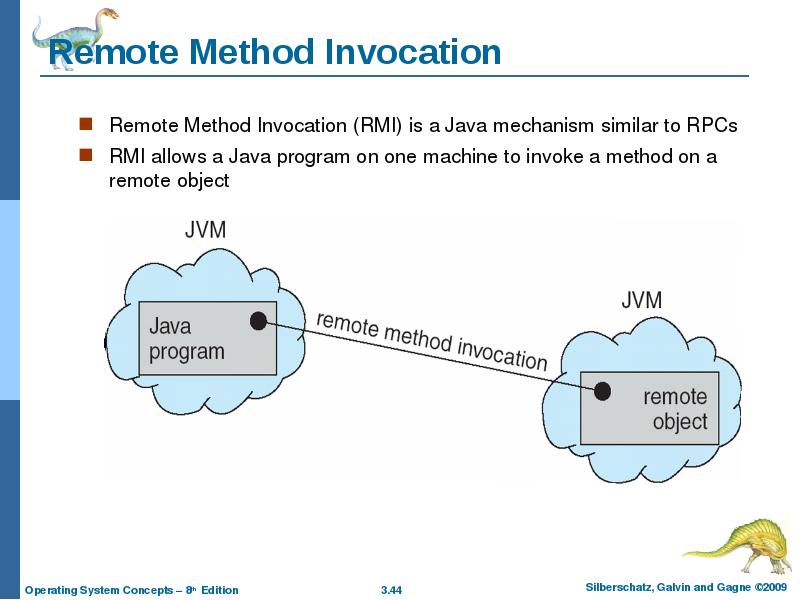
- 44. Remote Method Invocation Remote Method Invocation (RMI) is a Java mechanism
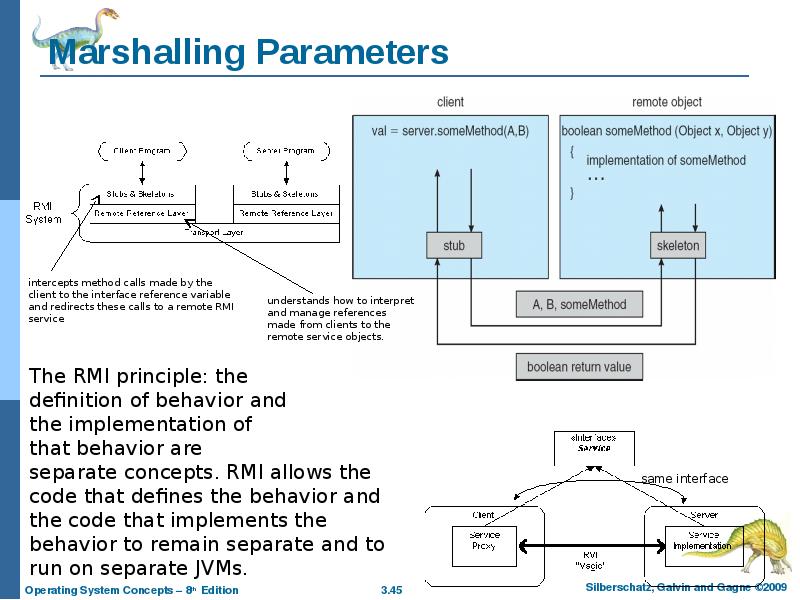
- 45. Marshalling Parameters
- 47. Скачать презентацию
Слайды и текст этой презентации
Слайд 1
Описание слайда:
פרק 3 – תהליכים (Processes)
Слайд 2
Описание слайда:
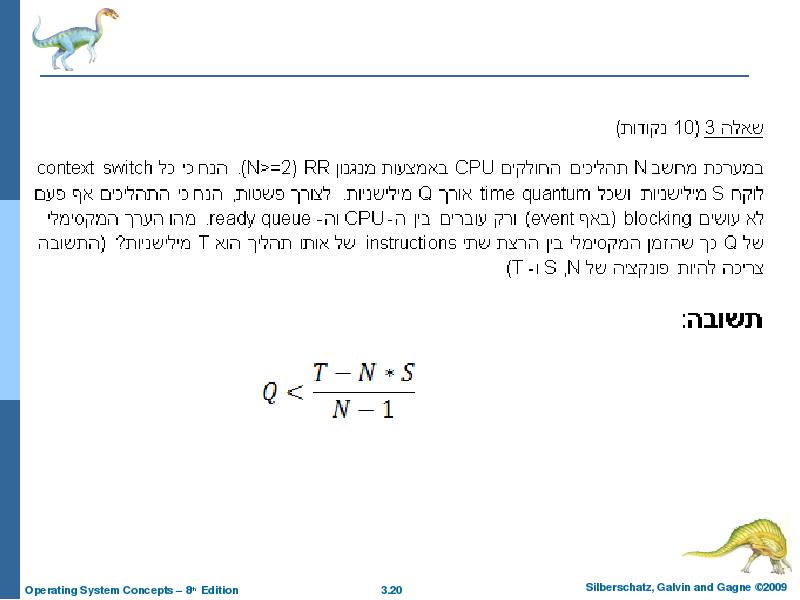
Слайд 3
Описание слайда:
Слайд 4
Описание слайда:
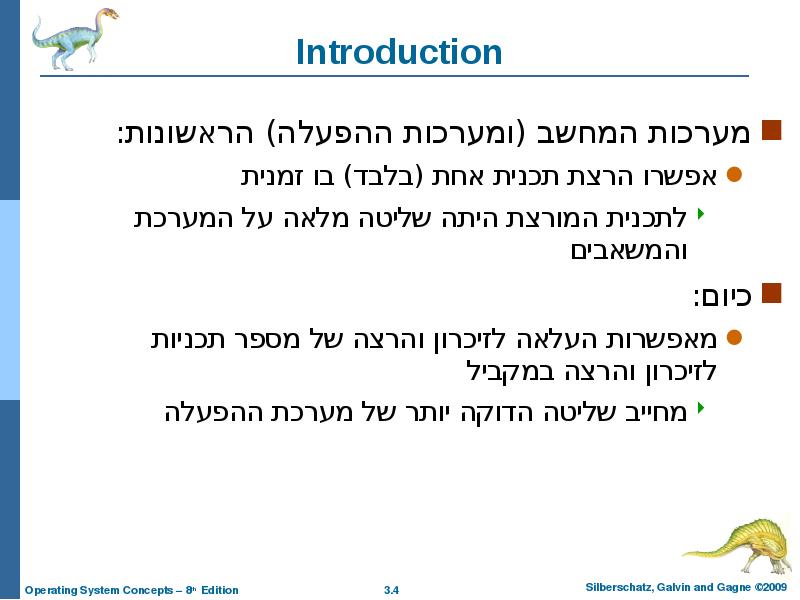
Introduction
מערכות המחשב (ומערכות ההפעלה) הראשונות:
אפשרו הרצת תכנית אחת (בלבד) בו זמנית
לתכנית המורצת היתה שליטה מלאה על המערכת והמשאבים
כיום:
מאפשרות העלאה לזיכרון והרצה של מספר תכניות לזיכרון והרצה במקביל
מחייב שליטה הדוקה יותר של מערכת ההפעלה
Слайд 5
Описание слайда:
מטרות השיעור
להציג את ה"תהליך" (process) – תוכנית בהרצה (program in execution),
לתאר מספר מאפיינים (features) של תהליכים, ובכלל זה תזמון (scheduling), יצירה (creation), עצירה (termination) ותקשורת (communication)
Слайд 6
Описание слайда:
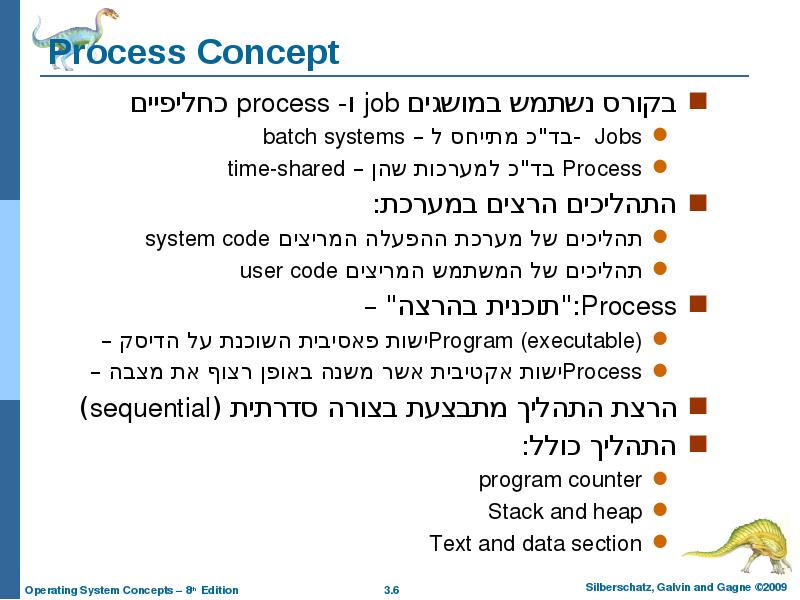
Process Concept
בקורס נשתמש במושגים job ו- process כחליפיים
Jobs – בד"כ מתייחס ל- batch systems
Process – בד"כ למערכות שהן time-shared
התהליכים הרצים במערכת:
תהליכים של מערכת ההפעלה המריצים system code
תהליכים של המשתמש המריצים user code
Process – "תוכנית בהרצה":
Program (executable) – ישות פאסיבית השוכנת על הדיסק
Process – ישות אקטיבית אשר משנה באופן רצוף את מצבה
הרצת התהליך מתבצעת בצורה סדרתית (sequential)
התהליך כולל:
program counter
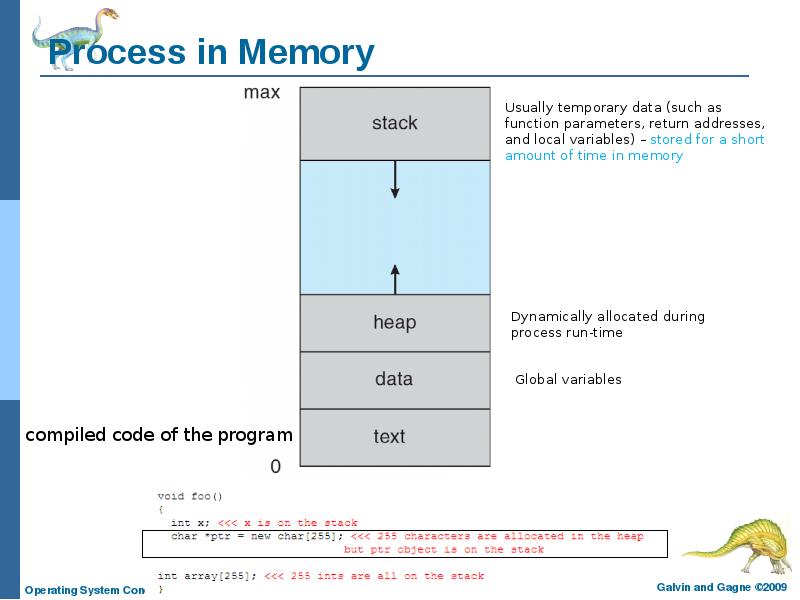
Stack and heap
Text and data section
Слайд 7
Описание слайда:
Process in Memory
Слайд 8
Описание слайда:
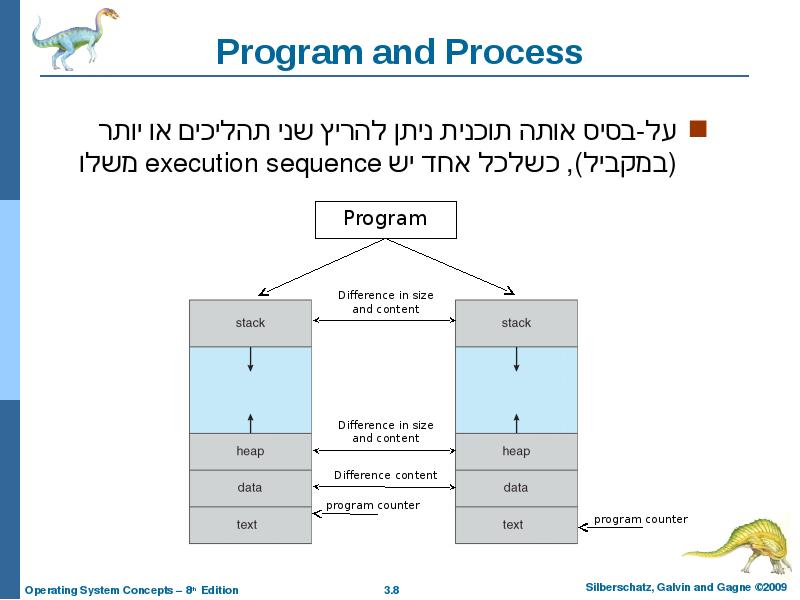
Program and Process
Слайд 9
Описание слайда:
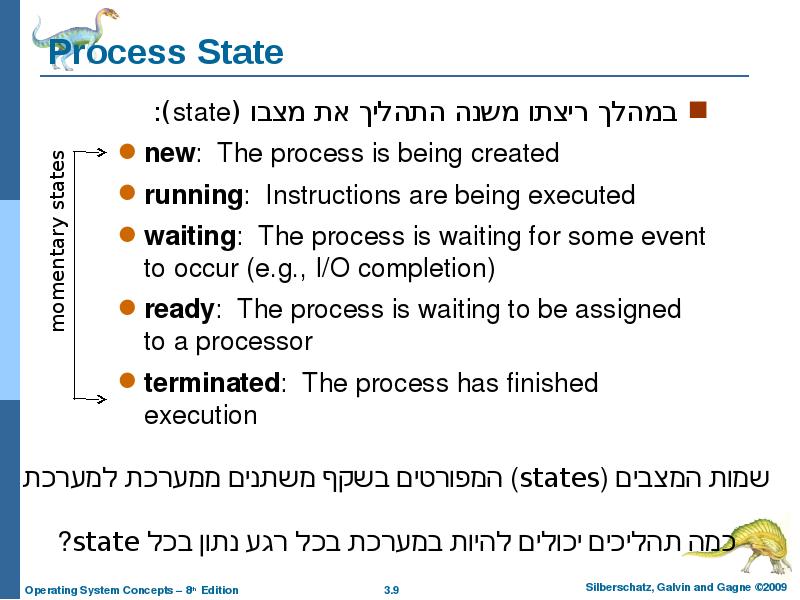
Process State
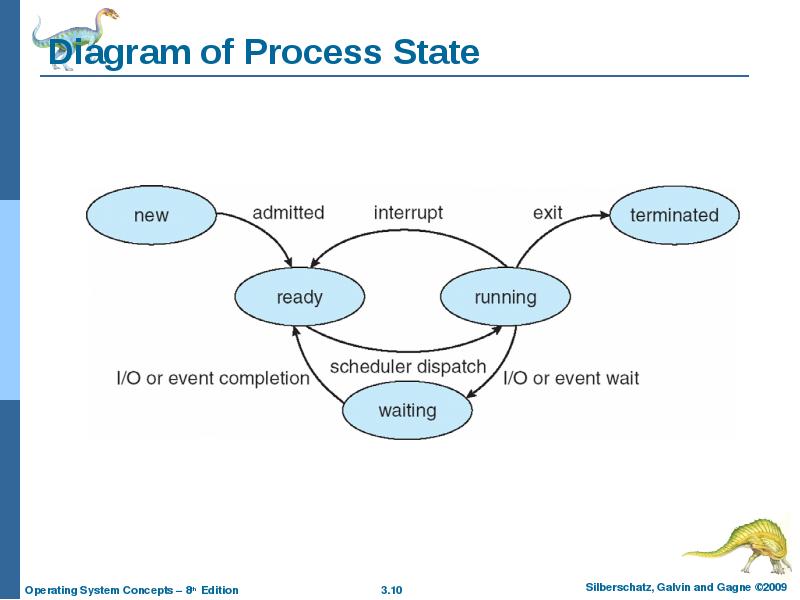
במהלך ריצתו משנה התהליך את מצבו (state):
new: The process is being created
running: Instructions are being executed
waiting: The process is waiting for some event to occur (e.g., I/O completion)
ready: The process is waiting to be assigned to a processor
terminated: The process has finished execution
Слайд 10
Описание слайда:
Diagram of Process State
Слайд 11
Описание слайда:
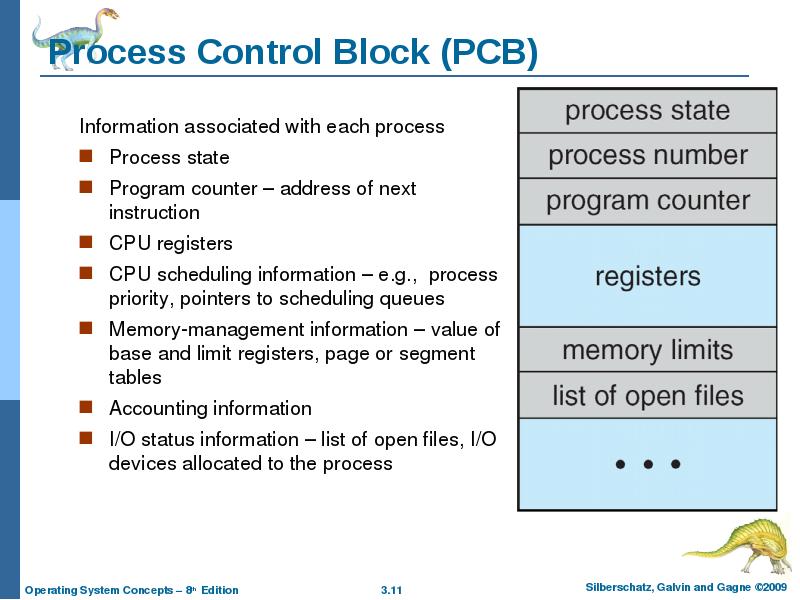
Process Control Block (PCB)
Information associated with each process
Process state
Program counter – address of next instruction
CPU registers
CPU scheduling information – e.g., process priority, pointers to scheduling queues
Memory-management information – value of base and limit registers, page or segment tables
Accounting information
I/O status information – list of open files, I/O devices allocated to the process
Слайд 12
Описание слайда:
CPU Switch From Process to Process
Слайд 13
Описание слайда:
Process Scheduling Queues
המטרה – שבכל עת יהיה תהליך שיכול לרוץ על המעבד (לצורך מקסום ניצולת המעבד)
למטרה זו נשתמש ב- Process scheduler
תורים בהם נעשה שימוש:
Job queue – סט כל התהליכים שבמערכת (לתור זה מגיעים כל התהליכים מיד עם יצירתם)
Ready queue – סט כל התהליכים אשר: א) נמצאים בזיכרון; ב) ממתינים להרצה
Device queues – סט התהליכים הממתינים ל- I/O device
במהלך הרצתו עובר התהליך בין התורים השונים
Слайд 14
Описание слайда:
Ready Queue And Various I/O Device Queues
Слайд 15
Описание слайда:
Representation of Process Scheduling
Слайд 16
Описание слайда:
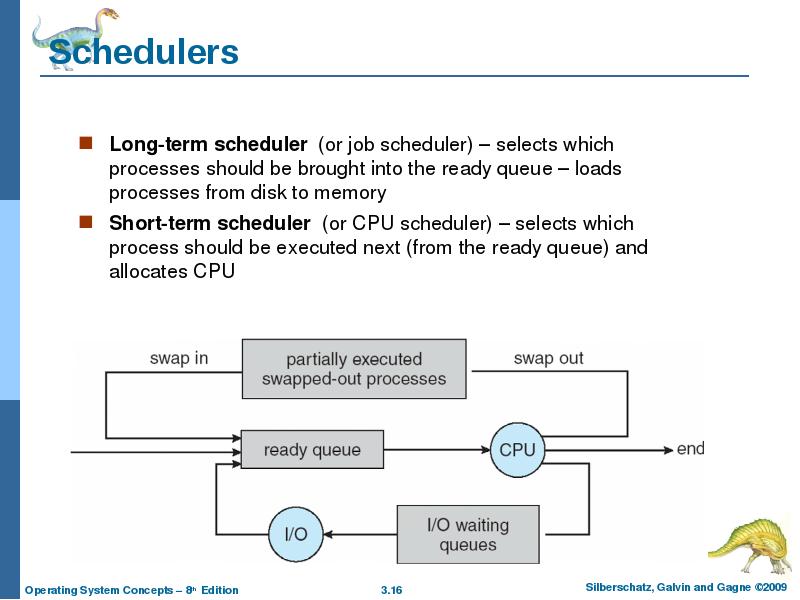
Schedulers
Long-term scheduler (or job scheduler) – selects which processes should be brought into the ready queue – loads processes from disk to memory
Short-term scheduler (or CPU scheduler) – selects which process should be executed next (from the ready queue) and allocates CPU
Слайд 17
Описание слайда:
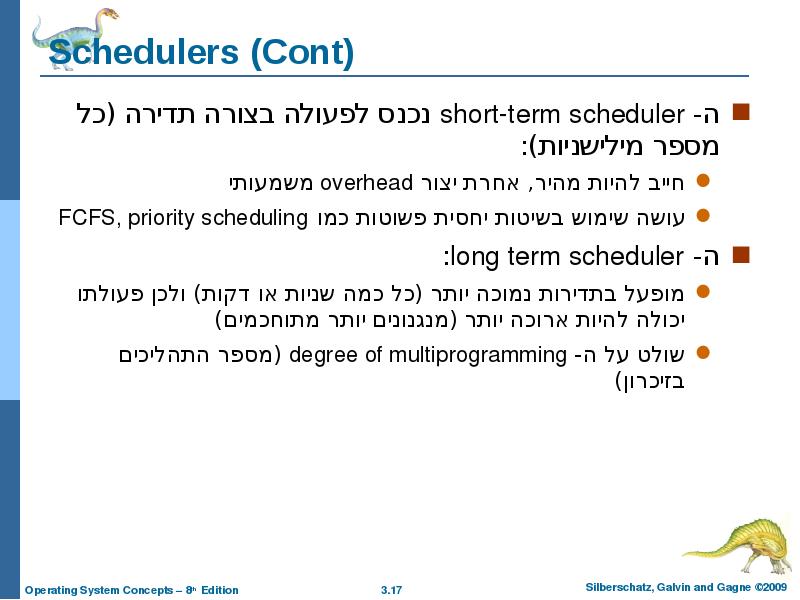
Schedulers (Cont)
ה- short-term scheduler נכנס לפעולה בצורה תדירה (כל מספר מילישניות):
חייב להיות מהיר, אחרת יצור overhead משמעותי
עושה שימוש בשיטות יחסית פשוטות כמו FCFS, priority scheduling
ה- long term scheduler:
מופעל בתדירות נמוכה יותר (כל כמה שניות או דקות) ולכן פעולתו יכולה להיות ארוכה יותר (מנגנונים יותר מתוחכמים)
שולט על ה- degree of multiprogramming (מספר התהליכים בזיכרון)
Слайд 18
Описание слайда:
Schedulers (Cont)
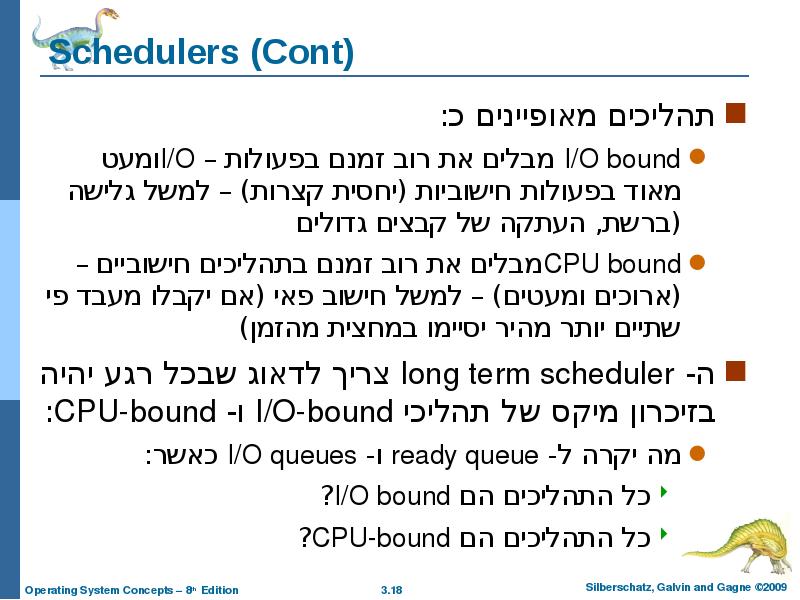
תהליכים מאופיינים כ:
I/O bound – מבלים את רוב זמנם בפעולות I/O ומעט מאוד בפעולות חישוביות (יחסית קצרות) – למשל גלישה ברשת, העתקה של קבצים גדולים)
CPU bound – מבלים את רוב זמנם בתהליכים חישוביים (ארוכים ומעטים) – למשל חישוב פאי (אם יקבלו מעבד פי שתיים יותר מהיר יסיימו במחצית מהזמן)
ה- long term scheduler צריך לדאוג שבכל רגע יהיה בזיכרון מיקס של תהליכי I/O-bound ו- CPU-bound:
מה יקרה ל- ready queue ו- I/O queues כאשר:
כל התהליכים הם I/O bound?
כל התהליכים הם CPU-bound?
Слайд 19
Описание слайда:
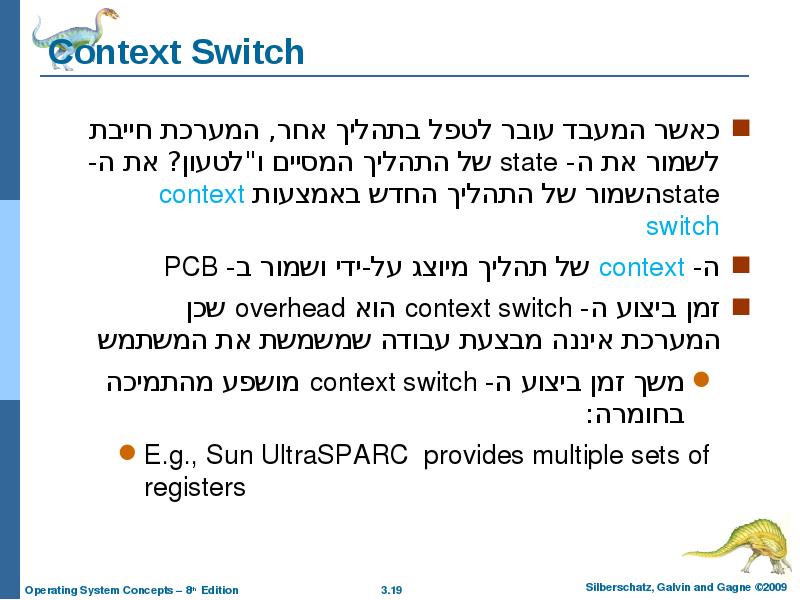
Context Switch
כאשר המעבד עובר לטפל בתהליך אחר, המערכת חייבת לשמור את ה- state של התהליך המסיים ו"לטעון? את ה- stateהשמור של התהליך החדש באמצעות context switch
ה- context של תהליך מיוצג על-ידי ושמור ב- PCB
זמן ביצוע ה- context switch הוא overhead שכן המערכת איננה מבצעת עבודה שמשמשת את המשתמש
משך זמן ביצוע ה- context switch מושפע מהתמיכה בחומרה:
E.g., Sun UltraSPARC provides multiple sets of registers
Слайд 20
Описание слайда:
Слайд 21
Описание слайда:
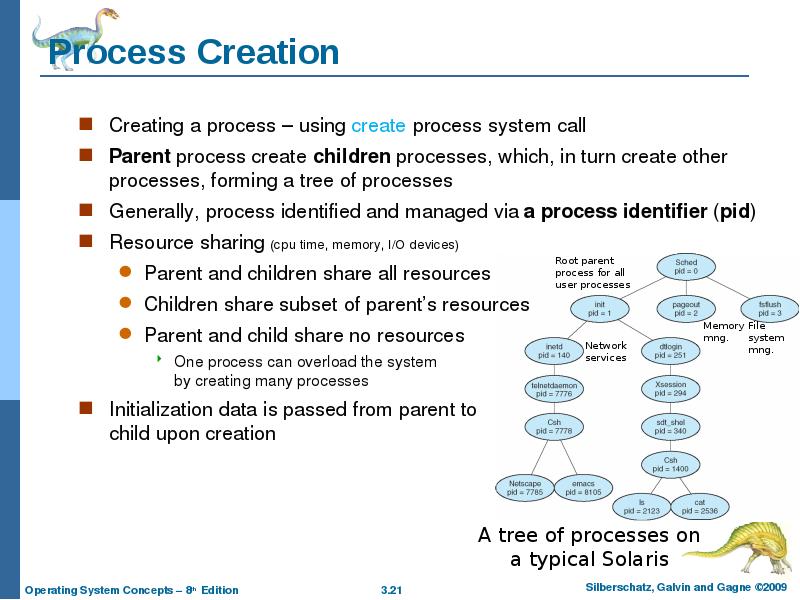
Process Creation
Creating a process – using create process system call
Parent process create children processes, which, in turn create other processes, forming a tree of processes
Generally, process identified and managed via a process identifier (pid)
Resource sharing (cpu time, memory, I/O devices)
Parent and children share all resources
Children share subset of parent’s resources
Parent and child share no resources
One process can overload the system
by creating many processes
Initialization data is passed from parent to
child upon creation
Слайд 22
Описание слайда:
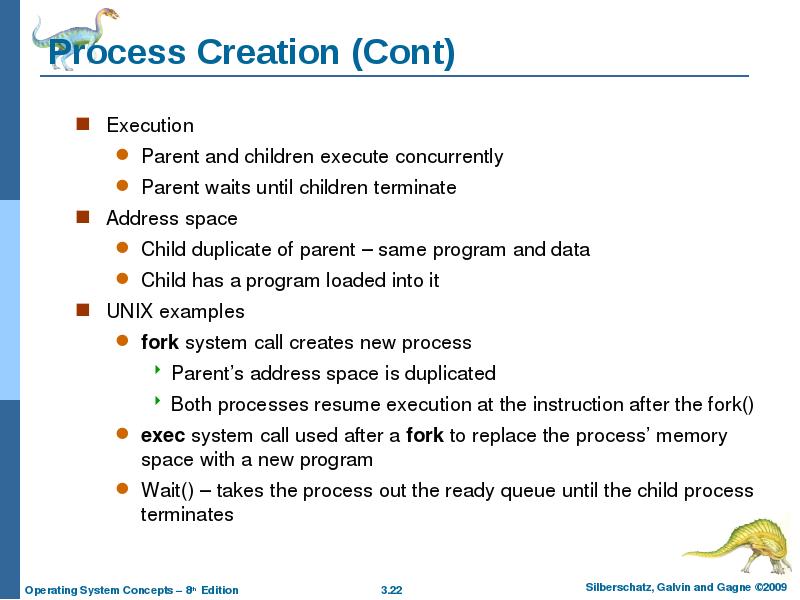
Process Creation (Cont)
Execution
Parent and children execute concurrently
Parent waits until children terminate
Address space
Child duplicate of parent – same program and data
Child has a program loaded into it
UNIX examples
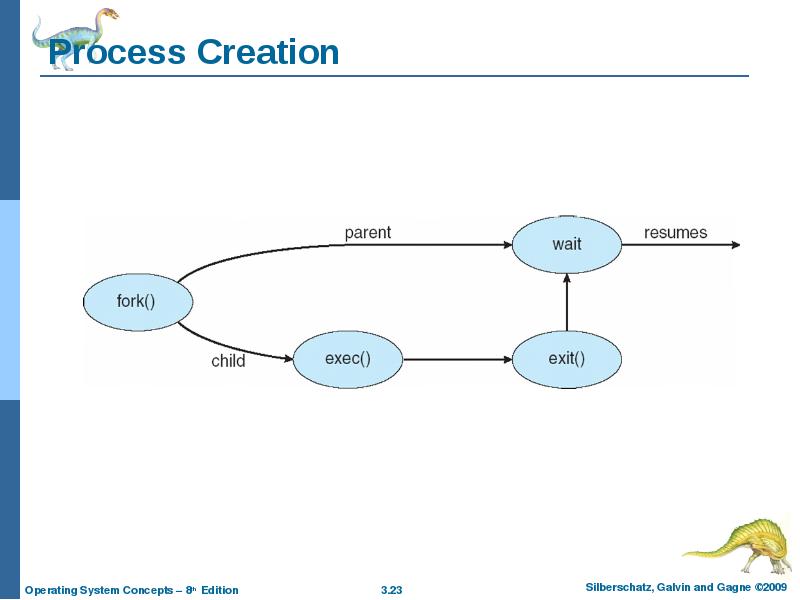
fork system call creates new process
Parent’s address space is duplicated
Both processes resume execution at the instruction after the fork()
exec system call used after a fork to replace the process’ memory space with a new program
Wait() – takes the process out the ready queue until the child process terminates
Слайд 23
Описание слайда:
Process Creation
Слайд 24
Описание слайда:
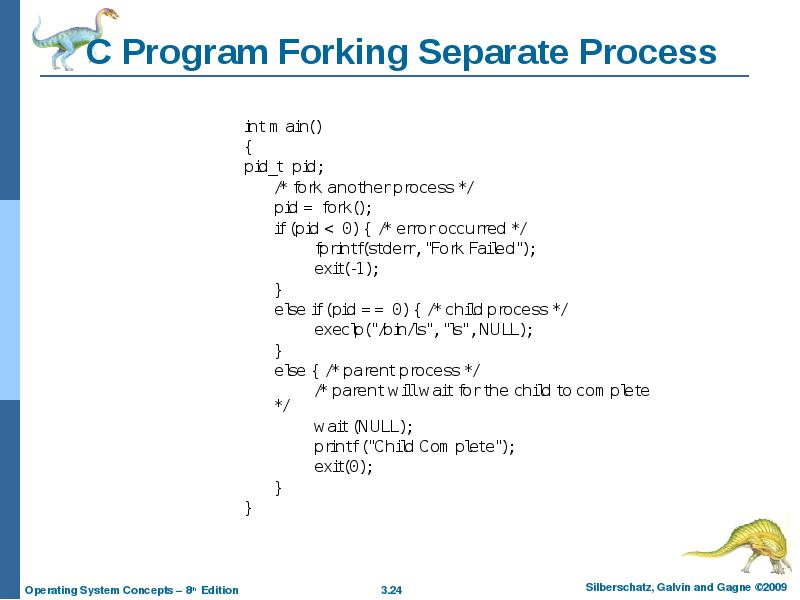
C Program Forking Separate Process
int main()
{
pid_t pid;
/* fork another process */
pid = fork();
if (pid < 0) { /* error occurred */
fprintf(stderr, "Fork Failed");
exit(-1);
}
else if (pid == 0) { /* child process */
execlp("/bin/ls", "ls", NULL);
}
else { /* parent process */
/* parent will wait for the child to complete */
wait (NULL);
printf ("Child Complete");
exit(0);
}
}
Слайд 25
Описание слайда:
Process Termination
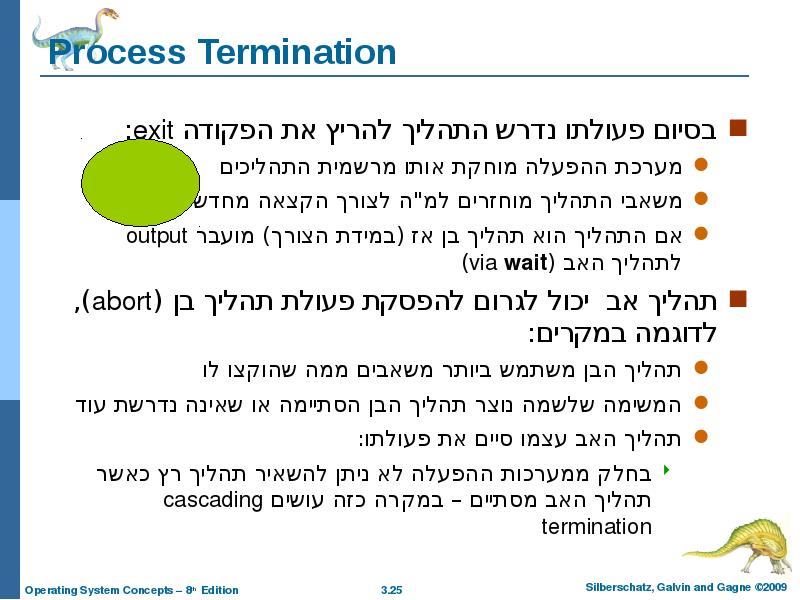
בסיום פעולתו נדרש התהליך להריץ את הפקודה exit:
מערכת ההפעלה מוחקת אותו מרשמית התהליכים
משאבי התהליך מוחזרים למ"ה לצורך הקצאה מחדש
אם התהליך הוא תהליך בן אז (במידת הצורך) מועבר output לתהליך האב (via wait)
תהליך אב יכול לגרום להפסקת פעולת תהליך בן (abort), לדוגמה במקרים:
תהליך הבן משתמש ביותר משאבים ממה שהוקצו לו
המשימה שלשמה נוצר תהליך הבן הסתיימה או שאינה נדרשת עוד
תהליך האב עצמו סיים את פעולתו:
בחלק ממערכות ההפעלה לא ניתן להשאיר תהליך רץ כאשר תהליך האב מסתיים – במקרה כזה עושים cascading termination
Слайд 26
Описание слайда:
Interprocess Communication
תהליכים צריכים דרך לחלוק ולשתף מידע ביניהם:
בין שרצים באותה מערכת ובין שרצים במערכות שונות
התמיכה בשיתוף מידע היא באמצעות IPC (interprocess communication)
שני מודלים של IPC:
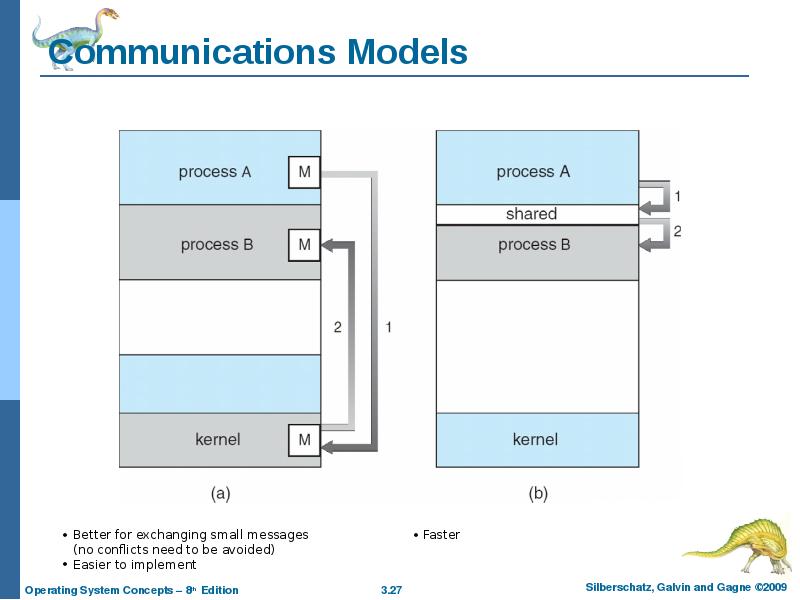
Shared memory – usually resides in the address space of creating process
Message passing
Слайд 27
Описание слайда:
Communications Models
Слайд 28
Описание слайда:
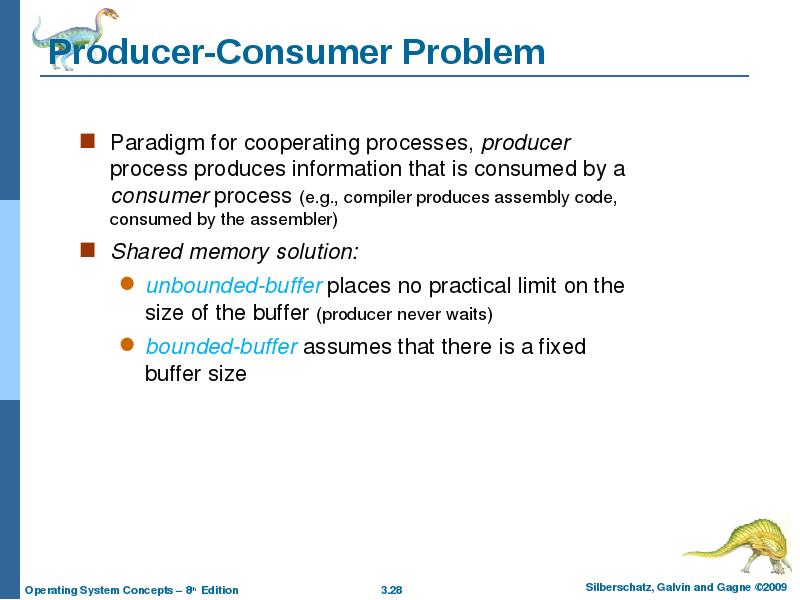
Producer-Consumer Problem
Paradigm for cooperating processes, producer process produces information that is consumed by a consumer process (e.g., compiler produces assembly code, consumed by the assembler)
Shared memory solution:
unbounded-buffer places no practical limit on the size of the buffer (producer never waits)
bounded-buffer assumes that there is a fixed buffer size
Слайд 29
Описание слайда:
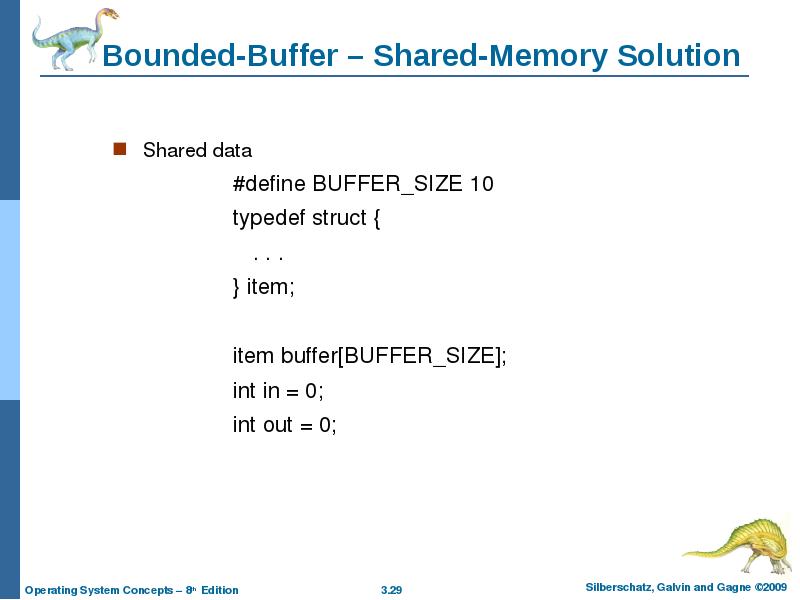
Bounded-Buffer – Shared-Memory Solution
Shared data
#define BUFFER_SIZE 10
typedef struct {
. . .
} item;
item buffer[BUFFER_SIZE];
int in = 0;
int out = 0;
Слайд 30
Описание слайда:
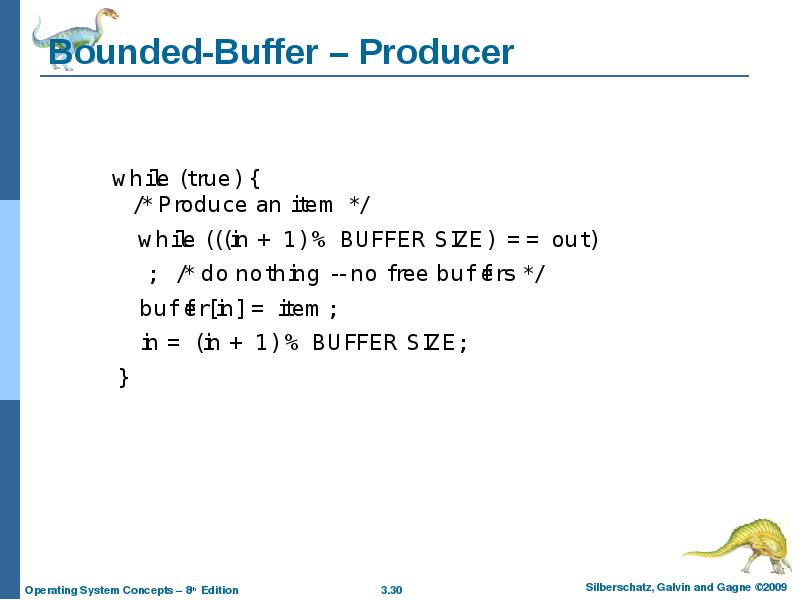
Bounded-Buffer – Producer
while (true) {
/* Produce an item */
while (((in + 1) % BUFFER SIZE) == out)
; /* do nothing -- no free buffers */
buffer[in] = item;
in = (in + 1) % BUFFER SIZE;
}
Слайд 31
Описание слайда:
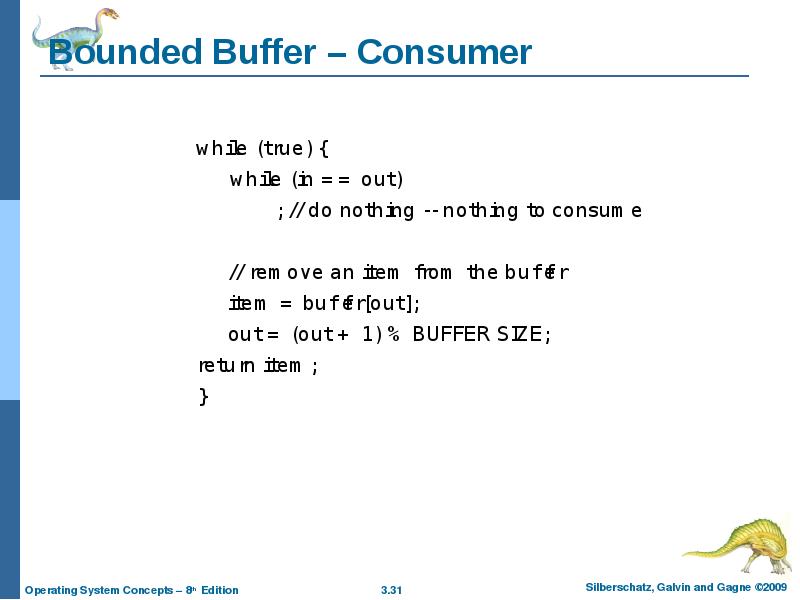
Bounded Buffer – Consumer
while (true) {
while (in == out)
; // do nothing -- nothing to consume
// remove an item from the buffer
item = buffer[out];
out = (out + 1) % BUFFER SIZE;
return item;
}
Слайд 32
Описание слайда:
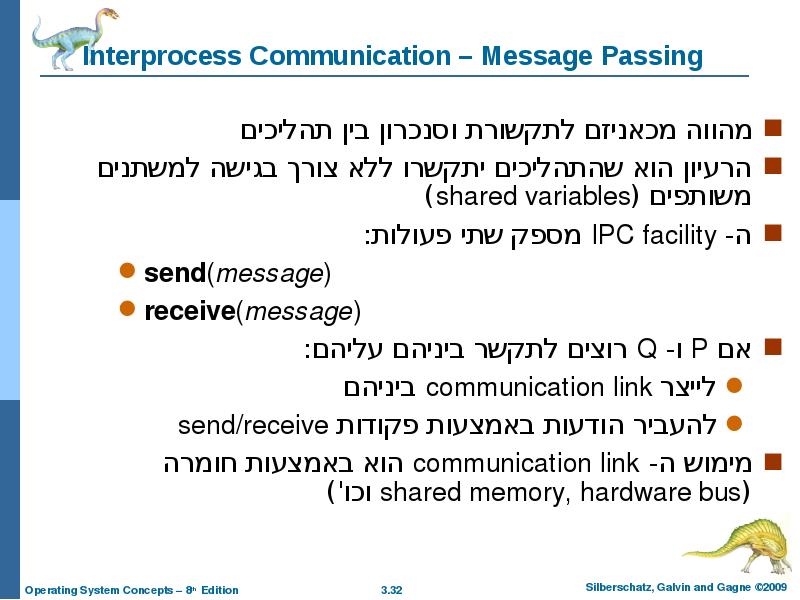
Interprocess Communication – Message Passing
מהווה מכאניזם לתקשורת וסנכרון בין תהליכים
הרעיון הוא שהתהליכים יתקשרו ללא צורך בגישה למשתנים משותפים (shared variables)
ה- IPC facility מספק שתי פעולות:
send(message)
receive(message)
אם P ו- Q רוצים לתקשר ביניהם עליהם:
לייצר communication link ביניהם
להעביר הודעות באמצעות פקודות send/receive
מימוש ה- communication link הוא באמצעות חומרה (shared memory, hardware bus וכו')
Слайд 33
Описание слайда:
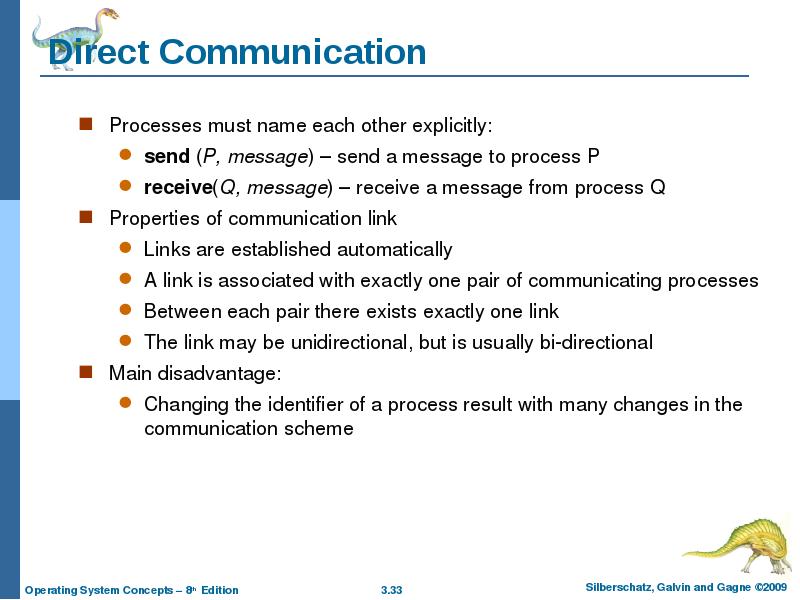
Direct Communication
Processes must name each other explicitly:
send (P, message) – send a message to process P
receive(Q, message) – receive a message from process Q
Properties of communication link
Links are established automatically
A link is associated with exactly one pair of communicating processes
Between each pair there exists exactly one link
The link may be unidirectional, but is usually bi-directional
Main disadvantage:
Changing the identifier of a process result with many changes in the communication scheme
Слайд 34
Описание слайда:
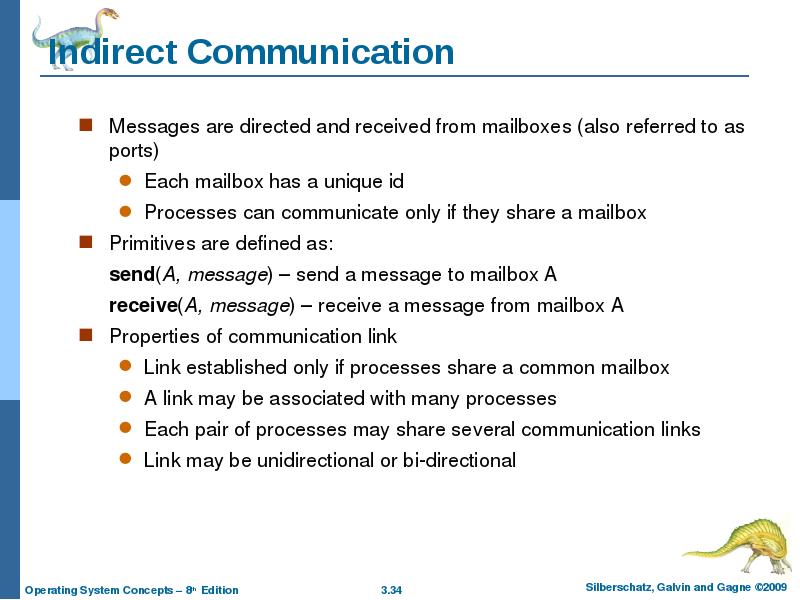
Indirect Communication
Messages are directed and received from mailboxes (also referred to as ports)
Each mailbox has a unique id
Processes can communicate only if they share a mailbox
Primitives are defined as:
send(A, message) – send a message to mailbox A
receive(A, message) – receive a message from mailbox A
Properties of communication link
Link established only if processes share a common mailbox
A link may be associated with many processes
Each pair of processes may share several communication links
Link may be unidirectional or bi-directional
Слайд 35
Описание слайда:
Indirect Communication
Operations
create a new mailbox
send and receive messages through mailbox
destroy a mailbox
Слайд 36
Описание слайда:
Indirect Communication
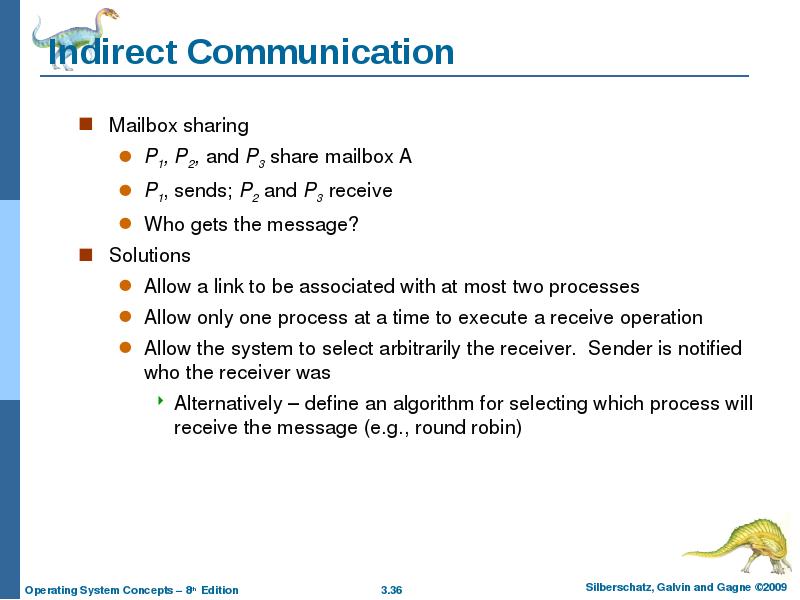
Mailbox sharing
P1, P2, and P3 share mailbox A
P1, sends; P2 and P3 receive
Who gets the message?
Solutions
Allow a link to be associated with at most two processes
Allow only one process at a time to execute a receive operation
Allow the system to select arbitrarily the receiver. Sender is notified who the receiver was
Alternatively – define an algorithm for selecting which process will receive the message (e.g., round robin)
Слайд 37
Описание слайда:
Synchronization
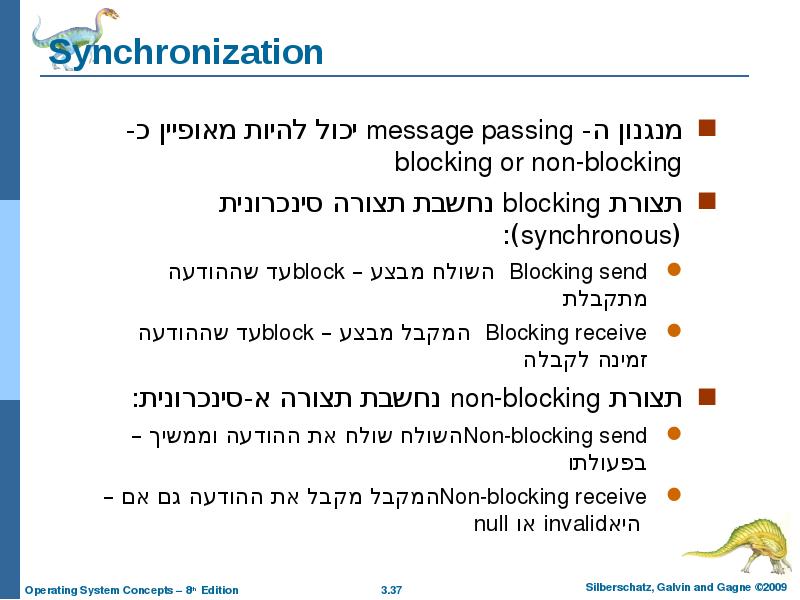
מנגנון ה- message passing יכול להיות מאופיין כ- blocking or non-blocking
תצורת blocking נחשבת תצורה סינכרונית (synchronous):
Blocking send – השולח מבצע block עד שההודעה מתקבלת
Blocking receive – המקבל מבצע block עד שההודעה זמינה לקבלה
תצורת non-blocking נחשבת תצורה א-סינכרונית:
Non-blocking send – השולח שולח את ההודעה וממשיך בפעולתו
Non-blocking receive – המקבל מקבל את ההודעה גם אם היא invalid או null
Слайд 38
Описание слайда:
Buffering
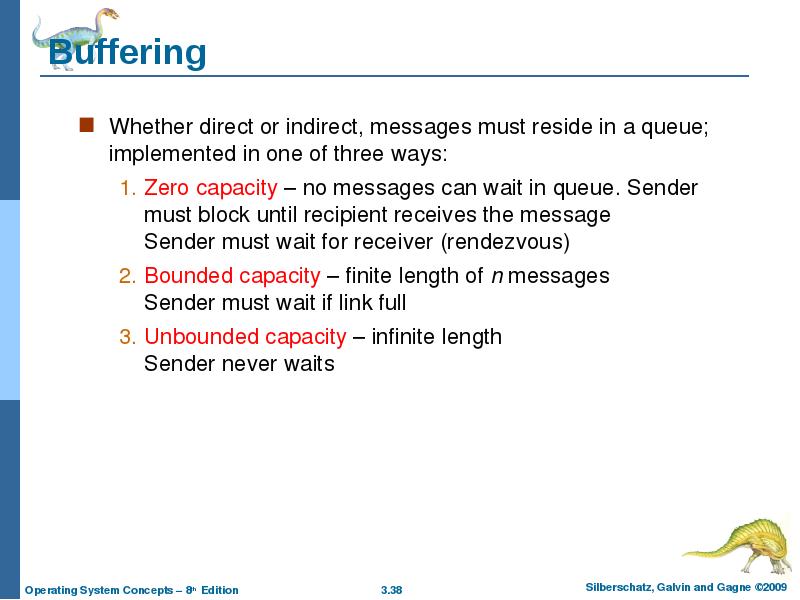
Whether direct or indirect, messages must reside in a queue; implemented in one of three ways:
1. Zero capacity – no messages can wait in queue. Sender must block until recipient receives the message
Sender must wait for receiver (rendezvous)
2. Bounded capacity – finite length of n messages
Sender must wait if link full
3. Unbounded capacity – infinite length
Sender never waits
Слайд 39
Описание слайда:
Communications in Client-Server Systems
Sockets
Remote Procedure Calls
Remote Method Invocation (Java)
Слайд 40
Описание слайда:
Sockets
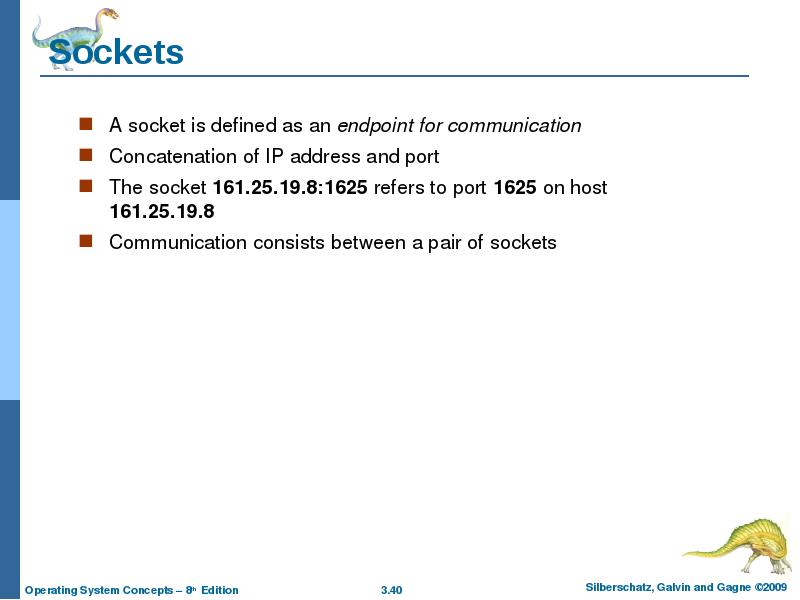
A socket is defined as an endpoint for communication
Concatenation of IP address and port
The socket 161.25.19.8:1625 refers to port 1625 on host 161.25.19.8
Communication consists between a pair of sockets
Слайд 41
Описание слайда:
What is a socket?
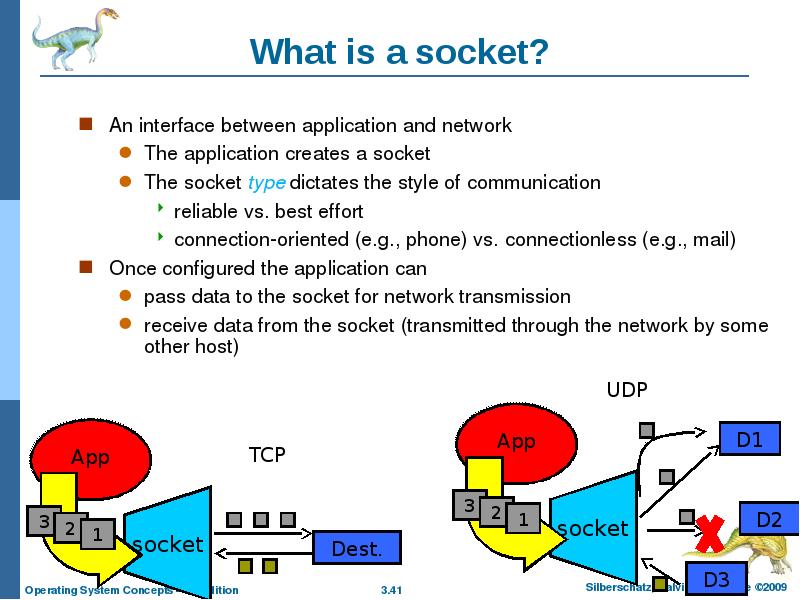
An interface between application and network
The application creates a socket
The socket type dictates the style of communication
reliable vs. best effort
connection-oriented (e.g., phone) vs. connectionless (e.g., mail)
Once configured the application can
pass data to the socket for network transmission
receive data from the socket (transmitted through the network by some other host)
Слайд 42
Описание слайда:
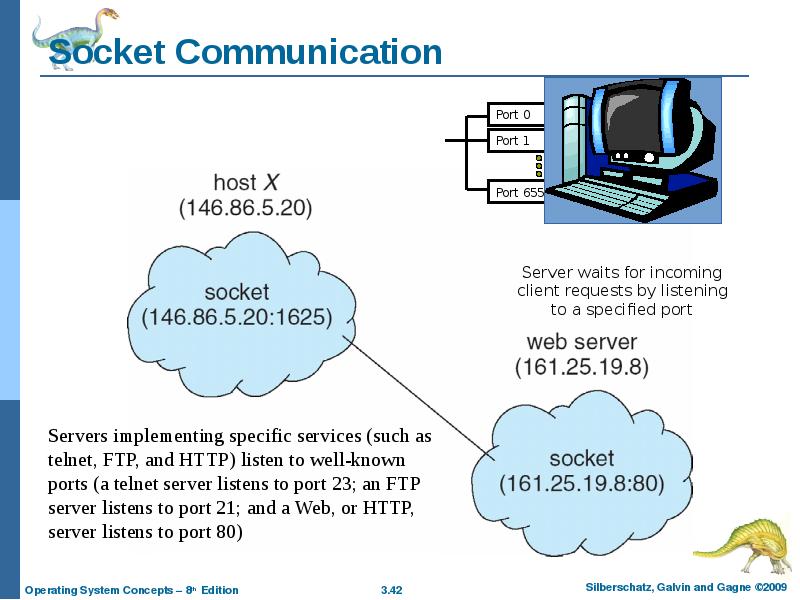
Socket Communication
Слайд 43
Описание слайда:
Remote Procedure Calls
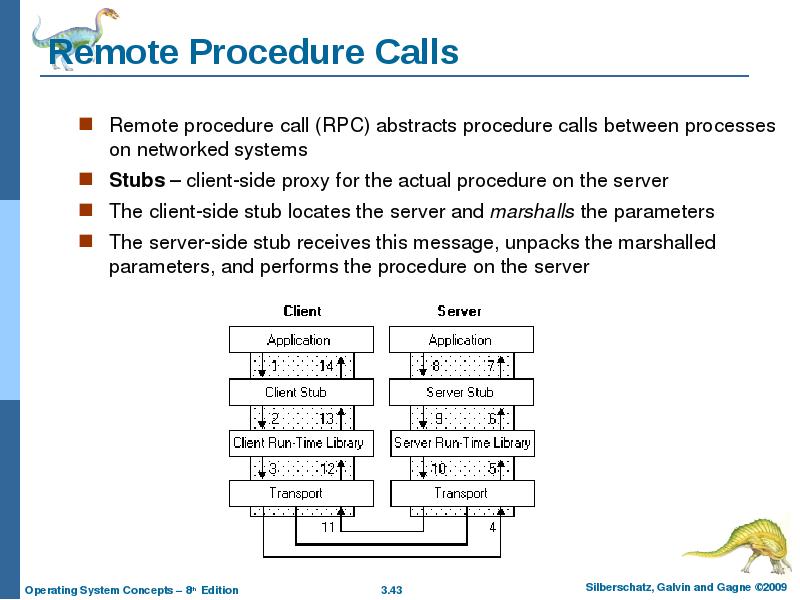
Remote procedure call (RPC) abstracts procedure calls between processes on networked systems
Stubs – client-side proxy for the actual procedure on the server
The client-side stub locates the server and marshalls the parameters
The server-side stub receives this message, unpacks the marshalled parameters, and performs the procedure on the server
Слайд 44
Описание слайда:
Remote Method Invocation
Remote Method Invocation (RMI) is a Java mechanism similar to RPCs
RMI allows a Java program on one machine to invoke a method on a remote object
Слайд 45
Описание слайда:
Marshalling Parameters
Слайд 46
Описание слайда:
Скачать презентацию на тему Operating system. Processes можно ниже: