Processes and threads. (Chapter 6) презентация
Содержание
- 2. Processes: Review Multiprogramming versus multiprocessing Kernel data structure: process control block
- 3. Process Behavior Processes: alternate between CPU and I/O CPU bursts Most
- 4. Process Scheduling Priority queues: multiples queues, each with a different priority
- 5. Processes and Threads Traditional process One thread of control through a
- 6. Threads Each thread has its own stack, PC, registers Share
- 7. Why use Threads? Large multiprocessors need many computing entities (one per
- 8. Why Threads? Single threaded process: blocking system calls, no parallelism Finite-state
- 9. Multi-threaded Clients Example : Web Browsers Browsers such as IE are
- 10. Multi-threaded Server Example Apache web server: pool of pre-spawned worker threads
- 11. Thread Management Creation and deletion of threads Static versus dynamic Critical
- 12. User-level versus kernel threads Key issues: Cost of thread management More
- 13. User-level Threads Threads managed by a threads library Kernel is unaware
- 14. User-level threads
- 15. Kernel-level threads Kernel aware of the presence of threads Better scheduling
- 16. Light-weight Processes Several LWPs per heavy-weight process User-level threads package Create/destroy
- 17. LWP Example
- 18. Thread Packages Posix Threads (pthreads) Widely used threads package Conforms to
- 19. Скачать презентацию
Слайды и текст этой презентации
Слайд 1
Описание слайда:
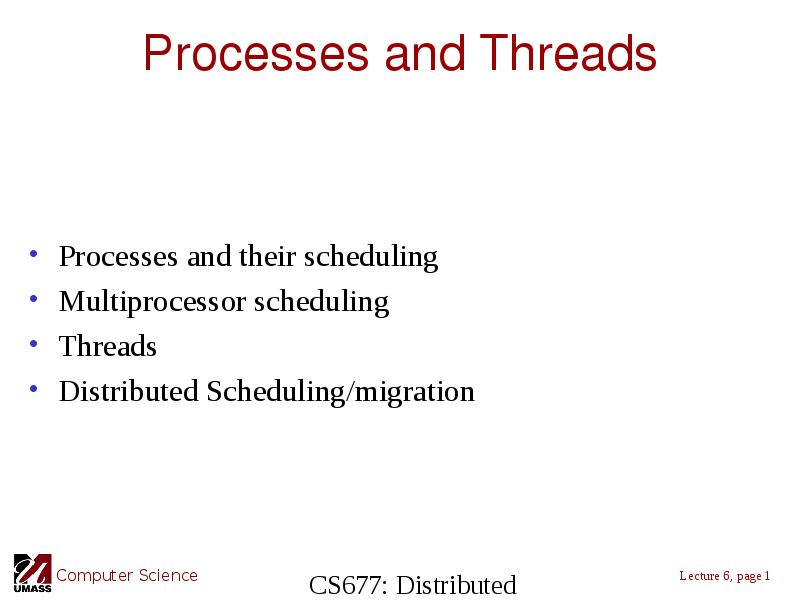
Processes and Threads
Processes and their scheduling
Multiprocessor scheduling
Threads
Distributed Scheduling/migration
Слайд 2
Описание слайда:
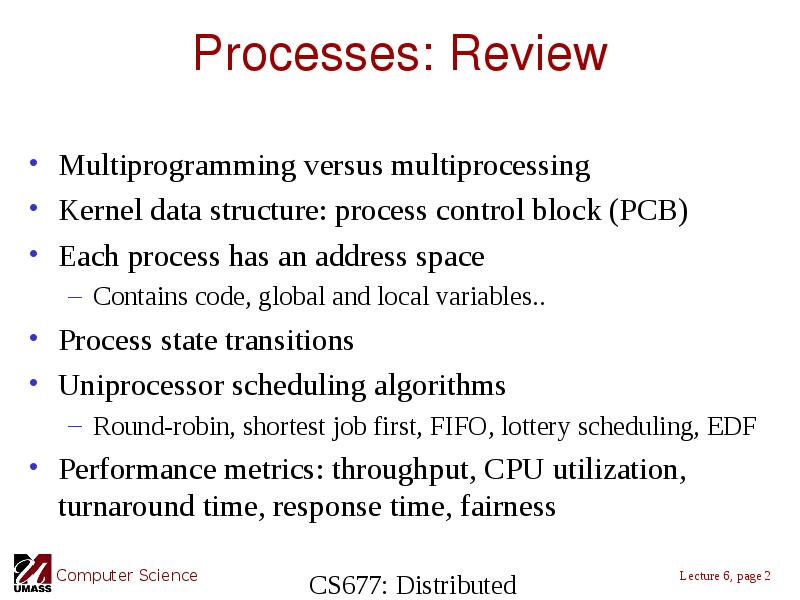
Processes: Review
Multiprogramming versus multiprocessing
Kernel data structure: process control block (PCB)
Each process has an address space
Contains code, global and local variables..
Process state transitions
Uniprocessor scheduling algorithms
Round-robin, shortest job first, FIFO, lottery scheduling, EDF
Performance metrics: throughput, CPU utilization, turnaround time, response time, fairness
Слайд 3
Описание слайда:
Process Behavior
Processes: alternate between CPU and I/O
CPU bursts
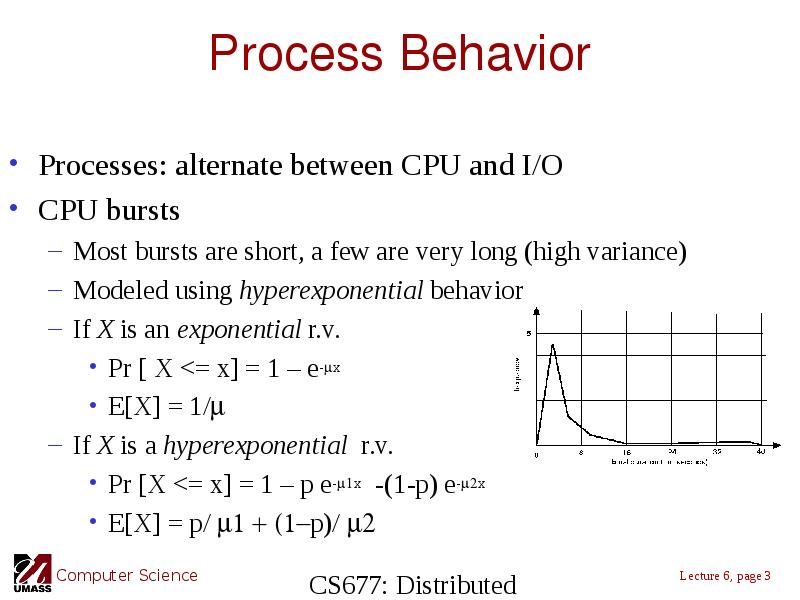
Most bursts are short, a few are very long (high variance)
Modeled using hyperexponential behavior
If X is an exponential r.v.
Pr [ X <= x] = 1 – e-x
E[X] = 1/
If X is a hyperexponential r.v.
Pr [X <= x] = 1 – p e-x -(1-p) e-x
E[X] = p/ p)/
Слайд 4
Описание слайда:
Process Scheduling
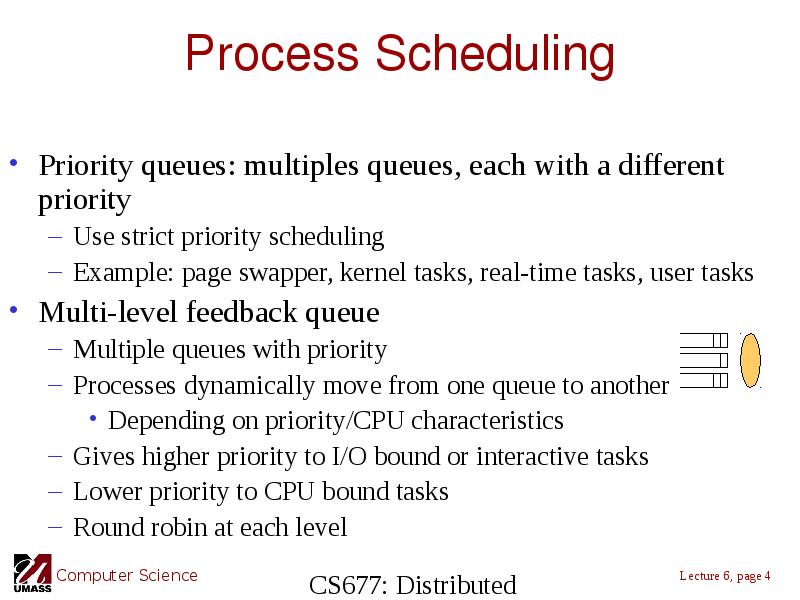
Priority queues: multiples queues, each with a different priority
Use strict priority scheduling
Example: page swapper, kernel tasks, real-time tasks, user tasks
Multi-level feedback queue
Multiple queues with priority
Processes dynamically move from one queue to another
Depending on priority/CPU characteristics
Gives higher priority to I/O bound or interactive tasks
Lower priority to CPU bound tasks
Round robin at each level
Слайд 5
Описание слайда:
Processes and Threads
Traditional process
One thread of control through a large, potentially sparse address space
Address space may be shared with other processes (shared mem)
Collection of systems resources (files, semaphores)
Thread (light weight process)
A flow of control through an address space
Each address space can have multiple concurrent control flows
Each thread has access to entire address space
Potentially parallel execution, minimal state (low overheads)
May need synchronization to control access to shared variables
Слайд 6
Описание слайда:
Threads
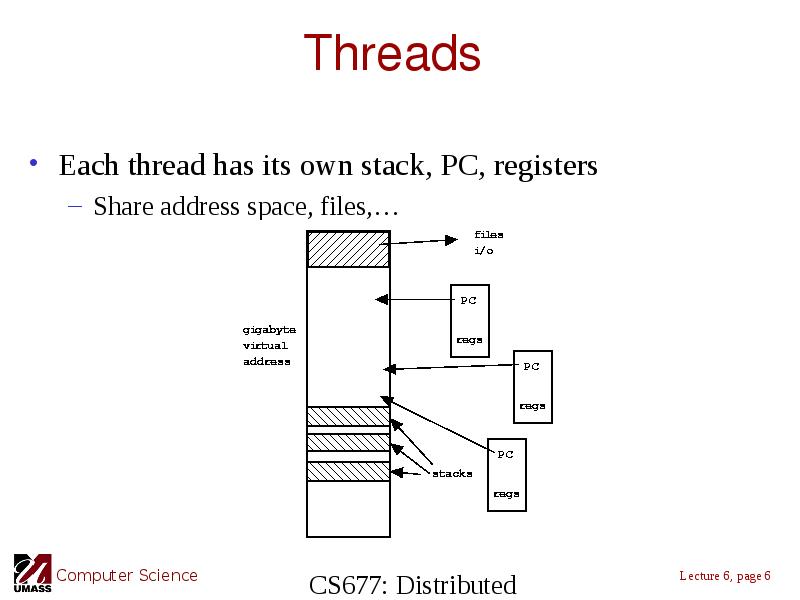
Each thread has its own stack, PC, registers
Share address space, files,…
Слайд 7
Описание слайда:
Why use Threads?
Large multiprocessors need many computing entities (one per CPU)
Switching between processes incurs high overhead
With threads, an application can avoid per-process overheads
Thread creation, deletion, switching cheaper than processes
Threads have full access to address space (easy sharing)
Threads can execute in parallel on multiprocessors
Слайд 8
Описание слайда:
Why Threads?
Single threaded process: blocking system calls, no parallelism
Finite-state machine [event-based]: non-blocking with parallelism
Multi-threaded process: blocking system calls with parallelism
Threads retain the idea of sequential processes with blocking system calls, and yet achieve parallelism
Software engineering perspective
Applications are easier to structure as a collection of threads
Each thread performs several [mostly independent] tasks
Слайд 9
Описание слайда:
Multi-threaded Clients Example : Web Browsers
Browsers such as IE are multi-threaded
Such browsers can display data before entire document is downloaded: performs multiple simultaneous tasks
Fetch main HTML page, activate separate threads for other parts
Each thread sets up a separate connection with the server
Uses blocking calls
Each part (gif image) fetched separately and in parallel
Advantage: connections can be setup to different sources
Ad server, image server, web server…
Слайд 10
Описание слайда:
Multi-threaded Server Example
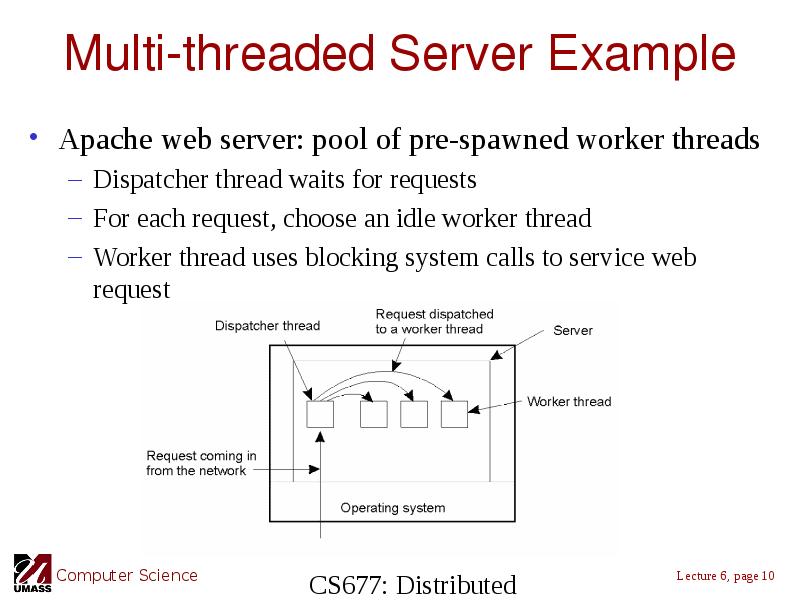
Apache web server: pool of pre-spawned worker threads
Dispatcher thread waits for requests
For each request, choose an idle worker thread
Worker thread uses blocking system calls to service web request
Слайд 11
Описание слайда:
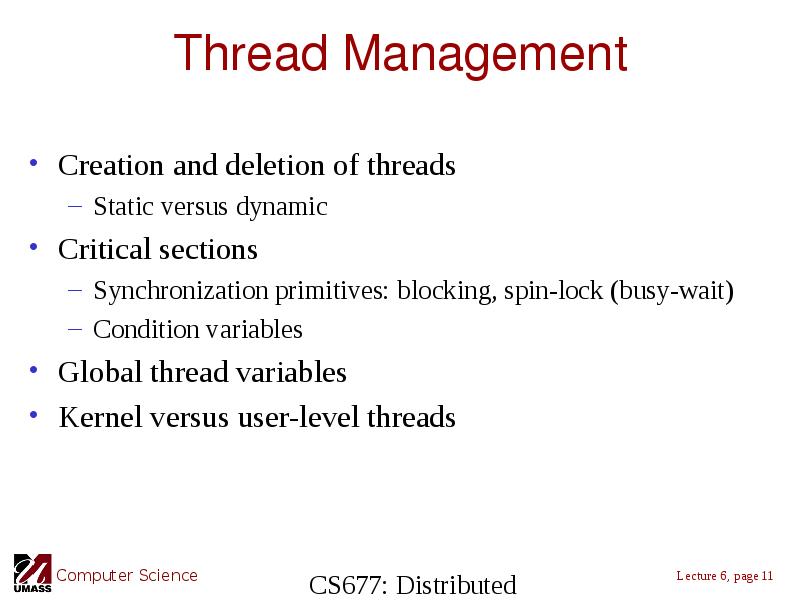
Thread Management
Creation and deletion of threads
Static versus dynamic
Critical sections
Synchronization primitives: blocking, spin-lock (busy-wait)
Condition variables
Global thread variables
Kernel versus user-level threads
Слайд 12
Описание слайда:
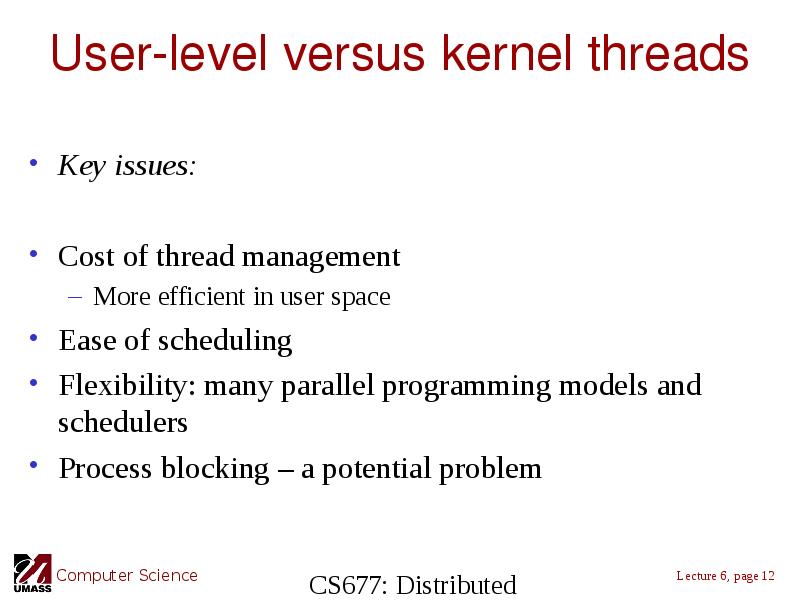
User-level versus kernel threads
Key issues:
Cost of thread management
More efficient in user space
Ease of scheduling
Flexibility: many parallel programming models and schedulers
Process blocking – a potential problem
Слайд 13
Описание слайда:
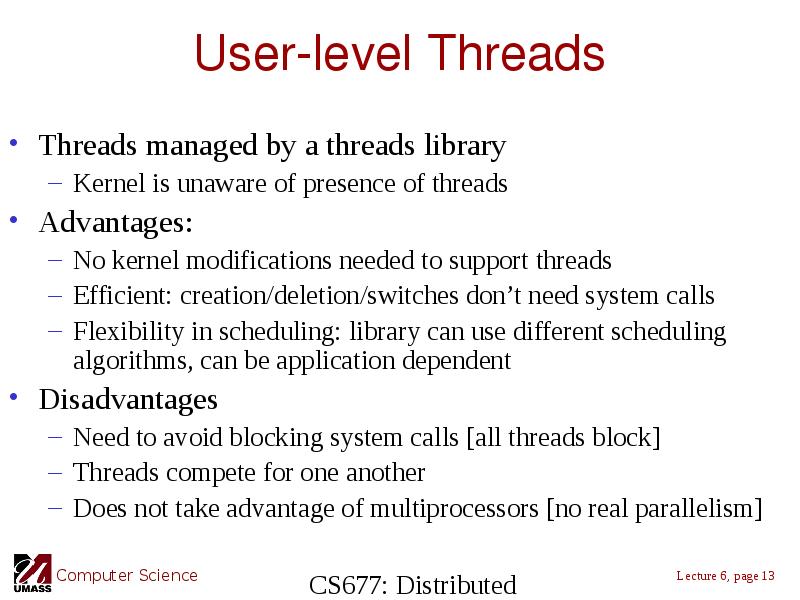
User-level Threads
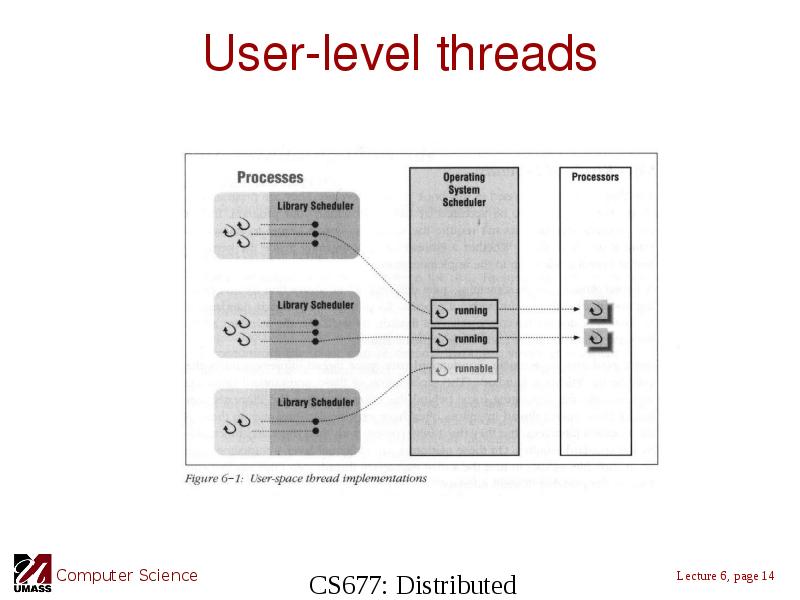
Threads managed by a threads library
Kernel is unaware of presence of threads
Advantages:
No kernel modifications needed to support threads
Efficient: creation/deletion/switches don’t need system calls
Flexibility in scheduling: library can use different scheduling algorithms, can be application dependent
Disadvantages
Need to avoid blocking system calls [all threads block]
Threads compete for one another
Does not take advantage of multiprocessors [no real parallelism]
Слайд 14
Описание слайда:
User-level threads
Слайд 15
Описание слайда:
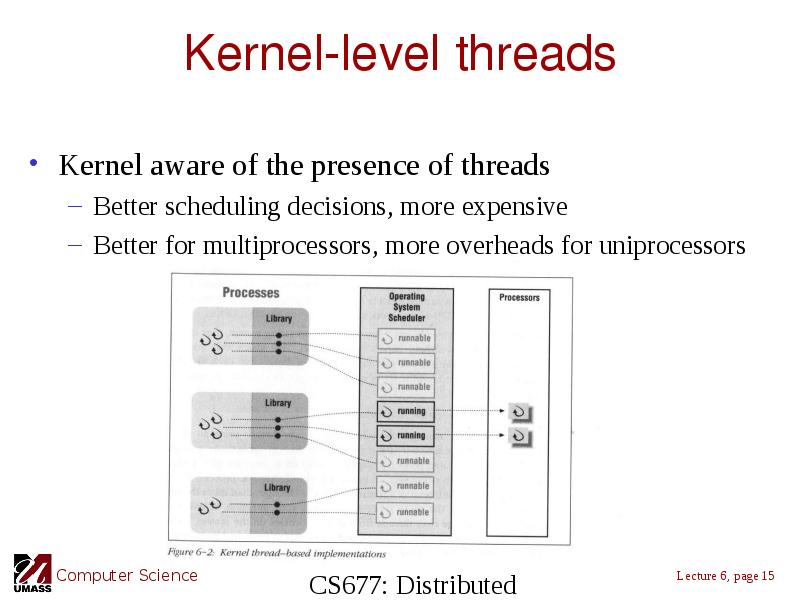
Kernel-level threads
Kernel aware of the presence of threads
Better scheduling decisions, more expensive
Better for multiprocessors, more overheads for uniprocessors
Слайд 16
Описание слайда:
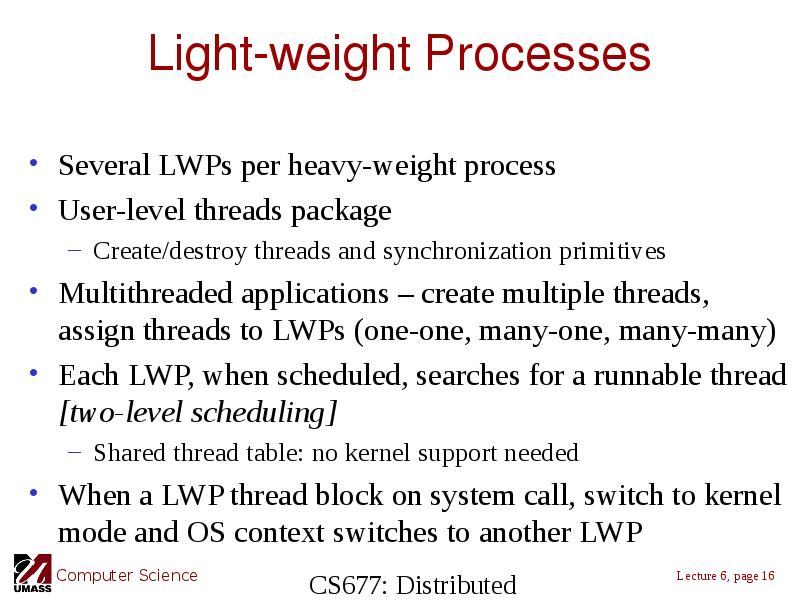
Light-weight Processes
Several LWPs per heavy-weight process
User-level threads package
Create/destroy threads and synchronization primitives
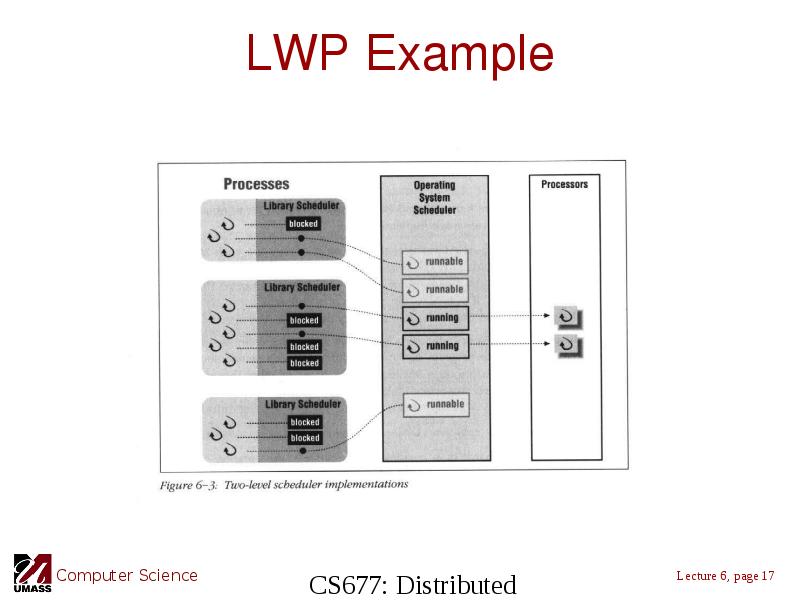
Multithreaded applications – create multiple threads, assign threads to LWPs (one-one, many-one, many-many)
Each LWP, when scheduled, searches for a runnable thread [two-level scheduling]
Shared thread table: no kernel support needed
When a LWP thread block on system call, switch to kernel mode and OS context switches to another LWP
Слайд 17
Описание слайда:
LWP Example
Слайд 18
Описание слайда:
Thread Packages
Posix Threads (pthreads)
Widely used threads package
Conforms to the Posix standard
Sample calls: pthread_create,…
Typical used in C/C++ applications
Can be implemented as user-level or kernel-level or via LWPs
Java Threads
Native thread support built into the language
Threads are scheduled by the JVM
Скачать презентацию на тему Processes and threads. (Chapter 6) можно ниже: