Serialization in Java презентация
Содержание
- 2. Object Serialization We all know the Java platform allows us to
- 3. Serializable Class is serializable if It can be transformed to
- 4. Usage RMI Enterprise Java Beans JMS Object Cache (disk storage) Application
- 5. Your own protocol
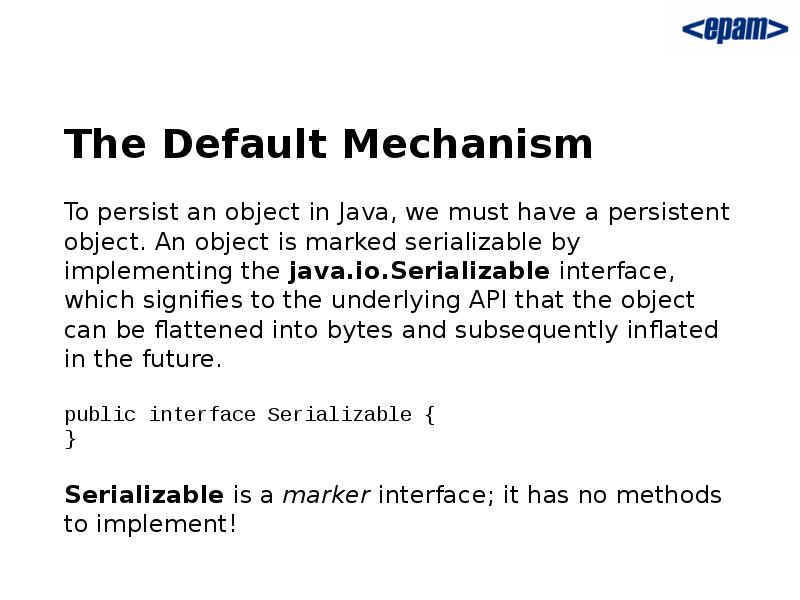
- 6. The Default Mechanism To persist an object in Java, we must
- 7. Working with ObjectOutputStream and ObjectInputStream ObjectOutputStream.writeObject() // serialize and write ObjectInputStream.readObject()
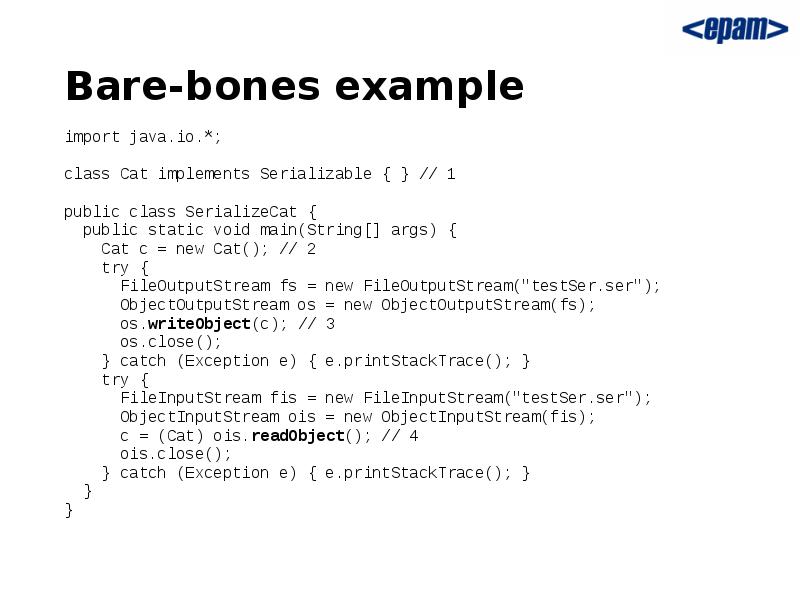
- 8. Bare-bones example import java.io.*; class Cat implements Serializable { } //
- 9. ?
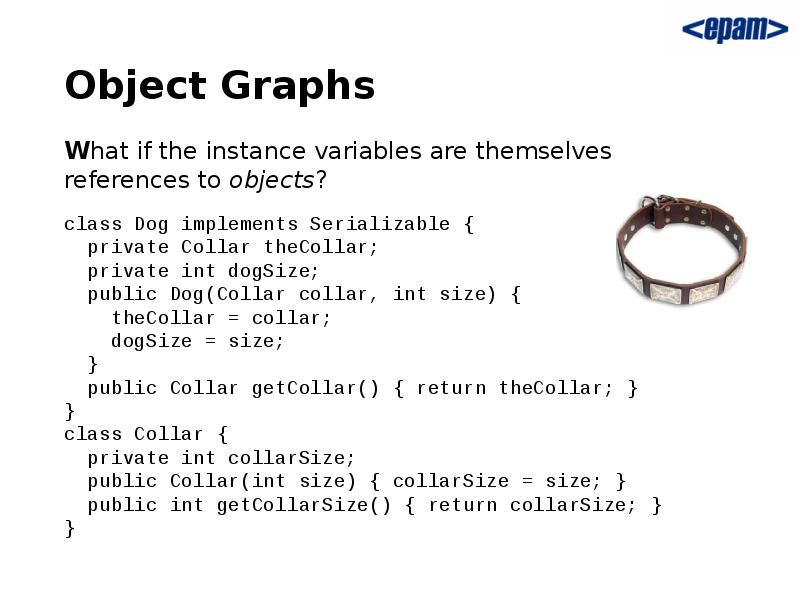
- 10. Object Graphs What if the instance variables are themselves references to
- 11. What did we forget? import java.io.*; public class SerializeDog { public
- 12. Good news! Only objects marked Serializable can be persisted. These classes are already
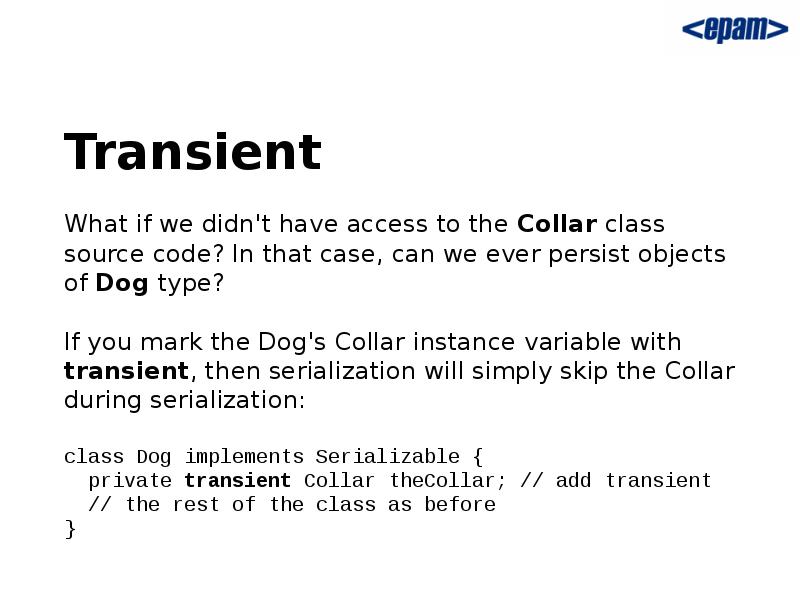
- 13. Transient What if we didn't have access to the Collar class
- 14. Using writeObject and readObject When the Dog is deserialized, it comes
- 15. Serialization Is Not for Statics You should think of static variables
- 16. ?
- 17. Create Your Own Protocol: the Externalizable Interface Instead of implementing the Serializable interface,
- 18. Externalizable
- 19. serialVersionID Used when deserialization for deciding if the serialized and loaded
- 20. Links Java Object Serialization Specification Implementing Serializable: best practices
- 21. Скачать презентацию








Слайды и текст этой презентации
Слайд 1
Описание слайда:
Serialization in Java
Слайд 2
Описание слайда:
Object Serialization
We all know the Java platform allows us to create reusable objects in memory. However, all of those objects exist only as long as the Java virtual machine remains running. It would be nice if the objects we create could exist beyond the lifetime of the virtual machine, wouldn't it?
Object serialization is the process of saving an object's state to a sequence of bytes, as well as the process of rebuilding those bytes into a live object at some future time.
Слайд 3
Описание слайда:
Serializable
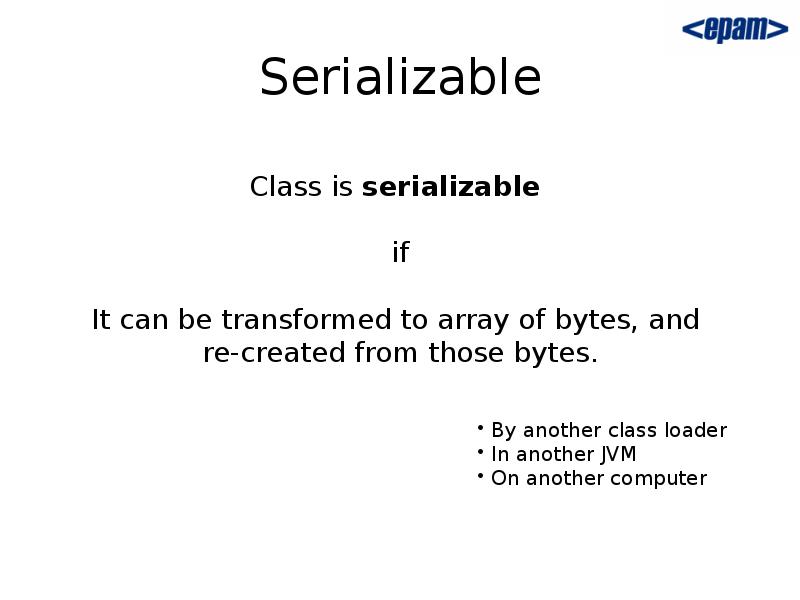
Class is serializable
if
It can be transformed to array of bytes, and
re-created from those bytes.
Слайд 4
Описание слайда:
Usage
RMI
Enterprise Java Beans
JMS
Object Cache (disk storage)
Application Server clustering
…
Слайд 5
Описание слайда:
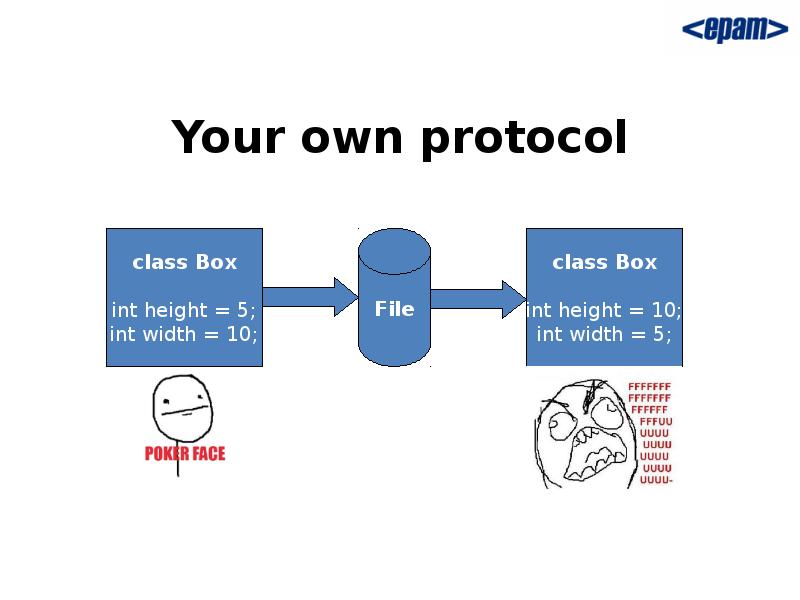
Your own protocol
Слайд 6
Описание слайда:
The Default Mechanism
To persist an object in Java, we must have a persistent object. An object is marked serializable by implementing the java.io.Serializable interface, which signifies to the underlying API that the object can be flattened into bytes and subsequently inflated in the future.
public interface Serializable {
}
Serializable is a marker interface; it has no methods to implement!
Слайд 7
Описание слайда:
Working with ObjectOutputStream and ObjectInputStream
ObjectOutputStream.writeObject() // serialize and write
ObjectInputStream.readObject() // read and deserialize
Слайд 8
Описание слайда:
Bare-bones example
import java.io.*;
class Cat implements Serializable { } // 1
public class SerializeCat {
public static void main(String[] args) {
Cat c = new Cat(); // 2
try {
FileOutputStream fs = new FileOutputStream("testSer.ser");
ObjectOutputStream os = new ObjectOutputStream(fs);
os.writeObject(c); // 3
os.close();
} catch (Exception e) { e.printStackTrace(); }
try {
FileInputStream fis = new FileInputStream("testSer.ser");
ObjectInputStream ois = new ObjectInputStream(fis);
c = (Cat) ois.readObject(); // 4
ois.close();
} catch (Exception e) { e.printStackTrace(); }
}
}
Слайд 9
Описание слайда:
?
Слайд 10
Описание слайда:
Object Graphs
What if the instance variables are themselves references to objects?
class Dog implements Serializable {
private Collar theCollar;
private int dogSize;
public Dog(Collar collar, int size) {
theCollar = collar;
dogSize = size;
}
public Collar getCollar() { return theCollar; }
}
class Collar {
private int collarSize;
public Collar(int size) { collarSize = size; }
public int getCollarSize() { return collarSize; }
}
Слайд 11
Описание слайда:
What did we forget?
import java.io.*;
public class SerializeDog {
public static void main(String[] args) {
Collar c = new Collar(3);
Dog d = new Dog(c, 8);
try {
FileOutputStream fs = new FileOutputStream("testSer.ser");
ObjectOutputStream os = new ObjectOutputStream(fs);
os.writeObject(d);
os.close();
} catch (Exception e) { e.printStackTrace(); }
}
}
But when we run this code we get a runtime exception something like this:
java.io.NotSerializableException: Collar
The Collar class must ALSO be Serializable!
Слайд 12
Описание слайда:
Good news!
Only objects marked Serializable can be persisted.
These classes are already serializable:
- Integer, Double, etc.
- String
- Date, Calendar
- ArrayList, LinkedList, HashSet, HashMap, etc.
Array of serializable objects is also serializable!
Слайд 13
Описание слайда:
Transient
What if we didn't have access to the Collar class source code? In that case, can we ever persist objects of Dog type?
If you mark the Dog's Collar instance variable with transient, then serialization will simply skip the Collar during serialization:
class Dog implements Serializable {
private transient Collar theCollar; // add transient
// the rest of the class as before
}
Слайд 14
Описание слайда:
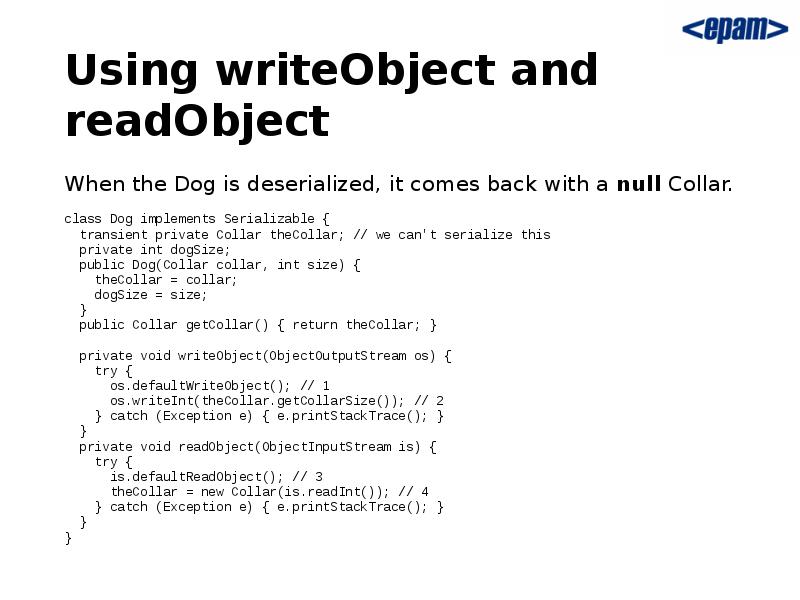
Using writeObject and readObject
When the Dog is deserialized, it comes back with a null Collar.
class Dog implements Serializable {
transient private Collar theCollar; // we can't serialize this
private int dogSize;
public Dog(Collar collar, int size) {
theCollar = collar;
dogSize = size;
}
public Collar getCollar() { return theCollar; }
private void writeObject(ObjectOutputStream os) {
try {
os.defaultWriteObject(); // 1
os.writeInt(theCollar.getCollarSize()); // 2
} catch (Exception e) { e.printStackTrace(); }
}
private void readObject(ObjectInputStream is) {
try {
is.defaultReadObject(); // 3
theCollar = new Collar(is.readInt()); // 4
} catch (Exception e) { e.printStackTrace(); }
}
}
Слайд 15
Описание слайда:
Serialization Is Not for Statics
You should think of static variables purely as CLASS variables.
Serialization applies only to OBJECTS.
Static variables are NEVER saved as part of the object's state…because they do not belong to the object!
Слайд 16
Описание слайда:
?
Слайд 17
Описание слайда:
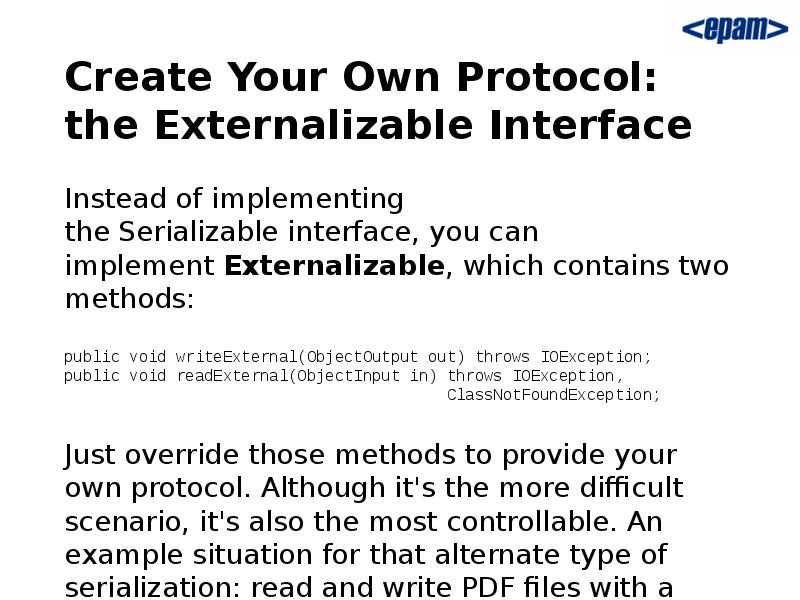
Create Your Own Protocol: the Externalizable Interface
Instead of implementing the Serializable interface, you can implement Externalizable, which contains two methods:
public void writeExternal(ObjectOutput out) throws IOException;
public void readExternal(ObjectInput in) throws IOException,
ClassNotFoundException;
Just override those methods to provide your own protocol. Although it's the more difficult scenario, it's also the most controllable. An example situation for that alternate type of serialization: read and write PDF files with a Java application.
Слайд 18
Описание слайда:
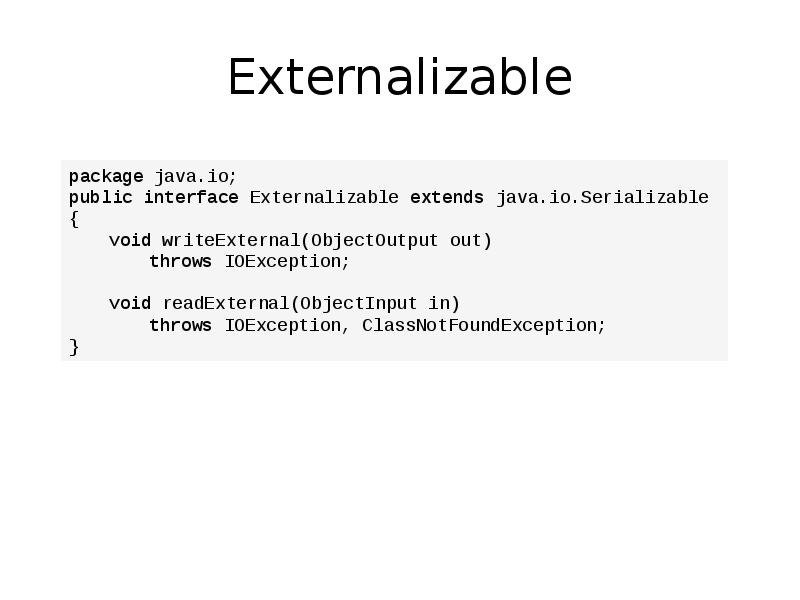
Externalizable
Слайд 19
Описание слайда:
serialVersionID
Used when deserialization for deciding if the serialized and loaded classes are compatible
If not present, JVM computes this value automatically
Слайд 20
Описание слайда:
Links
Java Object Serialization Specification
Implementing Serializable: best practices
Скачать презентацию на тему Serialization in Java можно ниже: