The Evolution Of Scala презентация
Содержание
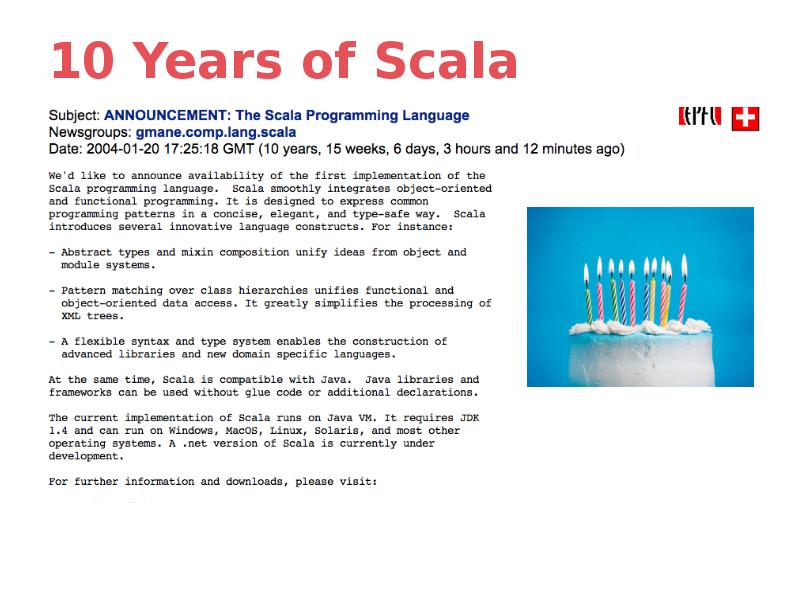
- 2. 10 Years of Scala
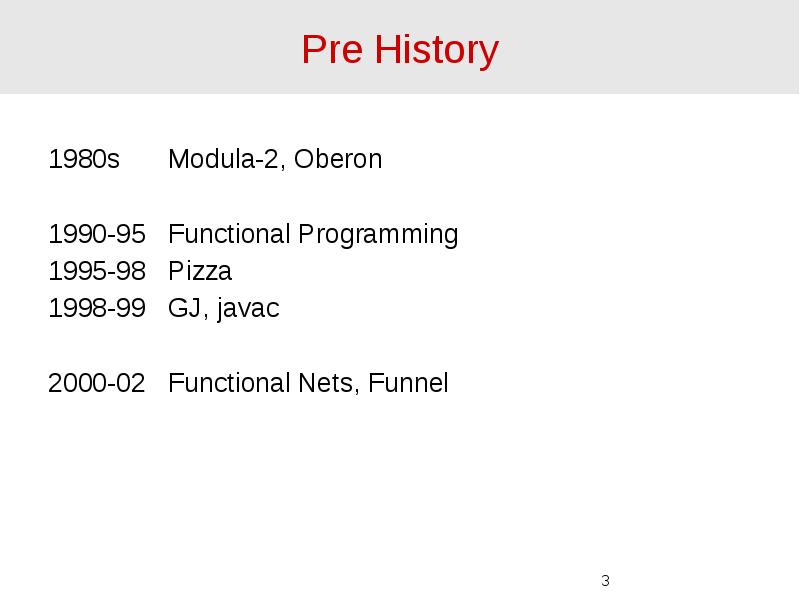
- 3. Pre History 1980s Modula-2, Oberon 1990-95 Functional Programming 1995-98 Pizza 1998-99 GJ, javac 2000-02 Functional Nets,
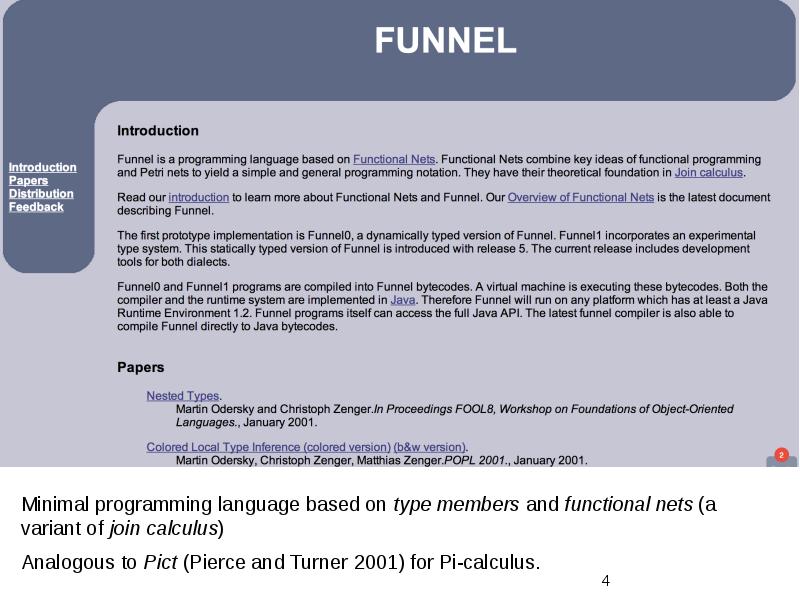
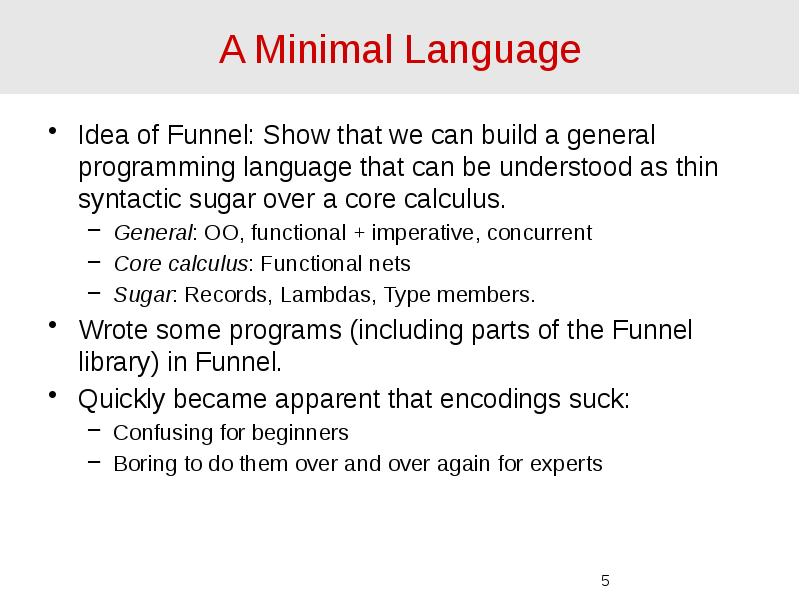
- 5. A Minimal Language Idea of Funnel: Show that we can build
- 6. Motivation for Scala Grew out of Funnel Wanted to show that
- 7. Why a New Language? The OO dogma ruled then: Encapsulate mutable
- 8. Really, Why a new Language? The work on Scala was motivated
- 9. How That Worked Out
- 10. Scala and Pizza Pizza (Odersky and Wadler 96) was another language
- 11. Java Features Not kept in Scala public static void Enumerations Annotation
- 12. Scala Beginnings 2003: First internal use to teach “Functional and Logic
- 13. Scala Reloaded 2006: Scala 2.0 released Compiler written in Scala Followed
- 14. Scala Reloaded 2006: Scala 2.0 released Compiler written in Scala Followed
- 15. Learning from Experience Scala 1.x had Parameterless methods supporting the uniform
- 16. Avoiding the Pitfalls Auto-add () for references f is to nullary
- 17. The Growth Year 2007: Scala 2.3-2.7 add lots of new features:
- 18. Why The Rapid Growth? People asked for it “If Scala only
- 19. Community Formation 2007: Lift web framework launched. 2008: First Scala
- 20. Scala 2.8 and 2.9: Consolidation 2010: Scala 2.8, with New collections
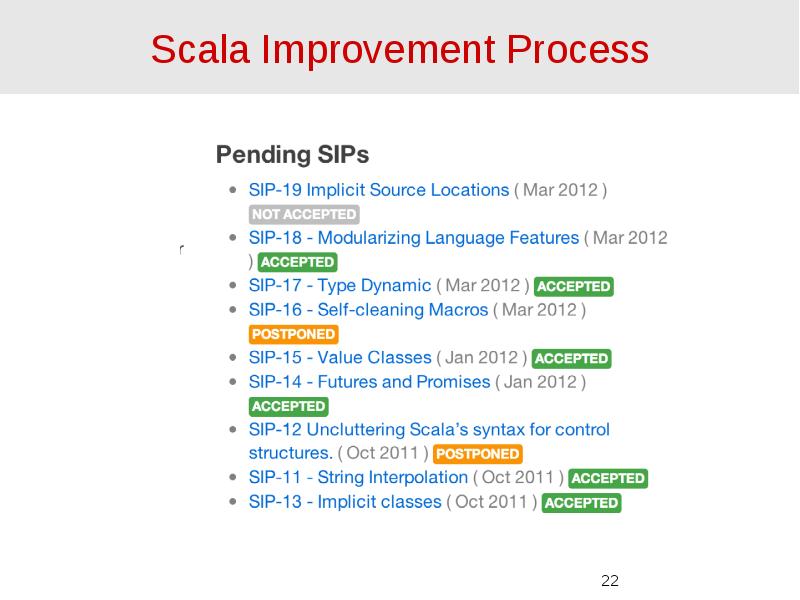
- 21. Scala 2.10: Differentiation 2012: Scala 2.10, with New features, added through
- 22. Scala Improvement Process
- 23. Design Tradeoffs The Scala way: Provide few constructs of maximal generality.
- 24. General Problem Scala is geared for orthogonality and expressiveness I believe
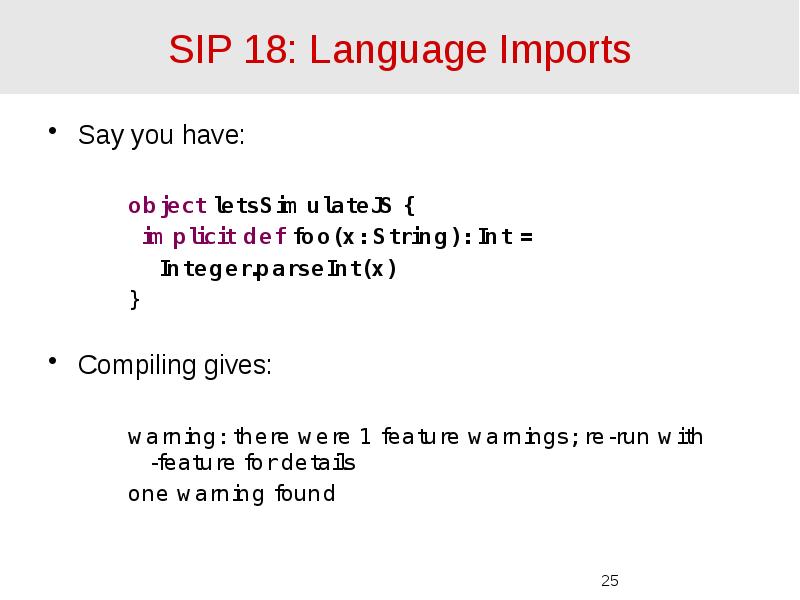
- 25. SIP 18: Language Imports Say you have: object letsSimulateJS { implicit
- 26. SIP 18: Language Imports Say you have: object letsSimulateJS { implicit
- 27. Turning off the Warnings You turn off the warning by bringing
- 28. Features Controlled by SIP-18 From language: Implicit Conversions Dynamic Postfix Operators
- 29. Now: Scala 2.11 Smaller: broke out parts of libraries into separate
- 30. Now: Scala.JS Why a Scala for Javascript? JS is becoming ubiquitous.
- 31. Invariants In all this evolution, what stays constant? What are some
- 32. 1st Invariant: A Scalable Language Instead of providing lots of features
- 33. Libraries on top of Scala
- 34. Growable = Good? In fact, it’s a double edged sword. DSLs
- 35. 2nd Invariant: It’s about the Types Scala’s core is its type
- 36. Stunted Evolution null - “The Million Dollar Mistake” Why does Scala
- 37. What’s Next? Scala 2.12 will be a fairly conservative evolution of
- 38. And After That? Main Goals: Make the language and its libraries
- 39. Scala “Aida” Will concentrate on the standard library. Reduce reliance on
- 40. Scala “Don Giovanni” Concentrates on the language Simple foundations: A
- 41. Scala “Don Giovanni” Removing puzzlers: Result types mandatory for implicit
- 42. The Growth Year, Revisited Extractors object Email { def unapply ... }
- 43. Conclusion Languages are not cast in stone; they evolve whether you
- 44. Скачать презентацию
Слайды и текст этой презентации
Слайд 1
Описание слайда:
The Evolution Of Scala
Martin Odersky
EPFL and Typesafe
Слайд 2
Описание слайда:
10 Years of Scala
Слайд 3
Описание слайда:
Pre History
1980s Modula-2, Oberon
1990-95 Functional Programming
1995-98 Pizza
1998-99 GJ, javac
2000-02 Functional Nets, Funnel
Слайд 4
Описание слайда:
Слайд 5
Описание слайда:
A Minimal Language
Idea of Funnel: Show that we can build a general programming language that can be understood as thin syntactic sugar over a core calculus.
General: OO, functional + imperative, concurrent
Core calculus: Functional nets
Sugar: Records, Lambdas, Type members.
Wrote some programs (including parts of the Funnel library) in Funnel.
Quickly became apparent that encodings suck:
Confusing for beginners
Boring to do them over and over again for experts
Слайд 6
Описание слайда:
Motivation for Scala
Grew out of Funnel
Wanted to show that we can do a practical combination of OOP and FP.
What got dropped:
Concurrency was relegated to libraries
No tight connection between language and core calculus (fragments were studied in the νObj paper and others.)
What got added:
Native object and class model, Java interop, XML literals (!).
Слайд 7
Описание слайда:
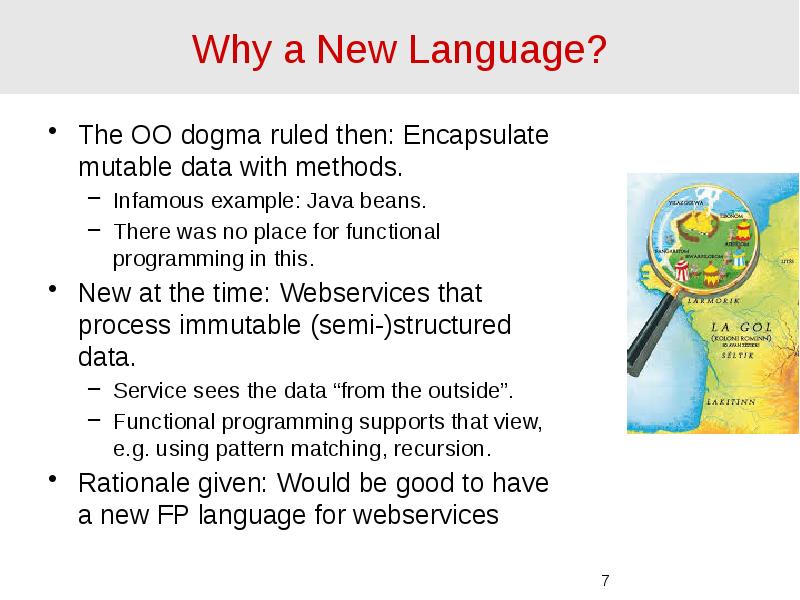
Why a New Language?
The OO dogma ruled then: Encapsulate mutable data with methods.
Infamous example: Java beans.
There was no place for functional programming in this.
New at the time: Webservices that process immutable (semi-)structured data.
Service sees the data “from the outside”.
Functional programming supports that view, e.g. using pattern matching, recursion.
Rationale given: Would be good to have a new FP language for webservices
Слайд 8
Описание слайда:
Really, Why a new Language?
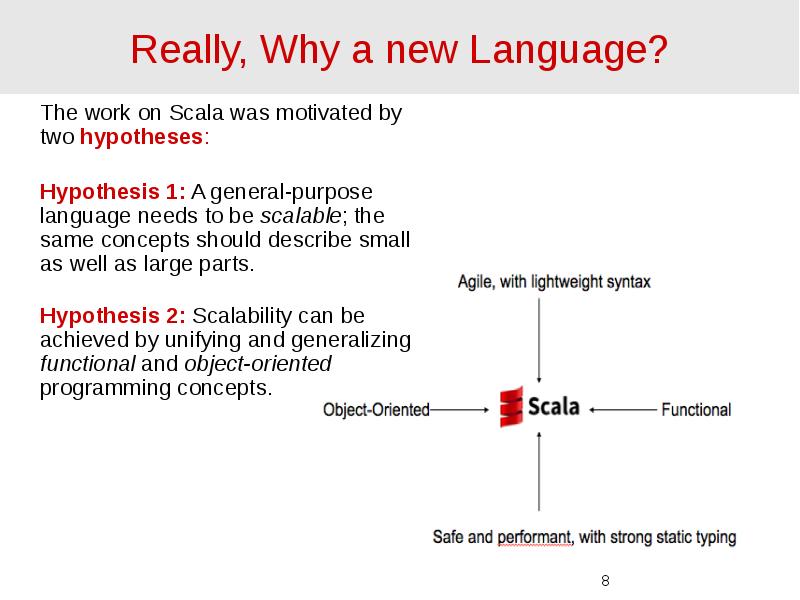
The work on Scala was motivated by two hypotheses:
Hypothesis 1: A general-purpose language needs to be scalable; the same concepts should describe small as well as large parts.
Hypothesis 2: Scalability can be achieved by unifying and generalizing functional and object-oriented programming concepts.
Слайд 9
Описание слайда:
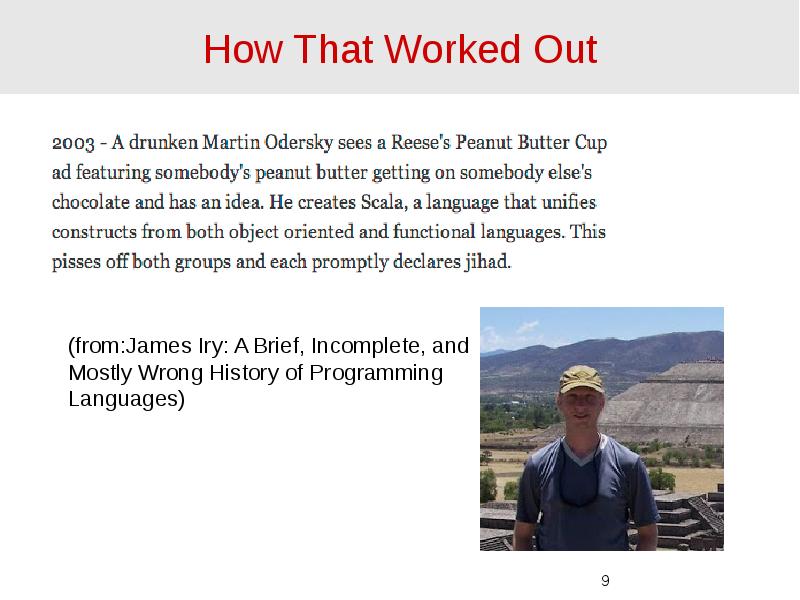
How That Worked Out
Слайд 10
Описание слайда:
Scala and Pizza
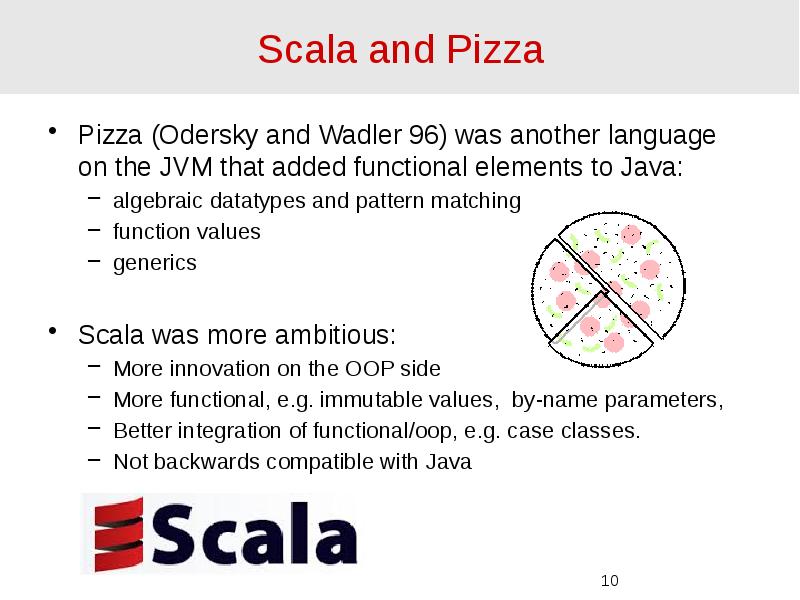
Pizza (Odersky and Wadler 96) was another language on the JVM that added functional elements to Java:
algebraic datatypes and pattern matching
function values
generics
Scala was more ambitious:
More innovation on the OOP side
More functional, e.g. immutable values, by-name parameters,
Better integration of functional/oop, e.g. case classes.
Not backwards compatible with Java
Слайд 11
Описание слайда:
Java Features Not kept in Scala
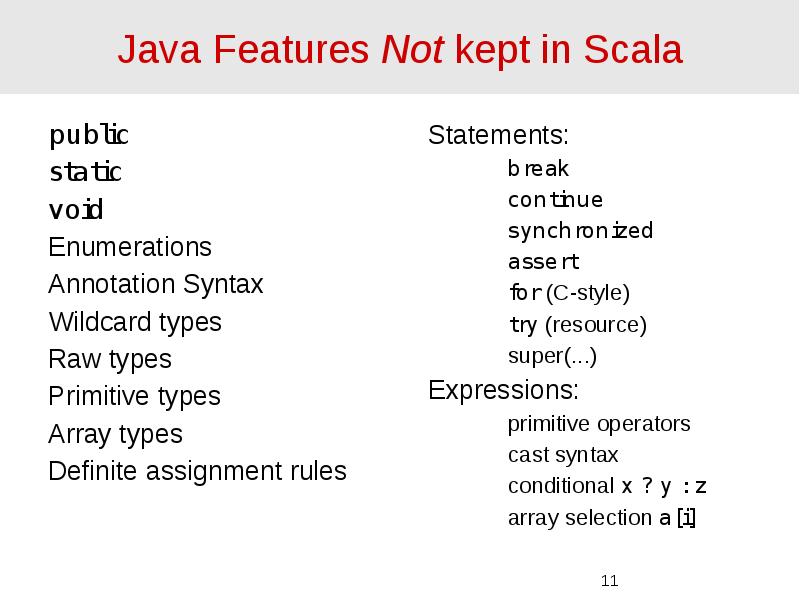
public
static
void
Enumerations
Annotation Syntax
Wildcard types
Raw types
Primitive types
Array types
Definite assignment rules
Слайд 12
Описание слайда:
Scala Beginnings
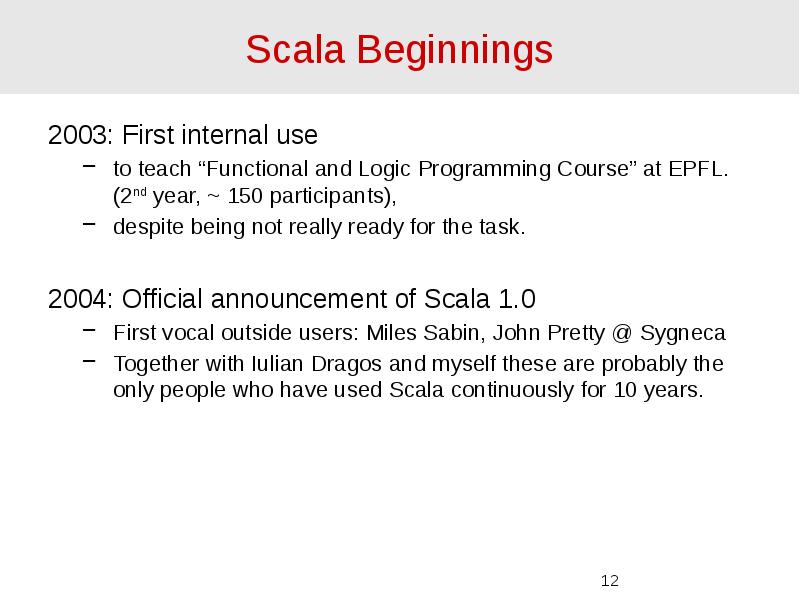
2003: First internal use
to teach “Functional and Logic Programming Course” at EPFL. (2nd year, ~ 150 participants),
despite being not really ready for the task.
2004: Official announcement of Scala 1.0
First vocal outside users: Miles Sabin, John Pretty @ Sygneca
Together with Iulian Dragos and myself these are probably the only people who have used Scala continuously for 10 years.
Слайд 13
Описание слайда:
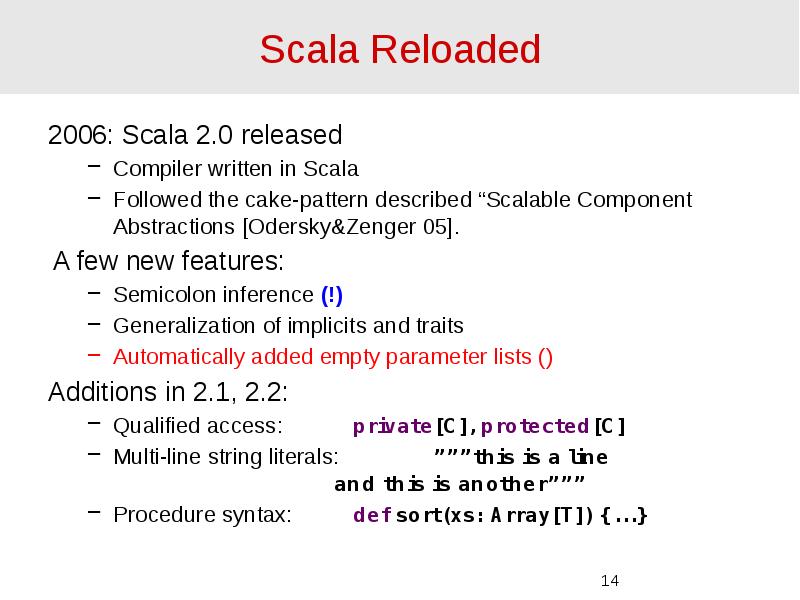
Scala Reloaded
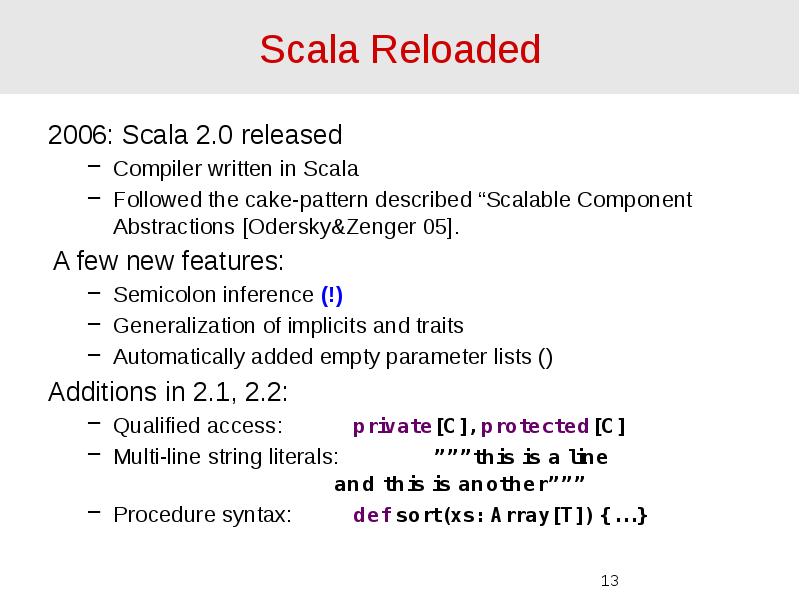
2006: Scala 2.0 released
Compiler written in Scala
Followed the cake-pattern described “Scalable Component Abstractions [Odersky&Zenger 05].
A few new features:
Semicolon inference (!)
Generalization of implicits and traits
Automatically added empty parameter lists ()
Additions in 2.1, 2.2:
Qualified access: private[C], protected[C]
Multi-line string literals: ”””this is a line
and this is another”””
Procedure syntax: def sort(xs: Array[T]) {...}
Слайд 14
Описание слайда:
Scala Reloaded
2006: Scala 2.0 released
Compiler written in Scala
Followed the cake-pattern described “Scalable Component Abstractions [Odersky&Zenger 05].
A few new features:
Semicolon inference (!)
Generalization of implicits and traits
Automatically added empty parameter lists ()
Additions in 2.1, 2.2:
Qualified access: private[C], protected[C]
Multi-line string literals: ”””this is a line
and this is another”””
Procedure syntax: def sort(xs: Array[T]) {...}
Слайд 15
Описание слайда:
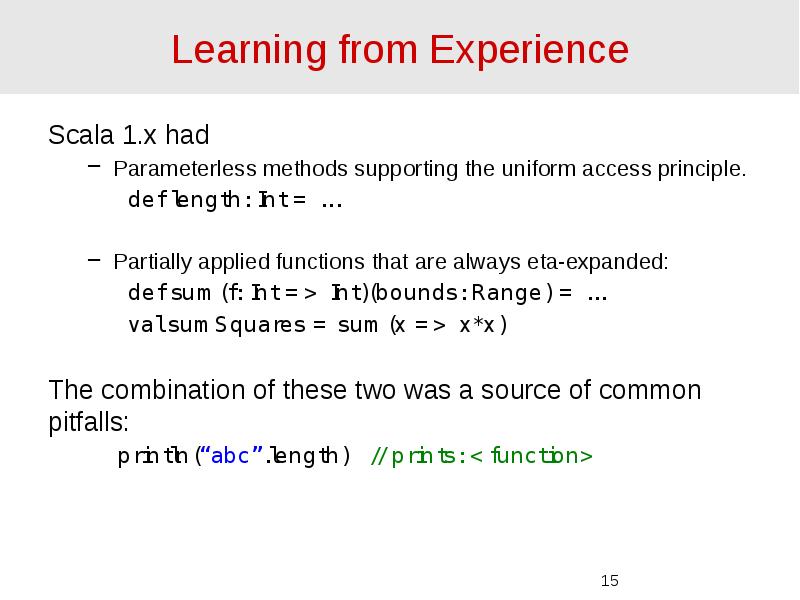
Learning from Experience
Scala 1.x had
Parameterless methods supporting the uniform access principle.
def length: Int = ...
Partially applied functions that are always eta-expanded:
def sum(f: Int => Int)(bounds: Range) = ...
val sumSquares = sum(x => x*x)
The combination of these two was a source of common pitfalls:
println(“abc”.length) // prints: <function>
Слайд 16
Описание слайда:
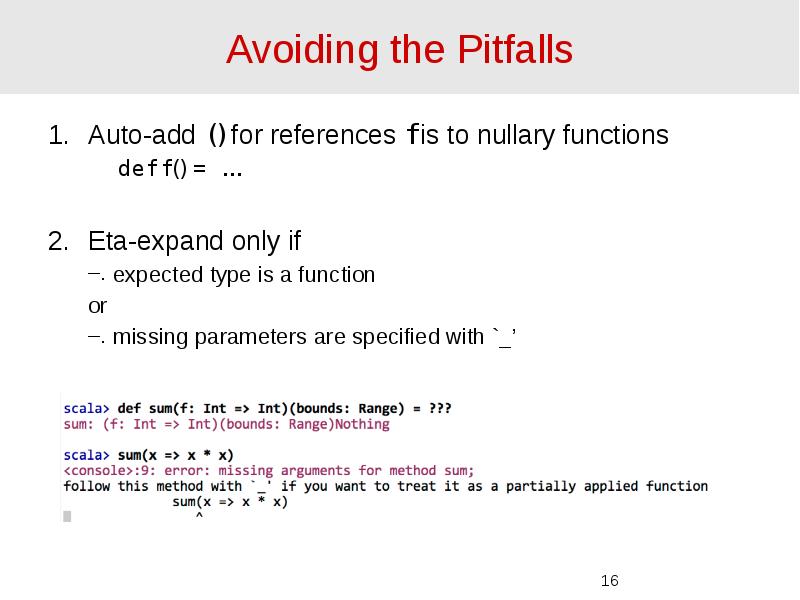
Avoiding the Pitfalls
Auto-add () for references f is to nullary functions
def f() = ...
Eta-expand only if
expected type is a function
or
missing parameters are specified with `_’
Слайд 17
Описание слайда:
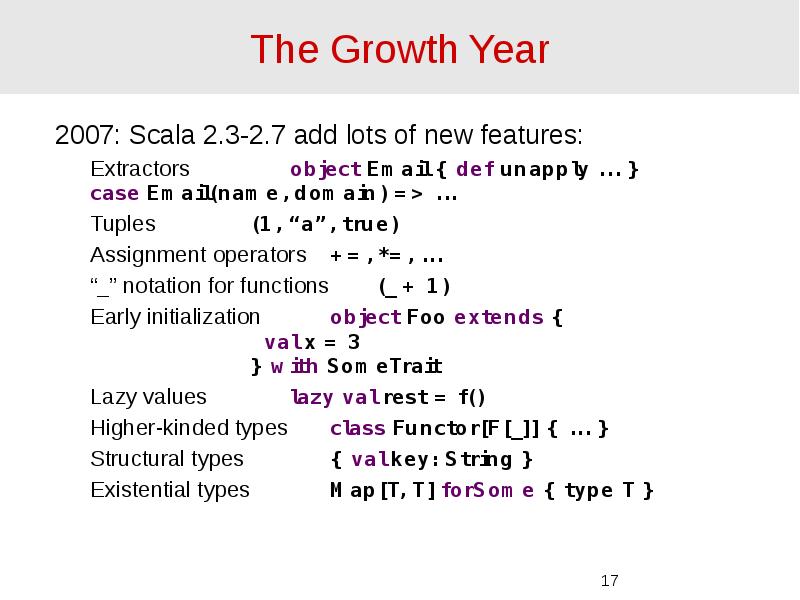
The Growth Year
2007: Scala 2.3-2.7 add lots of new features:
Extractors object Email { def unapply ... } case Email(name, domain) => ...
Tuples (1, “a”, true)
Assignment operators +=, *=, ...
“_” notation for functions (_ + 1)
Early initialization object Foo extends {
val x = 3
} with SomeTrait
Lazy values lazy val rest = f()
Higher-kinded types class Functor[F[_]] { ... }
Structural types { val key: String }
Existential types Map[T, T] forSome { type T }
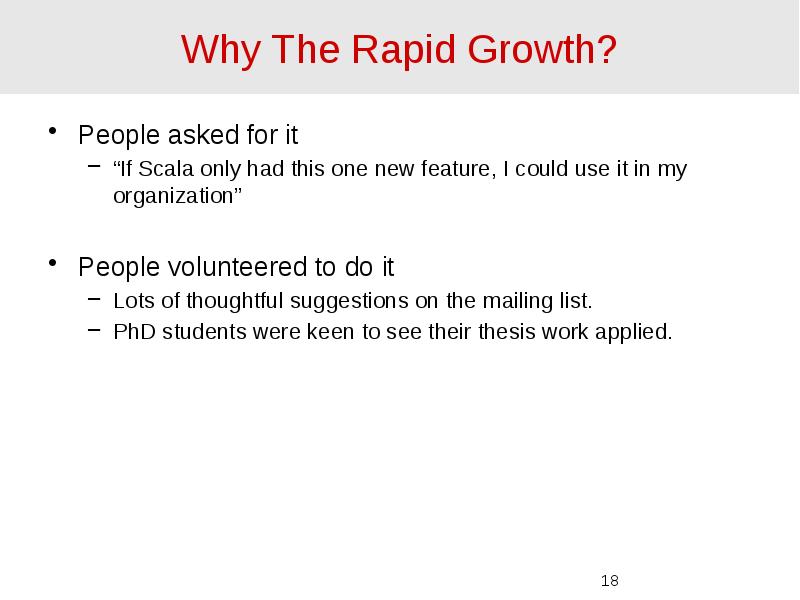
Слайд 18
Описание слайда:
Why The Rapid Growth?
People asked for it
“If Scala only had this one new feature, I could use it in my organization”
People volunteered to do it
Lots of thoughtful suggestions on the mailing list.
PhD students were keen to see their thesis work applied.
Слайд 19
Описание слайда:
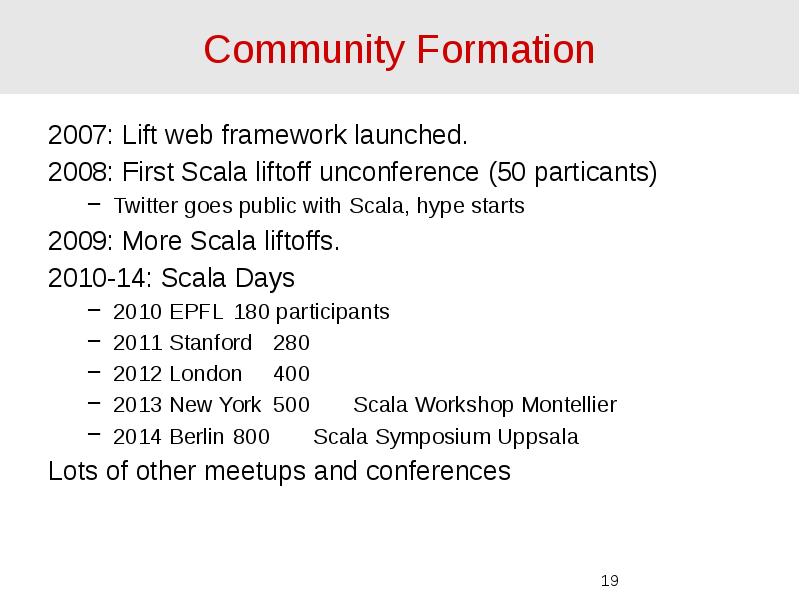
Community Formation
2007: Lift web framework launched.
2008: First Scala liftoff unconference (50 particants)
Twitter goes public with Scala, hype starts
2009: More Scala liftoffs.
2010-14: Scala Days
2010 EPFL 180 participants
2011 Stanford 280
2012 London 400
2013 New York 500 Scala Workshop Montellier
2014 Berlin 800 Scala Symposium Uppsala
Lots of other meetups and conferences
Слайд 20
Описание слайда:
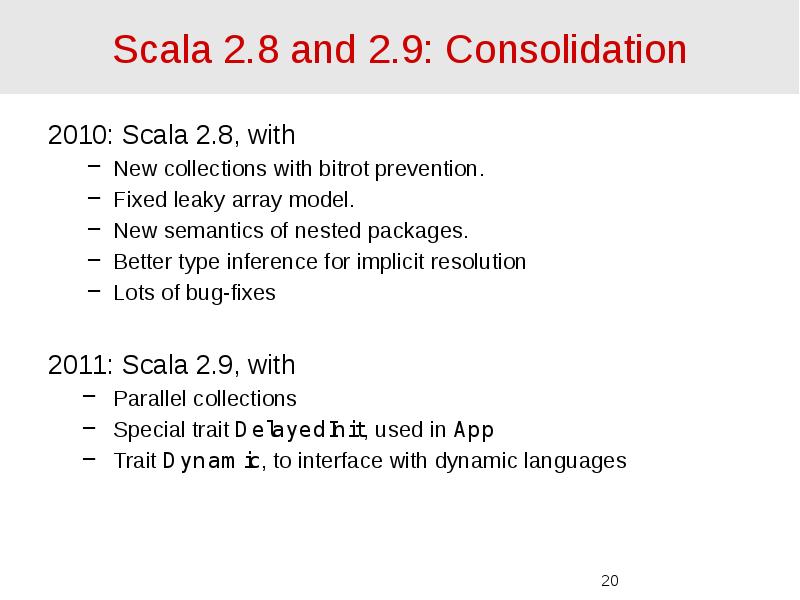
Scala 2.8 and 2.9: Consolidation
2010: Scala 2.8, with
New collections with bitrot prevention.
Fixed leaky array model.
New semantics of nested packages.
Better type inference for implicit resolution
Lots of bug-fixes
2011: Scala 2.9, with
Parallel collections
Special trait DelayedInit, used in App
Trait Dynamic, to interface with dynamic languages
Слайд 21
Описание слайда:
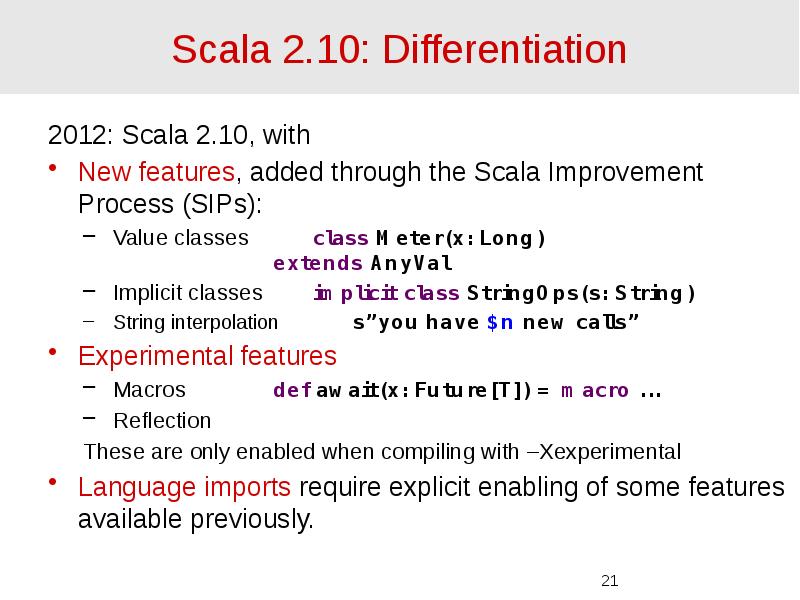
Scala 2.10: Differentiation
2012: Scala 2.10, with
New features, added through the Scala Improvement Process (SIPs):
Value classes class Meter(x: Long)
extends AnyVal
Implicit classes implicit class StringOps(s: String)
String interpolation s”you have $n new calls”
Experimental features
Macros def await(x: Future[T]) = macro ...
Reflection
These are only enabled when compiling with –Xexperimental
Language imports require explicit enabling of some features available previously.
Слайд 22
Описание слайда:
Scala Improvement Process
Слайд 23
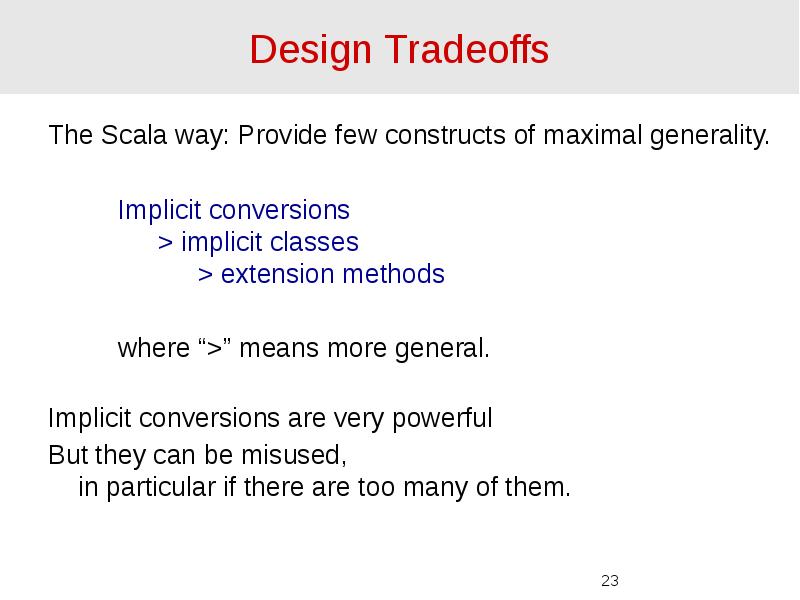
Описание слайда:
Design Tradeoffs
The Scala way: Provide few constructs of maximal generality.
Implicit conversions
> implicit classes
> extension methods
where “>” means more general.
Implicit conversions are very powerful
But they can be misused,
in particular if there are too many of them.
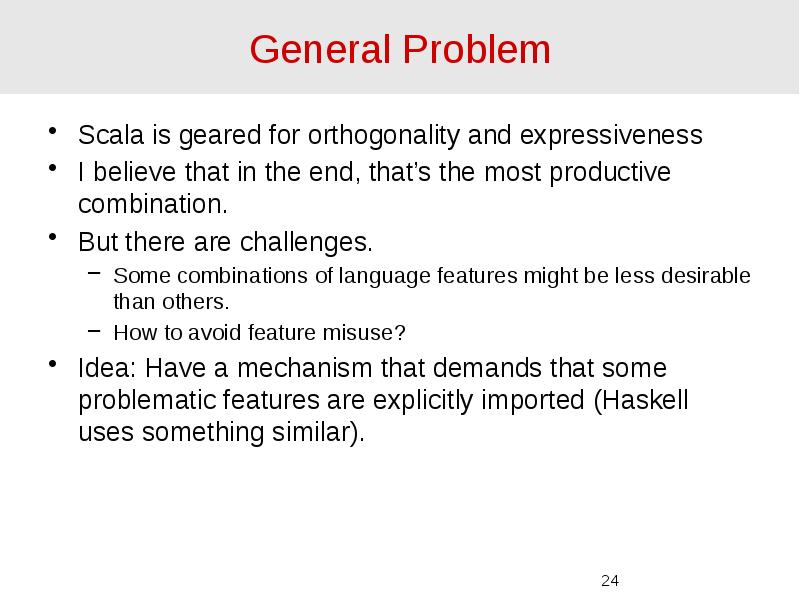
Слайд 24
Описание слайда:
General Problem
Scala is geared for orthogonality and expressiveness
I believe that in the end, that’s the most productive combination.
But there are challenges.
Some combinations of language features might be less desirable than others.
How to avoid feature misuse?
Idea: Have a mechanism that demands that some problematic features are explicitly imported (Haskell uses something similar).
Слайд 25
Описание слайда:
SIP 18: Language Imports
Say you have:
object letsSimulateJS {
implicit def foo(x: String): Int =
Integer.parseInt(x)
}
Compiling gives:
warning: there were 1 feature warnings; re-run with -feature for details
one warning found
Слайд 26
Описание слайда:
SIP 18: Language Imports
Say you have:
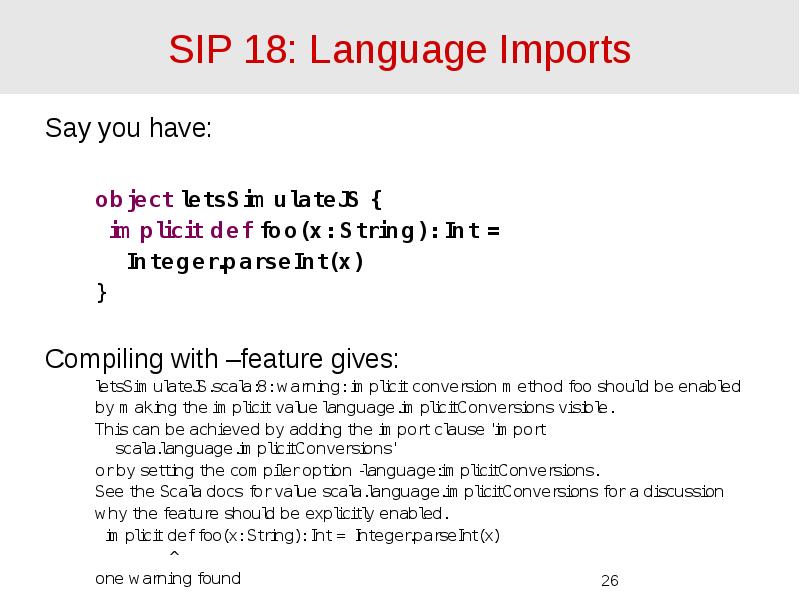
object letsSimulateJS {
implicit def foo(x: String): Int =
Integer.parseInt(x)
}
Compiling with –feature gives:
letsSimulateJS.scala:8: warning: implicit conversion method foo should be enabled
by making the implicit value language.implicitConversions visible.
This can be achieved by adding the import clause 'import scala.language.implicitConversions'
or by setting the compiler option -language:implicitConversions.
See the Scala docs for value scala.language.implicitConversions for a discussion
why the feature should be explicitly enabled.
implicit def foo(x: String): Int = Integer.parseInt(x)
^
one warning found
Слайд 27
Описание слайда:
Turning off the Warnings
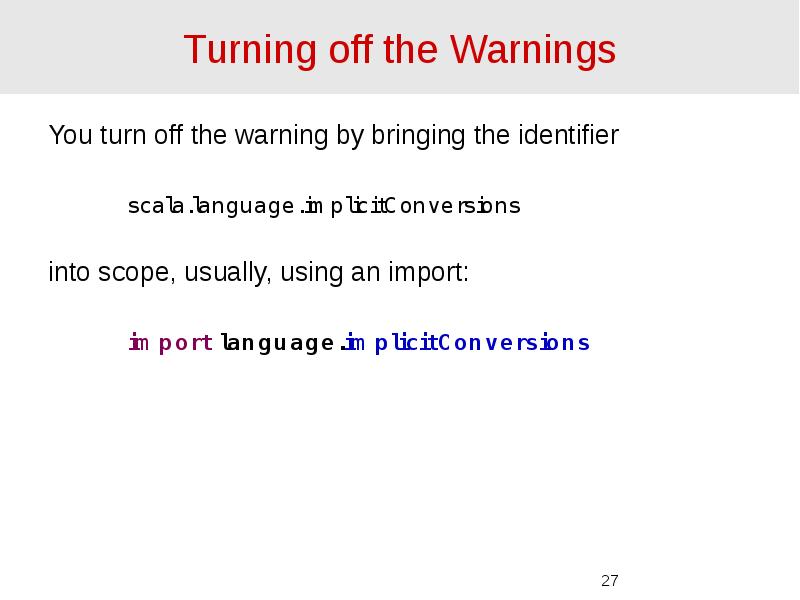
You turn off the warning by bringing the identifier
scala.language.implicitConversions
into scope, usually, using an import:
import language.implicitConversions
Слайд 28
Описание слайда:
Features Controlled by SIP-18
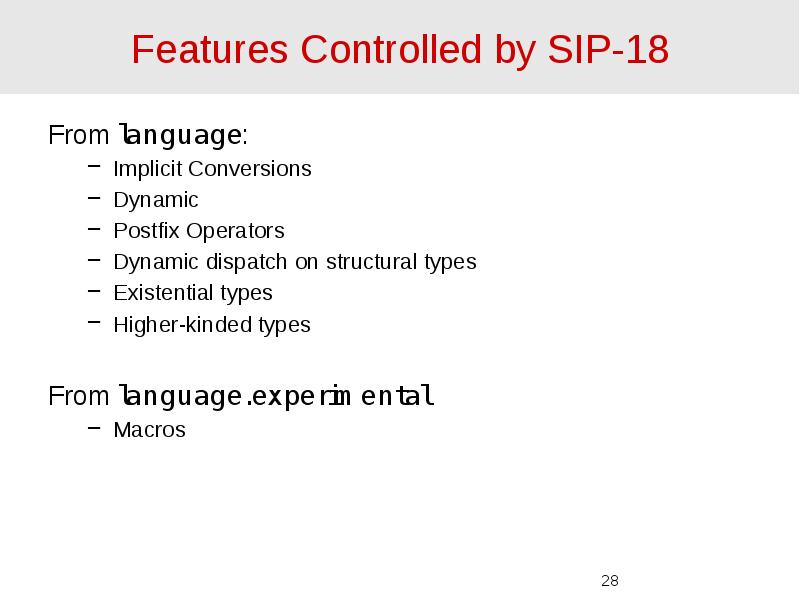
From language:
Implicit Conversions
Dynamic
Postfix Operators
Dynamic dispatch on structural types
Existential types
Higher-kinded types
From language.experimental
Macros
Слайд 29
Описание слайда:
Now: Scala 2.11
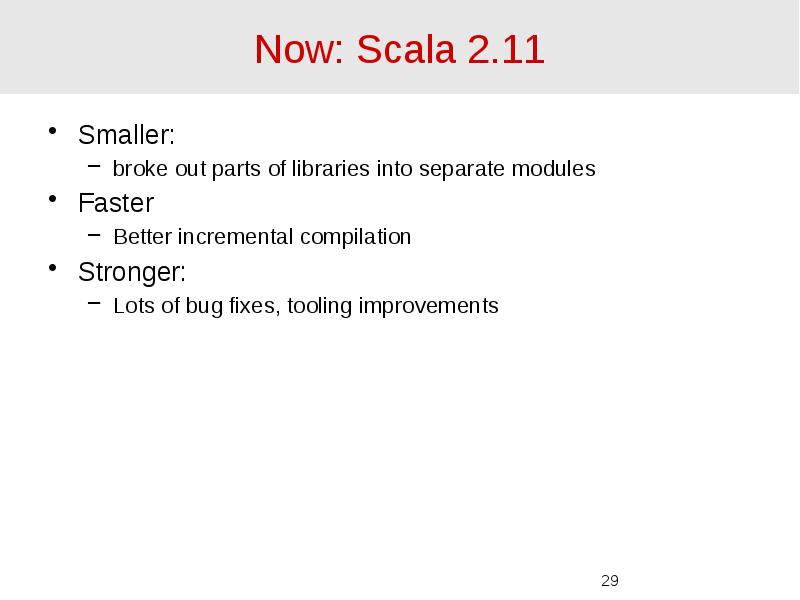
Smaller:
broke out parts of libraries into separate modules
Faster
Better incremental compilation
Stronger:
Lots of bug fixes, tooling improvements
Слайд 30
Описание слайда:
Now: Scala.JS
Why a Scala for Javascript?
JS is becoming ubiquitous.
Desire to use the same language on
client and server.
But not everybody likes Javascript or
dynamic languages.
Scala.JS profits from Scala’s tradition of
interoperating with a host language through very general abstractions.
Can combine JS DOM and Scala collections.
For the young age of the project, very mature and well-received.
Слайд 31
Описание слайда:
Invariants
In all this evolution, what stays constant?
What are some of the essential traits that make Scala what it is?
Слайд 32
Описание слайда:
1st Invariant: A Scalable Language
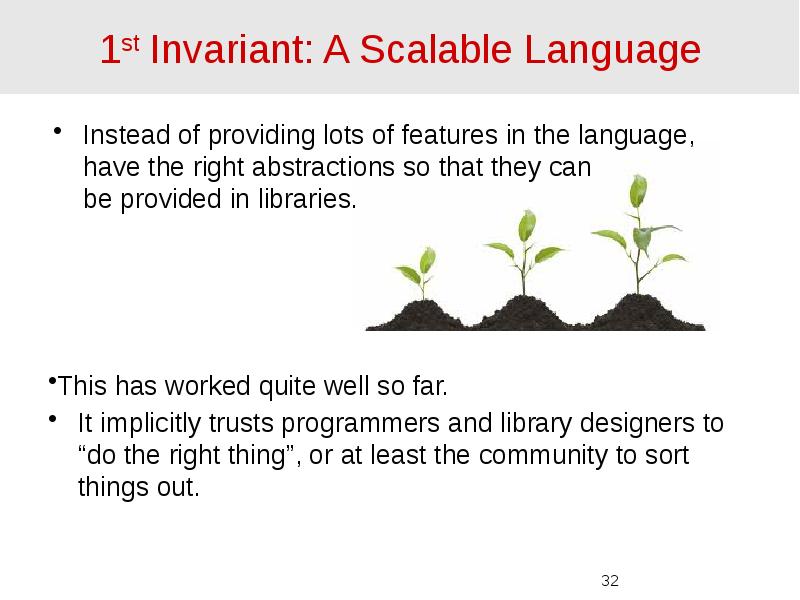
Instead of providing lots of features in the language, have the right abstractions so that they can
be provided in libraries.
This has worked quite well so far.
It implicitly trusts programmers and library designers to “do the right thing”, or at least the community to sort things out.
Слайд 33
Описание слайда:
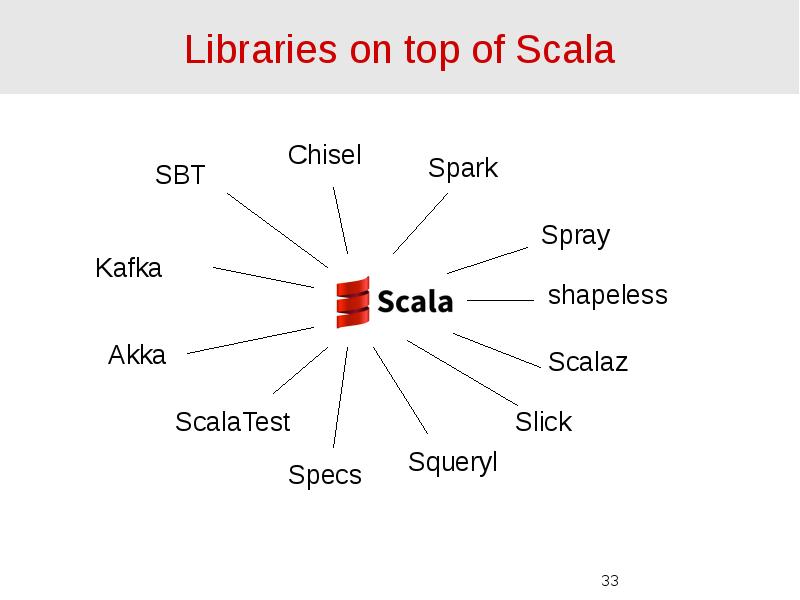
Libraries on top of Scala
Слайд 34
Описание слайда:
Growable = Good?
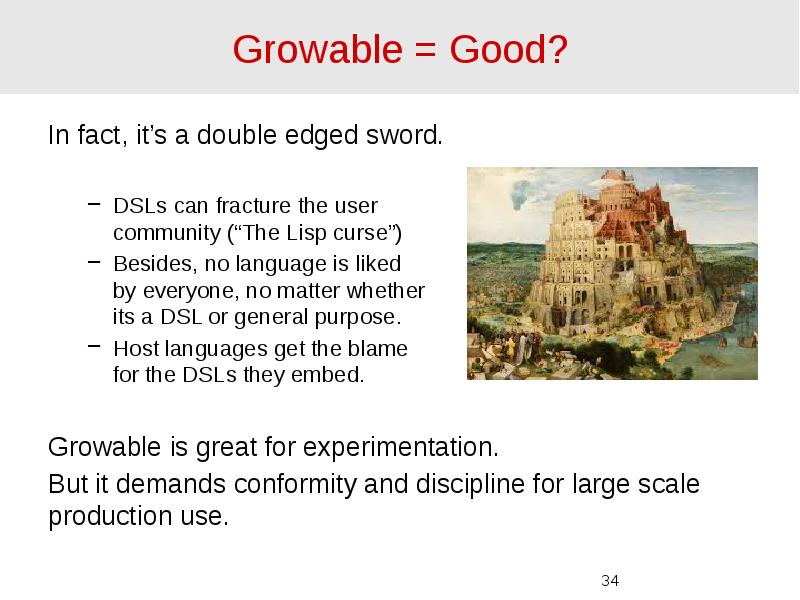
In fact, it’s a double edged sword.
DSLs can fracture the user
community (“The Lisp curse”)
Besides, no language is liked
by everyone, no matter whether
its a DSL or general purpose.
Host languages get the blame
for the DSLs they embed.
Growable is great for experimentation.
But it demands conformity and discipline for large scale production use.
Слайд 35
Описание слайда:
2nd Invariant: It’s about the Types
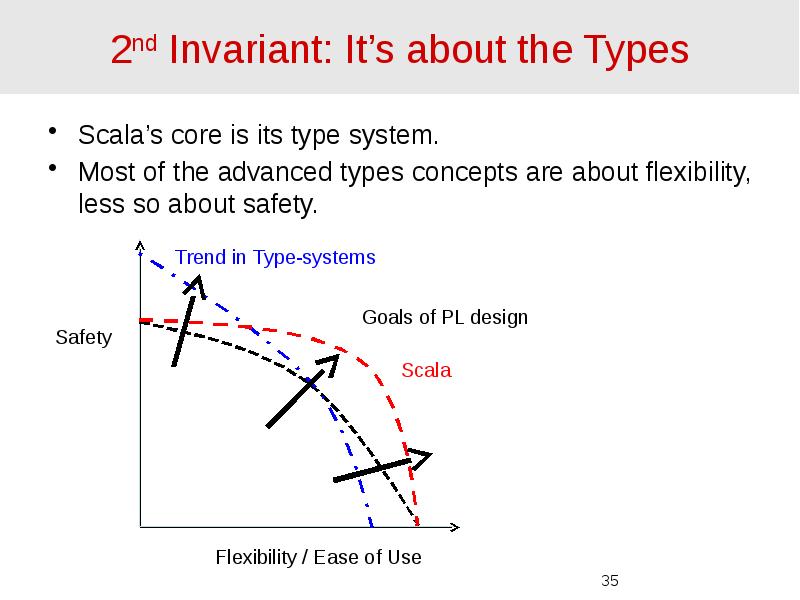
Scala’s core is its type system.
Most of the advanced types concepts are about flexibility, less so about safety.
Слайд 36
Описание слайда:
Stunted Evolution
null - “The Million Dollar Mistake”
Why does Scala not have null-safety?
We had plans to do it
you can see the traces in the stdlib with marker trait NotNull.
But by then everybody was using already Option.
So NPEs are actually quite rare in Scala code.
Don’t want two ways to do the same thing.
Слайд 37
Описание слайда:
What’s Next?
Scala 2.12 will be a fairly conservative evolution of 2.11
Main feature: Java 8 interop.
Scala and Java lambdas can understand each other
SAM method convention added to Scala
Should make use of Java 8 streams
Default methods for traits?
Слайд 38
Описание слайда:
And After That?
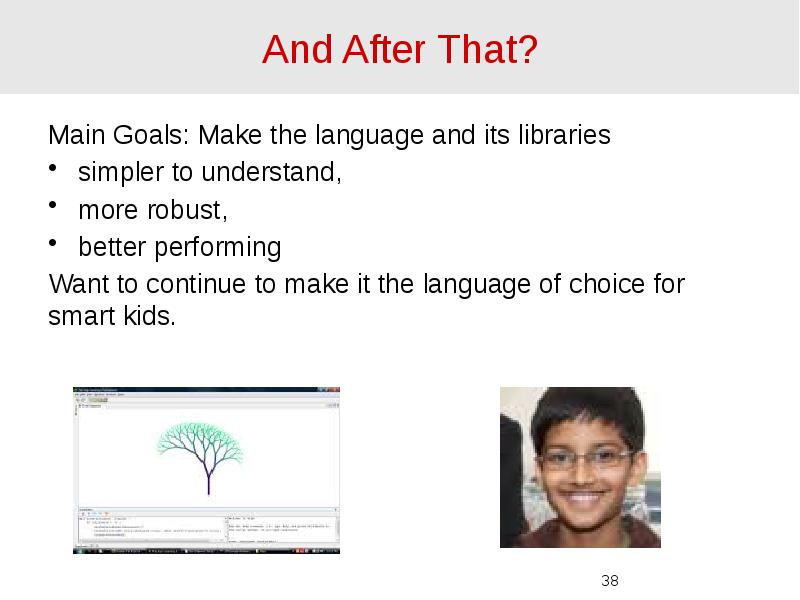
Main Goals: Make the language and its libraries
simpler to understand,
more robust,
better performing
Want to continue to make it the language of choice for smart kids.
Слайд 39
Описание слайда:
Scala “Aida”
Will concentrate on the standard library.
Reduce reliance on inheritance
Make all default collections immutable (e.g. scala.Seq will be an alias of scala.immutable.Seq)
Other small cleanups that are possible with a rewriting step (e.g. rename mapValues)
Projects which might make it if they mature fast enough:
scala.meta, the new, simplified approach to macros and reflection.
Collection fusion in the style of ScalaBlitz
Better specialization through miniboxing.
Слайд 40
Описание слайда:
Scala “Don Giovanni”
Concentrates on the language
Simple foundations:
A single fundamental concept - type members – can give precise meaning to generics, existential types, and higher-kinded types.
Intersection and union types.
Theoretical foundations given by minimal core calculus (DOT).
Cleaned-up syntax:
Trait parameters instead of early definition syntax
XML string interpolation instead of XML literals
Procedure syntax is dropped.
Simplified and unified type syntax for all forms of information elision, forSome syntax is eliminated.
Слайд 41
Описание слайда:
Scala “Don Giovanni”
Removing puzzlers:
Result types mandatory for implicit definitions.
Inherited explicit result types take precedence over locally-inferred ones.
String “+” needs explicit enabling.
Avoid surprising behavior of auto-tupling.
Backwards compatibility:
A migration tool will upgrade sources automatically.
Should work for almost all commonly used code.
Will not generally work for code using –Xexperimental
But we aim to have features that can support analogous functionality.
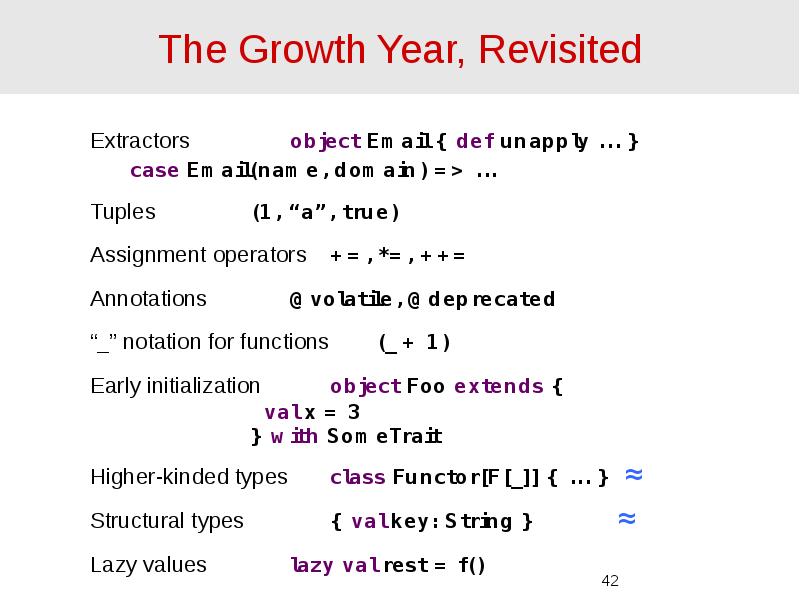
Слайд 42
Описание слайда:
The Growth Year, Revisited
Extractors object Email { def unapply ... } ✔ case Email(name, domain) => ...
Tuples (1, “a”, true) ✔
Assignment operators +=, *=, ++= ✔
Annotations @volatile, @deprecated ✔
“_” notation for functions (_ + 1) ✔
Early initialization object Foo extends { ✗
val x = 3
} with SomeTrait
Higher-kinded types class Functor[F[_]] { ... } ≈
Structural types { val key: String } ≈
Lazy values lazy val rest = f() ✔
Existential types Map[T, T] forSome { type T } ✗
Слайд 43
Описание слайда:
Conclusion
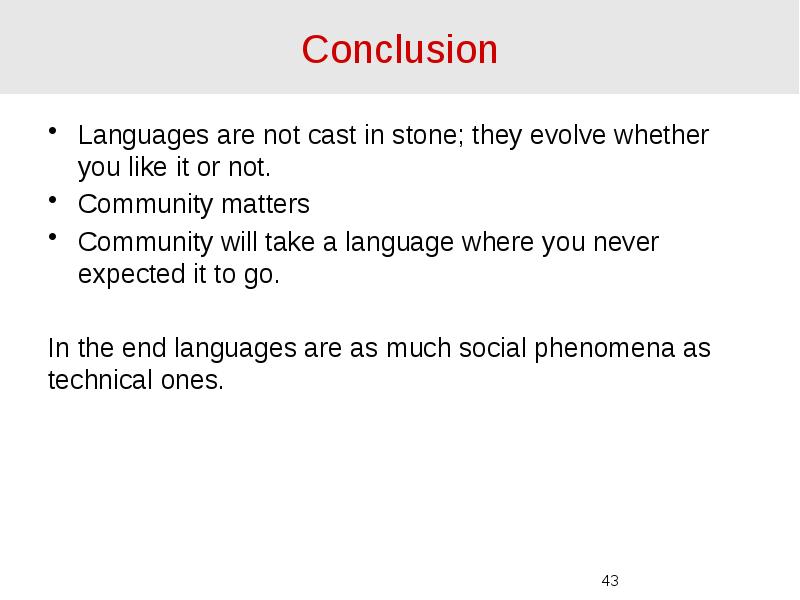
Languages are not cast in stone; they evolve whether you like it or not.
Community matters
Community will take a language where you never expected it to go.
In the end languages are as much social phenomena as technical ones.
Скачать презентацию на тему The Evolution Of Scala можно ниже: